
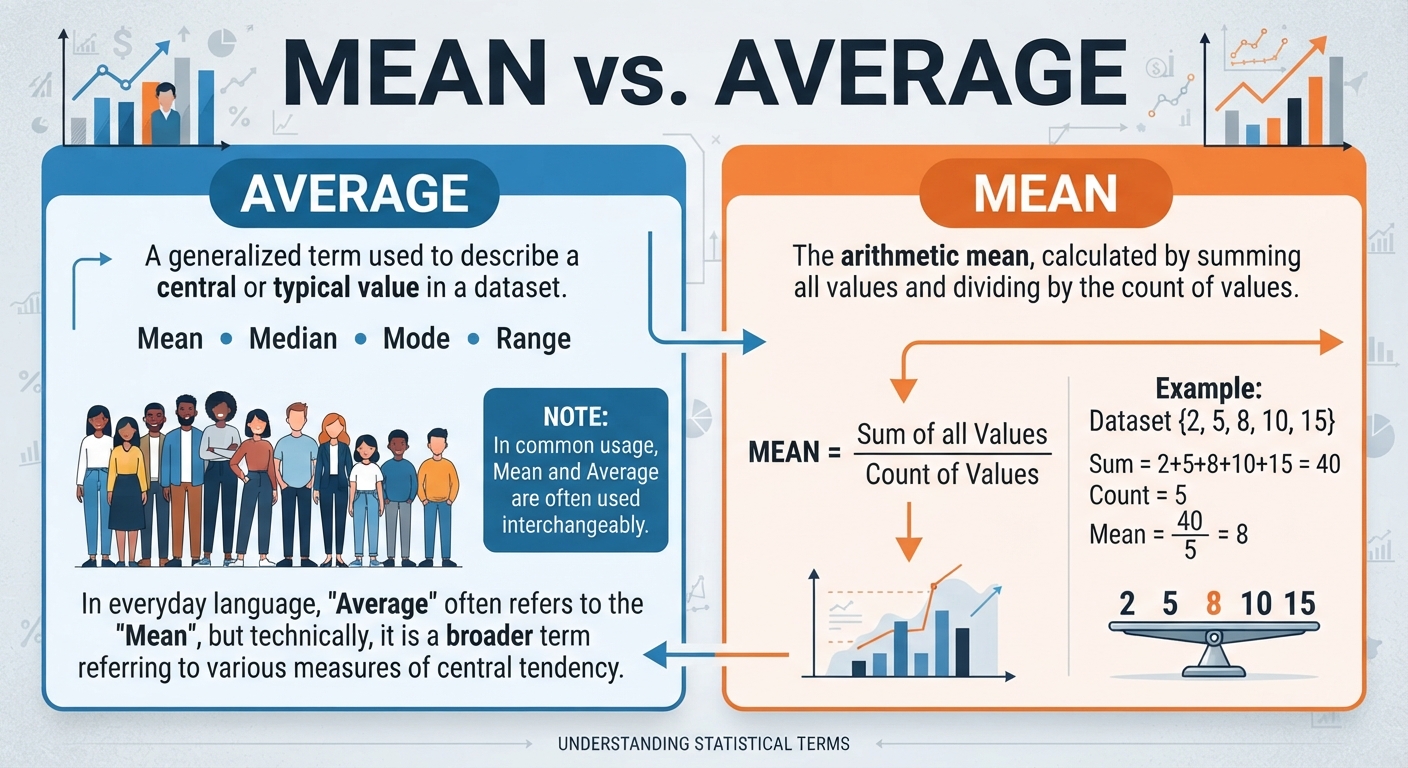
Mean Vs Average: Are They The Same?
The short version
- In school math, mean vs average is mostly a vocabulary question. When a worksheet says “average,” it almost always wants the mean: add the numbers, divide by how many there are.
- “Average” is the wider word. It covers any single number used to stand in for a whole set, which includes the median and the mode as well as the mean.
- The mean, median and mode can land far apart. One unusual value drags the mean toward it and leaves the median alone.
- If a question says “find the average” with no other clue, compute the mean and you’ll be right.
- Kids who miss these problems usually aren’t confused about averages. They’re stuck on the division step or on what to do with a remainder.
Mean vs average comes down to this: the mean is one specific kind of average, and it’s the one school means 99 percent of the time. To find it, add all the values and divide by how many values you added. “Average” is the everyday umbrella word for a number that represents a whole group, and the median and the mode sit under that umbrella too.
So when your child’s homework says “find the average of 4, 8, 6, 10 and 2,” it wants the mean, which is 6. Below we’ll show the steps, compare the three averages side by side, and work through the case where picking the wrong one gives a misleading answer.
Mean vs average: the actual difference
Think of “average” as a category and “mean” as one member of it. Statisticians call any measure of center an average. Three of them show up in K-12 math:
- Mean. Add everything, divide by the count.
- Median. Line the numbers up in order and take the middle one.
- Mode. The value that appears most often.
Outside of statistics class, almost nobody uses “average” that carefully. A news story about average rent, a teacher talking about a class average, a coach quoting an average score: all of them mean the arithmetic mean. That’s why textbooks treat the two words as interchangeable, and why the distinction only starts to matter in a stats unit.
There are other means in higher math, like the geometric mean used for growth rates, but those don’t appear before college for most students.
How to find the mean
Step 1. Add all the numbers.
Step 2. Count how many numbers you added.
Step 3. Divide the total by the count.
Example: five quiz scores of 8, 7, 9, 10 and 6.
Add: 8 + 7 + 9 + 10 + 6 = 40
Count: 5 scores
Divide: 40 ÷ 5 = 8
The mean is 8.
Example with a decimal answer: 7, 9, 10 and 12.
Add: 7 + 9 + 10 + 12 = 38
Divide: 38 ÷ 4 = 9.5
The mean is 9.5, which is fine. An average doesn’t have to be a value from the list, and it doesn’t have to be a whole number.
That second point is where a lot of kids stall. They get 38 ÷ 4, see that 4 doesn’t go in evenly, and either write “9 remainder 2” or decide they did something wrong. Neither. The answer is 9.5.
Working backward to a missing value
Tests love this one. Four quizzes have a mean of 85, and three of the scores are 82, 88 and 90. What was the fourth?
If the mean is 85 across 4 quizzes, the total has to be 4 × 85 = 340.
The three known scores add to 82 + 88 + 90 = 260.
So the missing score is 340 – 260 = 80.
The three averages side by side
| Average | How to find it | Good for | Weak spot |
|---|---|---|---|
| Mean | Add, then divide by the count | Sets with no extreme values | One huge or tiny value skews it |
| Median | Sort, then take the middle value | Incomes, home prices, anything lopsided | Ignores how spread out the data is |
| Mode | Find the value that repeats most | Categories, shoe sizes, survey answers | May not exist, or there may be several |
With an even count of numbers, the median is the mean of the two middle values. For 16 and 17 in the middle, the median is 16.5.
When the choice of average changes the story
Here’s where mean vs average stops being vocabulary. Six people work at a small shop, and their hourly pay is $15, $15, $16, $17, $18 and $120.
Mean: 15 + 15 + 16 + 17 + 18 + 120 = 201, and 201 ÷ 6 = $33.50.
Median: sorted, the two middle values are 16 and 17, so the median is $16.50.
Mode: $15, since it shows up twice.
Nobody at that shop earns $33.50. The $120 pulls the mean up by itself, while the median sits right where most of the staff actually are. When one value is far from the rest, the median describes the group better.
This is why home prices and household incomes are usually reported as medians. A few very expensive houses would make the mean say something untrue about a normal house on the street.
Common mistakes
Dividing by the wrong number. Kids divide by the largest value, or by the number of digits, instead of by how many values are in the set. Count the values first and write the count down before dividing.
Forgetting to sort before finding the median. The middle of 3, 9, 4, 7, 1 as written is 4, which happens to be right here, but that’s luck. Sorted it’s 1, 3, 4, 7, 9, and the median is 4 because it’s in the middle of the ordered list.
Dropping zeros. A zero is a value. If a kid scores 0 on one of five quizzes, the 0 still counts in the sum and still counts toward the divisor.
Rounding too early. Round the final answer if the problem asks, never the numbers going in.
Assuming the mean is always the best pick. On a lopsided set, the mean is technically correct and practically misleading. Tests do ask which average fits the data.
Practice problems
1. Find the mean of 4, 8, 6, 10 and 2.
2. Find the mean of 12, 15 and 9.
3. Find the median of 3, 9, 4, 7 and 1.
4. Find the mode of 5, 7, 7, 8, 9, 7 and 5.
5. Find the mean of 7, 9, 10 and 12.
6. Find both the mean and the median of 2, 3, 4, 5 and 86.
7. Marco’s first four test scores are 78, 85, 91 and 86. He wants a mean of 86 over five tests. What does he need on the fifth?
8. For the set 1, 2, 2, 3 and 200, which average describes the data best, and why?
Answers
1. 6. The values add to 30, and 30 ÷ 5 = 6.
2. 12. 12 + 15 + 9 = 36, and 36 ÷ 3 = 12.
3. 4. Sorted, the set is 1, 3, 4, 7, 9, and 4 sits in the middle.
4. 7. It appears three times, while 5 appears twice.
5. 9.5. The values add to 38, and 38 ÷ 4 = 9.5.
6. Mean 20, median 4. The values add to 100, and 100 ÷ 5 = 20. Sorted, the middle value is 4. The 86 is what pushes them apart.
7. 90. Five tests at a mean of 86 need a total of 430. His four scores add to 340, and 430 – 340 = 90.
8. The median, which is 2. The mean is 208 ÷ 5 = 41.6, and that number sits nowhere near four of the five values. The mode is also 2. The 200 is the outlier doing the damage.
What it means if your child is stuck here
Average problems look like statistics, but the arithmetic underneath is plain addition and division. When a kid misses them, watch which step breaks down.
If they add the list wrong, the gap is multi-digit addition. If they freeze at 38 ÷ 4, the gap is division with a remainder and turning that remainder into a decimal or fraction. That skill sits in fourth and fifth grade, and it keeps causing trouble years later, which is the pattern we describe in Struggling with algebra? The real problem is usually fourth grade fractions. Our rundown of math skills by grade level shows where each piece is supposed to land.
If the arithmetic is fine and your child still picks the wrong operation, the issue is reading the problem rather than doing it. That shows up across word problems, and it’s one of the signs covered in Is my child behind in math.
Frequently asked questions
Is the mean the same as the average?
In everyday use and in most school work, yes. Technically the mean is one type of average and the median and mode are others, but when a problem says “average” without naming a type, it wants the mean.
What is the average in math?
It’s a single number chosen to represent a whole set of numbers. The most common way to get it is the arithmetic mean, which you find by adding the values and dividing by how many values there are.
Can the mean and the median be the same number?
Often. For 6, 7, 8, 9 and 10, both are 8. They match when the data is fairly balanced, and they drift apart when a few values sit far from the rest.
Why do news reports use median income instead of mean income?
Because a small number of very high incomes pulls the mean up and makes it describe almost nobody. The median stays near the middle of the group, so it gives a truer picture of a typical household.
What grade do kids learn mean, median and mode?
Most students meet the mean around fourth or fifth grade and get all three averages in sixth grade, then revisit them with larger data sets in middle school statistics units.
Find the actual gap
When averages give a kid trouble, the fix is rarely more averages. Math Anon opens with a short adaptive assessment that changes its questions based on what your child answers, then gives you a written report naming the exact skills that are shaky, whether that’s division with remainders, decimals or something further back. Start the assessment and stop guessing.
After that your child works about 20 minutes a day on practice aimed straight at those gaps, and you get a weekly progress report so you can see the movement. The assessment costs $49 and we credit every dollar back on your first month. Details are on the pricing page, and the case for short daily sessions is in Why 20 minutes a day beats a 90 minute tutoring session.





