
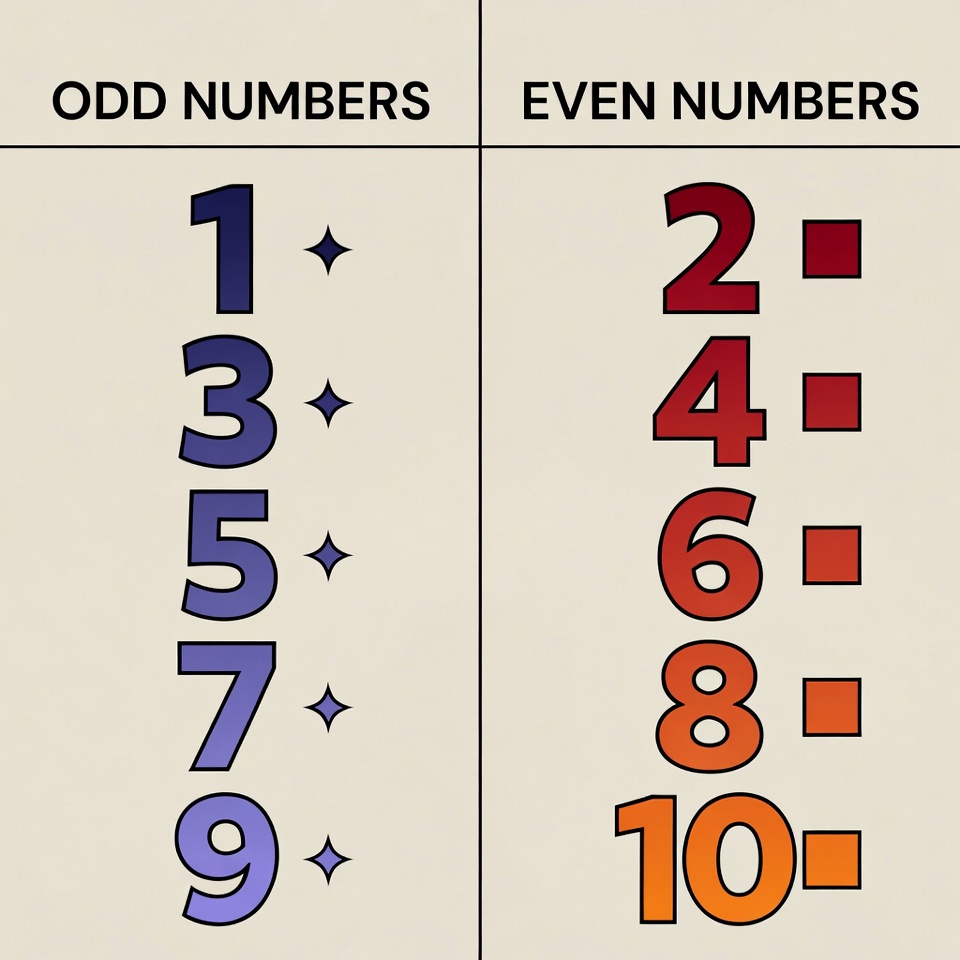
Odd And Even Numbers: Rules And Examples
The short version
- An even number divides by 2 with nothing left over. An odd number leaves 1 left over.
- Look at the last digit only. Ends in 0, 2, 4, 6, or 8 and it’s even. Ends in 1, 3, 5, 7, or 9 and it’s odd. This works on a number of any size.
- Adding two evens or two odds gives an even. Adding one of each gives an odd.
- Multiplying gives an odd only when both numbers are odd. Any even factor makes the product even.
- Zero is even, and negative numbers follow the same rules. Minus 8 is even, minus 7 is odd.
Odd and even numbers split every whole number into two groups based on one question: can you share it into two equal piles with nothing left over? If yes, the number is even. If one stubborn unit is left sitting there, the number is odd. Six cookies split between two kids gives three each, so 6 is even. Seven cookies leaves one on the plate, so 7 is odd.
That’s the whole definition, and kids meet it in kindergarten or first grade. What most explanations leave out is why the last digit rule works and why the behavior patterns matter later. Both are covered below, along with worked examples, the mistakes that keep showing up, and practice with answers.
How to tell if a number is odd or even
Ignore every digit except the last one.
| Last digit | Type | Examples |
|---|---|---|
| 0, 2, 4, 6, 8 | Even | 30, 172, 4,568, 90,000 |
| 1, 3, 5, 7, 9 | Odd | 41, 173, 4,569, 90,001 |
So 8,472,935 is odd. You don’t compute anything. The last digit is 5, and that settles it.
Why the last digit is enough
This is the part that turns a rule into an idea. Every place value above the ones is a multiple of 10: tens, hundreds, thousands. And 10 is even, so every multiple of 10 is even.
Take 4,568. Split it into 4,560 + 8. The 4,560 part is a multiple of 10, so it’s already even and splits perfectly in half. Whether the whole number is even comes down entirely to the 8. Since 8 is even, 4,568 is even.
Try it with 173. That’s 170 + 3. The 170 splits evenly. The 3 doesn’t, so 173 is odd. The last digit is carrying the entire decision, every time.
The other way to say it
Older students write it with a variable, and it’s worth showing this to a fifth or sixth grader who’s ready.
Even numbers look like 2n, where n is any whole number.
Odd numbers look like 2n + 1.
With n = 6: 2n = 12, which is even, and 2n + 1 = 13, which is odd.
This notation is what lets you prove the rules below instead of just memorizing them.
Rules for adding and subtracting
| Problem | Result | Example |
|---|---|---|
| Even + even | Even | 8 + 14 = 22 |
| Odd + odd | Even | 7 + 9 = 16 |
| Even + odd | Odd | 8 + 9 = 17 |
| Even – even | Even | 20 – 6 = 14 |
| Odd – odd | Even | 15 – 9 = 6 |
| Even – odd | Odd | 20 – 7 = 13 |
The surprising one is odd + odd = even. Kids expect odd plus odd to stay odd. Here’s why it doesn’t: each odd number has one leftover unit, and when you put two of them together those two leftovers pair up. Nothing is left over anymore.
In symbols: (2a + 1) + (2b + 1) = 2a + 2b + 2 = 2(a + b + 1). That final form is 2 times something, which is the definition of even. Check with numbers: 7 + 9 = 16, and 16 is even.
Rules for multiplying
| Problem | Result | Example |
|---|---|---|
| Even × even | Even | 6 × 4 = 24 |
| Even × odd | Even | 6 × 5 = 30 |
| Odd × odd | Odd | 7 × 9 = 63 |
One rule covers the first two lines: if either factor is even, the product is even. An even factor means the product contains a 2, so it can always be split in half. The product is odd only when both factors are odd.
Proof of the odd case: (2a + 1)(2b + 1) = 4ab + 2a + 2b + 1 = 2(2ab + a + b) + 1. That’s 2 times something, plus 1, which is exactly the form of an odd number. Test it: 7 × 9 = 63, and 63 is odd.
Division has no matching rule
Don’t let anyone extend the pattern to division. Even ÷ even can be either: 8 ÷ 4 = 2 is even, but 6 ÷ 2 = 3 is odd. And plenty of divisions don’t give whole numbers at all, so the question of odd or even doesn’t apply.
Zero, negatives, and the edge cases
Zero is even. Divide it by 2 and you get 0 with nothing left over, and it sits between two odd numbers, 1 and minus 1, exactly where an even number belongs.
Negative numbers work the same way. Minus 8 is even because it splits into two equal groups of minus 4. Minus 7 is odd. Use the same last digit rule and ignore the sign.
Fractions and decimals are neither. Odd and even apply only to whole numbers, so asking whether 3.5 is odd is like asking whether the color blue is odd. The question doesn’t fit.
Common mistakes with odd and even numbers
Looking at the first digit. Kids see 356 and think “3, that’s odd.” The last digit is the one that decides. 356 is even.
Expecting odd + odd = odd. This is the single most common error, and it’s why the paired leftovers explanation is worth going through out loud.
Calling zero odd, or neither. Zero is even. This shows up on tests.
Mixing up odd numbers and prime numbers. Lots of odd numbers aren’t prime, like 9, 15, and 21. And one prime number is even: 2.
Confusing “odd” with “weird.” Young kids hear the everyday meaning of the word. Say “odd number” as a two word phrase at first so it reads as a math term.
Practice problems
1. Which of these are even: 14, 27, 30, 41, 56?
2. Is 1,523 odd or even?
3. Is 4,830 odd or even?
4. Predict whether 17 + 23 is odd or even, then compute it.
5. Predict whether 12 × 9 is odd or even, then compute it.
6. Is 0 odd or even? Explain in one sentence.
7. Without adding, decide whether 4,321 + 8,642 is odd or even.
8. Is the sum of three odd numbers always odd, always even, or does it depend? Test it with 3 + 5 + 7.
Answers
1. 14, 30, and 56 are even. They end in 4, 0, and 6. The other two end in 7 and 1, so they’re odd.
2. Odd. It ends in 3.
3. Even. It ends in 0.
4. Odd + odd = even, and 17 + 23 = 40, which is even.
5. Even × odd = even, and 12 × 9 = 108, which is even.
6. Even, because 0 ÷ 2 = 0 with no remainder.
7. Odd. The first number ends in 1 and is odd, the second ends in 2 and is even, and odd + even = odd. If you check, 4,321 + 8,642 = 12,963, which ends in 3.
8. Always odd. The first two odds add to an even, and that even plus one more odd is odd. Testing it: 3 + 5 = 8, then 8 + 7 = 15, which is odd.
What it means if your child is stuck here
Odd and even is a first grade topic, so a second or third grader who still can’t sort numbers quickly is flagging something underneath. Usually it’s one of two things.
The first is skip counting by 2s. A kid who can’t rattle off 2, 4, 6, 8, 10 doesn’t have the even numbers as a group in their head yet, so every question becomes a calculation. Ten minutes of counting by 2s, forwards and backwards, moves this faster than any worksheet. The second is place value. A child who reads 356 as three separate digits rather than a number with a ones place won’t understand why only the last digit matters, and that same gap will hurt in rounding, regrouping, and long division.
Parity comes back later in a bigger way, too. Algebra students use odd and even reasoning to check answers and to write simple proofs, and the students who only memorized the rules tend to stall there. Math skills by grade level for grades 3 to 5 shows where these building blocks are supposed to land, and 12 signs your child is behind in math by grade level helps you tell an off day from a real gap. If your child knows the answer but freezes when asked out loud, math anxiety in children is the more useful read.
Frequently asked questions
Is 0 an even number?
Yes. Zero divides by 2 with no remainder, and it sits between the odd numbers 1 and minus 1. Every rule that holds for even numbers holds for zero.
What are the even numbers from 1 to 20?
2, 4, 6, 8, 10, 12, 14, 16, 18, and 20. The odd ones are 1, 3, 5, 7, 9, 11, 13, 15, 17, and 19.
Can a negative number be even?
Yes. Minus 4, minus 12, and minus 100 are all even. Check the last digit and ignore the sign.
Is 2 an odd or even number?
Even. It’s also the only even prime number, because every other even number has 2 as a factor and so can’t be prime.
What grade do kids learn odd and even numbers?
Kindergarten or first grade, usually alongside counting by 2s and pairing objects. The addition and multiplication rules come later, around second or third grade.
Why do odd and even numbers matter?
They’re the first taste of classifying numbers by a property instead of by size, and that idea runs straight through factors, multiples, divisibility rules, and into algebra. Parity checks are also a quick way to catch a wrong answer: if a problem must have an even answer and your child wrote an odd one, something went wrong.
Find the actual gap
When an older child struggles with something this basic, the useful question isn’t how to reteach odd and even. It’s what else from those same early years never locked in. Math Anon opens with a short adaptive assessment that adjusts as your child answers, then gives you a written report listing the specific skills that are missing, whatever grade they came from.
After that, your child works about 20 minutes a day on practice aimed straight at those gaps, and you get a progress report every week showing what closed. Start the assessment for $49, which comes back to you in full as credit on your first month. The pricing page covers the rest.





