
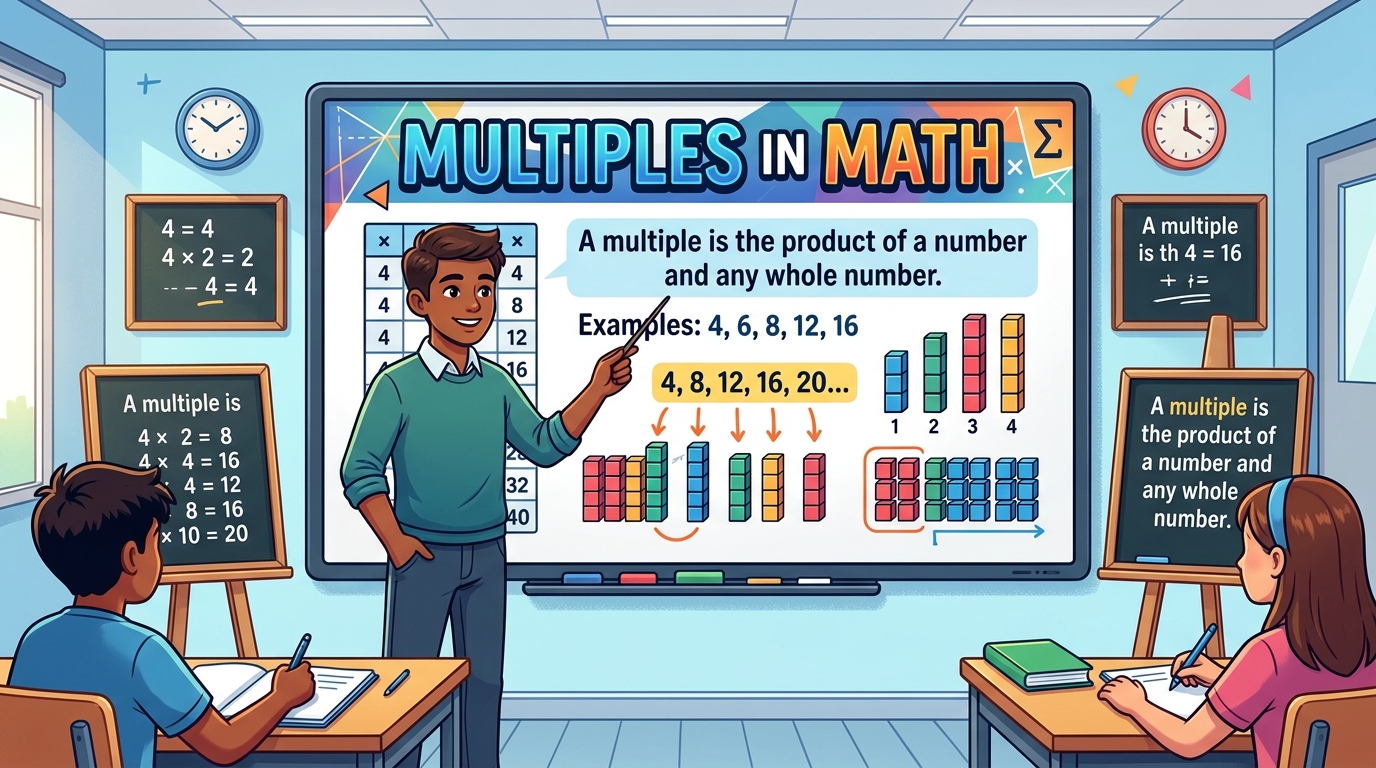
What Is A Multiple In Math? Definition, Examples And LCM
The short version
- A multiple of a number is what you get when you multiply it by a whole number. The multiples of 7 are 7, 14, 21, 28, 35, and so on forever.
- To check if one number is a multiple of another, divide. If there’s no remainder, it’s a multiple: 91 ÷ 7 = 13, so 91 is a multiple of 7.
- Factors and multiples are opposite views of the same fact. 3 is a factor of 12, and 12 is a multiple of 3.
- The least common multiple (LCM) is the smallest number that’s a multiple of two numbers at once. You need it to add fractions with different denominators.
A multiple in math is the result of multiplying a number by a whole number. Multiply 5 by 1, 2, 3, 4 and you get 5, 10, 15, 20: those are multiples of 5. Skip counting by a number lists its multiples, and the list never ends.
Below we’ll cover how to list multiples, how to test whether a big number is a multiple, how multiples differ from factors, and how to find the least common multiple, with practice problems and answers at the end.
What is a multiple in math?
Take any number and multiply it by 1, 2, 3, 4, and so on. Every answer you get is a multiple of that number.
Multiples of 4:
4 × 1 = 4
4 × 2 = 8
4 × 3 = 12
4 × 4 = 16
4 × 5 = 20
So 4, 8, 12, 16, and 20 are the first five multiples of 4. A few facts that follow from the definition:
- Every number is a multiple of itself, since n × 1 = n.
- Every number has infinitely many multiples. You can always multiply by one more.
- Multiples are never smaller than the number itself (for positive whole numbers), because the smallest one is n × 1.
- 0 is technically a multiple of every number, since n × 0 = 0. Elementary classes usually start the list at the number itself, so follow your teacher’s lead.
Here’s a quick reference for the first few multiples of 2 through 9. It’s really just the multiplication table read across a row.
| Number | First six multiples |
|---|---|
| 2 | 2, 4, 6, 8, 10, 12 |
| 3 | 3, 6, 9, 12, 15, 18 |
| 4 | 4, 8, 12, 16, 20, 24 |
| 5 | 5, 10, 15, 20, 25, 30 |
| 6 | 6, 12, 18, 24, 30, 36 |
| 7 | 7, 14, 21, 28, 35, 42 |
| 8 | 8, 16, 24, 32, 40, 48 |
| 9 | 9, 18, 27, 36, 45, 54 |
How to tell if a number is a multiple
Listing works for small numbers. For something like “Is 91 a multiple of 7?” you’d be counting for a while. Divide instead.
Worked example: yes
Is 91 a multiple of 7?
91 ÷ 7 = 13, remainder 0.
Since 7 × 13 = 91, yes.
Worked example: no
Is 100 a multiple of 6?
100 ÷ 6 = 16, remainder 4.
6 × 16 = 96 and 6 × 17 = 102. 100 falls between them, so no.
Divisibility shortcuts
These rules let you check without dividing at all:
| It’s a multiple of | If | Example |
|---|---|---|
| 2 | The last digit is even | 348 |
| 3 | The digits add to a multiple of 3 | 471 (4 + 7 + 1 = 12) |
| 4 | The last two digits make a multiple of 4 | 1,316 (16) |
| 5 | It ends in 0 or 5 | 985 |
| 6 | It’s a multiple of both 2 and 3 | 738 |
| 9 | The digits add to a multiple of 9 | 738 (7 + 3 + 8 = 18) |
| 10 | It ends in 0 | 2,050 |
Take 738. It’s even, so it’s a multiple of 2. Its digits add to 18, which is a multiple of 3 and of 9. So 738 is a multiple of 2, 3, 6, and 9. Quick check: 738 ÷ 9 = 82 and 738 ÷ 6 = 123.
Multiples vs factors
This is the number one mix-up when kids learn what a multiple in math is. Both words describe the same multiplication fact from opposite ends.
Since 3 × 4 = 12:
3 and 4 are factors of 12.
12 is a multiple of 3 and a multiple of 4.
| Factors of 12 | Multiples of 12 | |
|---|---|---|
| The list | 1, 2, 3, 4, 6, 12 | 12, 24, 36, 48, 60, … |
| How many? | A fixed number (6 here) | Infinitely many |
| Size | 12 or smaller | 12 or bigger |
| How to find | Numbers that divide into 12 | 12 times 1, 2, 3, … |
A memory trick some kids like: factors fit into a number, multiples multiply out from it.
Common multiples and the least common multiple
Once your kid can find a multiple in math, the next step is comparing two lists. A common multiple is a number that’s on both lists. The least common multiple (LCM) is the smallest one.
Worked example: LCM of 4 and 6
Multiples of 4: 4, 8, 12, 16, 20, 24
Multiples of 6: 6, 12, 18, 24
Common multiples: 12, 24, …
LCM: 12
Worked example: LCM by prime factors
For bigger numbers, listing gets slow. Use prime factors and take the highest power of each prime.
12 = 2 × 2 × 3 = 2² × 3
18 = 2 × 3 × 3 = 2 × 3²
LCM = 2² × 3² = 4 × 9 = 36
Where the LCM shows up
Adding fractions. To add 1/4 + 1/6, you need a common denominator, and the LCM of 4 and 6 is the smallest one: 1/4 + 1/6 = 3/12 + 2/12 = 5/12.
Word problems about things lining up. Hot dogs come in packs of 10 and buns in packs of 8. What’s the fewest of each you can buy to have the same number? The LCM of 10 and 8 is 40, so buy 4 packs of hot dogs and 5 packs of buns.
Common mistakes with multiples
- Swapping factors and multiples. A kid asked for multiples of 12 who writes 1, 2, 3, 4, 6, 12 has listed factors.
- Stopping the list too early. “The multiples of 5 are 5, 10, 15, 20” misses that the list goes on forever. Teachers often ask for “the first five.”
- Using the digit-sum rule for the wrong number. Adding digits works for 3 and 9, not for 4 or 7.
- Multiplying the two numbers and calling it the LCM. 4 × 6 = 24 is a common multiple, but the LCM is 12. The product is only the LCM when the numbers share no factors other than 1.
- Leaving out the number itself. 8 is a multiple of 8.
Practice problems
- List the first five multiples of 8.
- Is 84 a multiple of 7?
- Is 146 a multiple of 4?
- Which of these are multiples of 9: 45, 52, 63, 70?
- Find the LCM of 6 and 8.
- Find the LCM of 9 and 12.
- One bus leaves every 15 minutes and another every 20 minutes. Both leave at 8:00. When do they next leave together?
- Add 1/6 + 3/8 using the LCM as the common denominator.
Answers
- 8, 16, 24, 32, 40
- Yes. 84 ÷ 7 = 12 with no remainder.
- No. The last two digits are 46, and 46 ÷ 4 = 11 remainder 2.
- 45 and 63. Their digits add to 9 (4 + 5 and 6 + 3). 52 and 70 have digit sums of 7.
- Multiples of 6: 6, 12, 18, 24. Multiples of 8: 8, 16, 24. LCM = 24.
- 9 = 3², 12 = 2² × 3. LCM = 2² × 3² = 36.
- LCM of 15 and 20 is 60, so 60 minutes later: 9:00.
- LCM of 6 and 8 is 24. 1/6 = 4/24 and 3/8 = 9/24. Total: 13/24.
If your kid is stuck on multiples
Finding a multiple in math is really a test of multiplication fact fluency. If a kid has to count on their fingers to get 7 × 6, listing multiples of 7 is slow and error-prone, and finding the LCM of 12 and 18 feels impossible. Math facts are supposed to be automatic by the end of third grade. See where that falls in math skills by grade level.
That fluency matters more than it seems. Common multiples are how kids add and subtract fractions, and fractions are where a lot of later algebra trouble starts. We explain that chain in struggling with algebra. The fix for slow facts is short, frequent practice. Here’s why 20 minutes a day works better.
Frequently asked questions
What is a multiple of a number?
It’s the number times any whole number. 30 is a multiple of 6 because 6 × 5 = 30.
Is 0 a multiple of every number?
Yes, since any number times 0 is 0. In elementary school, lists of multiples usually start at the number itself, so 0 is often left out.
Is a number a multiple of itself?
Yes. Every number is its own first multiple, because n × 1 = n.
What’s the difference between a factor and a multiple?
Factors divide into a number and there are only so many. Multiples come from multiplying the number and there’s no end to them. 4 is a factor of 20, and 20 is a multiple of 4.
Can multiples be negative?
In middle school and beyond, yes. -14 is a multiple of 7 because 7 × -2 = -14. Elementary classes stick to positive multiples.
Find the actual gap
When multiples and LCM feel hard, the real hold-up is usually multiplication facts that never became automatic, and that gap spreads into fractions and beyond. Math Anon starts with a short adaptive assessment that finds exactly which skills are missing and gives you a written report on them.
Then your child does about 20 minutes of targeted practice a day on those skills, and you get a weekly progress report. It’s $49 to start, and that’s credited back in full on the first month. Start the assessment or check pricing.





