
What Is Multiplication? Meaning, Rules And Practice
The short version
- Multiplication is a fast way to add equal groups. 4 × 3 means four groups of three, which is 3 + 3 + 3 + 3 = 12.
- The numbers you multiply are called factors. The answer is the product.
- Order doesn’t change the answer: 4 × 3 and 3 × 4 both equal 12. That one fact cuts the times tables kids have to memorize roughly in half.
- Any number times 1 stays the same. Any number times 0 is 0. Any number times 10 just gains a zero.
- Kids who stall on multiplication in third or fourth grade usually have shaky skip counting or addition facts underneath, not a multiplication problem.
Multiplication is combining equal groups to find a total. If you have 5 bags and each bag holds 6 marbles, you don’t count all the marbles one at a time. You multiply: 5 × 6 = 30. That’s the whole idea, and every later use of multiplication (area, fractions, percents, algebra) is built on it.
It gets written a lot of ways and taught with several models, which is where kids get confused. Below is each one, plus the properties, the times tables, bigger worked examples, and practice with an answer key.
What multiplication means
Read the symbol as “groups of.” 4 × 3 is four groups of three.
3 + 3 + 3 + 3 = 12
4 × 3 = 12
Repeated addition works for whole numbers and it’s how most kids meet multiplication. It stops being the best picture with fractions and decimals, so teachers use two other models too.
Arrays
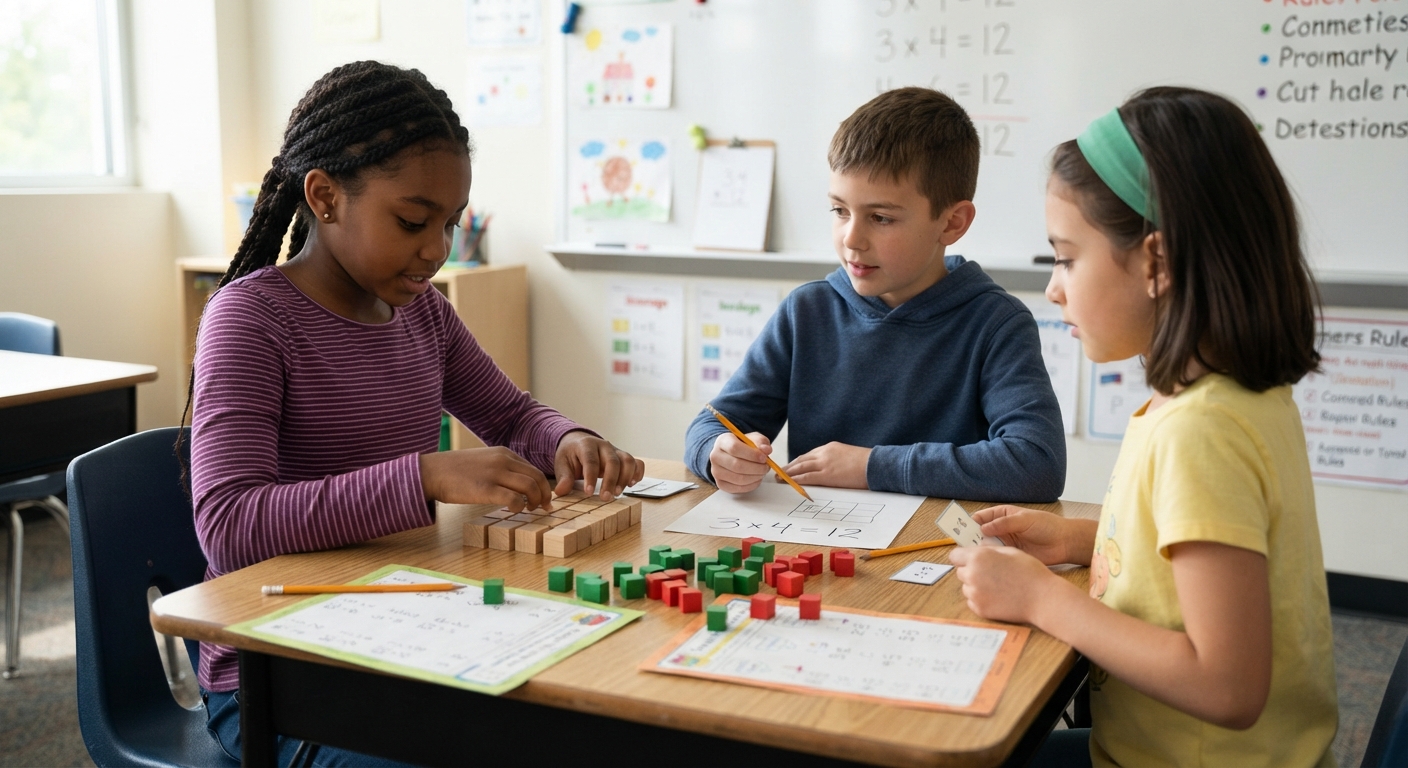
An array is rows and columns of objects. Six rows of four dots is 6 × 4 = 24 dots. Turn the same array sideways and it’s four rows of six, which is 4 × 6 = 24. Same dots, same total. Arrays are the cleanest way to show a kid why order doesn’t matter.
Area
A rectangle 8 units long and 5 units wide covers 8 × 5 = 40 square units. The area model scales up to big numbers, decimals and algebra, so it’s worth learning even when arrays feel easier to draw.
Ways to write multiplication
All of these mean the same thing. Kids meet the top of the list in elementary school and the bottom of it in algebra, so seeing them together helps.
| Written as | Read as | Where you see it |
|---|---|---|
| 6 × 4 | six times four | Elementary school |
| 6 · 4 | six times four | Middle school onward |
| 6(4) or (6)(4) | six times four | Algebra |
| 6n | six times n | Algebra, no symbol needed |
| 6 * 4 | six times four | Calculators, spreadsheets, code |
The
The × symbol gets dropped in algebra because it looks too much like the variable x. That switch trips up a lot of sixth graders who read 3(5) as something other than multiplication.
times; symbol gets dropped in algebra because it looks too much like the variable x. That switch trips up a lot of sixth graders who read 3(5) as something other than multiplication.
The words: factor, product, multiple
In 7 × 8 = 56, the 7 and 8 are factors and 56 is the product. 56 is a multiple of 7 and a multiple of 8.
Older textbooks also say multiplicand (the size of each group) and multiplier (how many groups). Most current curricula just say factors.
The properties of multiplication
These are the shortcuts that make mental math possible. Kids who know them stop grinding through every problem the long way.
| Property | What it says | Example |
|---|---|---|
| Commutative | Order doesn’t matter | 9 × 3 = 3 × 9 = 27 |
| Associative | Grouping doesn’t matter | (2 × 5) × 7 = 2 × (5 × 7) = 70 |
| Distributive | Split a factor, multiply both parts, add | 7 × 13 = (7 × 10) + (7 × 3) = 91 |
| Identity | Times 1 changes nothing | 42 × 1 = 42 |
| Zero | Times 0 is always 0 | 42 × 0 = 0 |
The distributive property is the one that pays off longest. It’s how kids multiply 7 × 13 in their head, and it’s the same move they’ll use on (x + 3)(x + 5) in algebra.
Times tables without the misery
There are 100 facts from 0 × 0 to 9 × 9, but you don’t memorize 100. The 0s, 1s, 2s, 5s and 10s come almost free, and commutativity means learning 6 × 8 also hands you 8 × 6. That leaves about 15 truly hard facts, mostly in the 3s, 4s, 6s, 7s and 8s.
Patterns that help:
- 2s: double it. 2 × 7 is 7 + 7.
- 4s: double twice. 4 × 7 is 7 doubled to 14, doubled again to 28.
- 5s: the answer always ends in 0 or 5, and it’s half of the 10s fact. 5 × 8 is half of 80, so 40.
- 9s: the two digits of the answer add to 9, and the tens digit is one less than the other factor. 9 × 7: tens digit is 6, ones digit is 3, so 63.
- Squares: 3 × 3, 4 × 4, 6 × 6, 7 × 7. Kids remember these as landmarks, and neighbors are one step away. If 7 × 7 = 49, then 7 × 8 = 49 + 7 = 56.
Short daily drilling beats long weekend sessions for facts. We wrote about why in Why 20 Minutes A Day Beats A 90-Minute Tutoring Session.
Multiplying bigger numbers
Once the facts are solid, big numbers are just the facts plus place value. Here’s 34 × 27 with partial products, which shows what’s really happening.
34 × 20 = 680
34 × 7 = 238
680 + 238 = 918
The standard algorithm is the same work stacked, with 238 on the first line and 680 shifted one place under it, then added.
If your kid gets a wildly wrong answer, have them estimate first. 34 and 27 are both close to 30, so the answer should be near 900. An answer of 238 is caught in two seconds.
Common mistakes
- Forgetting the placeholder zero. In 34 × 27, the second line is 34 × 20, not 34 × 2. Kids who write 68 instead of 680 get 306 and don’t notice.
- Multiplying by 0 and writing the other number. 7 × 0 is 0, not 7. This one comes from confusing the zero rule with the addition rule, where 7 + 0 really is 7.
- Counting the groups instead of the total. Asked for 4 × 3, a kid draws four groups of three and answers 4.
- Adding instead of multiplying under pressure. 6 × 7 comes out 13. Usually a speed or anxiety issue, not a knowledge gap.
- Only carrying once. In multi digit work, a carried digit gets added before the next multiply instead of after, which throws the whole column off.
Practice problems
- 6 × 7
- 8 × 9
- Write 5 + 5 + 5 + 5 as a multiplication, then solve it.
- An array has 7 rows with 6 dots in each row. How many dots?
- Use the distributive property to find 6 × 14.
- 23 × 4
- 46 × 32
- A case holds 12 rows of 8 cans. How many cans are in 3 cases?
Answers
- 42
- 72
- 4 × 5 = 20
- 42
- (6 × 10) + (6 × 4) = 60 + 24 = 84
- 92
- (46 × 30) + (46 × 2) = 1,380 + 92 = 1,472
- 12 × 8 = 96 cans per case, and 96 × 3 = 288 cans
What it means if your kid is stuck on multiplication
A kid who can’t do 7 × 8 usually isn’t failing at multiplication. They’re failing at something under it. Weak skip counting means the 6s, 7s and 8s never build. Shaky addition facts mean repeated addition is too slow to be useful, so the facts never get rehearsed enough to stick. Fuzzy place value means multi digit problems collapse even when every single fact is correct.
The tell is where the errors cluster. If the small facts are fine but 34 × 27 falls apart, it’s place value. If the small facts are slow and inconsistent, it’s fluency, and more worksheets on long multiplication won’t touch it. Our guide to Math Skills By Grade Level: What Your Child Should Know lays out what should be automatic by the end of each year, and Is My Child Behind In Math? 12 Signs By Grade Level covers the warning signs that show up before grades drop.
Unfixed multiplication gaps don’t stay small. Fractions, ratios and factoring all assume the facts are automatic, which is a big part of why algebra goes sideways later. We unpack that chain in Struggling With Algebra? The Real Problem Is Usually Fourth Grade Fractions.
Frequently asked questions
What does multiply mean?
To multiply means to find the total of several equal groups. Multiply 6 by 4 and you’re finding what four groups of six add up to: 24.
Is multiplication just repeated addition?
For whole numbers, yes, and that’s the right first picture. It breaks down with fractions. You can’t add 8 to itself “half a time,” but 0.5 × 8 = 4 still makes sense as half of a group of 8. That’s why teachers move kids toward area models.
What grade do kids learn multiplication?
Most kids meet multiplication as equal groups in second grade, work on it hard in third, and are expected to know the facts through 10 × 10 fluently by the end of third or during fourth. Multi digit multiplication usually lands in fourth and fifth.
What’s the fastest way to learn the times tables?
Five to ten minutes a day, one table at a time, with the facts your kid actually misses rather than a full deck every night. Use the patterns above, and always pair 6 × 8 with 8 × 6 so one fact does double duty.
Does the order of the factors matter?
Not for the answer. 3 × 9 and 9 × 3 are both 27. It can matter for the story: 3 bags of 9 apples and 9 bags of 3 apples are different situations with the same total.
What’s the difference between a factor and a multiple?
Factors are the numbers you multiply together. Multiples are what you get. 4 and 5 are factors of 20, and 20 is a multiple of both.
Find the actual gap
Drilling multiplication when the real problem is place value or addition fluency wastes a lot of evenings. Math Anon starts with a short adaptive assessment that works out exactly which skills are missing, then sends you a written report in plain English saying what it found and what to do about it.
After that it’s about 20 minutes of targeted daily practice aimed at those specific gaps, with a progress report every week so you can see what moved. The assessment is $49, and we credit the whole thing back on your first month. Start the assessment or look over pricing first.





