
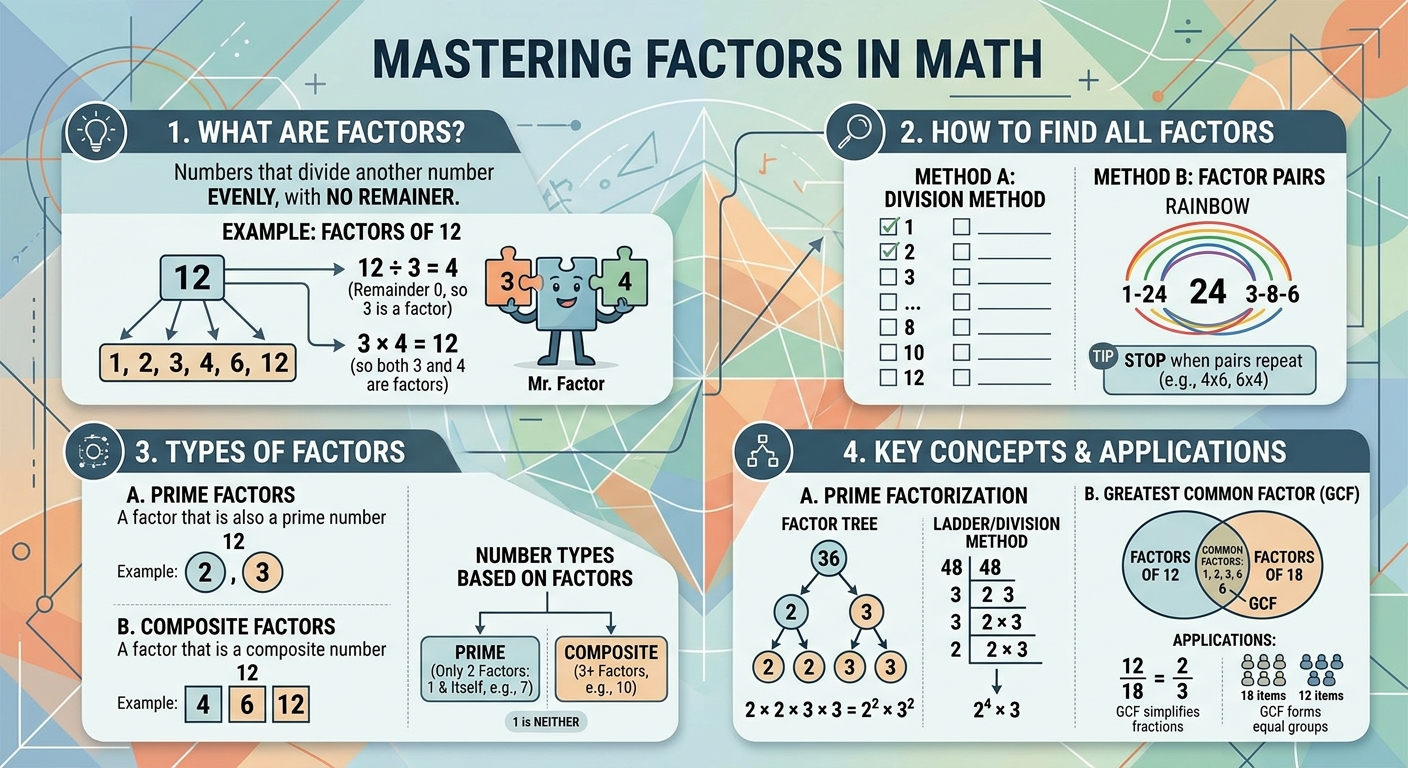
What Are Factors In Math? Factor Pairs, Chart And Examples
The short version
- A factor is a whole number that divides another whole number evenly, with nothing left over. The factors of 12 are 1, 2, 3, 4, 6 and 12.
- Factors come in pairs that multiply to the number. For 12, the pairs are 1 × 12, 2 × 6 and 3 × 4.
- Factors go into a number; multiples come out of it. 12 is a factor of 24, 36, 48, 60 and every other multiple of 12.
- To find every factor, test 1, 2, 3 and so on until the pairs start to repeat. You never need to test past the square root.
- If your kid is stuck on factors, the real gap is almost always multiplication and division facts.
In math, factors are the whole numbers you can multiply together to get another number. Put another way, a factor divides a number exactly, with no remainder. So 4 is a factor of 12 because 12 ÷ 4 = 3, and 5 isn’t, because 12 ÷ 5 = 2 remainder 2.
Below you’ll find how to list every factor of a number without missing any, a factor chart for 1 to 30, the difference between factors and multiples, prime factorization, and practice problems with answers.
What is a factor in math?
A factor of a number is any whole number that divides into it with zero remainder. Every number greater than 1 has at least two factors: 1 and itself. Most have more.
Take 12. Try each number from 1 up:
12 ÷ 1 = 12 (yes)
12 ÷ 2 = 6 (yes)
12 ÷ 3 = 4 (yes)
12 ÷ 4 = 3 (yes)
12 ÷ 5 = 2 R2 (no)
12 ÷ 6 = 2 (yes)
So the factors of 12 are 1, 2, 3, 4, 6 and 12. That’s six factors, which is a lot for a small number. It’s one reason 12 shows up everywhere: a dozen eggs split evenly into 2, 3, 4 or 6 groups.
In elementary and middle school, factors are positive whole numbers. Fractions and decimals don’t count. You’d never say 2.5 is a factor of 10, even though 2.5 × 4 = 10.
Factor pairs
Factors travel in pairs. Each pair multiplies to the original number:
1 × 12 = 12
2 × 6 = 12
3 × 4 = 12
Once you find one factor, you get its partner for free by dividing. If 3 is a factor of 12, then 12 ÷ 3 = 4 is too. That’s the trick that makes finding factors fast.
Factors vs multiples
This is the mix-up we see most. Factors and multiples are opposite directions of the same multiplication fact.
| Factors | Multiples | |
|---|---|---|
| Meaning | Numbers that divide into it evenly | Numbers you get by multiplying it by 1, 2, 3… |
| Size | Smaller than or equal to the number | Equal to or bigger than the number |
| How many | A limited list | They go on forever |
| Example for 12 | 1, 2, 3, 4, 6, 12 | 12, 24, 36, 48, 60… |
The sentence “3 is a factor of 12” means the same thing as “12 is a multiple of 3.” Same fact, flipped.
What is 12 a factor of?
12 is a factor of every multiple of 12: 12, 24, 36, 48, 60, 72, 84, 96, 108, 120 and on forever. To check a bigger number, divide by 12 and see if the answer is a whole number. 144 ÷ 12 = 12, so 12 is a factor of 144. 150 ÷ 12 = 12.5, so it isn’t.
A quicker test: a number is divisible by 12 when it’s divisible by both 3 and 4. For 156, the digits add to 12 (divisible by 3) and the last two digits, 56, divide by 4. So 12 is a factor of 156. Check: 12 × 13 = 156.
How to find all the factors of a number
Here’s the method that never misses one.
- Write 1 and the number itself as your first pair.
- Test 2, then 3, then 4, and so on. Each time one divides evenly, write it with its partner.
- Stop when the number you’re testing meets or passes its partner. After that, the pairs just repeat backward.
Worked example: factors of 36
1 × 36
2 × 18
3 × 12
4 × 9
5: 36 ÷ 5 = 7 R1, skip
6 × 6 (the partners met, so stop)
Factors of 36: 1, 2, 3, 4, 6, 9, 12, 18, 36. That’s nine factors, an odd count, because 6 pairs with itself. Only perfect squares have an odd number of factors.
Worked example: factors of 60
1 × 60
2 × 30
3 × 20
4 × 15
5 × 12
6 × 10
7: 60 ÷ 7 = 8 R4, skip
8: 60 ÷ 8 = 7 R4, skip
9: 60 ÷ 9 = 6 R6, skip
10 is already on the list as a partner, so stop.
Factors of 60: 1, 2, 3, 4, 5, 6, 10, 12, 15, 20, 30, 60. Twelve factors.
Worked example: factors of 29
1 × 29. Test 2, 3, 4 and 5. None divide evenly, and 6 × 6 = 36 is already bigger than 29, so you can stop. The only factors are 1 and 29. That makes 29 a prime number.
Factor chart for 1 to 30
Use this to check work. A prime number has exactly two factors. A composite number has more than two. The number 1 has only one factor, so it’s neither.
| Number | Factors | How many | Type |
|---|---|---|---|
| 1 | 1 | 1 | neither |
| 2 | 1, 2 | 2 | prime |
| 3 | 1, 3 | 2 | prime |
| 4 | 1, 2, 4 | 3 | composite |
| 5 | 1, 5 | 2 | prime |
| 6 | 1, 2, 3, 6 | 4 | composite |
| 7 | 1, 7 | 2 | prime |
| 8 | 1, 2, 4, 8 | 4 | composite |
| 9 | 1, 3, 9 | 3 | composite |
| 10 | 1, 2, 5, 10 | 4 | composite |
| 11 | 1, 11 | 2 | prime |
| 12 | 1, 2, 3, 4, 6, 12 | 6 | composite |
| 13 | 1, 13 | 2 | prime |
| 14 | 1, 2, 7, 14 | 4 | composite |
| 15 | 1, 3, 5, 15 | 4 | composite |
| 16 | 1, 2, 4, 8, 16 | 5 | composite |
| 17 | 1, 17 | 2 | prime |
| 18 | 1, 2, 3, 6, 9, 18 | 6 | composite |
| 19 | 1, 19 | 2 | prime |
| 20 | 1, 2, 4, 5, 10, 20 | 6 | composite |
| 21 | 1, 3, 7, 21 | 4 | composite |
| 22 | 1, 2, 11, 22 | 4 | composite |
| 23 | 1, 23 | 2 | prime |
| 24 | 1, 2, 3, 4, 6, 8, 12, 24 | 8 | composite |
| 25 | 1, 5, 25 | 3 | composite |
| 26 | 1, 2, 13, 26 | 4 | composite |
| 27 | 1, 3, 9, 27 | 4 | composite |
| 28 | 1, 2, 4, 7, 14, 28 | 6 | composite |
| 29 | 1, 29 | 2 | prime |
| 30 | 1, 2, 3, 5, 6, 10, 15, 30 | 8 | composite |
Notice 24 and 30 each have eight factors, the most on the chart. And the numbers with exactly three factors (4, 9 and 25) are all squares of primes.
Prime factors, prime factorization and the GCF
Once kids are solid on factors, the next steps build right on top.
Prime factorization
Prime factorization means writing a number as a product of primes only. A factor tree does it: split the number into any factor pair, then keep splitting until every branch ends in a prime.
60 = 6 × 10
6 = 2 × 3, and 10 = 2 × 5
So 60 = 2 × 2 × 3 × 5, or 2² × 3 × 5
You’ll get the same primes no matter which pair you start with. Start with 4 × 15 instead and you still land on 2 × 2 × 3 × 5.
Greatest common factor
The greatest common factor (GCF) is the biggest factor two numbers share. For 24 and 36:
Factors of 24: 1, 2, 3, 4, 6, 8, 12, 24
Factors of 36: 1, 2, 3, 4, 6, 9, 12, 18, 36
Shared: 1, 2, 3, 4, 6, 12. The greatest is 12.
The GCF is what you divide by to simplify a fraction in one step: 24/36 = 2/3 when you divide top and bottom by 12.
Common mistakes with factors
- Swapping factors and multiples. A kid asked for the factors of 8 who writes 8, 16, 24, 32 has listed multiples. Ask: “Do these go into 8, or does 8 go into them?”
- Forgetting 1 and the number itself. They’re always on the list, and they’re the easiest to leave off.
- Missing a middle pair. Jumping around instead of testing in order means 4 × 9 slips by when listing factors of 36. Go 1, 2, 3, 4 in order every time.
- Listing the square twice. For 36, 6 goes on the list once, not twice.
- Calling 1 prime. A prime has exactly two factors. 1 has one.
- Thinking odd means prime. 9, 15, 21 and 27 are odd and composite.
Practice problems
- List all the factors of 18.
- Is 7 a factor of 84?
- Write every factor pair of 40.
- Is 12 a factor of 138?
- Which numbers from 1 to 30 have exactly three factors?
- Write the prime factorization of 90.
- Find the greatest common factor of 42 and 56.
- A teacher sets up 48 chairs in equal rows. She wants at least 4 rows and at least 4 chairs in each row. How many different setups can she use?
Answers
- 1, 2, 3, 6, 9, 18
- Yes. 84 ÷ 7 = 12.
- 1 × 40, 2 × 20, 4 × 10, 5 × 8
- No. 138 ÷ 12 = 11.5. (138 passes the 3 test but 38 doesn’t divide by 4.)
- 4, 9 and 25
- 90 = 2 × 3 × 3 × 5, or 2 × 3² × 5
- 14. Factors of 42: 1, 2, 3, 6, 7, 14, 21, 42. Factors of 56: 1, 2, 4, 7, 8, 14, 28, 56.
- Four setups: 4 rows of 12, 6 rows of 8, 8 rows of 6, or 12 rows of 4.
If your child is stuck on factors
Factors are usually a fourth grade topic, and they lean entirely on multiplication and division facts. A kid who has to count up on fingers to check whether 7 goes into 56 will find factor lists slow and error-filled, and will start to dread them. The factor lesson is where that weak fact recall finally shows. It’s rarely the cause.
It matters because factors come back hard later. Simplifying fractions needs the GCF. Adding fractions needs common multiples. Algebra students factor expressions like x² + 7x + 12, which is really just “find two factors of 12 that add to 7.” We explain that chain in why algebra trouble usually traces back to fourth grade fractions.
If you’re not sure where your kid should be, our guide to math skills by grade level shows what’s expected in grades 3 to 5. Short, frequent fact practice works better than long cram sessions, which is why we recommend about 20 minutes a day.
Frequently asked questions
What are the factors of 12?
1, 2, 3, 4, 6 and 12. The factor pairs are 1 × 12, 2 × 6 and 3 × 4.
What is 12 a factor of?
12 is a factor of every multiple of 12: 24, 36, 48, 60, 72, 84, 96, 108, 120, 144 and so on. If a number divides by 12 with no remainder, 12 is one of its factors.
Is 1 a factor of every number?
Yes. Every whole number divides by 1 evenly, so 1 is a factor of all of them. Every number is also a factor of itself.
What’s the difference between a factor and a multiple?
A factor divides into a number; a multiple is what you get when you multiply the number. 4 is a factor of 20, and 20 is a multiple of 4. Factors are a short list. Multiples never end.
Can factors be negative?
In elementary and middle school, factors are positive whole numbers. In algebra, negative factors count too: -3 × -4 = 12, so -3 and -4 are factors of 12. Follow whatever your kid’s class is using.
Find the actual gap
If factors feel like a wall, there’s usually a specific missing skill underneath, like the 7s and 8s times tables or division with remainders. Math Anon starts with a short adaptive assessment that finds exactly which skills are missing and gives you a written report on what it found.
From there, your kid gets about 20 minutes a day of practice aimed only at those gaps, and you get a progress report every week. The assessment is $49, and that’s credited back in full on your first month. Start the assessment or see pricing.





