
Parts Of A Circle: Radius, Chord, Arc, Sector And More
The short version
- The main parts of a circle are the center, radius, diameter and circumference. Kids in upper elementary and middle school also learn chord, arc, sector, segment, tangent and secant.
- The radius runs from the center to the edge. The diameter goes all the way across through the center, so it’s always twice the radius.
- Circumference is the distance around: C = πd or C = 2πr. Area is the space inside: A = πr².
- A chord connects two points on the circle. The diameter is the longest possible chord.
- Most circle mistakes come from mixing up radius and diameter, so check which one a problem gives you before doing anything else.
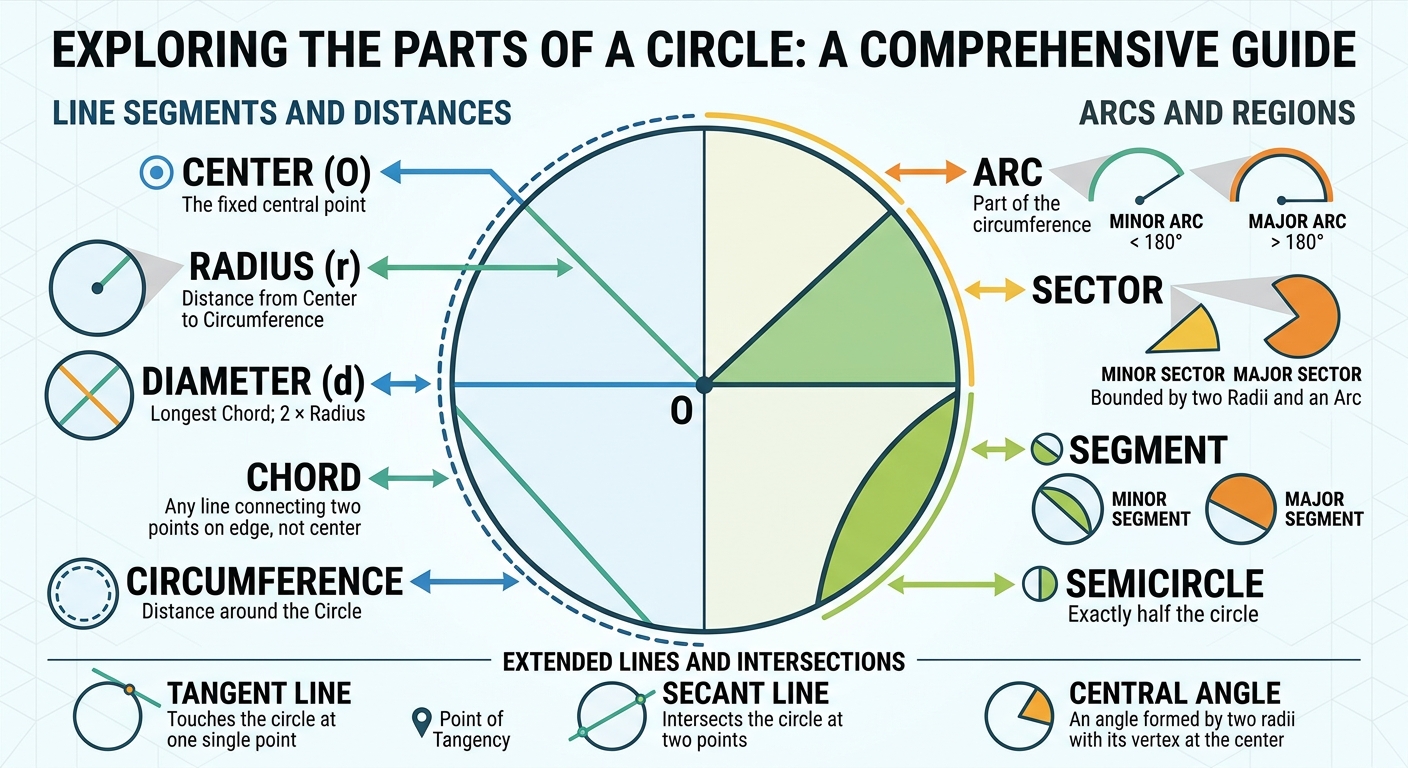
The parts of a circle are the center, radius, diameter, circumference, chord, arc, sector, segment, tangent and secant. The first four are the core: every circle problem in elementary and middle school uses them. The rest show up in 7th grade and high school geometry, along with central and inscribed angles.
Below is each part with a plain definition, a quick reference table, the formulas that connect them, worked examples with real numbers and practice problems with answers.
What a circle is
A circle is every point that’s the same distance from one fixed point, the center. That distance is the radius. It’s why a compass works: fix the point, keep the width the same, and swing the pencil around.
One thing trips kids up early. The circle is only the curved line. The flat space inside is the interior, or the disk. That’s why circumference (the line) and area (the inside) are different measurements with different units.
The parts of a circle, one by one
Center
The fixed point in the middle. Every point on the circle is the same distance from it. A circle is often named by its center, so “circle O” means the circle centered at point O.
Radius
A line segment from the center to any point on the circle. A circle has infinitely many radii (the plural), and they’re all the same length. Spokes on a bike wheel are a good picture of radii.
Diameter
A line segment that passes through the center and has both ends on the circle. It’s two radii joined end to end, so d = 2r and r = d ÷ 2.
Circumference
The distance all the way around the circle. It’s the circle’s perimeter. For every circle, circumference ÷ diameter is the same number: π, about 3.14159.
Chord
A line segment with both ends on the circle. It doesn’t have to go through the center. A chord that does go through the center is a diameter, and that’s the longest chord a circle can have.
Arc
A piece of the circle between two points. A minor arc is less than half the circle, a major arc is more than half, and a semicircle is exactly half. Arcs are measured two ways: in degrees (how much of the turn) or in length (how far along the curve).
Sector
The region between two radii and the arc that joins them. Think of a wedge cut from a round cheese. A sector touches the center.
Segment
The region between a chord and its arc. Slice a straight cut off the edge of a round tortilla and the piece that falls off is a segment. A segment doesn’t touch the center (unless the chord is a diameter, which makes it a half circle).
Tangent
A line that touches the circle at exactly one point, called the point of tangency. It never crosses into the inside. A tangent is always perpendicular to the radius drawn to that point, which means they meet at 90°.
Secant
A line that cuts through the circle and crosses it at two points. The part of a secant that sits inside the circle is a chord.
Central angle and inscribed angle
A central angle has its vertex at the center, with two radii as its sides. Its measure equals the arc it cuts off. An inscribed angle has its vertex on the circle, with two chords as its sides. It measures half of the arc it cuts off. So if a central angle and an inscribed angle open onto the same 80° arc, the central angle is 80° and the inscribed angle is 40°.
Parts of a circle reference table
| Part | What it is | Touches the center? | Points on the circle |
|---|---|---|---|
| Radius | Segment, center to edge | Yes (one end) | 1 |
| Diameter | Segment across, through center | Yes | 2 |
| Chord | Segment, edge to edge | Only if it’s a diameter | 2 |
| Tangent | Line touching the outside | No | 1 |
| Secant | Line cutting through | Sometimes | 2 |
| Arc | Piece of the curve | No | Many |
| Sector | Wedge region | Yes | Many |
| Segment | Region cut off by a chord | No (unless half) | Many |
Circle formulas that connect the parts
| Find | Formula |
|---|---|
| Diameter | d = 2r |
| Radius | r = d ÷ 2 |
| Circumference | C = πd or C = 2πr |
| Area | A = πr² |
| Arc length | (angle ÷ 360) × 2πr |
| Sector area | (angle ÷ 360) × πr² |
The last two are just fractions of the whole circle. A 90° arc is 90 ÷ 360 = 1/4 of the circumference. A 60° sector is 60 ÷ 360 = 1/6 of the area.
Worked example 1: from the radius
A circle has a radius of 5 cm. Find the diameter, circumference and area.
Diameter: d = 2 × 5 = 10 cm
Circumference: C = π × 10 = 10π ≈ 31.42 cm
Area: A = π × 5² = 25π ≈ 78.54 cm²
Notice area uses the radius, squared. The units are square centimeters because area covers space.
Worked example 2: from the diameter
A round table is 1.2 m across. How much trim goes around the edge?
“Across” is the diameter, so d = 1.2 m.
C = π × 1.2 ≈ 3.14 × 1.2 = 3.768, so about 3.77 m of trim.
Worked example 3: arc length
A circle has radius 8 in. How long is the arc cut off by a 90° central angle?
Full circumference: 2 × π × 8 = 16π
Fraction: 90 ÷ 360 = 1/4
Arc length: 16π ÷ 4 = 4π ≈ 12.57 in
Worked example 4: sector area
A sprinkler sprays a 60° wedge of lawn out to 6 m. How much grass gets watered?
Full area: π × 6² = 36π
Fraction: 60 ÷ 360 = 1/6
Sector area: 36π ÷ 6 = 6π ≈ 18.85 m²
Common mistakes with the parts of a circle
- Using the diameter in the area formula. A = πr² needs the radius. For a 10 cm diameter, the area is π × 5² = 25π, not π × 10² = 100π. That error makes the answer four times too big.
- Mixing up circumference and area. One is a length (cm), the other a space (cm²). If your kid writes cm² on a circumference answer, the formulas are blurred together.
- Calling any line through a circle a diameter. It’s only a diameter if it goes through the center. Otherwise it’s a chord.
- Confusing sector and segment. A sector is a wedge that reaches the center. A segment is cut off by a straight chord.
- Squaring before multiplying by π in the wrong order. For r = 3, compute 3² = 9 first, then 9π. Doing (3π)² gives 9π², which is wrong.
- Rounding π too early. Keep answers in terms of π until the last step, then round once.
Practice problems
- A circle has a diameter of 14 cm. What’s the radius?
- A line touches a circle at exactly one point. What’s it called?
- Find the circumference of a circle with diameter 10 in. Use 3.14 for π.
- Find the area of a circle with radius 3 m. Use 3.14 for π.
- A central angle measures 70°. What’s the measure of an inscribed angle that cuts off the same arc?
- Find the arc length for a 120° central angle in a circle with radius 12 cm. Give your answer in terms of π.
- Find the area of a 45° sector of a circle with radius 10 ft. Give your answer in terms of π, then rounded to two decimals.
- A circle’s circumference is 94.2 cm. Using 3.14 for π, find its area.
Answers
- 7 cm (14 ÷ 2)
- A tangent
- 31.4 in (3.14 × 10)
- 28.26 m² (3.14 × 3² = 3.14 × 9)
- 35° (half of 70°)
- 8π cm. Circumference is 24π, and 120 ÷ 360 = 1/3, so 24π ÷ 3 = 8π, about 25.13 cm.
- 12.5π ft², about 39.27 ft². Full area is 100π, and 45 ÷ 360 = 1/8.
- 706.5 cm². Diameter = 94.2 ÷ 3.14 = 30, so r = 15, and 3.14 × 15² = 3.14 × 225 = 706.5.
If your child is stuck on circles
Circle vocabulary is mostly memory, and a labeled drawing fixes it fast. When the formulas are the problem, the gap sits somewhere else. Squaring, multiplying decimals like 3.14 × 1.2, and working with fractions of a whole (60 ÷ 360 = 1/6) all come from earlier grades. A kid who can’t simplify 45/360 will stall on sector area even if they know exactly what a sector is.
Angle work matters too. Central and inscribed angles build on the angle facts in our post on supplementary angles. And if circle problems come with a lot of “I’m just bad at math,” read our guide to math anxiety in children before pushing more practice.
To see whether your kid is where they should be overall, our list of signs a child is behind in math breaks it down by grade.
Frequently asked questions
What are the 3 main parts of a circle?
Most elementary lessons start with the center, the radius and the diameter. Circumference usually comes next, since it’s the measurement that uses them.
How many parts of a circle are there?
There’s no fixed number. A typical middle school list has about ten: center, radius, diameter, circumference, chord, arc, sector, segment, tangent and secant. High school geometry adds central angles, inscribed angles and the point of tangency.
Is the diameter a chord?
Yes. A chord is any segment with both ends on the circle. The diameter is the special chord that passes through the center, and it’s the longest one.
What’s the difference between a chord and a secant?
A chord is a segment that stops at the circle. A secant is a full line that keeps going past both points. The piece of a secant inside the circle is a chord.
What’s the difference between a sector and a segment?
A sector is bounded by two radii and an arc, so it’s a wedge from the center. A segment is bounded by a chord and an arc, so it’s the sliver cut off the edge.
What grade learns the parts of a circle?
Kids often meet radius and diameter in upper elementary. Circumference and area formulas are a standard 7th grade topic. Tangents, secants, arcs and inscribed angles are high school geometry.
Find the actual gap
When a kid knows what a radius is but still gets the area wrong, the missing piece is usually squaring, decimal multiplication or fractions. Math Anon begins with a short adaptive assessment that pinpoints which of those skills are shaky and hands you a written report.
Then your kid does about 20 minutes a day of practice built around exactly those skills, and you get a progress report each week. The assessment costs $49, credited back in full toward the first month. Start the assessment or check pricing.





