
How To Multiply Decimals: Steps, Examples And Practice
The short version
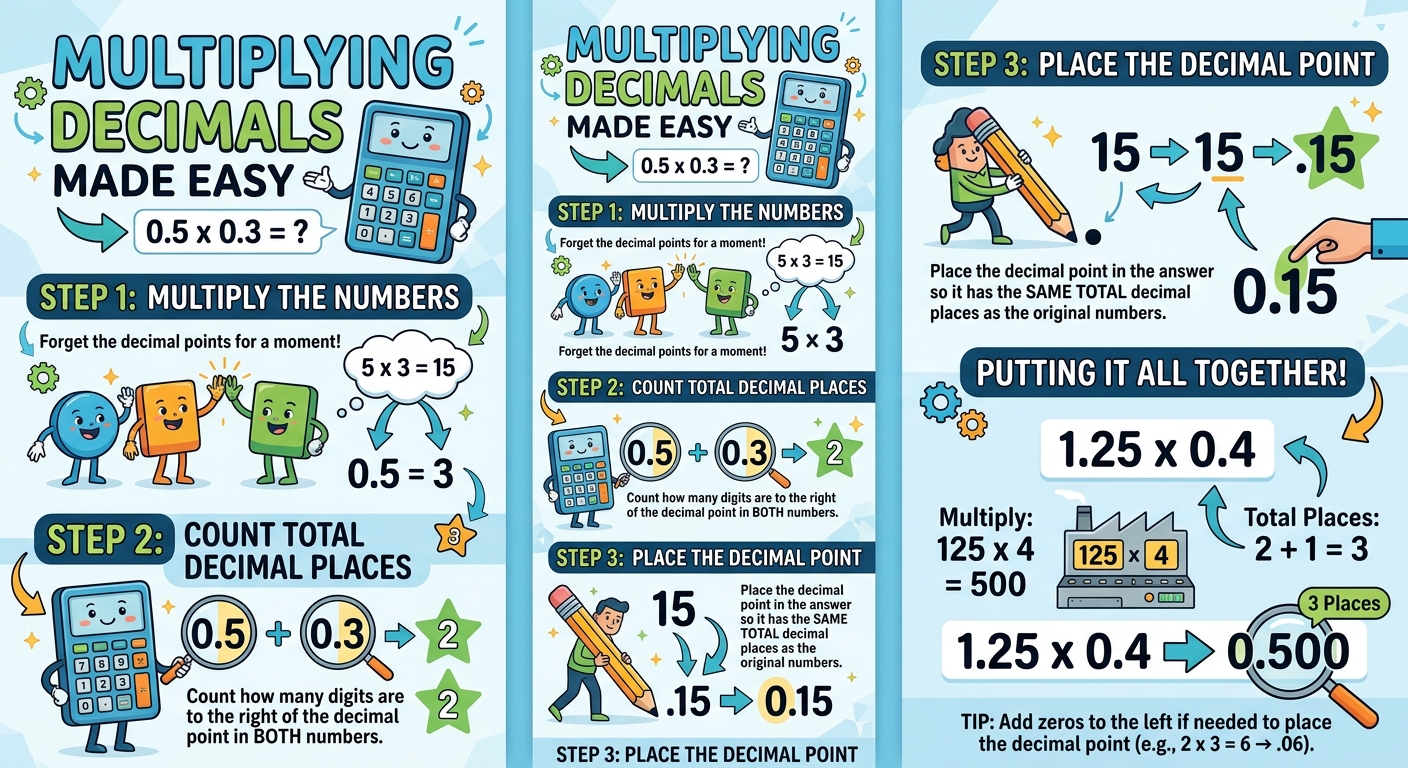
- To multiply decimals, ignore the decimal points, multiply the numbers as if they were whole numbers, then put the decimal point back.
- Count the digits after the decimal point in both factors and add them. The answer gets that many decimal places.
- You don’t line up the decimal points when you multiply. That rule belongs to adding and subtracting.
- If the product runs out of digits, fill in zeros on the left: 0.03 × 0.2 = 0.006.
- Estimate first. 4.6 × 2.5 is close to 5 × 2.5, so the answer should be a little under 12.5.
Here’s how to multiply decimals: take the decimal points out, multiply the whole numbers, then count the total number of decimal places in the two factors and move the point that many places from the right in your answer. So 2.35 × 1.4 becomes 235 × 14 = 3,290, and since there are 3 decimal places in total (two in 2.35, one in 1.4), the answer is 3.290, or 3.29.
That’s the whole method. The rest of this guide shows why it works, walks through the tricky cases (whole numbers, placeholder zeros, trailing zeros), and gives your kid practice problems with an answer key you can check at the kitchen table.
How to multiply decimals in 4 steps
This is how to multiply decimals for every problem type, from 0.4 × 3 to 15.25 × 0.04.
- Estimate. Round each number and get a rough answer. This is your safety net.
- Multiply as whole numbers. Drop the decimal points and multiply normally.
- Count decimal places. Count the digits to the right of the point in each factor. Add those counts.
- Place the point. Starting at the right end of your product, move left that many places and put the decimal point there. Compare with your estimate.
Kids skip step 1 all the time. It takes five seconds and it catches the most common error in this topic: a point in the wrong spot.
Why counting decimal places works
A decimal is really a fraction with 10, 100 or 1,000 on the bottom. 0.6 is 6 tenths. 0.7 is 7 tenths. When you multiply them:
0.6 × 0.7 = 6/10 × 7/10 = 42/100 = 0.42
Tenths times tenths gives hundredths. One decimal place plus one decimal place gives two. Hundredths times tenths gives thousandths, so two places plus one place gives three. The counting rule is just a shortcut for multiplying the denominators.
This also explains something that surprises kids: multiplying by a decimal less than 1 makes a number smaller. 8 × 0.5 = 4, because you’re taking half of 8. If your child expects every multiplication answer to be bigger, it’s worth talking through this one.
Worked examples
A decimal times a whole number
Problem: 3.4 × 2
Estimate: 3 × 2 = 6, so the answer is a bit over 6.
Multiply: 34 × 2 = 68
Decimal places: one in 3.4, none in 2. Total: 1
Answer: 6.8
Money problems work the same way. Three notebooks at $4.75 each: 475 × 3 = 1,425. Two decimal places, so $14.25.
A decimal times a decimal
Problem: 2.35 × 1.4
Estimate: 2 × 1.5 = 3, so expect something near 3.
Multiply: 235 × 14 = 3,290
Decimal places: two in 2.35, one in 1.4. Total: 3
Place the point: 3.290
Answer: 3.29 (the final zero can go)
Notice the order. You count places using the original numbers, then place the point in the full product 3,290 before you drop the trailing zero. If you drop the zero first and write 329, then move the point 3 places, you get 0.329, which is wrong. The estimate would catch it: 0.329 is nowhere near 3.
When you need placeholder zeros
Problem: 0.03 × 0.2
Multiply: 3 × 2 = 6
Decimal places: two in 0.03, one in 0.2. Total: 3
You need three places but only have one digit. Add zeros to the left: 006
Answer: 0.006
Check it with fractions: 3/100 × 2/10 = 6/1,000. Six thousandths.
When zeros disappear at the end
Problem: 12.5 × 0.08
Estimate: 12 × 0.1 = 1.2, so expect roughly 1.
Multiply: 125 × 8 = 1,000
Decimal places: one in 12.5, two in 0.08. Total: 3
Place the point: 1.000
Answer: 1
Multiplying by 10, 100 or 1,000
This is the one shortcut worth memorizing. Move the decimal point right one place for each zero.
| Problem | Zeros | Move point right | Answer |
|---|---|---|---|
| 3.62 × 10 | 1 | 1 place | 36.2 |
| 3.62 × 100 | 2 | 2 places | 362 |
| 3.62 × 1,000 | 3 | 3 places | 3,620 |
| 0.045 × 100 | 2 | 2 places | 4.5 |
Multiplying by 0.1, 0.01 or 0.001 goes the other way: move the point left. 36.2 × 0.1 = 3.62.
Multiplying decimals vs. adding decimals
A lot of confusion comes from mixing up the rules for different operations. This table sorts it out.
| Adding or subtracting decimals | Multiplying decimals | |
|---|---|---|
| Line up the points? | Yes, always | No. Line up the right edges like whole numbers |
| Where does the point go? | Straight down from the points above | Count total decimal places in both factors |
| Example | 1.2 + 0.3 = 1.5 | 1.2 × 0.3 = 0.36 |
Look at that last row. Same two numbers, but the sum has one decimal place and the product has two. A kid who applies the addition rule to multiplication will write 1.2 × 0.3 = 3.6, which is ten times too big.
Common mistakes when multiplying decimals
- Lining up the decimal points. Kids stack 4.6 over 2.5 with the points aligned, then bring the point straight down. That’s the addition rule. For multiplication, the position of the point in the setup doesn’t matter at all.
- Counting only one factor’s places. In 0.5 × 0.9, a kid counts one place and writes 4.5 instead of 0.45. Both factors count.
- Counting from the left. The point moves in from the right end of the product. Counting from the left gives nonsense.
- Dropping zeros too early. As in the 2.35 × 1.4 example, a trailing zero in the product has to stay until the point is placed.
- Forgetting the placeholder zeros. 0.07 × 0.6 is 0.042, not 0.42. If there aren’t enough digits, add zeros on the left.
- Weak whole-number multiplication. If 235 × 14 is shaky, the decimal step never gets a fair chance. Many “decimal” mistakes are really multi-digit multiplication mistakes.
Practice problems
Estimate first, then solve. They get harder as you go.
- 0.4 × 3
- 0.5 × 0.9
- 1.2 × 0.3
- 4.6 × 2.5
- 0.07 × 0.6
- 3.14 × 2.2
- 15.25 × 0.04
Answers
- 1.2 (4 × 3 = 12, one decimal place)
- 0.45 (5 × 9 = 45, two places)
- 0.36 (12 × 3 = 36, two places)
- 11.5 (46 × 25 = 1,150, two places gives 11.50)
- 0.042 (7 × 6 = 42, three places, so add a zero: 0.042)
- 6.908 (314 × 22 = 6,908, three places)
- 0.61 (1,525 × 4 = 6,100, four places gives 0.6100)
If your kid is stuck on multiplying decimals
When a child can’t multiply decimals, the decimal point is rarely the real problem. The counting rule takes ten minutes to teach. What usually breaks down is one of the skills underneath it:
- Multi-digit multiplication. If 46 × 25 takes three tries, 4.6 × 2.5 will too.
- Place value. A kid who isn’t sure that 0.3 is bigger than 0.25 can’t sanity check an answer.
- Fractions. Decimals are fractions in disguise. Kids who never got comfortable with tenths and hundredths as fractions end up memorizing rules without any feel for size.
Decimal multiplication shows up in 5th grade and gets polished in 6th, and it depends on 4th grade skills. Our guide to math skills by grade level lays out what should already be in place. If you’re seeing this struggle across several topics, these signs by grade level can help you tell a rough week from a real gap. And the fractions piece matters more than most parents expect: it’s the same weakness that shows up years later when kids struggle with algebra.
Frequently asked questions
Do you line up the decimals when multiplying?
No. You line up the numbers by their right edges, the same as whole-number multiplication, and ignore the points during the multiplying. Lining up the points is the rule for adding and subtracting.
How do you multiply a decimal by a decimal?
Multiply the numbers without the points, add up the decimal places in both factors, and put that many places in the answer. For 0.6 × 0.7: 6 × 7 = 42, two places total, so 0.42.
How do you multiply a decimal by a whole number?
Same method. The whole number has zero decimal places, so the answer has as many places as the decimal. 2.15 × 4: 215 × 4 = 860, two places, so 8.60, or 8.6.
Why is my answer smaller than the number I started with?
Because you multiplied by something less than 1. Multiplying by 0.5 means taking half, and multiplying by 0.1 means taking a tenth. That’s correct and expected.
What grade learns how to multiply decimals?
Most US standards introduce it in 5th grade with numbers to the hundredths place. By 6th grade, kids are expected to do it fluently with the standard method.
Can you multiply three decimals at once?
Yes. Multiply two, then multiply that result by the third, or multiply all three as whole numbers and count the places in all three factors. 0.2 × 0.3 × 0.5: 2 × 3 × 5 = 30, three places, so 0.030, or 0.03.
Find the actual gap
If decimal multiplication keeps falling apart, it helps to know which piece underneath is missing. Math Anon starts with a short adaptive assessment that pinpoints the exact skills your child hasn’t mastered yet, from place value to multi-digit multiplication, and you get a written report on what it found.
From there, your kid gets about 20 minutes a day of practice aimed at those gaps, and you get a progress report every week. The assessment is $49, and that’s credited back in full on your first month. Start the assessment or see pricing.





