
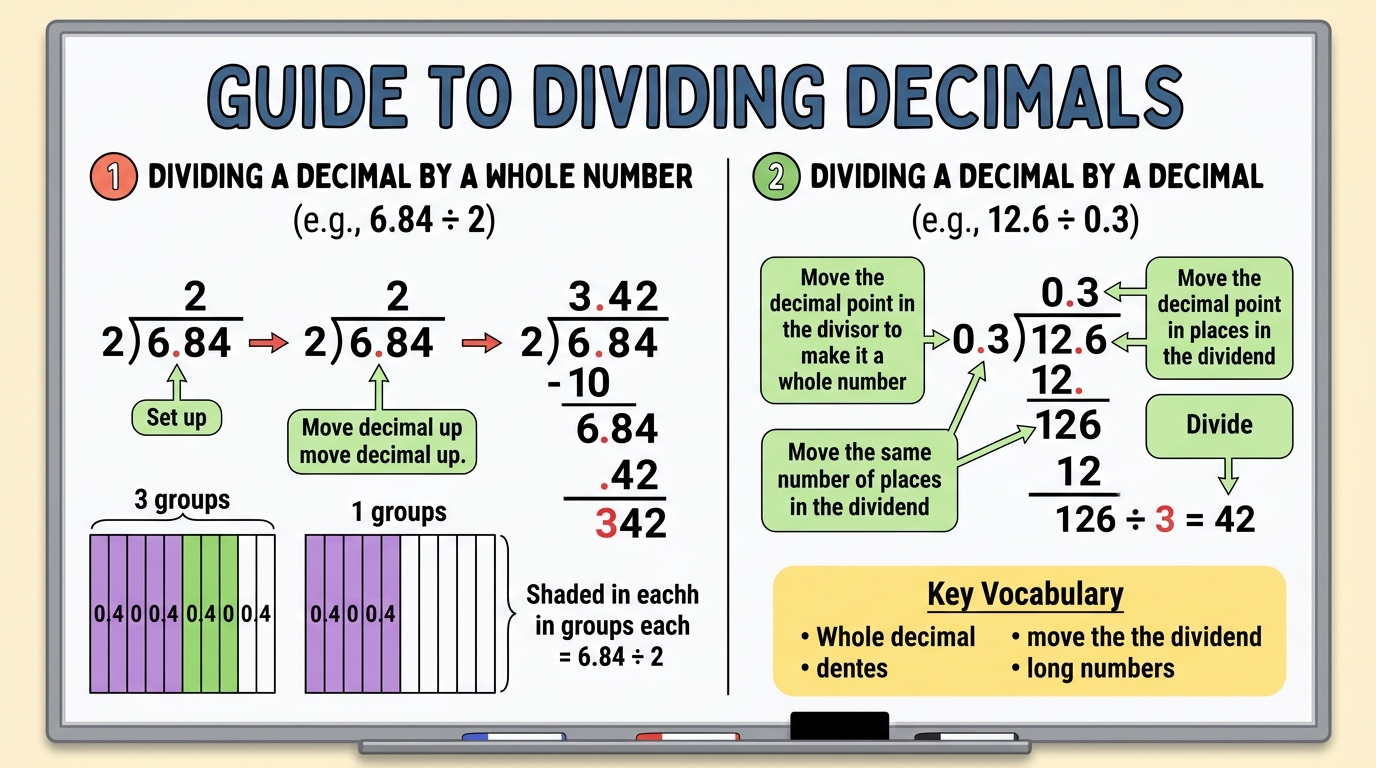
Dividing Decimals: Steps, Examples And Long Division
The short version
- If the divisor (the number you divide by) is a whole number, divide normally and put the decimal point in the answer directly above the one in the dividend.
- If the divisor is a decimal, move its decimal point right until it’s a whole number, then move the dividend’s decimal point right the same number of places. 4.56 ÷ 0.3 becomes 45.6 ÷ 3 = 15.2.
- When the division doesn’t come out even, add zeros to the end of the dividend and keep going. Some answers repeat forever, so round or use a bar.
- Check by multiplying: answer × divisor should give back the dividend.
Dividing decimals comes down to one move: make the divisor a whole number, then do ordinary long division. If you’re dividing by a whole number already, just divide and line the decimal point up straight above where it sits in the number being divided. If you’re dividing by a decimal, shift both decimal points to the right by the same number of places first.
That shift doesn’t change the answer. 4.56 ÷ 0.3 and 45.6 ÷ 3 are the same problem scaled up by 10, the way 1/2 and 10/20 are the same fraction. Below are the steps for every case, worked examples with real numbers, the mistakes that trip kids up, and practice with answers.
The words you need
In 7.44 ÷ 3 = 2.48:
- The dividend is 7.44, the number being split up.
- The divisor is 3, the number you divide by.
- The quotient is 2.48, the answer.
In long division, the divisor sits outside the bracket and the dividend sits inside. Everything below depends on knowing which is which, because only the divisor decides whether you need to move decimal points.
Case 1: dividing a decimal by a whole number
This is the easy one. Divide as if the decimal point weren’t there, and put the point in the quotient straight above the point in the dividend.
Worked example: 7.44 ÷ 3
Put the decimal point in the answer above the one in 7.44.
3 goes into 7 two times (6). 7 – 6 = 1.
Bring down the 4 to make 14. 3 goes into 14 four times (12). 14 – 12 = 2.
Bring down the next 4 to make 24. 3 goes into 24 eight times (24). Remainder 0.
Answer: 2.48
Check: 2.48 × 3 = 7.44. It works.
Worked example with a zero in the answer: 6.12 ÷ 6
6 goes into 6 one time. Remainder 0.
Bring down the 1. 6 goes into 1 zero times, so write 0 in the answer. Remainder 1.
Bring down the 2 to make 12. 6 goes into 12 two times.
Answer: 1.02
That 0 in the tenths place is the one kids skip most often. Leave it out and you get 1.2, which is wrong by a lot.
Case 2: dividing by a decimal
You can’t do long division with a decimal outside the bracket, so get rid of it.
- Count how many places the divisor’s decimal point needs to move right to become a whole number.
- Move the dividend’s decimal point right the same number of places. Add zeros if you run out of digits.
- Divide as in Case 1.
| Divisor looks like | Move both points | Same as multiplying by | Example |
|---|---|---|---|
| 0.3 (tenths) | 1 place right | 10 | 4.56 ÷ 0.3 = 45.6 ÷ 3 |
| 0.24 (hundredths) | 2 places right | 100 | 0.768 ÷ 0.24 = 76.8 ÷ 24 |
| 0.06 (hundredths) | 2 places right | 100 | 18 ÷ 0.06 = 1800 ÷ 6 |
| 0.008 (thousandths) | 3 places right | 1,000 | 4 ÷ 0.008 = 4000 ÷ 8 |
Worked example: 4.56 ÷ 0.3
0.3 needs one move to become 3. Move 4.56 one place too: 45.6.
Now 45.6 ÷ 3.
3 into 4 is 1, remainder 1. Bring down 5: 15. 3 into 15 is 5, remainder 0.
Bring down 6: 6. 3 into 6 is 2.
Answer: 15.2
Check: 15.2 × 0.3 = 4.56.
Worked example: 0.768 ÷ 0.24
0.24 needs two moves to become 24. Move 0.768 two places: 76.8.
24 into 76 is 3 (72), remainder 4. Bring down 8: 48.
24 into 48 is 2.
Answer: 3.2
Worked example: a whole number divided by a decimal, 18 ÷ 0.06
0.06 needs two moves to become 6. The number 18 is really 18.00, so moving two places gives 1800.
1800 ÷ 6 = 300.
Notice the answer is bigger than 18. Dividing by a number less than 1 always gives a bigger answer, because you’re asking how many small pieces fit. 0.06 fits into 18 three hundred times.
Long division with decimals that don’t come out even
When you run out of digits and still have a remainder, write zeros after the last digit of the dividend and keep dividing. Adding zeros to the end of a decimal doesn’t change its value: 9.3 and 9.300 are equal.
Worked example: 9.3 ÷ 4
4 into 9 is 2, remainder 1. Bring down 3: 13.
4 into 13 is 3, remainder 1. Out of digits, so add a 0 and bring it down: 10.
4 into 10 is 2, remainder 2. Add another 0: 20.
4 into 20 is 5, remainder 0.
Answer: 2.325
When it never ends: 5 ÷ 0.3
Move both points one place: 50 ÷ 3.
3 into 5 is 1, remainder 2. Bring down 0: 20. 3 into 20 is 6, remainder 2.
Add a 0: 20 again. 6 again, remainder 2. This repeats forever.
Answer: 16.666…, written 16.6 with a bar over the 6, or rounded to 16.67.
When the same remainder shows up twice, you’ve found a repeating decimal. Stop and round to whatever place the problem asks for.
Common mistakes when dividing decimals
- Moving only one decimal point. Shift the divisor but forget the dividend, and the answer is off by 10, 100 or more.
- Moving the dividend’s point by the wrong amount. The dividend moves as many places as the divisor needs, no matter how many decimal places the dividend has.
- Skipping zeros in the quotient. Every time the divisor doesn’t fit, a 0 goes in the answer. 6.12 ÷ 6 is 1.02, not 1.2.
- Stopping with a remainder. With decimals you usually add zeros and keep going instead of writing “R 2”.
- Expecting the answer to be smaller. Kids see 300 for 18 ÷ 0.06 and assume they messed up. Dividing by less than 1 makes things bigger.
- No estimate. A quick guess first catches most slips. 4.56 ÷ 0.3 is about 4.5 ÷ 0.3, which is 15. An answer of 1.52 or 152 should look wrong right away.
Practice problems
- 8.4 ÷ 4
- 15.6 ÷ 5
- 2.7 ÷ 0.9
- 36 ÷ 0.4
- 1.35 ÷ 0.05
- 0.912 ÷ 0.24
- 7 ÷ 0.6 (round to the nearest hundredth)
- A bag holds 0.25 lb of trail mix. How many bags can you fill from 3.75 lb?
Answers
- 2.1
- 3.12 (add a zero: 15.60 ÷ 5)
- 27 ÷ 9 = 3
- 360 ÷ 4 = 90
- 135 ÷ 5 = 27
- 91.2 ÷ 24 = 3.8
- 70 ÷ 6 = 11.666…, which rounds to 11.67
- 375 ÷ 25 = 15 bags
What it means if your kid is stuck on dividing decimals
Decimal division stacks four older skills on top of each other: place value, multiplication facts, whole-number long division and multiplying by 10 or 100. When a kid falls apart here, one of those is almost always the weak spot. Hand them 744 ÷ 3 with no decimals. If that goes badly, the problem is long division, and no amount of decimal-point rules will fix it. If it goes fine but they can’t say why 0.3 × 10 = 3, the gap is place value.
These gaps tend to show up again later. The same kid who guesses where the decimal point goes often has trouble with fractions, and that follows them into algebra, which we explain in why struggling with algebra usually traces back to fourth grade fractions. To see where these skills normally sit, check math skills by grade level. If homework time has turned into tears, our guide to math anxiety in children covers what helps.
Frequently asked questions
How do you do division in decimals step by step?
Make the divisor a whole number by moving its decimal point right, move the dividend’s point the same number of places, divide as usual, and place the decimal point in the answer directly above the dividend’s.
Why do you move the decimal point when dividing?
Moving both points the same number of places multiplies both numbers by the same power of 10, and that doesn’t change the quotient. 4.56 ÷ 0.3 and 45.6 ÷ 3 both equal 15.2.
What do you do with a remainder in long division with decimals?
Add a zero to the end of the dividend, bring it down and keep dividing. Keep going until the remainder is 0 or the digits start repeating.
How do you divide a decimal by 10, 100 or 1,000?
Move the decimal point left one place for each zero. 45.6 ÷ 10 = 4.56, and 45.6 ÷ 100 = 0.456.
What grade learns dividing decimals?
Most kids divide decimals to hundredths in fifth grade and become fluent with all four decimal operations in sixth grade, though curricula vary.
Find the actual gap
If decimal division keeps going sideways, it helps to know whether the real trouble is long division, place value or multiplication facts. Math Anon’s short adaptive assessment checks those skills and gives you a written report that says which ones are missing.
Then your child practices about 20 minutes a day on just those skills, and you get a weekly progress report. The assessment costs $49 and is credited back in full on your first month. Start the assessment or look over pricing first.





