
What Is A Quotient In Math? Meaning And Examples
The short version
- A quotient in math is the answer to a division problem. In 20 ÷ 4 = 5, the quotient is 5.
- The number being divided is the dividend, the number you divide by is the divisor, and anything left over is the remainder.
- Order matters. “The quotient of 20 and 4” means 20 ÷ 4, not 4 ÷ 20.
- You can check any quotient by multiplying: divisor × quotient + remainder = dividend.
- A quotient in math can be a whole number, a whole number with a remainder, a decimal, a fraction, or a negative number.
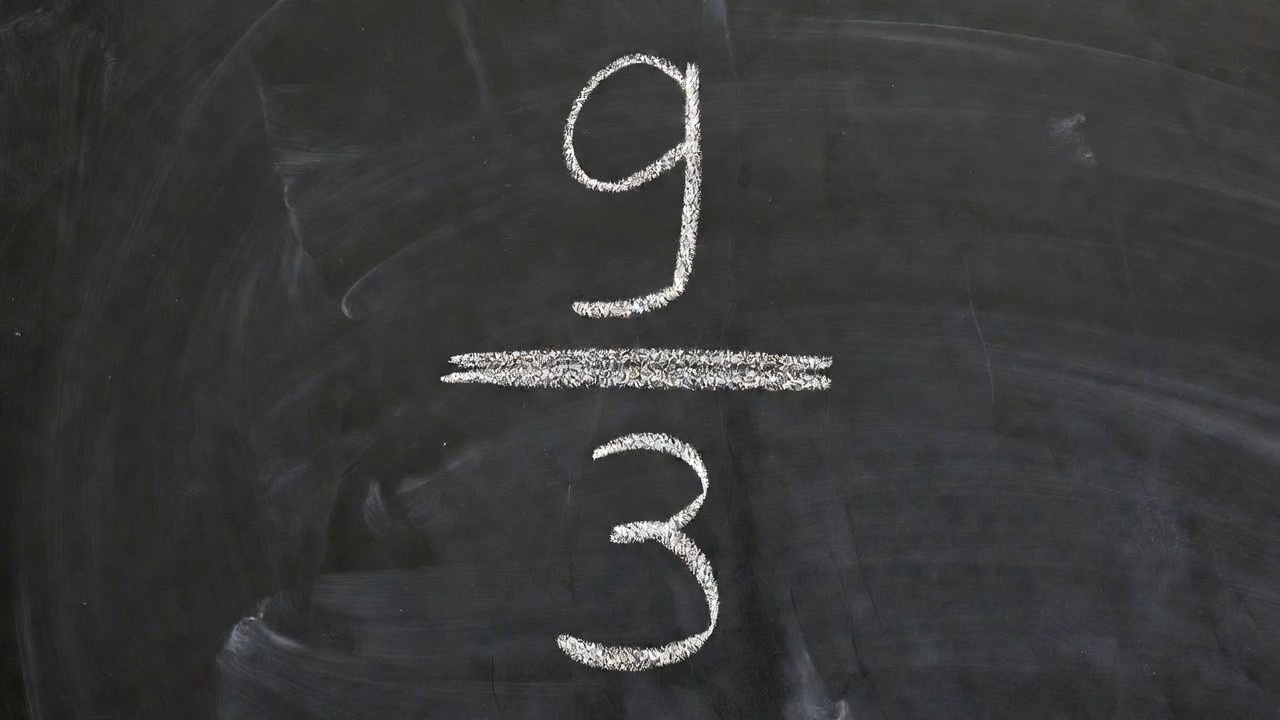
A quotient in math is the result you get when you divide one number by another. In 56 ÷ 7 = 8, the quotient is 8. It tells you how many times the divisor fits into the dividend, or how big each equal group is. The word comes from the Latin quotiens, meaning “how many times,” which is a handy way to remember it.
Below we’ll cover the parts of a division problem, the different ways a quotient can look, how to find one with remainders, decimals, fractions and negatives, how “quotient” shows up in word problems and algebra, and practice problems with answers.
The parts of a division problem
Every division problem has the same cast. Here they are for 47 ÷ 5:
| Term | What it is | In 47 ÷ 5 = 9 R2 |
|---|---|---|
| Dividend | The number being divided | 47 |
| Divisor | The number you divide by | 5 |
| Quotient | The answer | 9 |
| Remainder | What’s left over | 2 |
Division can be written several ways, and the quotient means the same thing in all of them:
- 47 ÷ 5
- 47/5 (a fraction bar is a division sign)
- Long division, with 5 outside the bracket and 47 inside. The quotient goes on top.
Quotient vs sum, difference and product
Kids often mix up the four “answer” words. A small chart on the fridge fixes that faster than anything.
| Operation | Answer is called | Example |
|---|---|---|
| Addition | Sum | 12 + 3 = 15 |
| Subtraction | Difference | 12 – 3 = 9 |
| Multiplication | Product | 12 × 3 = 36 |
| Division | Quotient | 12 ÷ 3 = 4 |
How to find a quotient in math, with worked examples
Example 1: A basic fact
56 ÷ 7
Ask: 7 times what makes 56? 7 × 8 = 56.
Quotient = 8
This is why multiplication facts matter so much. Every division fact is a multiplication fact in reverse.
Example 2: A quotient with a remainder
47 ÷ 5
The largest multiple of 5 that fits in 47 is 45, which is 5 × 9.
47 – 45 = 2 left over
Quotient = 9, remainder = 2, written 9 R2
Check: 5 × 9 + 2 = 45 + 2 = 47
The remainder must always be smaller than the divisor. If a kid gets 8 R7 here, the 7 means another 5 could have fit.
Example 3: The same problem as a decimal or fraction
In later grades, 47 ÷ 5 doesn’t stop at a remainder.
As a mixed number: the remainder 2 goes over the divisor 5, so 9 2/5
As a decimal: 2/5 = 0.4, so 9.4
Check: 5 × 9.4 = 47
9 R2, 9 2/5 and 9.4 are all the same quotient written three ways.
Example 4: Long division
846 ÷ 6
6 goes into 8 once. 8 – 6 = 2. Bring down the 4 to make 24.
6 goes into 24 four times. 24 – 24 = 0. Bring down the 6.
6 goes into 6 once. 6 – 6 = 0.
Quotient = 141
Check: 6 × 141 = 846
Example 5: Partial quotients
Many schools teach this method in grades 4 and 5 before (or instead of) long division. Same problem, 846 ÷ 6:
Take out 100 sixes: 846 – 600 = 246
Take out 40 sixes: 246 – 240 = 6
Take out 1 six: 6 – 6 = 0
Add the partial quotients: 100 + 40 + 1 = 141
If your child’s homework looks nothing like the division you learned, this is probably why. It’s the same math, just in friendlier chunks.
Quotients with fractions and negative numbers
Dividing fractions
To divide by a fraction, multiply by its reciprocal (flip the second fraction).
3/4 ÷ 1/2
= 3/4 × 2/1
= 6/4 = 3/2 = 1 1/2
Notice the quotient is bigger than 3/4. Dividing by a number less than 1 gives a bigger answer, which surprises a lot of kids. It makes sense if you ask “how many halves fit in three quarters?” One and a half of them.
Dividing negative numbers
The sign rules are the same as for multiplication:
- Same signs give a positive quotient: -24 ÷ -6 = 4
- Different signs give a negative quotient: -24 ÷ 6 = -4 and 24 ÷ -6 = -4
Dividing by zero
You can’t. 12 ÷ 0 has no quotient, because no number times 0 gives 12. Math calls it undefined. Zero divided by a number is fine, though: 0 ÷ 12 = 0.
“Quotient” in word problems and algebra
Word problems use the word on purpose, and the order of the numbers is the order of the division.
- “The quotient of 36 and 9” means 36 ÷ 9 = 4.
- “The quotient of a number and 5” means x ÷ 5, usually written x/5.
- “The quotient of a number and 4 is 11” means x/4 = 11, so x = 44.
Real problems also make kids decide what to do with a remainder. Say 30 students need rides and each van holds 8. 30 ÷ 8 = 3 R6. The quotient says 3 full vans, but 6 kids would be left behind, so the real answer is 4 vans. Deciding whether to round up, round down or keep the remainder is a skill of its own.
Common mistakes with quotients
- Reversing the order. Reading “the quotient of 5 and 20” as 20 ÷ 5. It’s 5 ÷ 20 = 0.25.
- A remainder bigger than the divisor. A sign the quotient is too small.
- Dropping a zero in long division. 612 ÷ 6 is 102, not 12. When the divisor doesn’t fit, a 0 goes in the quotient.
- Mixing up quotient and product. Common on vocabulary quizzes. The chart above helps.
- Forgetting to flip the second fraction when dividing fractions, or flipping the first one instead.
Practice problems
- Find the quotient: 72 ÷ 9
- In 45 ÷ 5 = 9, name the dividend, divisor and quotient.
- Find the quotient and remainder: 58 ÷ 6
- Write the quotient of 58 and 8 as a decimal.
- Use long division: 912 ÷ 8
- Find the quotient: -63 ÷ 7
- Find the quotient: 2/3 ÷ 4/9
- The quotient of a number and 4 is 13. What’s the number?
Answers
- 8, because 9 × 8 = 72.
- Dividend 45, divisor 5, quotient 9.
- 9 R4. Check: 6 × 9 + 4 = 54 + 4 = 58.
- 58 ÷ 8 = 7.25. Check: 8 × 7.25 = 58.
- 114. Check: 8 × 114 = 912.
- -9 (different signs give a negative quotient).
- 2/3 × 9/4 = 18/12 = 3/2 = 1 1/2.
- 52, because 52 ÷ 4 = 13.
If your child is stuck on division
When a kid can explain what a quotient in math is but still can’t find one, the gap is almost always underneath division. The usual suspects are multiplication facts (every quotient is a multiplication fact backward), subtraction with regrouping (long division is mostly subtracting), and place value (which is why zeros go missing in answers like 102).
Division is formally taught in grade 3 and long division with bigger numbers in grades 4 to 6, so these gaps can hide for a while. Our list of math skills by grade level shows what should be solid by when. If division time turns into tears, it may be more than a skill gap, and math anxiety in children covers what that looks like. Short, regular practice on facts works better than one long weekend session, as we explain in why 20 minutes a day beats a 90-minute tutoring session.
Frequently asked questions
What does quotient mean for math?
A quotient in math means the answer to a division problem. If you divide 18 by 3, the quotient is 6.
Is the quotient the answer to division or multiplication?
Division. The answer to multiplication is the product.
Does the quotient include the remainder?
In whole-number division, the quotient is the whole-number part and the remainder is listed separately, like 9 R2. If you write the answer as a mixed number or decimal, the leftover becomes part of the quotient: 9 2/5 or 9.4.
Can a quotient be bigger than the dividend?
Yes, when you divide by a number between 0 and 1. For example, 6 ÷ 1/2 = 12, because twelve halves fit in 6.
What is a partial quotient?
It’s one piece of the answer in the partial quotients method. You subtract easy chunks of the divisor (like 100 or 10 groups at a time), then add up all the pieces to get the full quotient.
Find the actual gap
If division homework keeps stalling, it helps to know which piece underneath is weak: facts, regrouping or place value. Math Anon begins with a short adaptive assessment that finds exactly which skills are missing and gives you a written report on what it found.
Your child then works on just those skills for about 20 minutes a day, and you get a progress report every week. Start the assessment for $49. That fee is credited back in full on your first month, and you can compare plans on our pricing page.
Related reading
- Math Skills By Grade Level: What Your Child Should Know
- Is My Child Behind In Math? 12 Signs By Grade Level
- Why 20 Minutes A Day Beats A 90-Minute Tutoring Session
- Math Anxiety In Children: What It Looks Like And What Helps
- What Is A Product In Math? Meaning And Examples
- What Is Difference In Math? Meaning, Methods And Examples





