
What Is A Mixed Number? Converting, Adding And More
The short version
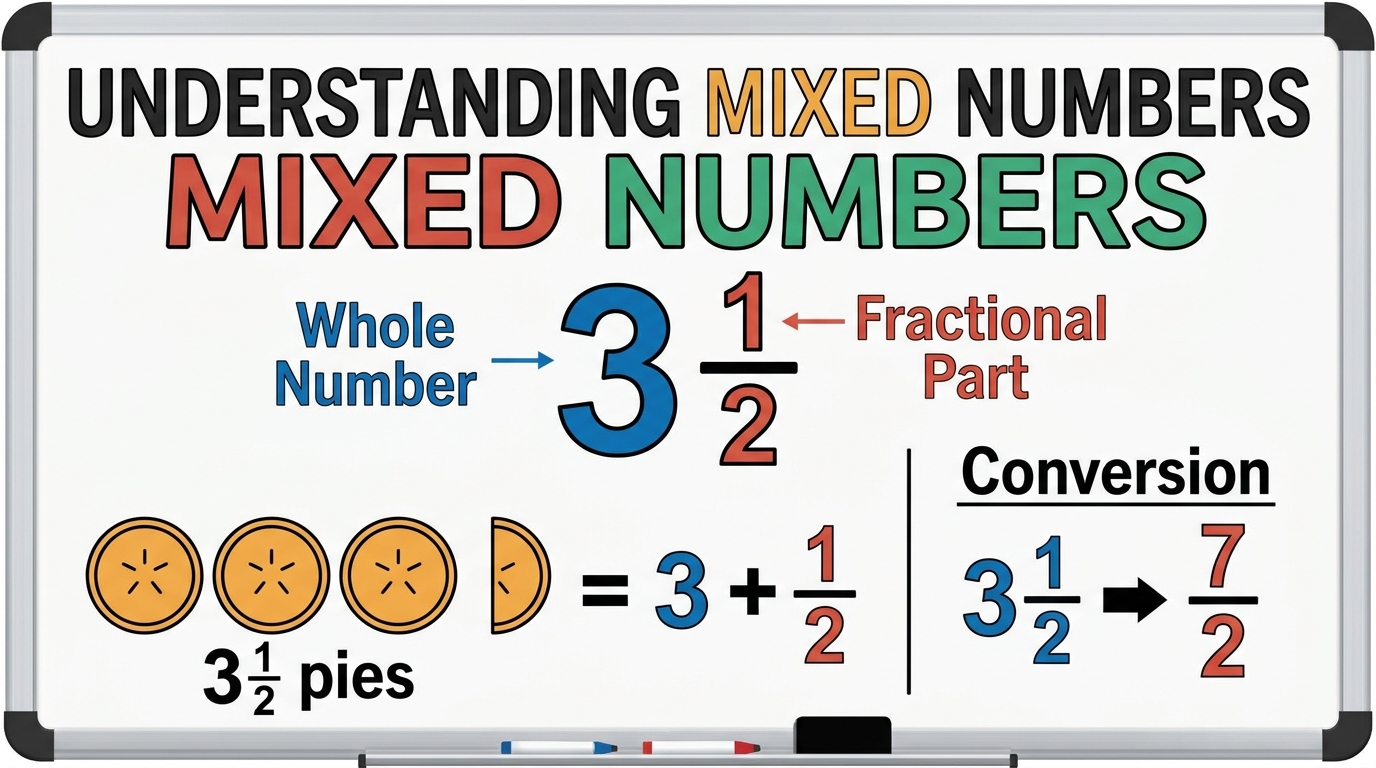
- A mixed number is a whole number and a proper fraction written together, like 3 1/2. It means 3 + 1/2.
- To turn a mixed number into an improper fraction, multiply the whole number by the denominator, add the numerator, and keep the denominator: 3 1/2 = 7/2.
- To go back, divide: 7 ÷ 2 = 3 remainder 1, so 7/2 = 3 1/2.
- Add and subtract mixed numbers in place if you like, but convert to improper fractions before you multiply or divide.
- The fraction part must be less than 1. 2 5/4 isn’t finished; it simplifies to 3 1/4.
A mixed number is a number made of a whole number and a proper fraction, such as 2 3/4, which means 2 + 3/4. It’s a way of writing an amount bigger than 1 that isn’t a whole number, the same way you’d say “two and three-quarter cups” in a recipe.
Every mixed number can also be written as an improper fraction (2 3/4 = 11/4), and switching between the two is the skill most homework is really testing. Below: both conversions with the reasoning behind them, all four operations, where kids go wrong, and practice problems with answers.
What is a mixed number, exactly?
A mixed number has two parts:
- A whole number part, like the 2 in 2 3/4
- A proper fraction part, where the numerator is smaller than the denominator, like the 3/4
Picture two full pizzas plus three slices of a third pizza cut into four slices. That’s 2 3/4 pizzas. Count every slice instead and you get 4 + 4 + 3 = 11 quarter slices, or 11/4. Same food, two ways to write it.
| Type | Example | Value |
|---|---|---|
| Proper fraction | 3/4 | Less than 1 |
| Improper fraction | 11/4 | 1 or more |
| Mixed number | 2 3/4 | More than 1 |
| Whole number | 3 | No fraction part |
On a number line, 2 3/4 sits between 2 and 3, three quarters of the way from 2 toward 3. That picture helps kids check whether an answer makes sense.
How to convert a mixed number (both directions)
Mixed number to improper fraction
The rule: multiply the whole number by the denominator, add the numerator, and put that over the same denominator.
Example: Convert 4 3/8.
4 × 8 = 32 (four wholes contain 32 eighths)
32 + 3 = 35 eighths
4 3/8 = 35/8
The reason it works: each whole holds as many pieces as the denominator says. Four wholes cut into eighths is 32 eighths. Add the 3 extra eighths and you have 35.
Improper fraction to mixed number
The rule: divide the numerator by the denominator. The quotient is the whole number, and the remainder goes over the original denominator.
Example: Convert 17/5.
17 ÷ 5 = 3 remainder 2
17/5 = 3 2/5
Check: 3 × 5 + 2 = 17. Yes.
If the remainder is 0, the answer is a whole number. 20/5 = 4.
Adding and subtracting mixed numbers
Adding
Add the whole numbers, add the fractions, then clean up if the fraction part is 1 or more.
Example: 2 3/4 + 1 2/3
Wholes: 2 + 1 = 3
Fractions need a common denominator of 12: 3/4 = 9/12 and 2/3 = 8/12
9/12 + 8/12 = 17/12 = 1 5/12
Total: 3 + 1 5/12 = 4 5/12
Subtracting (with borrowing)
This is the step that trips up the most kids. If the top fraction is smaller than the one you’re taking away, borrow 1 from the whole number.
Example: 5 1/4 – 2 3/4
You can’t take 3/4 from 1/4, so borrow 1 whole from the 5.
That 1 whole is 4/4, so 5 1/4 becomes 4 + 4/4 + 1/4 = 4 5/4
4 5/4 – 2 3/4 = 2 2/4 = 2 1/2
Kids who learned regrouping with whole numbers (borrowing a ten) already know this move. The difference is that here you borrow a whole, and a whole equals the denominator over itself, which isn’t always 10.
The backup method: convert both to improper fractions. 21/4 – 11/4 = 10/4 = 5/2 = 2 1/2. Same answer, no borrowing.
Multiplying and dividing mixed numbers
For these, always convert to improper fractions first.
Multiply: 2 1/2 × 1 3/5
Convert: 5/2 × 8/5
Multiply across: 40/10 = 4
Here’s why converting matters. A common shortcut is to multiply the wholes (2 × 1 = 2) and the fractions (1/2 × 3/5 = 3/10) and get 2 3/10. That’s wrong, and way too small. Estimation catches it: 2 1/2 is more than 2 and 1 3/5 is more than 1.5, so the answer must be more than 3.
Divide: 3 3/4 ÷ 1 1/4
Convert: 15/4 ÷ 5/4
Flip the second fraction and multiply: 15/4 × 4/5 = 60/20 = 3
Check: 1 1/4 three times is 3 3/4. Yes.
Mixed numbers in real life
Recipes and measurements are where most people use mixed numbers.
Scaling a recipe: A recipe needs 2 1/4 cups of flour and you want to make 1 1/2 batches.
2 1/4 × 1 1/2 = 9/4 × 3/2 = 27/8 = 3 3/8 cups
Cutting wood: A board is 6 feet long and you cut off 2 5/8 feet.
6 = 5 8/8
5 8/8 – 2 5/8 = 3 3/8 feet left
A tape measure is basically a number line of mixed numbers, which is why carpentry problems show up in so many textbooks.
Common mistakes with mixed numbers
- Adding the whole number to the numerator. 3 1/2 becomes 4/2. The whole number has to be multiplied by the denominator first: 3 × 2 + 1 = 7, so 7/2.
- Multiplying parts separately. 2 1/2 × 2 1/2 is not 4 1/4. It’s 5/2 × 5/2 = 25/4 = 6 1/4.
- Subtracting backward. In 5 1/4 – 2 3/4, kids sometimes do 3/4 – 1/4 because it’s easier. Borrow instead.
- Leaving the fraction part too big. 3 7/5 isn’t simplified. 7/5 = 1 2/5, so the answer is 4 2/5.
- Misreading negatives. -2 1/2 means -(2 + 1/2) = -5/2. It doesn’t mean -2 + 1/2.
Practice problems
- Write 23/4 as a mixed number.
- Write 3 2/7 as an improper fraction.
- 1 3/8 + 2 1/8
- 3 1/2 + 2 3/5
- 4 1/3 – 1 2/3
- 1 1/2 × 2 2/3
- 4 1/2 ÷ 1 1/2
- Which is bigger, 2 3/5 or 2 2/3?
Answers
- 23 ÷ 4 = 5 remainder 3, so 5 3/4.
- 3 × 7 + 2 = 23, so 23/7.
- 3 4/8 = 3 1/2.
- Wholes: 5. Fractions: 5/10 + 6/10 = 11/10 = 1 1/10. Total: 6 1/10.
- Borrow: 3 4/3 – 1 2/3 = 2 2/3.
- 3/2 × 8/3 = 24/6 = 4.
- 9/2 × 2/3 = 18/6 = 3.
- 2 2/3. Compare 3/5 = 9/15 with 2/3 = 10/15.
If your kid is stuck on mixed numbers
Mixed numbers are usually a 4th and 5th grade topic, and they depend on a few earlier skills: division with remainders (for converting), multiplication facts, and a solid sense of what a fraction is. A kid who can’t convert 17/5 might be fine on fractions and shaky on division. A kid who can’t subtract 5 1/4 – 2 3/4 may never have really understood that 1 = 4/4.
These gaps matter more than they seem. We explain why fraction trouble keeps showing up years later in Struggling With Algebra? The Real Problem Is Usually Fourth Grade Fractions. To see what’s expected when, check math skills by grade level. And if fractions homework ends in tears most nights, our guide to math anxiety in children covers what helps.
Frequently asked questions
What is an example of a mixed number?
1 1/2, 3 3/4 and 10 2/5 are all mixed numbers. Each has a whole number and a proper fraction.
What’s the difference between a mixed number and an improper fraction?
They can name the same amount written two ways. 2 1/3 is a mixed number, and 7/3 is the same value as an improper fraction. Mixed numbers are easier to picture, while improper fractions are easier to multiply and divide.
Is a mixed number always greater than 1?
A positive mixed number is always greater than 1, because it has at least one whole plus a bit more.
Is 5 a mixed number?
No. 5 is a whole number because it has no fraction part.
Can the fraction part of a mixed number be improper?
No. If you end up with something like 2 5/4, simplify it: 5/4 = 1 1/4, so the answer is 3 1/4.
Find the actual gap
When mixed numbers won’t click, the missing piece is usually older, like division with remainders or knowing that a whole is 4/4, 5/5 or 8/8. Math Anon starts with a short adaptive assessment that finds which of those skills are missing and sends you a written report.
Your kid then practices about 20 minutes a day on exactly those skills, and you get a progress report every week. The assessment costs $49 and is credited back in full on the first month. Start the assessment or see pricing.





