
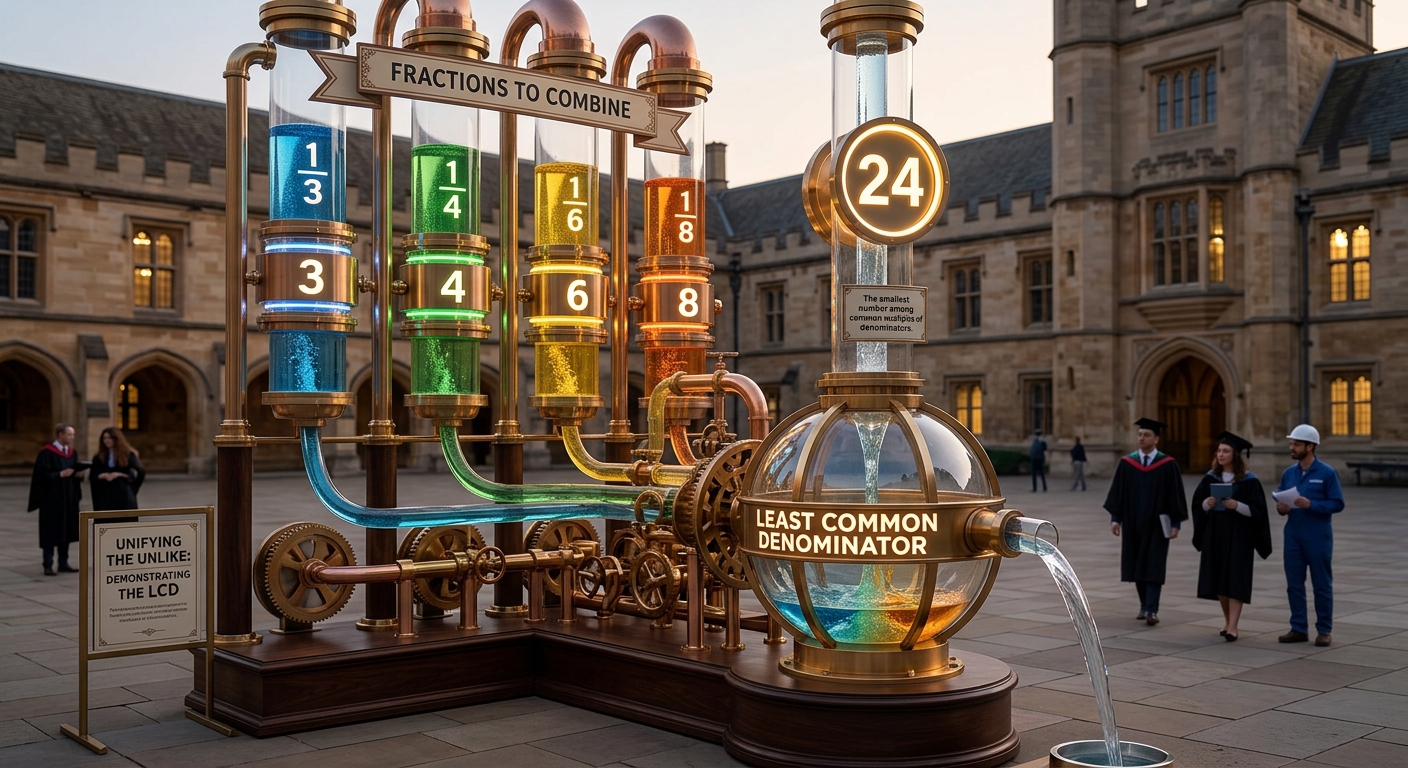
Least Common Denominator (LCD): How To Find It Fast
The short version
- The least common denominator (LCD) is the smallest number that every denominator in your problem divides into evenly. For 1/4 and 1/6, it’s 12.
- It’s the same thing as the least common multiple of the denominators. “Lowest common denominator” means exactly the same thing.
- Fast ways to find it: count up by the biggest denominator until the others divide in, or use prime factorization for big numbers.
- Two shortcuts: if one denominator divides the other (3 and 12), the bigger one is the LCD. If they share no factors (5 and 7), multiply them.
- Once you have the LCD, multiply the top and bottom of each fraction by the same number so every fraction has that denominator. Then add, subtract or compare.
The least common denominator is the smallest number that all the denominators in a set of fractions divide into with no remainder. For 1/4 and 1/6, the least common denominator is 12, because 12 is the first number both 4 and 6 go into. You need it to add, subtract or compare fractions whose bottoms don’t match.
You’ll also see it called the lowest common denominator. Same idea, same answer. Below we’ll cover three ways to find it (including the prime factorization method that makes big numbers easy), how to rewrite the fractions once you have it, worked examples with mixed numbers, and the mistakes that show up most on homework.
What is the least common denominator, and why do you need it?
A denominator tells you the size of the pieces. Fourths are bigger than sixths. You can’t add 1 fourth to 1 sixth and call it “2 somethings,” because the pieces aren’t the same size. That’s like adding 1 foot to 1 inch and saying you have 2.
So you cut both into pieces of the same size first. Twelfths work, because a fourth is exactly 3 twelfths and a sixth is exactly 2 twelfths:
1/4 + 1/6
= 3/12 + 2/12
= 5/12
Lots of numbers would work as a common denominator here: 12, 24, 36, 48. The least one keeps the numbers small, which means less simplifying at the end and fewer chances to slip.
How to find the least common denominator
Method 1: List the multiples
Write out the multiples of each denominator and look for the first match. Good for small numbers.
Denominators 4 and 6:
Multiples of 4: 4, 8, 12, 16, 20, 24
Multiples of 6: 6, 12, 18, 24
LCD = 12
Method 2: Count up by the biggest denominator
This is quicker than writing two lists. Take the largest denominator and go through its multiples, checking whether the smaller denominators divide in.
Denominators 8 and 12:
12 ÷ 8? Doesn’t divide evenly.
24 ÷ 8 = 3. Yes.
LCD = 24
Method 3: Prime factorization
Best for bigger numbers, where listing multiples takes forever. Break each denominator into primes, then take every prime the highest number of times it appears in any one denominator.
Denominators 18 and 24:
18 = 2 × 3 × 3
24 = 2 × 2 × 2 × 3
Most 2s in either one: three (from 24). Most 3s in either one: two (from 18).
LCD = 2 × 2 × 2 × 3 × 3 = 72
Two shortcuts worth knowing
| Situation | Example | LCD |
|---|---|---|
| One denominator divides the other | 3 and 12 | 12 (the bigger one) |
| Denominators share no common factor except 1 | 5 and 7 | 35 (multiply them) |
| They share some factors | 6 and 8 | 24 (smaller than 6 × 8 = 48) |
Rewriting fractions with the LCD
Finding the least common denominator is half the job. Next, turn each fraction into an equivalent one with that denominator. Ask, “What do I multiply this denominator by to get the LCD?” and multiply the numerator by the same number.
5/18 + 7/24, with LCD 72:
72 ÷ 18 = 4, so 5/18 = (5 × 4)/(18 × 4) = 20/72
72 ÷ 24 = 3, so 7/24 = (7 × 3)/(24 × 3) = 21/72
20/72 + 21/72 = 41/72
41 is prime, so 41/72 can’t be simplified. Done.
Multiplying the top and bottom by the same number is really multiplying by 1 (4/4 or 3/3), which is why the value of the fraction doesn’t change.
Worked examples
Example 1: Adding
2/3 + 1/4
3 and 4 share no factors, so LCD = 3 × 4 = 12
2/3 = 8/12 and 1/4 = 3/12
8/12 + 3/12 = 11/12
Example 2: Subtracting
5/6 – 3/8
Count by 8: 8, 16, 24. 24 ÷ 6 = 4, so LCD = 24
5/6 = 20/24 and 3/8 = 9/24
20/24 – 9/24 = 11/24
Example 3: Three fractions
1/2 + 2/3 + 3/4
Count by 4: 4, 8, 12. Both 2 and 3 go into 12, so LCD = 12
6/12 + 8/12 + 9/12 = 23/12 = 1 11/12
Example 4: Mixed numbers with borrowing
3 1/4 – 1 5/6
LCD of 4 and 6 is 12
3 3/12 – 1 10/12
3/12 is smaller than 10/12, so borrow 1 from the 3: 3 3/12 = 2 15/12
2 15/12 – 1 10/12 = 1 5/12
Example 5: Comparing
Which is bigger, 5/8 or 7/12?
LCD of 8 and 12 is 24
5/8 = 15/24 and 7/12 = 14/24
15/24 is bigger, so 5/8 > 7/12
Example 6: The same idea in algebra
3/x + 5/x²
x goes into x², so LCD = x²
3/x = 3x/x²
3x/x² + 5/x² = (3x + 5)/x²
This is why the least common denominator matters long after fifth grade. Adding rational expressions in Algebra 1 and 2 uses the exact same steps.
LCD vs LCM vs GCF
| Term | What it is | For 6 and 8 | Used for |
|---|---|---|---|
| Least common multiple (LCM) | Smallest number both divide into | 24 | Any two whole numbers |
| Least common denominator (LCD) | The LCM of the denominators | 24 | Adding, subtracting, comparing fractions |
| Greatest common factor (GCF) | Biggest number that divides into both | 2 | Simplifying fractions |
The LCD is always at least as big as the largest denominator. The GCF is never bigger than the smallest one. If a kid’s “LCD” comes out smaller than one of the denominators, they found the GCF by mistake.
Common mistakes
- Adding the denominators. A kid who writes 1/4 + 1/6 = 2/10 has added tops and bottoms. The denominator names the piece size; it doesn’t get added.
- Changing only the bottom. Turning 2/3 into 2/12 changes its value. Whatever you multiply the denominator by, the numerator gets multiplied too.
- Using a common denominator that isn’t the least. For 5/6 – 3/8, multiplying 6 × 8 = 48 works, but then 40/48 – 18/48 = 22/48 still has to be simplified to 11/24. Not wrong, just more work and more room for error.
- Mixing up LCD and GCF. Covered above. The LCD can’t be smaller than your biggest denominator.
- Forgetting to borrow with mixed numbers. In 3 1/4 – 1 5/6, subtracting 3/12 – 10/12 as “7/12” gives the wrong answer. Borrow first.
Practice problems
- Find the LCD of 1/3 and 1/5.
- Find the LCD of 3/4 and 5/8.
- Find the LCD of 1/6 and 1/9.
- Add: 3/10 + 1/4
- Subtract: 7/12 – 1/8
- Find the LCD of 1/4, 5/6 and 7/10.
- Add: 2 2/3 + 1 3/5
- Use prime factorization to find the LCD of 5/36 and 7/48, then add them.
Answers
- 15. 3 and 5 share no factors, so 3 × 5 = 15.
- 8. 4 divides into 8.
- 18. Count by 9: 9 isn’t divisible by 6, 18 is.
- 11/20. LCD 20: 6/20 + 5/20 = 11/20.
- 11/24. LCD 24: 14/24 – 3/24 = 11/24.
- 60. Count by 10: 10, 20, 30, 40, 50, 60. 60 is the first one both 4 and 6 divide into.
- 4 4/15. LCD 15: 2 10/15 + 1 9/15 = 3 19/15 = 4 4/15.
- LCD 144. 36 = 2 × 2 × 3 × 3 and 48 = 2 × 2 × 2 × 2 × 3, so LCD = 2 × 2 × 2 × 2 × 3 × 3 = 144. Then 20/144 + 21/144 = 41/144.
If your kid is stuck on the least common denominator
When finding the LCD feels impossible, the real problem is almost never the LCD. It’s usually one of the skills it’s built from: multiplication facts that aren’t automatic (so listing multiples is slow and error-prone), a shaky sense of what equivalent fractions are, or never quite getting why the pieces have to match before you add. Those are third and fourth grade skills, and our grade 3 to 5 skills guide shows where each one lands.
Fraction gaps don’t stay put, either. They come back in algebra as rational expressions and equations with fractions, which we cover in why the real problem is usually fourth grade fractions. Short, steady practice on the missing piece works better than long cram sessions; here’s why 20 minutes a day beats 90.
Frequently asked questions
What is the least common denominator?
It’s the smallest number that every denominator in a group of fractions divides into evenly. For 1/6 and 1/8, it’s 24. It lets you rewrite the fractions with matching denominators so you can add, subtract or compare them.
Is the lowest common denominator the same as the least common denominator?
Yes. “Lowest” and “least” are used interchangeably, and both are abbreviated LCD. You’ll find the same number either way.
What’s the difference between the LCD and the LCM?
The LCM is the least common multiple of any set of whole numbers. The LCD is the LCM of the denominators of some fractions. Same calculation, different context.
How do you find the least common denominator of three fractions?
Count up by the largest denominator until you hit a number all the others divide into. For 1/4, 5/6 and 7/10, count by 10 until you reach 60. For big numbers, prime factorization is faster.
Do you have to use the least common denominator?
No. Any common denominator gives the right answer as long as you simplify at the end. Multiplying the denominators together always works. The LCD just keeps the numbers smaller.
What grade learns the least common denominator?
Kids usually build toward it with equivalent fractions in fourth grade, then use it to add and subtract fractions with unlike denominators in fifth grade. It keeps coming back through middle school and algebra.
Find the actual gap
If fractions have become a nightly fight, the question worth answering is which skill underneath is missing. Math Anon’s short adaptive assessment works that out and gives you a written report on exactly which skills your kid has and which ones they don’t.
Then it builds about 20 minutes of targeted practice a day around those gaps, and you’ll get a progress report each week. The assessment costs $49, credited back in full on your first month. Start the assessment, or check pricing first.





