
Greatest Common Factor (GCF): How To Find It
The short version
- The greatest common factor (GCF) is the biggest number that divides evenly into every number in the group. The GCF of 4 and 6 is 2.
- For small numbers, list all the factors of each number and pick the biggest one they share.
- For bigger numbers, use prime factorization and multiply the primes the numbers have in common, using the lowest power of each.
- If two numbers share no factor except 1, their GCF is 1. That doesn’t mean you made a mistake.
- Kids use the GCF most for simplifying fractions and, later, for factoring in algebra.
The greatest common factor of two or more numbers is the largest number that divides into all of them with no remainder. The GCF of 4 and 6 is 2: the factors of 4 are 1, 2, and 4, the factors of 6 are 1, 2, 3, and 6, and the biggest number on both lists is 2. You’ll also see it called the greatest common divisor (GCD) or highest common factor (HCF). They all mean the same thing.
Factors first: what we’re looking for
A factor of a number divides into it evenly. The factors of 12 are 1, 2, 3, 4, 6, and 12, because 12 ÷ each of those leaves no remainder.
The easiest way to find all of them without missing any is to hunt in pairs. Start at 1 and work up:
1 × 12
2 × 6
3 × 4
(4 × 3 is a repeat, so stop)
Once the pairs start repeating, you’ve found every factor. Kids who skip this pairing habit tend to miss one, and a missed factor is often the answer.
Method 1: List the factors
- Write every factor of each number, using factor pairs.
- Circle the factors that appear on both lists.
- The biggest circled number is the GCF.
Worked example: the GCF of 18 and 24
Factors of 18: 1, 2, 3, 6, 9, 18
Factors of 24: 1, 2, 3, 4, 6, 8, 12, 24
Common factors: 1, 2, 3, 6
GCF of 18 and 24 = 6
A quicker version: list the factors of the smaller number from largest to smallest, and test each one on the bigger number. For 18 and 24, try 18 (no), 9 (no), 6 (yes). Done in three checks.
Method 2: Prime factorization
Listing gets messy with numbers like 60 and 84, which have lots of factors. Prime factorization keeps it tidy.
- Break each number into primes.
- Find the primes that appear in every number.
- For each shared prime, take the lowest power that appears.
- Multiply them.
Worked example: the GCF of 60 and 84
60 = 2 × 2 × 3 × 5 = 2² × 3 × 5
84 = 2 × 2 × 3 × 7 = 2² × 3 × 7
Shared primes: 2² and 3 (5 and 7 each appear in only one number)
GCF = 2² × 3 = 4 × 3 = 12
Check: 60 ÷ 12 = 5 and 84 ÷ 12 = 7. And since 5 and 7 share no factors, we know nothing bigger than 12 would work.
Method 3: Divide and use the remainder
This one is old (it goes back to Euclid) and it’s the fastest for large numbers. It doesn’t need any factoring.
- Divide the bigger number by the smaller one and note the remainder.
- Replace the bigger number with the smaller one, and the smaller one with the remainder.
- Repeat until the remainder is 0. The last divisor you used is the GCF.
Worked example: the GCF of 84 and 120
120 ÷ 84 = 1 remainder 36
84 ÷ 36 = 2 remainder 12
36 ÷ 12 = 3 remainder 0
GCF of 84 and 120 = 12
Many classes skip this method, but it’s a nice one to show an older student who likes shortcuts.
Finding the greatest common factor of three numbers
The GCF has to divide every number in the group, so find a factor that works for all three.
Worked example: the GCF of 12, 18, and 30
12 = 2² × 3
18 = 2 × 3²
30 = 2 × 3 × 5
Primes in all three: 2 and 3. Lowest powers: 2¹ and 3¹.
GCF = 2 × 3 = 6
You can also go in pairs: the GCF of 12 and 18 is 6, and the GCF of 6 and 30 is 6.
What the GCF is actually for
Simplifying fractions
Divide the top and bottom by their GCF and the fraction is fully simplified in one step.
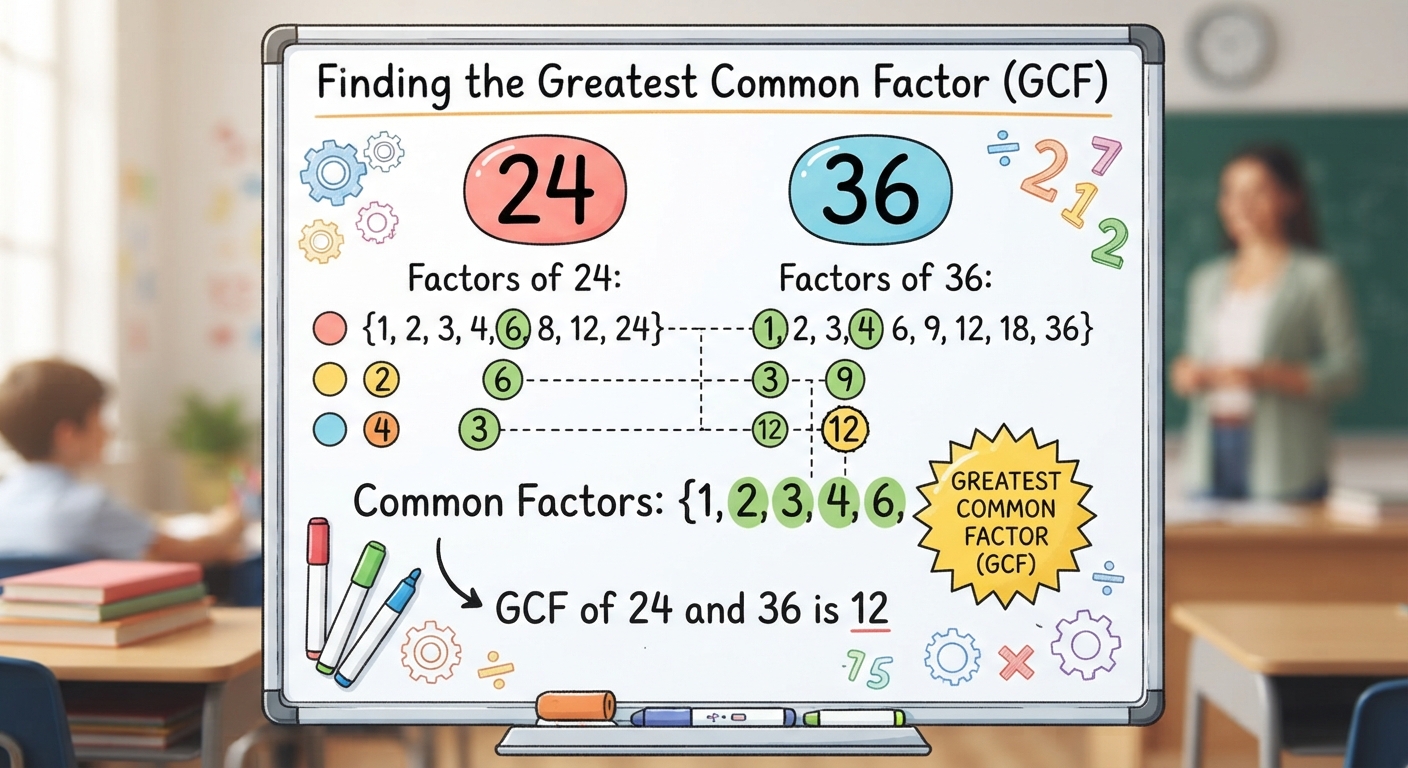
24/36: GCF of 24 and 36 is 12
24 ÷ 12 = 2 and 36 ÷ 12 = 3
24/36 = 2/3
A kid who divides by 2, then 2 again, then 3 gets the same answer, just slower. Using the GCF also means you never stop too early.
Splitting things into equal groups
Say you have 24 cookies and 36 brownies and want to pack identical bags with nothing left over, using as many bags as possible. The GCF of 24 and 36 is 12, so you can make 12 bags, each with 2 cookies and 3 brownies.
Factoring in algebra
Later, the same skill pulls a common factor out of an expression. In 6x + 9, the GCF of 6 and 9 is 3, so 6x + 9 = 3(2x + 3).
Common mistakes with the greatest common factor
- Giving the LCM instead. The GCF can never be bigger than the smallest number in the group. If a kid says the GCF of 4 and 6 is 12, they found the least common multiple.
- Missing a factor. Listing factors of 36 as 1, 2, 3, 4, 9, 12, 36 skips 6 and 18. Using factor pairs prevents this.
- Taking the highest powers in prime factorization. That builds the LCM. The GCF uses only shared primes, at their lowest power.
- Including a prime that isn’t shared. In 60 and 84, the 5 and the 7 don’t belong in the GCF.
- Thinking a GCF of 1 is wrong. 9 and 14 share only the factor 1, so their GCF is 1. Numbers like that are called relatively prime, or coprime.
Practice problems
- What is the greatest common factor of 4 and 6?
- Find the GCF of 8 and 12.
- Find the GCF of 9 and 14.
- Find the GCF of 45 and 75.
- Find the GCF of 48 and 180 using prime factorization.
- Find the GCF of 18, 27, and 45.
- Use the GCF to simplify 42/56.
- A crafter has 30 red beads and 45 blue beads. She wants to make identical bracelets using all the beads. What’s the greatest number of bracelets she can make, and what goes on each one?
Answers
- 2. Factors of 4 are 1, 2, 4. Factors of 6 are 1, 2, 3, 6.
- 4. Factors of 8 are 1, 2, 4, 8, and 4 also divides 12.
- 1. 9 = 3 × 3 and 14 = 2 × 7 share no primes.
- 15. 45 = 3² × 5 and 75 = 3 × 5², so the GCF is 3 × 5 = 15.
- 12. 48 = 2⁴ × 3 and 180 = 2² × 3² × 5, so the GCF is 2² × 3 = 12.
- 9. 18 = 2 × 3², 27 = 3³, 45 = 3² × 5. The only shared prime is 3, lowest power 3², so the GCF is 9.
- 3/4. The GCF of 42 and 56 is 14, and 42 ÷ 14 = 3, 56 ÷ 14 = 4.
- 15 bracelets, each with 2 red and 3 blue beads. The GCF of 30 and 45 is 15.
If your kid is stuck on GCF, check these skills
A child who struggles with the greatest common factor usually doesn’t have a GCF problem. They have a factors problem, and under that, a multiplication and division facts problem. If “what times what makes 36?” takes a long time, every GCF question turns into a slow guessing game. Our breakdown of math skills by grade level shows when those facts and factor pairs are expected to be automatic.
It’s worth fixing now. The GCF is the engine behind simplifying fractions, and shaky fractions are the most common hidden cause of algebra trouble, as we explain in Struggling With Algebra? The Real Problem Is Usually Fourth Grade Fractions. Short daily practice closes this kind of gap faster than a long weekly session, for reasons we cover in Why 20 Minutes A Day Beats A 90-Minute Tutoring Session.
Frequently asked questions
What is the greatest common factor of 4 and 6?
It’s 2. The only factors 4 and 6 share are 1 and 2, and 2 is the bigger one.
Is GCF the same as GCD and HCF?
Yes. Greatest common factor, greatest common divisor, and highest common factor are three names for the same number. Which one your child sees depends on the textbook and the country.
What is the difference between GCF and LCM?
The GCF is the biggest number that divides into both numbers. The LCM is the smallest number both numbers divide into. For 8 and 12, the GCF is 4 and the LCM is 24.
Can the GCF be one of the numbers?
Yes, when the smaller number divides evenly into the bigger one. The GCF of 7 and 21 is 7.
What grade learns greatest common factor?
In most US schools, students find the GCF of two whole numbers in sixth grade, building on factor pairs from fourth grade. It then comes back when they simplify fractions and factor expressions.
Find the actual gap
When GCF questions take forever, the missing piece is often multiplication facts or factor pairs from a couple of grades back. Math Anon’s short adaptive assessment finds exactly which of those earlier skills aren’t solid and hands you a written report.
From there, your child practices about 20 minutes a day on just those skills, and you get a weekly progress report so you can see the gap closing. Start the assessment. It’s $49, and the full amount comes off your first month. See pricing for plan details.





