
Prime Factorization: Factor Trees Made Easy
The short version
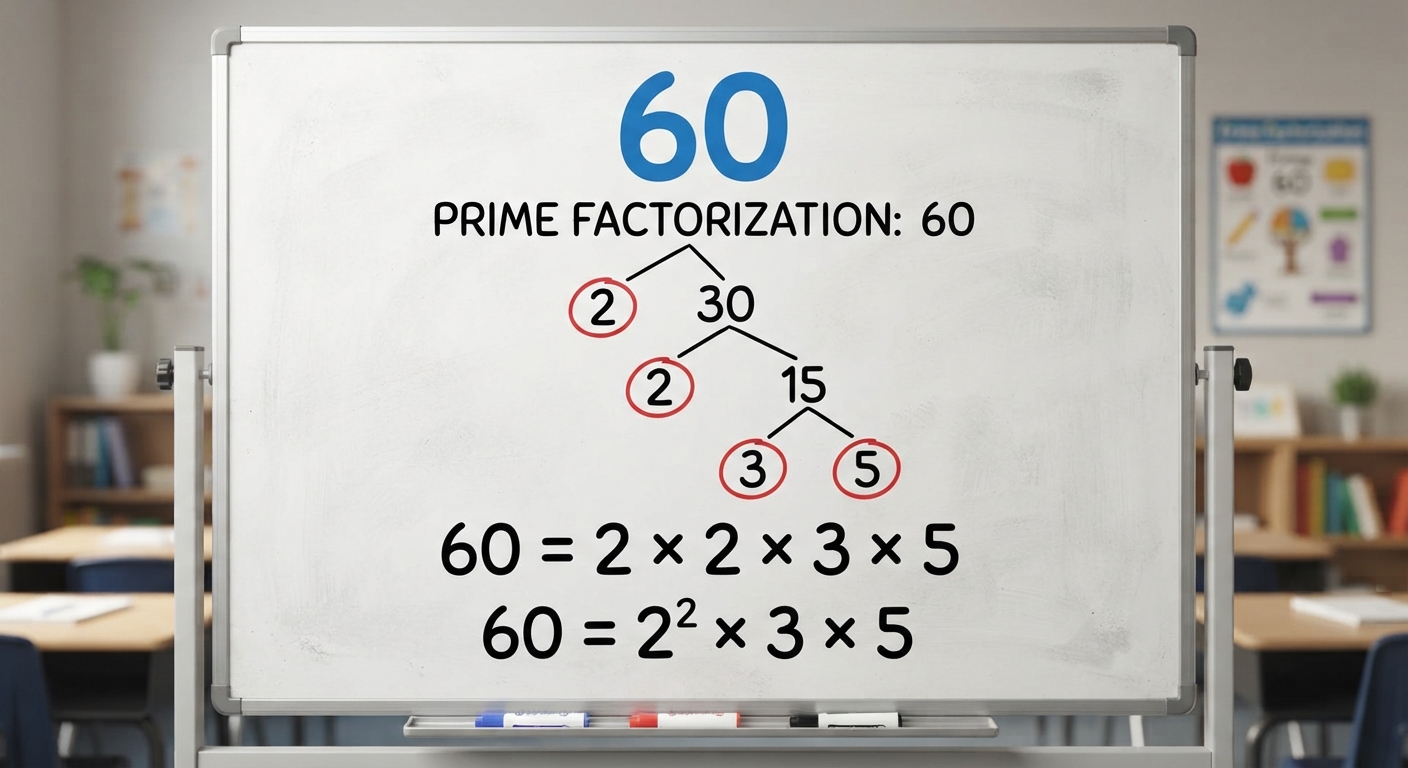
- Prime factorization means writing a number as a product of prime numbers only. For example, 60 = 2 × 2 × 3 × 5, or 2² × 3 × 5.
- Prime factors are the prime numbers that multiply together to make the original number. The prime factors of 60 are 2, 3, and 5.
- Use a factor tree (split the number into any two factors, keep splitting until every branch ends in a prime) or divide by the smallest prime over and over.
- Every whole number above 1 has exactly one prime factorization, so any correct tree gives the same answer.
- It’s the tool behind GCF, LCM, simplifying fractions, and simplifying square roots.
Prime factorization is writing a whole number as a multiplication of prime numbers, and nothing else. The prime factorization of 60 is 2 × 2 × 3 × 5, which is written more compactly as 2² × 3 × 5. You find it by breaking the number apart into smaller factors until every piece is prime.
What are prime factors?
A prime number has exactly two factors: 1 and itself. The first few are 2, 3, 5, 7, 11, 13, 17, 19, 23, and 29. A number with more than two factors, like 12, is called composite.
The prime factors of a number are the primes that divide into it evenly. For 60, those are 2, 3, and 5. When a question says “list the prime factors,” it usually wants each prime once (2, 3, 5). When it says “write the prime factorization,” it wants the full product with repeats (2 × 2 × 3 × 5). That difference trips up plenty of kids on tests.
Two quick facts to settle early. The number 1 isn’t prime, because it only has one factor. And 2 is the only even prime, since every other even number can be divided by 2.
How to do prime factorization with a factor tree
- Write the number at the top.
- Split it into any two factors (other than 1 and itself) and draw two branches.
- Circle any branch that’s prime. It’s finished.
- Keep splitting every branch that isn’t prime.
- When every branch ends in a circled prime, multiply them together in order, using exponents for repeats.
Worked example: 60
60 = 6 × 10
6 = 2 × 3 (both prime, circle them)
10 = 2 × 5 (both prime, circle them)
Circled primes: 2, 3, 2, 5
60 = 2 × 2 × 3 × 5 = 2² × 3 × 5
Now start a different way. 60 = 4 × 15, then 4 = 2 × 2 and 15 = 3 × 5. The circled primes are 2, 2, 3, 5, the exact same set. That’s always true. However you split a number, the primes at the bottom of the tree come out the same. Mathematicians call this the Fundamental Theorem of Arithmetic, and it’s the reason your child’s tree can look different from the teacher’s and still be right.
The division method (the ladder)
Some kids find trees messy. The ladder is tidier and makes it harder to lose a branch.
- Divide the number by the smallest prime that goes in evenly.
- Write the result underneath and repeat with the new number.
- Stop when you reach 1. The primes you divided by are the prime factorization.
Worked example: 180
180 ÷ 2 = 90
90 ÷ 2 = 45
45 ÷ 3 = 15
15 ÷ 3 = 5
5 ÷ 5 = 1
180 = 2 × 2 × 3 × 3 × 5 = 2² × 3² × 5
Always try 2 until it stops working, then 3, then 5, then 7. Going in order means the factors come out already sorted.
Divisibility rules that speed it up
Most of the time spent on prime factorization is testing whether a prime divides in. These rules let you check without doing long division.
| Prime | It divides the number if… | Example |
|---|---|---|
| 2 | The last digit is even | 458 ends in 8 |
| 3 | The digits add up to a multiple of 3 | 471: 4 + 7 + 1 = 12 |
| 5 | The last digit is 0 or 5 | 735 ends in 5 |
| 7 | No easy rule, just divide | 91 ÷ 7 = 13 |
| 11 | Alternating sum of the digits is 0 or a multiple of 11 | 462: 4 – 6 + 2 = 0 |
Worked example: 462
462 is even: 462 ÷ 2 = 231
2 + 3 + 1 = 6, so 3 works: 231 ÷ 3 = 77
77 = 7 × 11
462 = 2 × 3 × 7 × 11
How to tell when a number is prime
The hardest moment in prime factorization is a leftover number like 91 or 97, where you can’t tell if you’re finished. Here’s the rule: you only need to test primes whose square is less than or equal to the number.
For 97: 10 × 10 = 100, which is bigger than 97, so test primes below 10. That’s 2, 3, 5, and 7. None of them divide 97 evenly, so 97 is prime.
For 91: test 2 (no), 3 (9 + 1 = 10, no), 5 (no), 7 (91 ÷ 7 = 13, yes). So 91 = 7 × 13. It looks prime, which is why teachers love putting it on quizzes.
What prime factorization is used for
GCF and LCM in one go
36 = 2² × 3²
60 = 2² × 3 × 5
GCF: shared primes, lowest powers = 2² × 3 = 12
LCM: every prime, highest powers = 2² × 3² × 5 = 180
Spotting perfect squares
A number is a perfect square when every exponent in its prime factorization is even. 144 = 2⁴ × 3², so it’s a perfect square (it’s 12 × 12). 72 = 2³ × 3², and the odd exponent on 2 tells you 72 isn’t one.
Simplifying fractions
Write the top and bottom as primes and cancel matching ones. 30/42 = (2 × 3 × 5)/(2 × 3 × 7) = 5/7.
Common mistakes with prime factorization
- Stopping at a composite number. Writing 60 = 2 × 2 × 15 leaves 15 unbroken. Every branch has to end in a prime.
- Including 1. 1 isn’t prime, so it never goes in a prime factorization.
- Losing a factor in the tree. Kids circle a prime on one branch and forget to copy it into the final answer. Multiply the answer back out to check: 2² × 3 × 5 = 4 × 3 × 5 = 60.
- Calling 9, 15, 21, 27, or 51 prime. They’re all odd, so they feel prime, but each one is divisible by 3.
- Mixing up “prime factors” and “prime factorization.” The prime factors of 72 are 2 and 3. The prime factorization of 72 is 2³ × 3².
Practice problems
- Find the prime factorization of 12.
- Find the prime factorization of 45.
- Find the prime factorization of 72.
- Find the prime factorization of 100.
- Find the prime factorization of 210.
- Is 91 prime? If not, factor it.
- Is 113 prime? Which primes do you need to test?
- Find the prime factorization of 504.
Answers
- 12 = 2² × 3
- 45 = 3² × 5
- 72 = 2³ × 3²
- 100 = 2² × 5²
- 210 = 2 × 3 × 5 × 7
- Not prime. 91 = 7 × 13.
- Yes, 113 is prime. Since 11 × 11 = 121 is bigger than 113, you only test 2, 3, 5, and 7, and none of them divide evenly.
- 504 = 2³ × 3² × 7 (504 ÷ 2 = 252, ÷ 2 = 126, ÷ 2 = 63, ÷ 3 = 21, ÷ 3 = 7)
If your kid is stuck, the gap is usually earlier
Prime factorization is a division workout. A kid who can’t quickly see that 63 = 7 × 9 will stall on every tree, and after a few minutes it feels like the whole topic is impossible. Usually the real gap is multiplication and division facts that never became automatic, the skills we list in Math Skills By Grade Level.
A second common gap is not knowing the small primes by sight. If 2, 3, 5, 7, 11, and 13 aren’t familiar, kids don’t know which numbers to try. That’s easy to fix with a little daily practice, which works better than a long cram session.
If factoring trouble is showing up next to other signs, like slow fraction work or dread before math homework, our list of signs your child is behind in math can help you see whether it’s one topic or something bigger. And if the dread is the bigger issue, read Math Anxiety In Children: What It Looks Like And What Helps.
Frequently asked questions
What are prime factors?
Prime factors are the prime numbers that divide a number evenly and multiply together to build it. The prime factors of 30 are 2, 3, and 5, because 2 × 3 × 5 = 30.
Does it matter how you start a factor tree?
No. Any starting pair gives the same primes at the end. A number has only one prime factorization, apart from the order you write the primes in.
What is the prime factorization of a prime number?
Just the number itself. The prime factorization of 17 is 17.
Why isn’t 1 a prime number?
A prime has exactly two different factors. 1 has only one. Leaving 1 out also keeps prime factorization unique; otherwise you could tack on as many 1s as you liked.
What grade learns prime factorization?
Students meet prime and composite numbers in fourth grade in most US schools. Full prime factorization with factor trees usually shows up around fifth or sixth grade, right before GCF and LCM.
Find the actual gap
When factor trees keep falling apart, it’s rarely about the tree. Math Anon begins with a short adaptive assessment that finds which earlier skills are missing, such as multiplication facts or divisibility, and gives you a written report of the results.
Then your child gets roughly 20 minutes a day of practice built around those gaps, with a progress report landing every week. Start the assessment for $49, credited in full toward your first month. Full plan details are on our pricing page.





