
Least Common Multiple (LCM): 3 Ways To Find It
The short version
- The least common multiple (LCM) of two numbers is the smallest number both of them divide into evenly. The LCM of 3 and 9 is 9, and the LCM of 4 and 6 is 12.
- For small numbers, list the multiples of each and stop at the first one they share.
- For bigger numbers, use prime factorization: take every prime that shows up, at its highest power, and multiply.
- Already know the greatest common factor? Multiply the two numbers and divide by the GCF. That’s the LCM.
- Kids mostly need the LCM for adding and subtracting fractions, where it becomes the least common denominator.
The least common multiple of two or more numbers is the smallest positive number that every one of them divides into with no remainder. For 3 and 9, the answer is 9, because 9 is a multiple of 3 (3 × 3) and of 9 (9 × 1), and nothing smaller works for both. People shorten it to LCM, and some textbooks call it the lowest common multiple.
What a multiple is (and why “least” matters)
A multiple of a number is what you get when you multiply it by 1, 2, 3, 4, and so on. The multiples of 6 are 6, 12, 18, 24, 30, 36, and they go on forever.
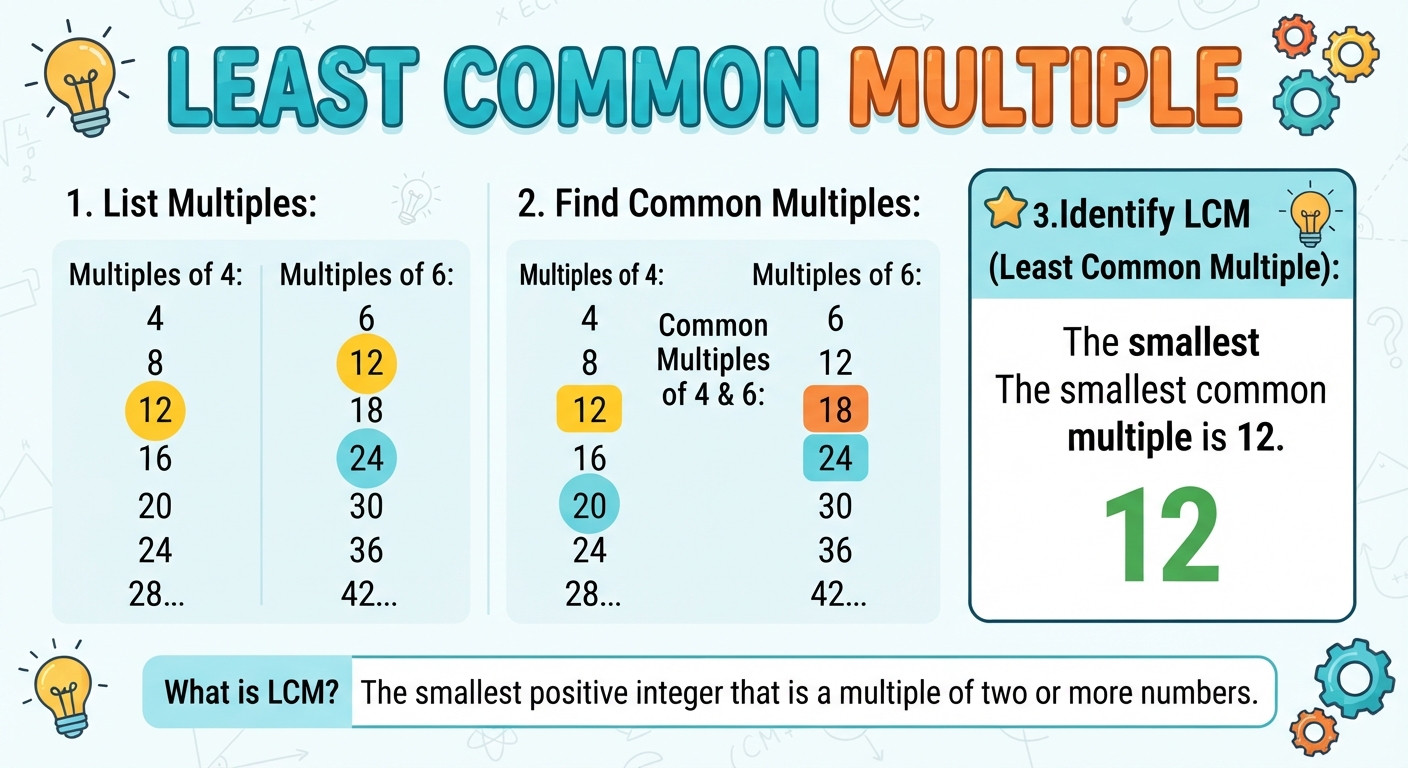
A common multiple is a number that shows up on two lists. The multiples of 4 are 4, 8, 12, 16, 20, 24. The multiples of 6 are 6, 12, 18, 24. Both lists contain 12 and 24, and they’ll keep sharing numbers (36, 48, 60…) forever. There’s no greatest common multiple, since you can always go higher. That’s why the question is always about the least one. Here it’s 12.
Method 1: List the multiples
This is the method most kids learn first, and for small numbers it’s the quickest.
- Write the first several multiples of the larger number (its list climbs faster).
- Check each one, in order, to see if the smaller number divides into it.
- The first one that works is the LCM.
Worked example: the LCM of 6 and 8
Multiples of 8: 8, 16, 24, 32…
Does 6 go into 8? No. Into 16? No. Into 24? Yes, 6 × 4 = 24.
LCM of 6 and 8 = 24
Worked example: the LCM of 3 and 9
Multiples of 9: 9, 18, 27…
Does 3 go into 9? Yes, 3 × 3 = 9.
LCM of 3 and 9 = 9
That second one catches a lot of kids. When one number divides evenly into the other, the bigger number is the LCM. You don’t have to multiply them together. The LCM of 5 and 20 is 20, and the LCM of 7 and 21 is 21.
Method 2: Prime factorization
Listing gets slow once the numbers pass about 20. Prime factorization works for any size.
- Break each number into prime factors. Write repeated primes as powers.
- Make a list of every prime that appears in any of the numbers.
- For each prime, keep the highest power you see.
- Multiply those together.
Worked example: the LCM of 12 and 18
12 = 2 × 2 × 3 = 2² × 3
18 = 2 × 3 × 3 = 2 × 3²
Primes that appear: 2 and 3
Highest power of 2: 2² (from 12). Highest power of 3: 3² (from 18).
LCM = 2² × 3² = 4 × 9 = 36
Check it: 36 ÷ 12 = 3 and 36 ÷ 18 = 2. Both divide evenly, so 36 works.
Worked example: the LCM of 20 and 45
20 = 2² × 5
45 = 3² × 5
Take 2², 3², and 5.
LCM = 4 × 9 × 5 = 180
Method 3: The GCF shortcut
If your child already knows how to find the greatest common factor, this is the fastest way for two numbers:
LCM = (first number × second number) ÷ GCF
Worked example: the LCM of 16 and 40
GCF of 16 and 40 = 8
16 × 40 = 640
640 ÷ 8 = 80
LCM of 16 and 40 = 80
Check: 80 ÷ 16 = 5 and 80 ÷ 40 = 2.
A small trick makes the arithmetic easier: divide first, then multiply. 16 ÷ 8 = 2, and 2 × 40 = 80. Same answer, smaller numbers.
One warning. This shortcut only works for two numbers at a time. For three numbers, use prime factorization or do it in pairs.
Finding the least common multiple of three numbers
Prime factorization handles three numbers the same way it handles two.
Worked example: the LCM of 6, 10, and 15
6 = 2 × 3
10 = 2 × 5
15 = 3 × 5
Take 2, 3, and 5, each to the first power.
LCM = 2 × 3 × 5 = 30
You can also go in pairs. Find the LCM of the first two, then find the LCM of that answer and the third number. LCM of 6 and 10 is 30. LCM of 30 and 15 is 30. Same result.
Which method should your kid use?
| Situation | Best method | Example |
|---|---|---|
| Both numbers under about 15 | List multiples of the bigger one | 4 and 6 gives 12 |
| One number divides the other | The bigger number is the LCM | 3 and 9 gives 9 |
| No shared factors at all | Multiply them | 7 and 11 gives 77 |
| Larger numbers, GCF is easy to spot | Product ÷ GCF | 16 and 40 gives 80 |
| Larger numbers or three or more | Prime factorization | 6, 10, 15 gives 30 |
Where kids actually use the LCM
The big one is fractions. To add 5/6 + 3/8, you need a common denominator, and the smallest one is the LCM of 6 and 8.
LCM of 6 and 8 = 24
5/6 = 20/24 (multiply top and bottom by 4)
3/8 = 9/24 (multiply top and bottom by 3)
20/24 + 9/24 = 29/24 = 1 5/24
Any common denominator would work, including 48. But the LCM keeps the numbers small and usually saves a simplifying step at the end.
It also shows up in “when will these line up again” word problems. If one bus leaves every 12 minutes and another every 18 minutes, and both leave at 8:00, they’ll next leave together 36 minutes later, at 8:36, because the LCM of 12 and 18 is 36.
Common mistakes with the least common multiple
- Multiplying the two numbers every time. 6 × 8 = 48 is a common multiple of 6 and 8, but the least one is 24. Multiplying only gives the LCM when the numbers share no factors.
- Mixing up LCM and GCF. The LCM is at least as big as the larger number. The GCF is at most as big as the smaller number. If a kid says the LCM of 12 and 18 is 6, they’ve found the GCF.
- Taking the lowest powers in prime factorization. That gives the GCF. For the LCM, you want the highest power of each prime.
- Dropping a prime that only shows up once. For 20 and 45, the 2² only comes from 20 and the 3² only comes from 45. Both belong in the LCM.
- Using the GCF shortcut on three numbers. 6 × 10 × 15 = 900, and the GCF of all three is 1, but the LCM is 30. The formula breaks past two numbers.
Practice problems
- What is the least common multiple of 3 and 9?
- Find the LCM of 4 and 6.
- Find the LCM of 7 and 11.
- Find the LCM of 8 and 12.
- Find the LCM of 15 and 20.
- Find the LCM of 18 and 24 using prime factorization.
- Find the LCM of 4, 6, and 10.
- Hot dogs come 10 to a pack and buns come 8 to a pack. What’s the smallest number of each you can buy to have no extras? How many packs of each is that?
Answers
- 9. Since 3 divides into 9, the bigger number is the LCM.
- 12. Multiples of 6 are 6, 12, and 4 goes into 12.
- 77. They share no factors, so multiply: 7 × 11 = 77.
- 24. Multiples of 12 are 12, 24, and 8 goes into 24 (but not 12).
- 60. Multiples of 20 are 20, 40, 60, and 15 goes into 60.
- 72. 18 = 2 × 3² and 24 = 2³ × 3, so the LCM is 2³ × 3² = 8 × 9 = 72.
- 60. 4 = 2², 6 = 2 × 3, 10 = 2 × 5, so the LCM is 2² × 3 × 5 = 60.
- 40 of each. The LCM of 10 and 8 is 40, so that’s 4 packs of hot dogs and 5 packs of buns.
If your kid is stuck on LCM, look one step back
Finding a least common multiple is mostly a test of multiplication facts in disguise. A kid who has to count up on their fingers to find multiples of 7 will find LCM slow and error prone, and the frustration looks like “I don’t get LCM” when the real issue is facts that were never automatic. Our guide to math skills by grade level shows where those facts are supposed to be solid.
The other common gap is factors and divisibility. Prime factorization only goes smoothly if a kid can quickly tell that 45 splits into 9 × 5. If that part is shaky, the whole method feels like guesswork.
This matters because LCM feeds straight into fractions, and fractions feed straight into algebra. We wrote about that chain in Struggling With Algebra? The Real Problem Is Usually Fourth Grade Fractions. If you’re seeing trouble in more than one topic, these signs by grade level can help you sort out how far back it goes.
Frequently asked questions
What is the least common multiple of 3 and 9?
It’s 9. Because 9 is a multiple of 3, it’s the smallest number both 3 and 9 divide into evenly.
What is the difference between LCM and GCF?
The LCM is the smallest number both numbers divide into. The GCF is the biggest number that divides into both. For 12 and 18, the LCM is 36 and the GCF is 6. A handy check: the LCM times the GCF equals the two numbers multiplied, and 36 × 6 = 216 = 12 × 18.
Is the LCM the same as the least common denominator?
Almost. The least common denominator of two fractions is the LCM of their denominators. So the LCD of 1/4 and 1/6 is 12, because the LCM of 4 and 6 is 12.
Can the LCM be one of the numbers?
Yes. Whenever the smaller number divides evenly into the larger one, the larger number is the LCM. The LCM of 4 and 12 is 12.
What is the LCM of two prime numbers?
Their product. Two different primes share no factors, so the LCM of 5 and 13 is 65.
Find the actual gap
If LCM keeps going sideways, the fix usually sits a grade or two earlier, in multiplication facts or factoring. Math Anon starts with a short adaptive assessment that pinpoints which skills are missing and gives you a written report on what it found.
After that, your child gets about 20 minutes a day of practice aimed at those exact gaps, and you get a progress report every week. Start the assessment for $49, which is credited back in full on your first month. Plans are on the pricing page.





