
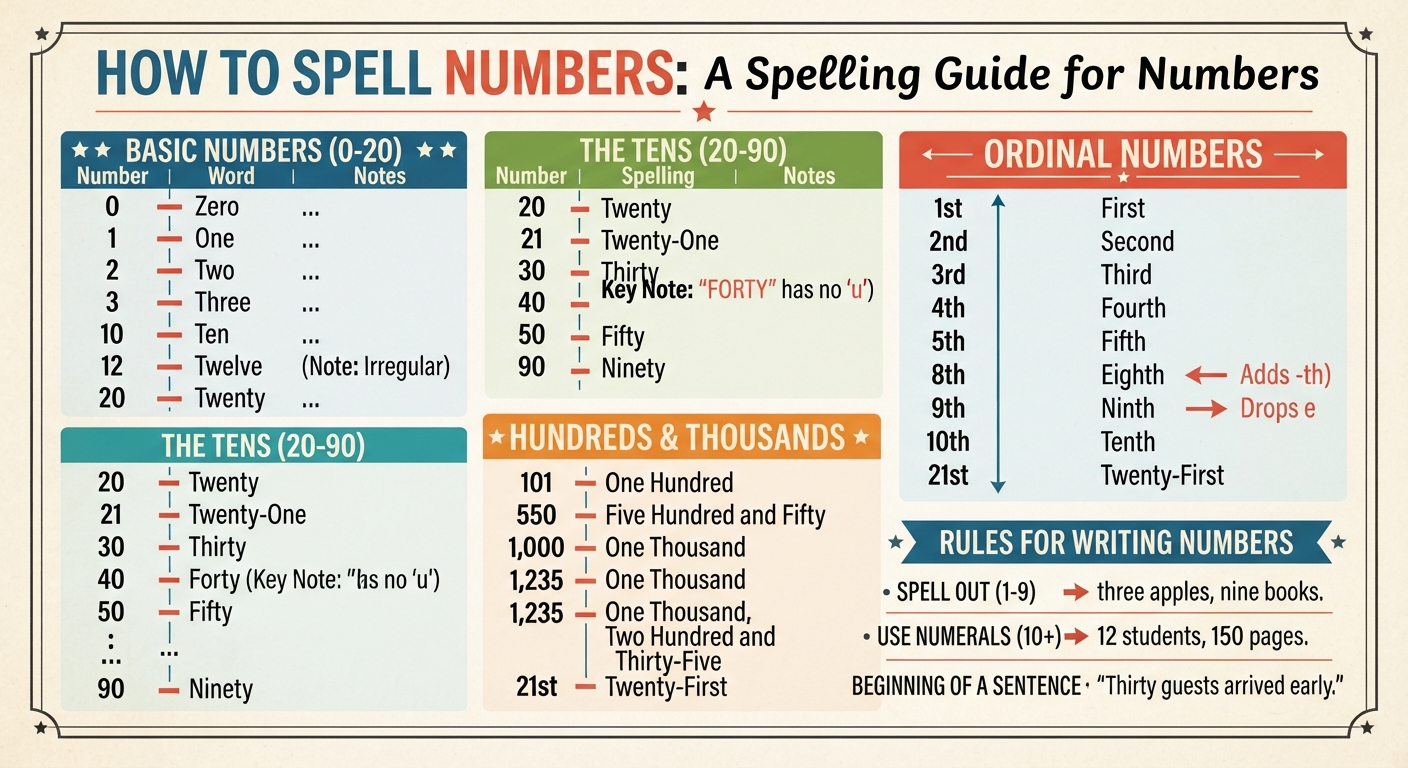
How To Spell Numbers 1 To 100 (With Full Chart)
The short version
- Numbers 1 to 20 each have their own word and have to be memorized. Watch fourteen, fifteen, and eighteen (one t).
- The tens are twenty, thirty, forty, fifty, sixty, seventy, eighty, ninety. Forty has no u. Ninety keeps the e.
- For 21 to 99, write the tens word, a hyphen, then the ones word: twenty-one, forty-seven, ninety-nine.
- 100 is one hundred. Above that, only the part from 21 to 99 gets a hyphen: 345 is three hundred forty-five.
Here’s how to spell numbers from 1 to 100: memorize the words for 1 to 20 and the eight tens words (twenty through ninety), then build every other number by joining a tens word and a ones word with a hyphen, like thirty-six or eighty-two. 100 is written one hundred. A full chart of all 100 spellings is below.
After the chart we cover the spellings kids miss most, how to write bigger numbers like 418 and 1,965 in words, ordinal words like “twelfth,” and when to use words instead of digits. There’s a short practice set with answers at the end.
Number words from 1 to 20
There’s no pattern to lean on for the first twenty. Each word has to be learned by heart, though the teens get easier once you notice most are a ones word plus “teen.”
| Number | Word | Number | Word |
|---|---|---|---|
| 1 | one | 11 | eleven |
| 2 | two | 12 | twelve |
| 3 | three | 13 | thirteen |
| 4 | four | 14 | fourteen |
| 5 | five | 15 | fifteen |
| 6 | six | 16 | sixteen |
| 7 | seven | 17 | seventeen |
| 8 | eight | 18 | eighteen |
| 9 | nine | 19 | nineteen |
| 10 | ten | 20 | twenty |
The odd ones out: eleven and twelve don’t end in “teen” at all. Thirteen and fifteen change their first part (thir, fif instead of three, five). Eighteen has only one t, because “eight” already ends in t. Fourteen keeps the u from “four,” which matters later because forty drops it.
How to spell numbers from 21 to 99
Every number from 21 to 99 that isn’t a multiple of ten follows one pattern:
tens word + hyphen + ones word
So you only need the tens words:
| Number | Word | Watch out for |
|---|---|---|
| 20 | twenty | Starts with tw, like two |
| 30 | thirty | Same “thir” as thirteen |
| 40 | forty | No u, even though four and fourteen have one |
| 50 | fifty | Same “fif” as fifteen |
| 60 | sixty | Regular |
| 70 | seventy | Regular |
| 80 | eighty | One t |
| 90 | ninety | Keeps the e from nine |
Worked examples
73: the tens part is 70, seventy. The ones part is 3, three.
Join with a hyphen: seventy-three.
44: forty, then four. forty-four. Notice the u shows up in the second part only.
98: ninety, then eight. ninety-eight.
The hyphen here is part of the correct spelling. “Twenty one” without the hyphen is a common error on school worksheets.
Number spelling chart: 1 to 100
Every number from 1 to 100, spelled out. Print it or keep it open while your child does homework.
| Number | Word | Number | Word |
|---|---|---|---|
| 1 | one | 51 | fifty-one |
| 2 | two | 52 | fifty-two |
| 3 | three | 53 | fifty-three |
| 4 | four | 54 | fifty-four |
| 5 | five | 55 | fifty-five |
| 6 | six | 56 | fifty-six |
| 7 | seven | 57 | fifty-seven |
| 8 | eight | 58 | fifty-eight |
| 9 | nine | 59 | fifty-nine |
| 10 | ten | 60 | sixty |
| 11 | eleven | 61 | sixty-one |
| 12 | twelve | 62 | sixty-two |
| 13 | thirteen | 63 | sixty-three |
| 14 | fourteen | 64 | sixty-four |
| 15 | fifteen | 65 | sixty-five |
| 16 | sixteen | 66 | sixty-six |
| 17 | seventeen | 67 | sixty-seven |
| 18 | eighteen | 68 | sixty-eight |
| 19 | nineteen | 69 | sixty-nine |
| 20 | twenty | 70 | seventy |
| 21 | twenty-one | 71 | seventy-one |
| 22 | twenty-two | 72 | seventy-two |
| 23 | twenty-three | 73 | seventy-three |
| 24 | twenty-four | 74 | seventy-four |
| 25 | twenty-five | 75 | seventy-five |
| 26 | twenty-six | 76 | seventy-six |
| 27 | twenty-seven | 77 | seventy-seven |
| 28 | twenty-eight | 78 | seventy-eight |
| 29 | twenty-nine | 79 | seventy-nine |
| 30 | thirty | 80 | eighty |
| 31 | thirty-one | 81 | eighty-one |
| 32 | thirty-two | 82 | eighty-two |
| 33 | thirty-three | 83 | eighty-three |
| 34 | thirty-four | 84 | eighty-four |
| 35 | thirty-five | 85 | eighty-five |
| 36 | thirty-six | 86 | eighty-six |
| 37 | thirty-seven | 87 | eighty-seven |
| 38 | thirty-eight | 88 | eighty-eight |
| 39 | thirty-nine | 89 | eighty-nine |
| 40 | forty | 90 | ninety |
| 41 | forty-one | 91 | ninety-one |
| 42 | forty-two | 92 | ninety-two |
| 43 | forty-three | 93 | ninety-three |
| 44 | forty-four | 94 | ninety-four |
| 45 | forty-five | 95 | ninety-five |
| 46 | forty-six | 96 | ninety-six |
| 47 | forty-seven | 97 | ninety-seven |
| 48 | forty-eight | 98 | ninety-eight |
| 49 | forty-nine | 99 | ninety-nine |
| 50 | fifty | 100 | one hundred |
How to spell numbers over 100
Once you know how to spell numbers up to 99, bigger numbers are just chunks, and each chunk uses the rules above.
- Say the hundreds: 4 hundreds is “four hundred.”
- Spell the last two digits as a normal 1 to 99 number.
- For thousands, spell the thousands part first, then the word “thousand,” then the rest.
418 = four hundred + eighteen = four hundred eighteen
345 = three hundred + forty-five = three hundred forty-five
1,965 = one thousand + nine hundred + sixty-five = one thousand nine hundred sixty-five
5,008 = five thousand + eight = five thousand eight
Only the part between 21 and 99 gets a hyphen. There’s no hyphen after “hundred” or “thousand,” and no commas inside the words.
About “and”: in American math class, “and” is saved for the decimal point, so 101 is “one hundred one” and 3.5 is “three and five tenths.” British English normally says “one hundred and one.” Both are correct in their own setting, but if your child’s teacher uses the American rule, “and” in 101 will get marked.
Ordinal number words
Ordinals give position: first, second, third. Most just add “th,” but a handful change spelling.
| Number | Ordinal | Number | Ordinal |
|---|---|---|---|
| 1st | first | 9th | ninth (no e) |
| 2nd | second | 12th | twelfth (f, not v) |
| 3rd | third | 20th | twentieth (y becomes ie) |
| 5th | fifth | 21st | twenty-first |
| 8th | eighth (one t) | 100th | one hundredth |
Common number spelling mistakes
- fourty for forty. The single most common one.
- ninty for ninety, and nineth for ninth. Ninety keeps the e; ninth drops it.
- eightteen or eightty. Eighteen and eighty each have one t.
- twelth for twelfth. The f stays.
- fiveteen or fivety, from following the pattern too literally.
- Missing hyphens in twenty-one to ninety-nine, or extra hyphens like “one-hundred.”
Practice problems
1. Spell 14.
2. Spell 40.
3. Spell 58.
4. Spell 99.
5. Spell 112.
6. Spell 360.
7. Write “six hundred seven” as a numeral.
8. Spell 2,019.
Answers
1. fourteen
2. forty
3. fifty-eight
4. ninety-nine
5. one hundred twelve
6. three hundred sixty
7. 607. The 0 holds the tens place because there are no tens.
8. two thousand nineteen
If your child keeps mixing up number words
Spelling mistakes like “fourty” are just spelling and fade with practice. The ones to pay attention to are mistakes that show a place value gap, and problem 7 is the classic test. A kid who writes “six hundred seven” as 6007 or 67 is writing what they hear, piece by piece, without knowing how the places fit together.
That same gap shows up later as trouble lining up numbers to add, reading big numbers, and handling decimals. Reading and writing numbers in words and digits is usually a second grade skill for numbers up to 1,000, and it keeps growing through fourth grade. Our guide to math skills by grade level shows where it fits, and Is My Child Behind In Math? lists other early warning signs. A few minutes of number writing on most days does more than a long session once a week, as we explain in Why 20 Minutes A Day Beats A 90-Minute Tutoring Session.
Frequently asked questions
How do you spell 14?
Fourteen. It keeps the u from “four,” unlike forty.
Is it forty or fourty?
Forty. It’s the most commonly misspelled number word, and the u only belongs in four and fourteen.
Do you hyphenate numbers like twenty-one?
Yes. Compound numbers from twenty-one to ninety-nine always take a hyphen, including when they’re part of a bigger number, like three hundred twenty-one.
How do you spell 100?
One hundred, as two words with no hyphen. “A hundred” is fine in casual writing.
When should you write numbers as words instead of digits?
It depends on the style guide. Many school and book styles spell out whole numbers from zero to one hundred, while news style usually spells out only one through nine. Every style spells out a number that starts a sentence.
Find the actual gap
If number words are just a spelling problem, a chart and some practice will handle it. If your child also struggles to write the numeral for a number they hear, that’s place value, and it’s worth checking properly. Math Anon’s short adaptive assessment does exactly that and gives you a written report showing which skills are missing.
Your child then practices the missing skills for about 20 minutes a day, and you get a progress report every week. The assessment is $49, fully credited back on your first month. Start the assessment or see pricing.





