
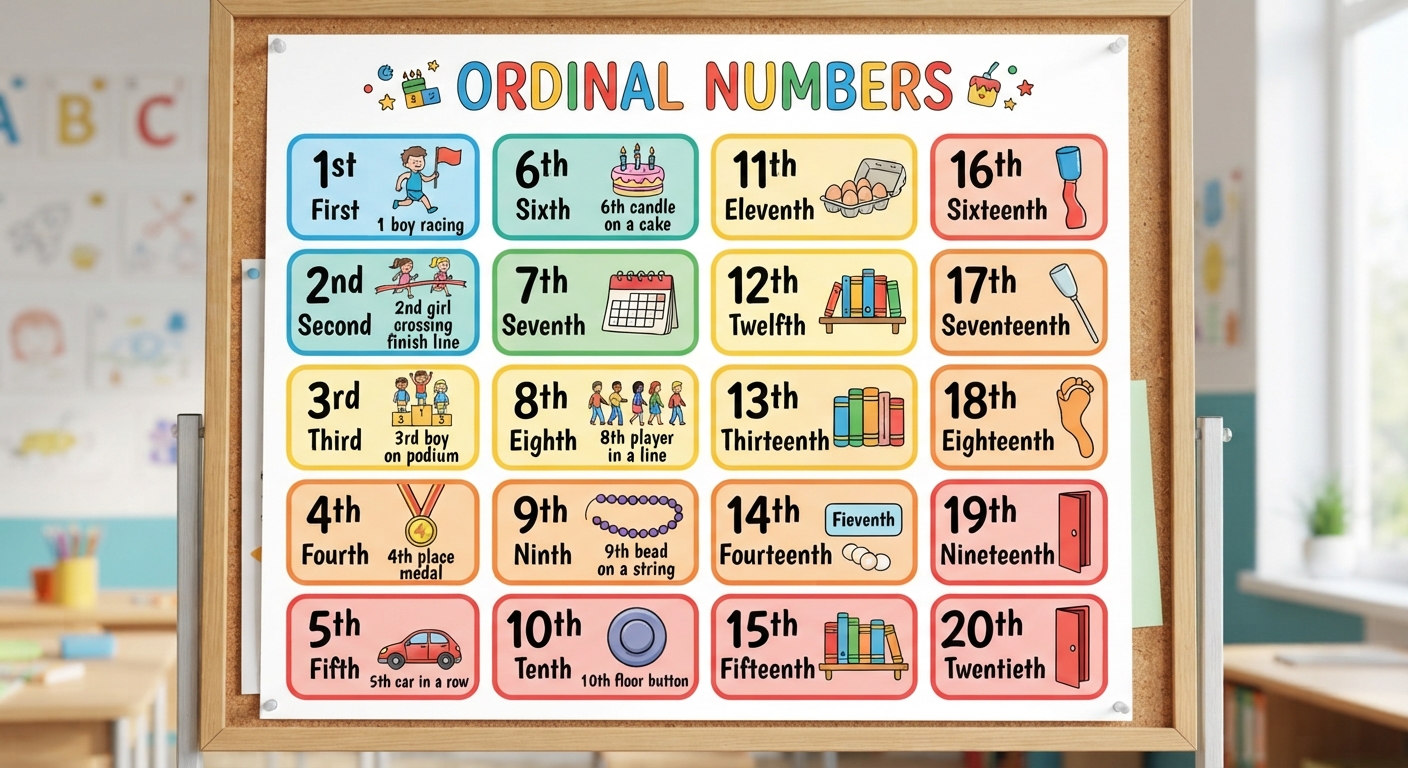
Ordinal Numbers: Definition, Spelling Chart And Examples
The short version
- Ordinal numbers tell position or rank: first, second, third, 4th, 10th, 21st. They answer “which one?” or “what place?”
- Cardinal numbers tell how many (one, two, three). Nominal numbers are labels, like a jersey number or ZIP code.
- Most ordinals end in th. The exceptions end in st, nd or rd (1st, 2nd, 3rd, 21st, 32nd, 43rd), but 11th, 12th and 13th always use th.
- Watch the tricky spellings: fifth, eighth, ninth, twelfth and the tens like twentieth.
Ordinal numbers are numbers that show position or order in a list, like first, second, third and fourth. If five kids finish a race, the one who crosses the line first is in 1st place, and the one after that is in 2nd. The ordinal tells you where something falls in a sequence, not how many there are.
The definition of ordinal comes from the Latin word for order, and that’s the easiest way to remember it: ordinal means order. Below you’ll find how ordinal numbers compare with cardinal and nominal numbers, the suffix rules, a spelling chart, where ordinals show up in math class, and practice problems with answers.
Ordinal vs cardinal vs nominal numbers
The same digit can do three different jobs depending on how it’s used.
| Type | What it tells you | Question it answers | Examples |
|---|---|---|---|
| Cardinal | How many | How many are there? | 3 dogs, twelve eggs, 100 pages |
| Ordinal | Position or rank | Which one? What place? | 3rd in line, twelfth birthday, 100th day of school |
| Nominal | A name or label | Which one is it called? | Jersey #3, bus 12, a ZIP code |
Here’s a sentence with all three: “Our 3rd game had 3 goals, all scored by number 3.” The first 3 is ordinal (which game), the second is cardinal (how many goals), and the last is nominal (a player’s label). A nominal number doesn’t mean anything as an amount or a position. Number 3 isn’t bigger or earlier than number 10 on a team roster.
How to write ordinal numbers
Look at the last two digits of the number.
- If the number ends in 11, 12 or 13, use th: 11th, 12th, 13th, 111th, 213th.
- Otherwise, look at the last digit. 1 takes st, 2 takes nd, 3 takes rd.
- Every other ending (0 and 4 through 9) takes th.
Example: 22
Doesn’t end in 11, 12 or 13. Last digit is 2.
22nd
Example: 112
Last two digits are 12, so rule 1 applies.
112th (not 112nd)
Example: 101
Last two digits are 01, not 11. Last digit is 1.
101st
The reason 11, 12 and 13 are different is that we say “eleventh,” “twelfth” and “thirteenth” out loud. The suffix follows the spoken word, and those words don’t end in “first,” “second” or “third.”
Ordinal numbers spelling chart
| Number | Ordinal | Spelled out | Number | Ordinal | Spelled out |
|---|---|---|---|---|---|
| 1 | 1st | first | 13 | 13th | thirteenth |
| 2 | 2nd | second | 14 | 14th | fourteenth |
| 3 | 3rd | third | 15 | 15th | fifteenth |
| 4 | 4th | fourth | 20 | 20th | twentieth |
| 5 | 5th | fifth | 21 | 21st | twenty-first |
| 6 | 6th | sixth | 22 | 22nd | twenty-second |
| 7 | 7th | seventh | 23 | 23rd | twenty-third |
| 8 | 8th | eighth | 30 | 30th | thirtieth |
| 9 | 9th | ninth | 40 | 40th | fortieth |
| 10 | 10th | tenth | 50 | 50th | fiftieth |
| 11 | 11th | eleventh | 90 | 90th | ninetieth |
| 12 | 12th | twelfth | 100 | 100th | hundredth |
Spelling rules worth knowing
- The first three are irregular: first, second, third. Kids just have to learn them.
- Five and twelve swap “ve” for “f”: fifth, twelfth.
- Eight only adds an h: eighth.
- Nine drops its e: ninth.
- Tens change y to ie and add th: twenty becomes twentieth, forty becomes fortieth.
- In bigger numbers, only the last word changes: twenty-first, one hundred fifth.
Where ordinal numbers show up in math
Lines, lists and “from the back” problems
Early word problems love positions. These look easy but cause off-by-one errors all the time.
Example: A line has 12 kids. Sam is 5th from the back. What place is he from the front?
Count the kids in front of him: 12 – 5 = 7
He’s right after them, so he’s 8th from the front.
Shortcut: total – position + 1 = 12 – 5 + 1 = 8
Example: How many kids stand between the 3rd and 9th kid?
The kids between them are 4th, 5th, 6th, 7th and 8th.
That’s 5 kids, or 9 – 3 – 1 = 5.
A quick subtraction (9 – 3 = 6) overcounts by one.
Fractions
Fraction names borrow ordinal words. 1/3 is “one third,” 3/5 is “three fifths,” 7/10 is “seven tenths.” The bottom number gets an ordinal name, with two exceptions: 1/2 is a half and 1/4 is often called a quarter. Kids who stumble over “fifths” and “eighths” as spoken words sometimes stumble over the fractions too.
Dates and calendars
We write “March 3” but say “March third.” Counting days is a classic ordinal puzzle. If today is the 28th of a 30-day month, the 3rd of next month is 5 days away: 2 days to get to the 30th, then 3 more.
In higher math
Mathematicians also use “ordinal” for a type of number in set theory that extends the idea of position past every counting number. Kids won’t meet that until college, but it’s the same core idea: ordinals describe order.
Common mistakes with ordinal numbers
- 11st, 12nd, 13rd. The teen exception is the most common slip. They’re always 11th, 12th and 13th, including 111th, 112th and 113th.
- Treating ordinal and cardinal as the same count. Being 5th in line means 4 people are ahead of you, not 5.
- Misspelling the irregulars. “Fiveth,” “eigth,” “nineth” and “twelveth” all show up on homework. The chart above has the correct spellings.
- Subtracting positions to count what’s between. Between the 3rd and 9th there are 5 items, not 6.
Practice problems
- Write 3 as an ordinal number, in both digits and words.
- Spell out 12th.
- Add the correct suffix: 22, 13, 101, 111.
- Cardinal, ordinal or nominal? (a) jersey number 23, (b) 4 apples, (c) the 4th of July.
- In a line of 15 kids, Maya is 6th from the front. What place is she from the back?
- How many kids stand between the 4th and 11th kid in line?
- Spell out 40th.
Answers
- 3rd, third.
- twelfth
- 22nd, 13th, 101st, 111th.
- (a) nominal, (b) cardinal, (c) ordinal.
- 10th. 15 – 6 + 1 = 10. Check: 9 kids are behind her, so she’s 10th counting from the back.
- 6 kids (5th through 10th). 11 – 4 – 1 = 6.
- fortieth (no u, even though it’s “four”).
If your child mixes up ordinal numbers
Ordinals are a kindergarten and first grade skill, so a kid who’s still unsure about “first” and “fourth” in those grades is usually just still learning the words. If an older child keeps missing position problems, the gap tends to be elsewhere: counting on and back, or telling the difference between “how many” and “which one.” Those same off-by-one errors show up later in elapsed time, calendar problems and counting terms in a pattern.
It’s worth checking whether other early number skills are shaky too. Is My Child Behind In Math? 12 Signs By Grade Level lists what to watch for at each age, and Math Skills By Grade Level covers what should be in place by grades 3 to 5. If you’d like a clear picture instead of guessing, our guide to math assessment for kids explains what a good one looks at.
Frequently asked questions
What is the definition of ordinal?
Ordinal means relating to order or position. An ordinal number tells you where something ranks in a sequence, like 1st, 2nd or 10th.
What is the difference between cardinal and ordinal numbers?
Cardinal numbers count how many (seven books). Ordinal numbers tell position (the seventh book). Every ordinal has a matching cardinal: seventh goes with seven.
Is zero an ordinal number?
In everyday English we don’t use “zeroth” much, and school math starts ordinals at first. It does show up in computer science and some higher math, where counting sometimes starts at 0.
What are the first 10 ordinal numbers?
First, second, third, fourth, fifth, sixth, seventh, eighth, ninth and tenth, written 1st through 10th.
Why is it 12th and not 12nd?
Because we say “twelfth,” not “twelve-second.” The suffix matches the spoken word, so 11, 12 and 13 all take th, even inside bigger numbers like 312th.
Find the actual gap
If position problems are one of several things going wrong, it helps to know which early skills are actually missing. Math Anon starts with a short adaptive assessment that pinpoints those skills and gives you a written report you can read in a few minutes.
Your child then practices about 20 minutes a day on just those skills, and you get a progress report every week. The assessment is $49, and the full amount is credited back on your first month. Start the assessment or see pricing.





