
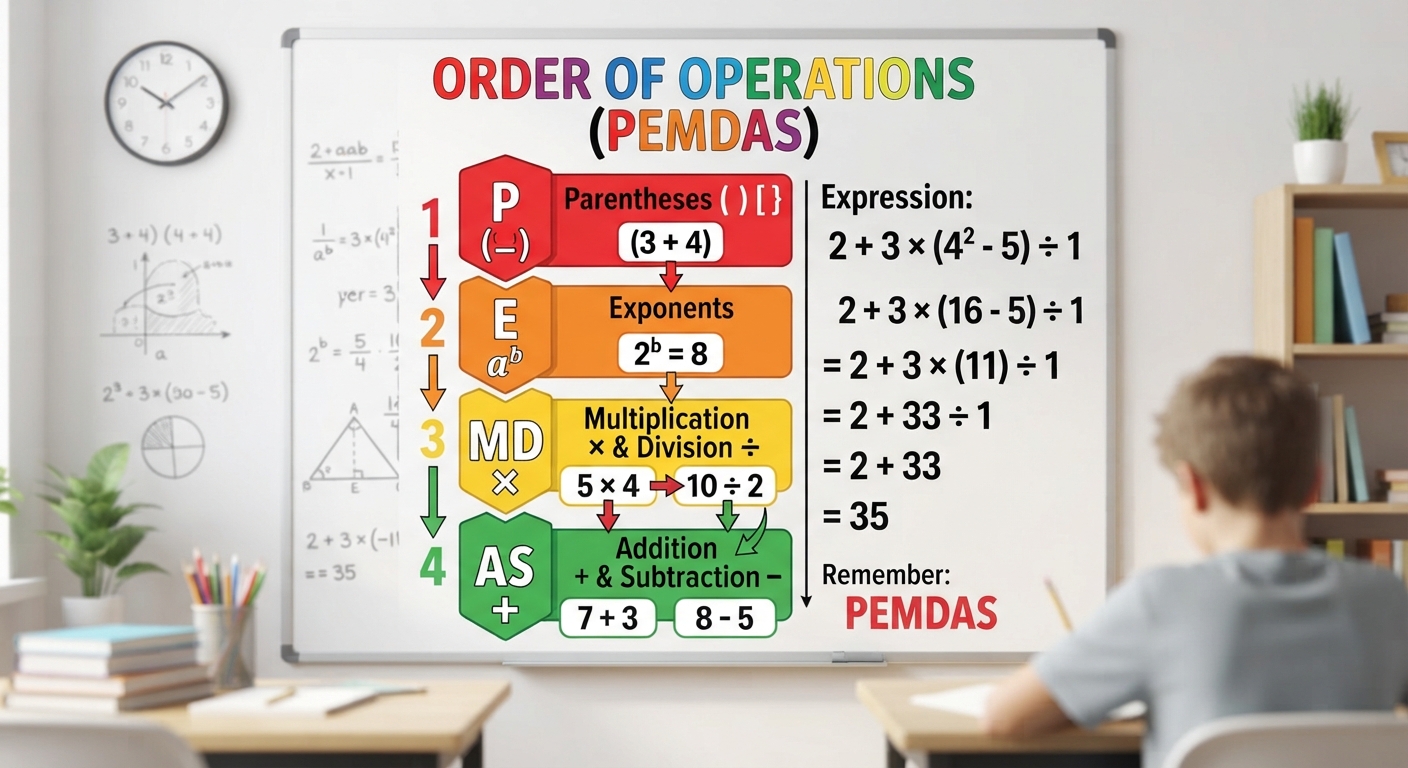
Order Of Operations: PEMDAS And BEDMAS Explained
The short version
- The order of operations is the agreed rule for which part of a math problem to do first: parentheses, then exponents, then multiplication and division, then addition and subtraction.
- PEMDAS and BEDMAS are two acronyms for the same order. B for brackets means the same thing as P for parentheses.
- Multiplication and division are one step, done left to right. Addition and subtraction are one step, also left to right. This is where most mistakes happen.
- So 20 – 8 + 3 is 15, and 24 ÷ 4 × 2 is 12, because you go left to right in both.
The order of operations is the set of rules that tells you which calculation to do first when a problem has more than one operation. Work in this order: parentheses (or brackets), exponents, multiplication and division from left to right, then addition and subtraction from left to right. Using that order, 6 + 4 × 3 = 18, because you multiply before you add.
In the US, kids learn it as PEMDAS. In Canada it’s usually BEDMAS, and in the UK and many other countries it’s BODMAS. They all describe the same rules. The part most kids (and plenty of adults) get wrong is the left to right rule, so we’ll spend real time on that, then walk through worked examples, nested brackets, fraction bars and a practice set with answers.
The order of operations, step by step
| Step | What to do | Example |
|---|---|---|
| 1 | Parentheses or brackets: work inside them first | (2 + 5) × 3 = 7 × 3 |
| 2 | Exponents (powers and roots) | 4 + 3² = 4 + 9 |
| 3 | Multiplication and division, left to right | 12 ÷ 3 × 2 = 4 × 2 |
| 4 | Addition and subtraction, left to right | 10 – 4 + 1 = 6 + 1 |
Think of it as four levels instead of six separate steps. Multiplication and division share a level. Addition and subtraction share a level. Within a level, you go left to right like reading a sentence.
PEMDAS, BEDMAS and the other acronyms
| Acronym | Where it’s common | Letters stand for |
|---|---|---|
| PEMDAS | United States | Parentheses, Exponents, Multiplication, Division, Addition, Subtraction |
| BEDMAS | Canada | Brackets, Exponents, Division, Multiplication, Addition, Subtraction |
| BODMAS | UK, India, Australia and others | Brackets, Orders (or Of), Division, Multiplication, Addition, Subtraction |
| GEMDAS | Some US classrooms | Grouping symbols, Exponents, Multiplication, Division, Addition, Subtraction |
Notice PEMDAS lists M before D, and BEDMAS lists D before M. If the letter order really mattered, the two countries would get different answers. They don’t, because the order within each pair was never the point. The order of operations acronym is a memory aid, and it hides the most important rule: pairs go left to right.
The memory phrase “Please Excuse My Dear Aunt Sally” makes the same mistake easy, since it sounds like a strict six-step list. If your kid uses it, have them write PE(MD)(AS) with the pairs grouped.
The left to right rule
This is where the order of operations trips people up.
Example: 20 – 8 + 3
Addition and subtraction are on the same level, so go left to right.
20 – 8 = 12
12 + 3 = 15
A kid who reads PEMDAS literally does the addition first: 8 + 3 = 11, then 20 – 11 = 9. That’s wrong. The correct answer is 15.
Example: 24 ÷ 4 × 2
Division and multiplication are on the same level, so go left to right.
24 ÷ 4 = 6
6 × 2 = 12
Doing the multiplication first gives 24 ÷ 8 = 3, which is wrong.
One way to see why left to right is right: subtracting 8 is the same as adding -8. So 20 – 8 + 3 is really 20 + (-8) + 3, and you can add those in any order and still get 15. Division works the same way, since dividing by 4 is multiplying by 1/4.
Worked examples
Example 1: 6 + 4 × 3
No parentheses or exponents. Multiply first: 4 × 3 = 12
Then add: 6 + 12 = 18
Example 2: 3 + 2 × (7 – 4)²
Parentheses: 7 – 4 = 3, so 3 + 2 × 3²
Exponent: 3² = 9, so 3 + 2 × 9
Multiply: 2 × 9 = 18, so 3 + 18
Add: 21
Nested brackets
When grouping symbols sit inside each other, start with the innermost set and work outward.
Example 3: 5 × [12 – (3 + 1) × 2]
Innermost parentheses: 3 + 1 = 4, so 5 × [12 – 4 × 2]
Inside the brackets, multiply first: 4 × 2 = 8, so 5 × [12 – 8]
Finish the brackets: 12 – 8 = 4, so 5 × 4
Multiply: 20
Fraction bars
A fraction bar acts like a grouping symbol. Work out the whole top and the whole bottom first, then divide.
Example 4: (10 + 6) / (2 × 4)
Top: 10 + 6 = 16
Bottom: 2 × 4 = 8
Divide: 16 ÷ 8 = 2
Negative numbers and exponents
Example 5: -3² compared to (-3)²
In -3², the exponent comes before the negative, so it’s -(3 × 3) = -9.
In (-3)², the parentheses make the whole -3 the base, so it’s (-3) × (-3) = 9.
This one matters a lot in algebra and on calculators, which follow the same rule.
Why the order of operations exists
It’s an agreement. Without it, 6 + 4 × 3 could be 30 or 18 depending on who’s reading it, and nobody could share a formula. Mathematicians settled on a convention so that any written expression has exactly one value.
The order isn’t random, though. Multiplication is repeated addition, and an exponent is repeated multiplication. The more “packed” an operation is, the earlier it gets done. Parentheses sit on top because they’re how you override the default when you need to.
About those viral problems
Puzzles like 8 ÷ 2(2 + 2) go around online because they’re written to be ambiguous. If you treat 2(2 + 2) as ordinary multiplication and go left to right, you get 8 ÷ 2 × 4 = 16. Some people treat the 2 attached to the parentheses as a single grouped term and get 1. Different textbooks and calculators handle that implied multiplication differently. The real lesson is that a clearly written problem uses parentheses or a fraction bar so there’s no argument.
Common mistakes
- Always multiplying before dividing. In 40 ÷ 5 × 2, the answer is 16. Doing 5 × 2 first gives 4.
- Always adding before subtracting. In 18 – 5 + 2, the answer is 15. Adding first gives 11.
- Going strictly left to right for everything. Kids who ignore PEMDAS entirely get 6 + 4 × 3 = 30. Multiplication still comes first.
- Skipping the exponent. In 2 × 3², square first (9), then multiply (18). Multiplying first gives 6² = 36.
- Losing track in long problems. Doing two steps in one line is where errors slip in. Rewrite the whole expression after each step.
Practice problems
- 9 + 6 × 2
- 18 – 6 ÷ 3
- 40 ÷ 5 × 2
- (7 + 3) × 4 – 5
- 2 × 3² + 4
- 50 – 3 × (4 + 2)² ÷ 9
- 6 + [15 – (2 + 3) × 2] ÷ 5
- (4² – 1) / (2 + 3)
Answers
- 21. Multiply: 6 × 2 = 12. Add: 9 + 12 = 21.
- 16. Divide: 6 ÷ 3 = 2. Subtract: 18 – 2 = 16.
- 16. Left to right: 40 ÷ 5 = 8, then 8 × 2 = 16.
- 35. Parentheses: 10. Multiply: 10 × 4 = 40. Subtract: 40 – 5 = 35.
- 22. Exponent: 3² = 9. Multiply: 2 × 9 = 18. Add: 18 + 4 = 22.
- 38. Parentheses: 6. Exponent: 36. Left to right: 3 × 36 = 108, then 108 ÷ 9 = 12. Subtract: 50 – 12 = 38.
- 7. Innermost: 2 + 3 = 5. Brackets: 15 – 5 × 2 = 15 – 10 = 5. Divide: 5 ÷ 5 = 1. Add: 6 + 1 = 7.
- 3. Top: 16 – 1 = 15. Bottom: 5. Divide: 15 ÷ 5 = 3.
If your child keeps getting these wrong
Order of operations problems pile several skills into one line, so a wrong answer can come from anywhere. Sometimes it’s the rule itself, usually the left to right part. Just as often it’s a multiplication or division fact that came out wrong halfway through, or an exponent treated as multiplying by 2. Look at the work and find the first line where it goes off. That tells you more than the final answer.
If the slip is in basic facts, that’s a grade 3 to 5 skill, and our breakdown of math skills by grade level shows what should be solid by now. The order of operations also leads straight into simplifying algebraic expressions, so gaps here tend to resurface later, as we explain in our post on struggling with algebra. Short, regular practice fixes this kind of rule-following faster than long cram sessions, which is the case we make in Why 20 Minutes A Day Beats A 90-Minute Tutoring Session.
Frequently asked questions
What is the order of operations in math?
It’s the rule for which operation to do first: grouping symbols, then exponents, then multiplication and division from left to right, then addition and subtraction from left to right.
Is PEMDAS the same as BEDMAS?
Yes. Parentheses and brackets mean the same thing, and whether the acronym lists M or D first doesn’t matter, since those two are done together from left to right. Both give the same answer every time.
Do you multiply or divide first?
Neither always comes first. Do whichever one appears first reading left to right. The same goes for addition and subtraction.
What grade learns the order of operations?
Kids usually start using parentheses in simple expressions around third grade. Most state standards formally cover order of operations with parentheses and brackets in fifth grade, then add exponents in sixth grade.
Do calculators follow the order of operations?
Most scientific and graphing calculators do. Some basic four-function calculators work each operation as you type it, so 6 + 4 × 3 comes out as 30. If you’re not sure, test your calculator on that problem.
Find the actual gap
When order of operations answers keep coming back wrong, you need to know whether it’s the rule or a skill underneath it. Math Anon’s short adaptive assessment checks both and gives you a written report of exactly which skills are missing.
After that, your child gets about 20 minutes of targeted practice a day on those skills, and you get a progress report each week. The assessment is $49, credited back in full on your first month. Start the assessment or check pricing.





