
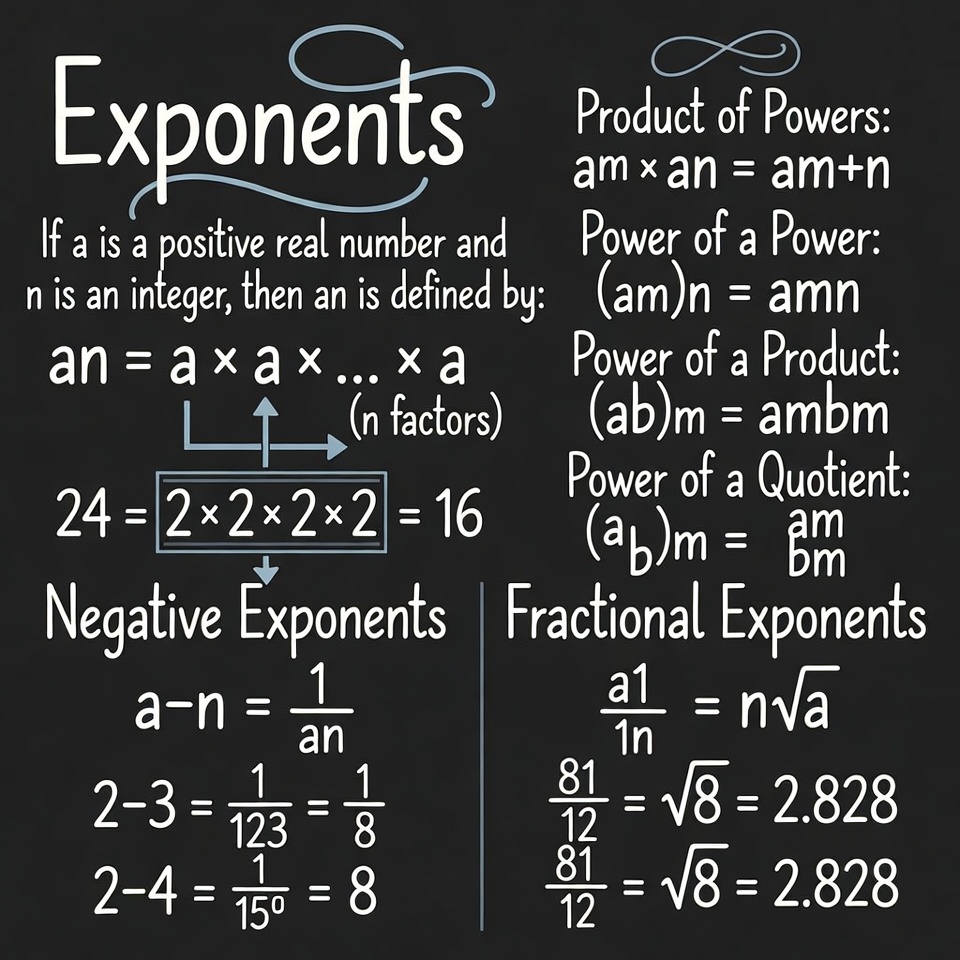
Exponents Explained: Rules And Examples
The short version
- An exponent tells you how many times to multiply a number by itself. In 25, the base is 2, the exponent is 5, and the value is 2 × 2 × 2 × 2 × 2 = 32.
- Multiplying powers with the same base adds the exponents. Dividing subtracts them. Raising a power to a power multiplies them.
- Any number except 0 raised to the 0 power equals 1, and any number raised to the 1 power is itself.
- For powers of 10, the exponent is just the number of zeros: 104 = 10,000.
- The most common mistake is reading 34 as 3 × 4. It’s 3 × 3 × 3 × 3 = 81.
Exponents are a shorthand for repeated multiplication. Instead of writing 7 × 7 × 7 × 7, you write 74. The small raised number is the exponent, and it counts how many copies of the base get multiplied together. That’s the whole idea, and once a kid has it, the rules that follow stop feeling random.
Most students meet exponents in fifth or sixth grade with squares and cubes, then use them constantly through algebra, scientific notation, and beyond. Below you get the vocabulary, every rule in one table, worked examples with real numbers, the mistakes kids actually make, and practice problems with an answer key.
The parts of an exponent
Take 63.
Base: 6. The number being multiplied.
Exponent: 3. How many copies of the base to multiply.
Power: the whole expression, 63, and also the answer, 216.
63 = 6 × 6 × 6 = 216. Note that it is not 6 × 3 = 18. That single confusion causes more wrong answers than every exponent rule combined.
How to read them out loud
| Written | Said | Means | Value |
|---|---|---|---|
| 52 | five squared | 5 × 5 | 25 |
| 53 | five cubed | 5 × 5 × 5 | 125 |
| 54 | five to the fourth power | 5 × 5 × 5 × 5 | 625 |
Squared and cubed come from geometry. A square with side 5 has area 52 = 25 square units. A cube with edge 5 has volume 53 = 125 cubic units. After the third power the names run out and we just say “to the fourth,” “to the fifth,” and so on.
The exponent rules in one table
These rules all come from the same place: expand the powers, cross off matching factors, and count what’s left.
| Rule | What it says | Example |
|---|---|---|
| Product rule | am × an = am+n | 35 × 32 = 37 = 2,187 |
| Quotient rule | am ÷ an = am-n | 56 ÷ 54 = 52 = 25 |
| Power of a power | (am)n = am×n | (32)4 = 38 = 6,561 |
| Power of a product | (ab)n = anbn | (2x)3 = 8x3 |
| Zero exponent | a0 = 1, for a not 0 | 70 = 1 |
| Exponent of 1 | a1 = a | 71 = 7 |
The rules only work when the bases match. 23 × 52 does not simplify to a single power, because 2 and 5 are different bases. You’d just compute 8 × 25 = 200.
Why the product rule works
Expand both sides instead of memorizing.
35 × 32
= (3 × 3 × 3 × 3 × 3) × (3 × 3)
= 3 × 3 × 3 × 3 × 3 × 3 × 3
= 37
Five threes plus two threes is seven threes. You add the exponents because you’re counting factors. Check it with numbers: 35 = 243, 32 = 9, and 243 × 9 = 2,187, which is 37.
Why the quotient rule works
56 ÷ 54
= (5 × 5 × 5 × 5 × 5 × 5) ÷ (5 × 5 × 5 × 5)
Four fives cancel top and bottom.
= 5 × 5 = 52 = 25
Check: 56 = 15,625 and 54 = 625. Then 15,625 ÷ 625 = 25. It holds.
Why anything to the zero power is 1
Run the quotient rule on a case where the answer is obvious.
73 ÷ 73 = 343 ÷ 343 = 1
By the rule, 73 ÷ 73 = 73-3 = 70
So 70 must equal 1.
The rule is not a trick somebody invented. It’s the only value that keeps the other rules consistent. The one exception is 00, which is left undefined in most school math.
Powers of 10
Powers of 10 deserve their own look, because they’re the backbone of place value and scientific notation. The exponent is exactly the number of zeros after the 1.
| Power | Value | Name |
|---|---|---|
| 101 | 10 | ten |
| 102 | 100 | hundred |
| 103 | 1,000 | thousand |
| 106 | 1,000,000 | million |
| 109 | 1,000,000,000 | billion |
This is why scientific notation works. 4,500,000 becomes 4.5 × 10⁶, and the exponent tells you how many places the decimal point moved. Kids who know powers of 10 cold find scientific notation easy. Kids who don’t will fight it all year.
Negative exponents, briefly
A negative exponent means “take the reciprocal,” not “make the answer negative.” 5-2 = 1 ÷ 52 = 1/25. The value is still positive. The pattern comes straight from the quotient rule: 52 ÷ 54 = 5-2, and computing it directly gives 25 ÷ 625 = 1/25. Same answer.
Common mistakes with exponents
Multiplying the base by the exponent. 34 is 81, not 12. This is the big one. Have your kid write out the factors until the habit breaks.
Adding exponents when the bases differ. 23 × 53 is not 106. It’s 8 × 125 = 1,000, which happens to be 103. Same exponent, multiply the bases: (2 × 5)3.
Multiplying exponents when you should add. 42 × 43 = 45, not 46. Multiply exponents only for a power of a power, like (42)3.
Mishandling the minus sign. (-3)2 = 9, because the parentheses square the negative too. But -32 = -9, because only the 3 is squared and the minus sign stays out front. Parentheses decide it.
Thinking a0 = 0. It equals 1.
Distributing a power over addition. (a + b)2 is not a2 + b2. Test it: (2 + 3)2 = 25, while 22 + 32 = 13. Powers distribute over multiplication, never over addition.
Practice problems
1. Write 4 × 4 × 4 using an exponent, then find the value.
2. What is 26?
3. Simplify 35 × 32 as a single power, then give its value.
4. Simplify 108 ÷ 105 and write the answer as a whole number.
5. What is 90 + 91?
6. Simplify (23)2 and give the value.
7. Which is bigger, 34 or 43?
8. Write 5-2 as a fraction.
Answers
1. 43 = 64
2. 26 = 2 × 2 × 2 × 2 × 2 × 2 = 64
3. 35+2 = 37 = 2,187
4. 108-5 = 103 = 1,000
5. 1 + 9 = 10
6. 23×2 = 26 = 64
7. 34 = 81 and 43 = 64, so 34 is bigger. Order matters with exponents.
8. 5-2 = 1/52 = 1/25
What it means if your child is stuck on exponents
When a kid can’t do exponents, the problem is usually not exponents. Watch what they do on 43. If they write 12, they never built the meaning and they’re pattern matching on the numbers in front of them. If they get 43 right but stall on 73, the gap is multiplication facts, and that’s a third or fourth grade skill that’s now slowing down every sixth grade problem.
There’s a third case worth naming. Some students handle 23 fine but fall apart on x3 · x5. That’s not an exponent problem either. That’s variables, and it usually means the jump into symbolic thinking hasn’t happened yet. Our post on why algebra trouble usually traces back to fourth grade fractions walks through how these earlier gaps surface later, and 12 signs your child is behind in math by grade level helps you tell a temporary wobble from a real hole.
Whichever case it is, drilling more exponent worksheets won’t fix it. You have to find the layer underneath and patch that first. If you’re not sure how to look, a parent’s guide to math assessment explains what a useful assessment actually tests.
Frequently asked questions
What is an exponent in simple terms?
It’s a small raised number that tells you how many times to multiply the base by itself. In 82, the exponent 2 says multiply 8 by itself twice: 8 × 8 = 64.
What grade do kids learn exponents?
Squares and simple exponents usually appear in fifth or sixth grade, with the full set of exponent rules coming in seventh or eighth grade and again in algebra 1.
What is the difference between a power and an exponent?
The exponent is the small raised number. The power is the whole expression, and people also use “power” for the result. In 25 = 32, the exponent is 5, and 32 is the fifth power of 2.
Why does any number to the power of 0 equal 1?
Because dividing a power by itself gives 1, and the quotient rule turns that same division into an exponent of 0. Since 62 ÷ 62 = 1 and also equals 60, the value has to be 1.
What is 2 to the 10th power?
1,024. It comes up a lot in computing, which is why a kilobyte was originally 1,024 bytes rather than 1,000.
How do you multiply exponents with different bases?
You can’t combine them into one power unless the exponents match. 23 × 73 can be written as (2 × 7)3 = 143 = 2,744. If both the bases and the exponents differ, just compute each piece and multiply.
Find the actual gap
Exponent errors are a good signal, because each kind of error points at a different missing skill. The trouble is that a worksheet score tells you a kid got 6 out of 10 and nothing about why. Math Anon opens with a short adaptive assessment that adjusts as your child answers, then hands you a written report naming the specific skills that are missing.
From there it’s about 20 minutes of targeted daily practice aimed at those exact gaps, plus a weekly progress report so you can see the change rather than guess at it. Start the assessment for $49, and that $49 comes back to you in full on your first month. Everything else is on the pricing page.





