
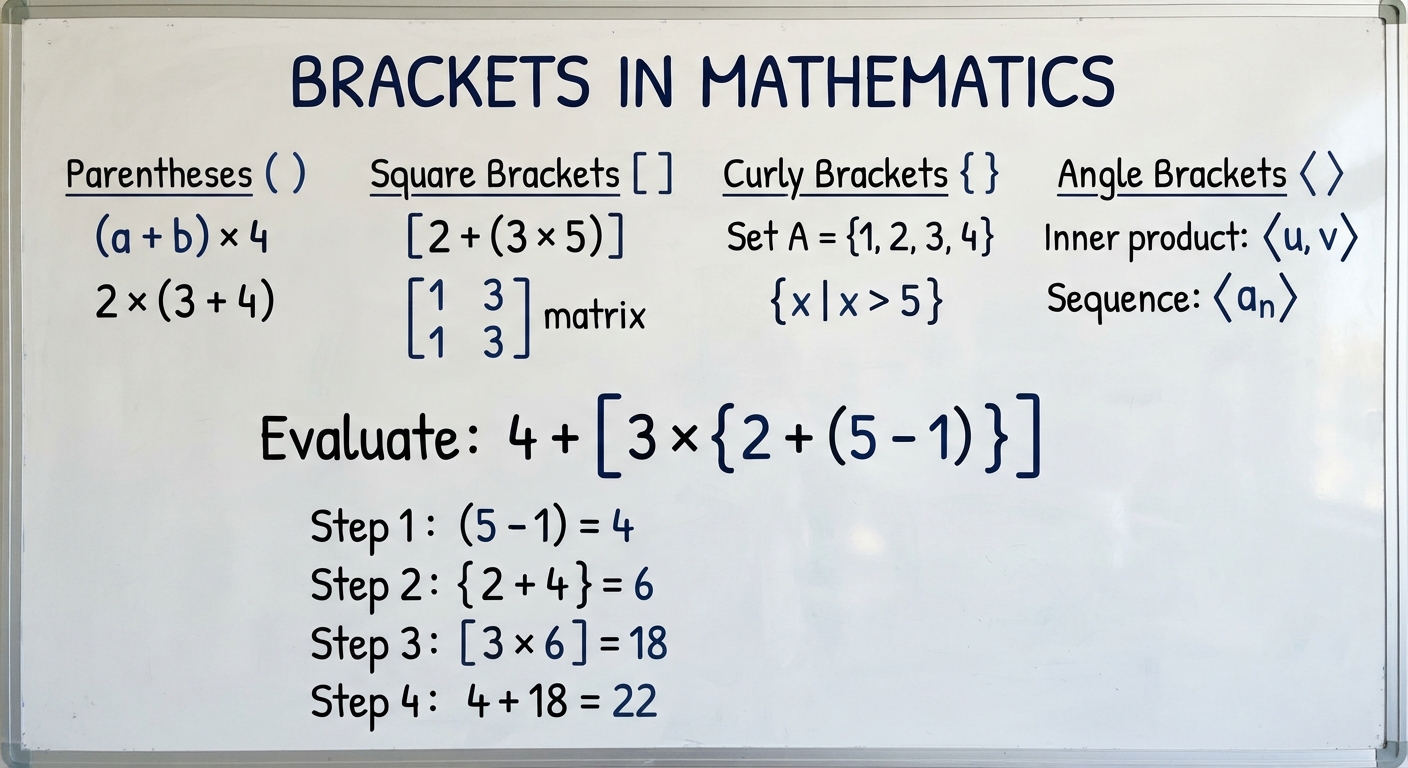
Brackets In Math, Explained
The short version
- Brackets group part of an expression so you do that part first. In 4 × (3 + 2), the brackets force the addition ahead of the multiplication, giving 20 instead of 14.
- Three kinds show up in school math: parentheses ( ), square brackets [ ], and braces { }. For order of operations they all behave identically. The different shapes only make nested expressions easier to read.
- When brackets sit inside other brackets, work from the innermost pair outward.
- Square brackets have a second job in interval notation, where [ means the endpoint is included and ( means it isn’t. So [2, 7) covers every number from 2 up to but not including 7.
- Braces also name a set, as in {1, 2, 3}. Context tells you which meaning is in play.
Brackets in math are grouping symbols. Whatever sits inside them gets handled first, before anything outside touches it. That one rule covers most of what a student needs, whether the symbol on the page is a parenthesis, a square bracket or a brace.
The reason brackets exist is that arithmetic has a fixed pecking order, and sometimes you need to override it. Multiplication normally outranks addition, so 4 × 3 + 2 equals 14. Put brackets around the addition and you change the order on purpose: 4 × (3 + 2) = 4 × 5 = 20. Same numbers, same operations, different answer.
The three kinds of brackets in math
| Symbol | Name | Main jobs | Example |
|---|---|---|---|
| ( ) | Parentheses, or round brackets | Grouping, multiplication, ordered pairs, open intervals | 3 × (2 + 5) |
| [ ] | Square brackets | The outer layer of nested grouping, closed intervals, matrices | 2 × [9 + (4 – 1)] |
| { } | Braces, or curly brackets | The outermost layer of grouping, and naming sets | {2, 4, 6, 8} |
A naming note that confuses plenty of families: in the United States, “brackets” usually means the square ones and ( ) are parentheses. In the UK and much of the rest of the world, “brackets” means ( ) and that’s the B in BODMAS. If a homework sheet or a video says something that sounds off, this is often why.
How brackets work in the order of operations
Whether your child learned PEMDAS or BODMAS, brackets come first. The full order runs: brackets, then exponents, then multiplication and division left to right, then addition and subtraction left to right.
With nested brackets, the rule extends: innermost pair first, then work your way out. The usual convention is ( ) inside [ ] inside { }, so the shapes give you a visual map of the layers.
Worked example 1: one set of brackets
Solve 30 – 4 × (7 – 5).
Inside the brackets: 7 – 5 = 2
Now the expression is 30 – 4 × 2
Multiply: 4 × 2 = 8
Subtract: 30 – 8 = 22
Skipping the brackets and going left to right gives 30 – 4 = 26, then 26 × 7 and the answer falls apart. The brackets are instructions, not decoration.
Worked example 2: nested brackets
Solve 2 × [8 + (5 – 3)].
Innermost first: 5 – 3 = 2
Now: 2 × [8 + 2]
Inside the square brackets: 8 + 2 = 10
Multiply: 2 × 10 = 20
Worked example 3: three layers deep
Solve 3 + 2 × {12 ÷ [7 – (2 + 2)]}.
Parentheses: 2 + 2 = 4
Square brackets: 7 – 4 = 3
Braces: 12 ÷ 3 = 4
Multiply: 2 × 4 = 8
Add: 3 + 8 = 11
One layer per line, crossing out as you go, is the habit that keeps these from unravelling. Trying to hold two layers in your head at once is how students lose track of a minus sign.
Brackets that mean multiply
Once numbers and letters sit next to each other, brackets quietly pick up a second job. Anything written directly against a bracket is multiplied by what’s inside.
3(5) means 3 × 5 = 15
(2)(6) means 2 × 6 = 12
4(x + 1) means 4 × (x + 1)
That last one is the distributive property, and it’s where brackets in math start doing real algebra work. You multiply the outside number by every term inside.
5(x + 3) = 5x + 15
-2(x – 4) = -2x + 8
-(a + b) = -a – b
The second line catches people. Multiplying -2 by -4 gives +8, so the sign flips. The third line is the same rule with an invisible 1 out front, and forgetting to hand that minus sign to the b is one of the most common algebra errors there is.
Square brackets in interval notation
By around algebra 1, square brackets show up describing ranges of numbers, and here the shape really does change the meaning.
| Notation | Reads as | Endpoints |
|---|---|---|
| [2, 7] | 2 ≤ x ≤ 7 | Both included |
| (2, 7) | 2 < x < 7 | Neither included |
| [2, 7) | 2 ≤ x < 7 | 2 included, 7 not |
| (3, ∞) | x > 3 | 3 not included |
A square bracket says “this endpoint counts.” A parenthesis says “get as close as you like, but don’t include it.” Infinity always takes a parenthesis, since you can never reach it.
Watch out for (2, 7). In interval notation it means every number strictly between 2 and 7. In coordinate geometry the identical symbols mean the point 2 across and 7 up. Only the surrounding sentence tells you which one you’re looking at.
Common mistakes
Working outside in. Students often solve the expression left to right and treat the brackets as an afterthought. Innermost first, always.
Only distributing to the first term. Writing 3(x + 5) = 3x + 5 drops half the problem. Every term inside gets multiplied.
Losing a negative sign. 10 – (4 + 3) is 10 – 7 = 3. Expanding it means subtracting both, so 10 – 4 – 3 = 3. Writing 10 – 4 + 3 = 9 is the classic slip.
Assuming square brackets outrank parentheses. They don’t. Position in the nest decides the order, not the shape of the symbol.
Dropping brackets when substituting. If x = -3, then x² means (-3)² = 9. Typing -3² into a calculator returns -9, because the exponent grabs the 3 before the minus sign does.
Forgetting to close a bracket on a calculator. Many calculators silently assume the missing bracket goes at the end, which is often not where you meant it. Count your open and closed brackets before pressing equals.
Practice problems
1. 6 × (4 + 1)
2. 20 – (8 – 5)
3. 2 + 4 × (9 ÷ 3)
4. 3 × [10 – (2 + 4)]
5. Expand 4(x + 6)
6. Expand -3(x – 5)
7. {30 ÷ [3 × (6 – 4)]} + 7
8. Write “every number from 1 up to but not including 9” in interval notation.
Answers
1. 4 + 1 = 5, then 6 × 5 = 30
2. 8 – 5 = 3, then 20 – 3 = 17
3. 9 ÷ 3 = 3, then 4 × 3 = 12, then 2 + 12 = 14
4. 2 + 4 = 6, then 10 – 6 = 4, then 3 × 4 = 12
5. 4x + 24
6. -3x + 15, since -3 × -5 = +15
7. 6 – 4 = 2, then 3 × 2 = 6, then 30 ÷ 6 = 5, then 5 + 7 = 12
8. [1, 9). The square bracket includes 1 and the parenthesis leaves 9 out.
What it means if your child is stuck on brackets
Bracket problems are rarely about brackets. They’re a test of whether a student can hold a multi step problem together, and they expose whatever is shaky underneath.
If the arithmetic inside the brackets is wrong, the gap is number facts or integer operations, not grouping. If they solve each piece correctly but combine them in the wrong order, the gap is the order of operations itself, and that usually needs to be rebuilt rather than reminded. If the trouble starts only when letters appear, the gap is the distributive property, which sits right at the front door of algebra.
One useful test at home: give them the same expression twice, once with brackets and once without, and ask whether the answers should match. A kid who says yes hasn’t understood what brackets do yet. For where this sits in the sequence, see math skills by grade level, and if algebra is already going badly, the real problem is usually fourth grade fractions explains what we see most often. 12 signs your child is behind in math helps you judge how serious it is.
Frequently asked questions
What do brackets mean in math?
They mean “do this part first.” Brackets in math group an operation so it happens before anything outside the brackets, which lets you override the normal order of operations.
What is the difference between brackets and parentheses?
In American usage, parentheses are ( ) and brackets are [ ]. For order of operations they do the same job, and the square ones are simply used on the outside of a nested expression so the layers stay readable. Elsewhere in the world, “brackets” is the everyday word for ( ).
Which bracket do you solve first?
The innermost one, regardless of its shape. In 2 × [8 + (5 – 3)], the parentheses are deepest, so 5 – 3 gets solved first.
What does a square bracket mean in a range of numbers?
It means the endpoint is included. In [2, 7], both 2 and 7 count. Swap one for a parenthesis, as in [2, 7), and 7 is excluded while every number below it still counts.
Are braces the same as brackets?
Braces { } act as grouping symbols in arithmetic, usually as the outermost layer. They also have a separate meaning as set notation, where {2, 4, 6} names a collection of numbers rather than telling you to calculate anything.
Do brackets always mean multiply?
No. They mean multiply only when something is written against them with no operation in between, like 3(5) or 4(x + 1). In 12 ÷ (3 + 1), the brackets are grouping and the operation is division.
Find the actual gap
A student who misses bracket questions might be weak at integer arithmetic, might not have the order of operations locked in, or might be fine at both and just rushing. Those need different fixes, and a worksheet treats them all the same. Math Anon begins with a short adaptive assessment that separates them, then sends you a written report naming the specific skills to work on.
Practice after that runs about 20 minutes a day and targets only those skills, and you get a progress report each week showing what changed. Start the assessment for $49, credited back in full against your first month. Our pricing page has the details, and our guide to math assessment explains what the report actually tells you.





