
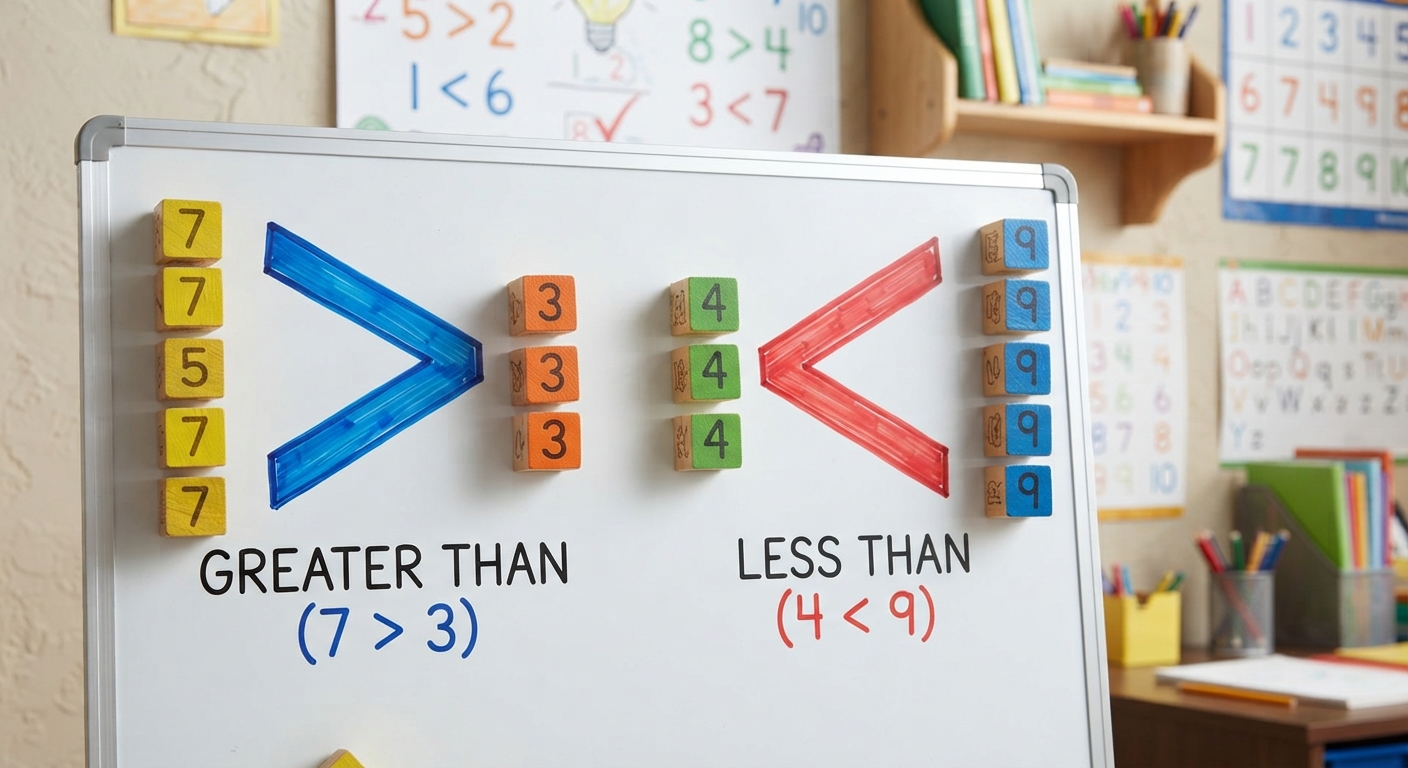
Greater Than Less Than Signs, Explained
The short version
- The symbol > means “greater than” and the symbol < means “less than.” So 7 > 3 reads “seven is greater than three,” and 3 < 7 reads “three is less than seven.”
- The most reliable trick: the pointy end always points at the smaller number, and the wide open end always faces the bigger one.
- Add a line underneath and you get ≥ (greater than or equal to) and ≤ (less than or equal to). Those allow the two numbers to be the same.
- On a keyboard, < is Shift plus comma and > is Shift plus period. The ≥ and ≤ symbols need a shortcut, which we list below.
- Most errors on these problems aren’t symbol errors. They’re comparison errors with decimals, fractions or negative numbers, where the kid picks the wrong number as “bigger” before the symbol ever gets written.
Greater than less than signs are the two arrow shapes you use to compare two numbers. Write > when the first number is bigger, and < when the first number is smaller. A third symbol, =, covers the case where they’re equal. That’s the entire system, and it works the same way in first grade and in algebra class.
The part that trips kids up is deciding which number is actually bigger. Once that’s settled, choosing the symbol takes a second. So this page covers both: how to read and write the symbols, and how to compare numbers that don’t sort themselves in an obvious order.
Reading the symbols out loud
An inequality is read left to right, like a sentence. The number on the left comes first.
9 > 4 says “nine is greater than four.”
4 < 9 says “four is less than nine.”
6 = 6 says “six equals six.”
Those first two statements say the same thing about the same two numbers. You can flip the order as long as you flip the symbol with it. That flip is where a lot of wrong answers come from, because a student who only ever reads > as “greater” will read 4 > 9 as true without noticing the order changed.
Tricks for remembering which greater than less than sign to use
The alligator. The symbol is a hungry alligator’s mouth, and the alligator always wants to eat the bigger number, so the open mouth faces the larger amount. It works fine for small whole numbers.
The letter L. The less than sign < looks a bit like a slanted letter L, and L stands for less. That one settles which symbol is which when a kid blanks out.
The point rule. This is the one we’d teach first. The narrow point of the symbol always aims at the smaller number. The wide end always opens toward the bigger number. It’s the same idea as the alligator with none of the story, and it keeps working when the numbers are fractions, decimals or negatives, where a cartoon alligator stops helping.
Here’s the thing about the alligator: it only tells you where to draw the mouth after you already know which number is bigger. A child who can’t decide between 0.7 and 0.65 gets no help from it at all.
Every comparison symbol in one table
| Symbol | Name | Means | True example |
|---|---|---|---|
| > | Greater than | Left side is bigger | 12 > 8 |
| < | Less than | Left side is smaller | 8 < 12 |
| ≥ | Greater than or equal to | Bigger, or the same | 5 ≥ 5 |
| ≤ | Less than or equal to | Smaller, or the same | 3 ≤ 9 |
| = | Equals | Exactly the same | 7 = 7 |
| ≠ | Not equal to | Different values | 7 ≠ 8 |
The line under ≥ and ≤ is the “or equal to” part. So 5 > 5 is false, because 5 isn’t bigger than itself, but 5 ≥ 5 is true. That single line is the difference between a height sign that says you must be taller than 48 inches and one that says 48 inches is tall enough.
How to type these symbols
| Symbol | Windows | Mac | Phone |
|---|---|---|---|
| < and > | Shift plus comma, Shift plus period | Shift plus comma, Shift plus period | Symbols keyboard |
| ≥ | Alt plus 242 on the number pad | Option plus Shift plus period | Copy and paste |
| ≤ | Alt plus 243 on the number pad | Option plus Shift plus comma | Copy and paste |
| ≠ | Alt plus 8800 | Option plus equals | Copy and paste |
In Microsoft Word and Google Docs there’s a second route: type 2265 and press Alt plus X for ≥, or 2264 and Alt plus X for ≤. On phones, ≥ and ≤ usually aren’t on the symbol keyboard, so copying them is quickest.
Comparing numbers that don’t sort themselves
Whole numbers
Count the digits first. A four digit number beats any three digit number, so 1,024 > 998 without doing any real work. If the digit counts match, compare from the left and stop at the first place where they differ.
Compare 4,317 and 4,329.
Thousands: 4 and 4, tie.
Hundreds: 3 and 3, tie.
Tens: 1 and 2, and 1 is smaller. Stop there.
So 4,317 < 4,329.
Decimals
Here’s where “more digits means bigger” causes real damage. Compare 0.7 and 0.65. A kid who sees 65 next to 7 says 0.65 is larger. Add a zero so both have the same number of decimal places: 0.70 and 0.65. Now it’s 70 hundredths against 65 hundredths, and 0.7 > 0.65.
Fractions
Compare 3/5 and 2/3. Give them a common denominator of 15.
3/5 = 9/15
2/3 = 10/15
Since 9 < 10, we get 3/5 < 2/3.
Cross multiplying gets there faster. Multiply 3 by 3 to get 9, then multiply 2 by 5 to get 10. Compare 9 and 10, keep the order, and you land on the same answer. It works because you’ve effectively used the same common denominator without writing it down.
Negative numbers
On a number line, further right means greater, so the negative that looks bigger is actually smaller: -8 < -3. Temperature makes it click, since -8 degrees is colder than -3 degrees. Any negative number is less than any positive number.
Common mistakes
Writing the symbol without deciding which number is bigger. The symbol is the last step, not the first. If a kid is guessing at the comparison, drawing alligator teeth on it only hides the guess.
Assuming longer decimals are larger. 0.9 is bigger than 0.85, and 0.5 is bigger than 0.4999. Pad with zeros before comparing.
Flipping negatives. A student who knows 8 > 3 will often write -8 > -3 on autopilot. Put the two numbers on a number line and the error disappears.
Ignoring the order of the sentence. 4 > 9 and 9 > 4 are not the same statement. One is false. Reading the inequality aloud catches this every time.
Treating ≥ like >. On a test question about a minimum, the line underneath changes which answers count. A score of exactly 70 satisfies “score ≥ 70” and fails “score > 70.”
Comparing fractions by their numerators alone. 1/8 is not bigger than 1/3 just because 8 is bigger than 3. The bigger the denominator, the smaller the slice.
Practice problems
Fill in the blank with >, < or = for problems 1 through 6.
1. 47 __ 74
2. 108 __ 89
3. 0.8 __ 0.75
4. 3/5 __ 2/3
5. -6 __ -2
6. 1/4 __ 0.3
7. Write 15 > 9 out in words.
8. A ride requires riders to be 48 inches tall or taller. Using h for a rider’s height, write that rule with a symbol.
Answers
1. 47 < 74. Same digit count, and 4 is less than 7 in the tens place.
2. 108 > 89. Three digits beats two digits.
3. 0.8 > 0.75, because 0.80 is more than 0.75.
4. 3/5 < 2/3, because 9/15 is less than 10/15.
5. -6 < -2, because -6 sits further left on the number line.
6. 1/4 < 0.3, because 1/4 is 0.25 and 0.25 is less than 0.30.
7. Fifteen is greater than nine.
8. h ≥ 48. The “or taller” part means a rider who measures exactly 48 inches gets on, so the line under the symbol has to be there.
What it means if your child is stuck on this
Symbol confusion in kindergarten or first grade is normal and usually clears up with practice. Past about third grade, missed greater than less than problems point somewhere else, and the symbol is rarely the real issue.
Look at which comparisons go wrong. If whole numbers are the problem, the gap is place value: the child isn’t reading 4,317 as four thousands, three hundreds, one ten and seven ones, so they compare digit strings instead of values. If decimals are the problem, it’s decimal place value, and the fix is tenths and hundredths, not more symbol worksheets. If fractions are the problem, it’s what a denominator means, which is the single skill that causes the most trouble later in algebra. And if negatives are the problem, it’s the number line, and a thermometer is a better tool than a worksheet.
The fraction case matters most. We wrote about how algebra trouble usually traces back to fourth grade fractions, and comparing fractions is where that gap shows up first. If you’re unsure whether this is a real gap or a bad week, 12 signs your child is behind in math sorts it out by grade, and math skills by grade level shows what should already be solid.
Frequently asked questions
Which symbol is greater than?
The > symbol means greater than. Its wide open side faces left, toward the larger number, and its point aims right at the smaller one. So 10 > 2 says ten is greater than two.
What is the alligator trick?
You picture the symbol as an alligator’s mouth that always opens toward the bigger number, because the alligator wants the bigger meal. It’s a memory aid for writing the symbol, not a method for figuring out which number is bigger, so it stops being useful once fractions and negatives arrive.
What is the difference between > and ≥?
The > symbol excludes equality and ≥ includes it. So 5 > 5 is false and 5 ≥ 5 is true. In word problems, “more than” points to > while “at least” points to ≥.
How do you type the greater than or equal to symbol?
On a Mac, press Option plus Shift plus period. On Windows, hold Alt and type 242 on the number pad, or in Word type 2265 and press Alt plus X. On a phone, copying the symbol is usually faster than hunting for it.
What grade do kids learn greater than and less than?
The symbols show up in kindergarten and first grade with small whole numbers. Comparing multi digit numbers lands in second and third grade, decimals and fractions in fourth and fifth, and negative numbers in sixth. The same symbols run through every algebra inequality after that.
How do you compare two decimals?
Give them the same number of decimal places by adding zeros on the end, then compare them like whole numbers. To compare 0.4 and 0.38, rewrite 0.4 as 0.40. Since 40 hundredths beats 38 hundredths, 0.4 > 0.38.
Find the actual gap
If your child keeps missing comparison problems, more worksheets on the symbols won’t fix it. The wrong answers are telling you something specific about place value, fractions or the number line, and the trick is knowing which. Math Anon opens with a short adaptive assessment that pins down which skills are missing, then hands you a written report that says it plainly.
From there it’s about 20 minutes of daily practice aimed straight at those gaps, with a progress report every week so you can watch them close. Start the assessment for $49, and we credit the whole amount back on your first month. See our pricing page for the rest, or read why 20 minutes a day beats a 90 minute session first.
Related reading
- Is My Child Behind In Math? 12 Signs By Grade Level
- Struggling With Algebra? The Real Problem Is Usually Fourth Grade Fractions
- Mind The Gap: A Parent’s Guide To Math Assessment For Kids
- Math Anxiety In Children: What It Looks Like And What Helps
- How Much Does A Math Tutor Cost? Private, Center And Online Rates





