
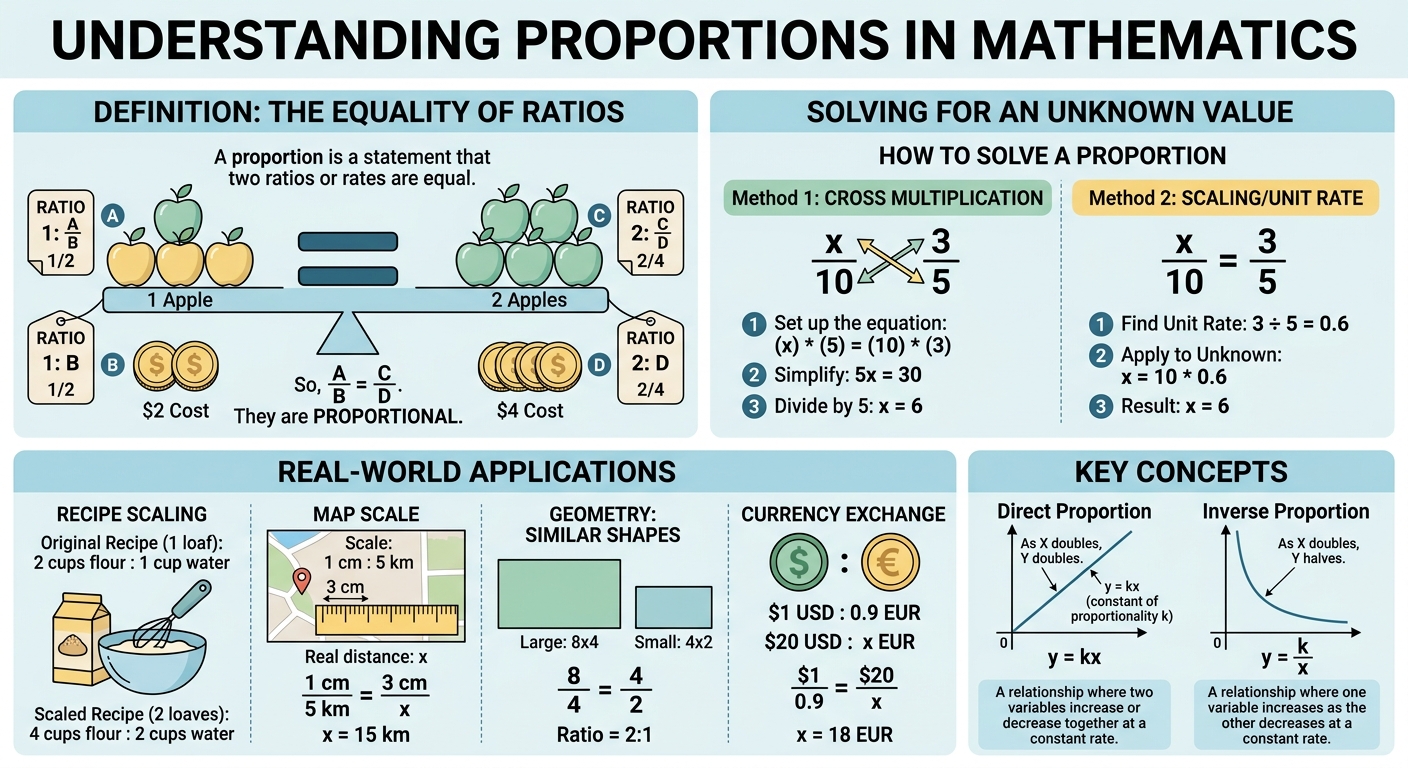
How To Solve Proportions With Cross Multiplication
The short version
- A proportion says two ratios are equal, like 3/4 = x/12. To solve it, cross multiply (3 × 12 = 4 × x), then divide to get x by itself: 36 = 4x, so x = 9.
- If one ratio is a simple multiple of the other, you can skip cross multiplication and scale up instead: 4 × 3 = 12, so 3 × 3 = 9.
- For word problems, set both ratios up in the same order (cups over cookies = cups over cookies). A flipped ratio is the most common wrong answer.
- Cross multiplication only works when there’s exactly one fraction on each side of the equals sign. It doesn’t work for adding or subtracting fractions.
- Always check: plug your answer back in and make sure both ratios simplify to the same fraction.
To solve proportions, cross multiply and then divide. Take a/b = c/d, multiply each numerator by the opposite denominator to get a × d = b × c, and divide both sides by the number next to the variable. For 3/4 = x/12, that’s 3 × 12 = 4x, so 36 = 4x and x = 9.
That handles nearly every homework problem. Below we’ll show why it works, when a faster method is better, how to set up word problems so the answer comes out right, and the mistakes that cost kids the most points. There are practice problems with a full answer key at the end.
What is a proportion?
A ratio compares two amounts, like 2 cups of flour for every 3 eggs. A proportion is an equation saying two ratios are equal:
2/3 = 8/12
Both sides describe the same relationship at a different size. If you use 8 cups of flour, you need 12 eggs. Solving a proportion means one of the four numbers is missing, and you’re finding the value that keeps the two ratios equal.
A quick way to test whether two ratios form a proportion is to cross multiply and compare. For 2/3 and 8/12: 2 × 12 = 24 and 3 × 8 = 24. The products match, so it’s a true proportion. For 3/5 and 5/8: 3 × 8 = 24 and 5 × 5 = 25. They don’t match, so those ratios aren’t equal.
How to solve proportions with cross multiplication
- Write the proportion as one fraction equals one fraction.
- Multiply the top of the left fraction by the bottom of the right fraction.
- Multiply the bottom of the left fraction by the top of the right fraction.
- Set those two products equal.
- Divide both sides by the number multiplying the variable.
- Check by plugging your answer back in.
Example 1: the variable on top
x/15 = 4/6
6 × x = 15 × 4
6x = 60
x = 60 ÷ 6
x = 10
Check: 10/15 simplifies to 2/3, and 4/6 simplifies to 2/3. Equal.
Example 2: the variable on the bottom
5/8 = 20/x
5 × x = 8 × 20
5x = 160
x = 32
Check: 20/32 simplifies to 5/8. Kids often freeze when x is in a denominator. The steps don’t change.
Example 3: a decimal answer
9/4 = x/10
4x = 9 × 10
4x = 90
x = 22.5
Proportions don’t have to come out to whole numbers. If the problem is about something that can be split, like miles or cups, a decimal is fine.
Example 4: an expression in the numerator
(x + 2)/5 = 6/10
10(x + 2) = 5 × 6
10x + 20 = 30
10x = 10
x = 1
Check: (1 + 2)/5 = 3/5, and 6/10 = 3/5. The parentheses matter here. Writing 10x + 2 instead of 10x + 20 is a classic slip.
Why cross multiplication works
It’s a shortcut for clearing the fractions. Start with a/b = c/d. Multiply both sides by b, then by d:
a/b × b × d = c/d × b × d
a × d = c × b
The b cancels on the left and the d cancels on the right. That’s all cross multiplying is. Knowing this helps kids remember the limits: it only works when the whole left side is one fraction and the whole right side is one fraction.
Two faster ways to solve proportions
Scale factor
When the numbers are friendly, you don’t need an equation. Look for a multiplier that turns one ratio into the other. In 3/7 = x/28, the bottom went from 7 to 28, which is × 4. Do the same to the top: 3 × 4 = 12, so x = 12.
Unit rate
Find the value for one unit, then multiply. If 3 pounds of apples cost $4.50, one pound costs $4.50 ÷ 3 = $1.50. Seven pounds cost 7 × $1.50 = $10.50. Unit rates work well for prices, speeds, and anything “per” something.
| Method | Best when | Example |
|---|---|---|
| Scale factor | One number is an easy multiple of its partner | 3/7 = x/28 |
| Unit rate | The problem is about price, speed, or “per” | $4.50 for 3 lb, find 7 lb |
| Cross multiplication | The numbers are awkward, or x is on the bottom | 5/8 = 20/x |
How to set up proportion word problems
Kids who can solve proportions on a worksheet often miss them in word problems. Most wrong answers come from the setup, not the arithmetic. The fix is to label each ratio with its units before writing numbers.
Example 5: a recipe
A recipe uses 3 cups of flour to make 24 cookies. How much flour for 40 cookies?
cups/cookies = cups/cookies
3/24 = x/40
24x = 3 × 40
24x = 120
x = 5 cups
Example 6: a map scale
On a map, 2 inches represents 15 miles. Two towns are 7 inches apart on the map. How far apart are they?
inches/miles = inches/miles
2/15 = 7/x
2x = 15 × 7
2x = 105
x = 52.5 miles
A kid who writes 2/15 = x/7 (mixing inches over miles with miles over inches) gets x = 14/15, less than a mile. A quick “does this make sense?” check catches it: 7 inches has to be more than 15 miles.
Common mistakes when solving proportions
- Flipping one ratio. Units have to line up in the same order on both sides.
- Cross multiplying to add fractions. 1/2 + 1/3 has no equals sign between two fractions, so cross multiplication doesn’t apply. You need a common denominator.
- Cross multiplying with extra terms. In x/3 + 1 = 5/6, the left side isn’t a single fraction. Subtract 1 first (or clear fractions another way).
- Dropping parentheses. 10(x + 2) is 10x + 20. Multiply every term.
- Dividing the wrong way. From 6x = 60, the answer is 60 ÷ 6 = 10, not 6 ÷ 60.
- Skipping the check. Plugging the answer back in takes ten seconds and catches most of the errors above.
Practice problems
- Solve: x/15 = 2/5
- Solve: 7/x = 21/12
- Do 6/14 and 9/21 form a proportion?
- Solve: 3/8 = x/20
- A car travels 150 miles in 3 hours. At the same speed, how far does it go in 5 hours?
- 4 pencils cost $1.80. How much do 10 pencils cost?
- Solve: (x – 1)/4 = 9/12
- A muffin recipe uses 2/3 cup of sugar for 12 muffins. How much sugar for 30 muffins?
Answers
- 5x = 30, so x = 6.
- 21x = 84, so x = 4.
- Yes. 6 × 21 = 126 and 14 × 9 = 126.
- 8x = 60, so x = 7.5.
- 150/3 = x/5, so 3x = 750 and x = 250 miles.
- Unit rate: $1.80 ÷ 4 = $0.45 per pencil, and 10 × $0.45 = $4.50.
- 12(x – 1) = 36, so x – 1 = 3 and x = 4.
- (2/3)/12 = x/30, so 12x = 2/3 × 30 = 20 and x = 20/12 = 5/3, or 1 2/3 cups.
If your child is stuck on proportions
Ratios arrive in 6th grade and proportional relationships in 7th. But when a kid can’t solve proportions, the steps above are rarely what’s missing. The gap is usually one of these:
- Equivalent fractions. If 3/4 = 9/12 doesn’t feel obvious, proportions will feel like magic tricks.
- Multiplication and division facts. Slow facts turn a two-step problem into a ten-minute one.
- Knowing what a fraction means as a comparison of two amounts.
All three are 3rd to 5th grade skills, and you can see where each lands in Math Skills By Grade Level: What Your Child Should Know. Proportions are also the bridge into algebra, so a fraction gap here tends to get worse next year. We explain that pattern in Struggling With Algebra? The Real Problem Is Usually Fourth Grade Fractions. For fixing it, a little practice every day beats one long session a week, and Why 20 Minutes A Day Beats A 90-Minute Tutoring Session explains why.
Frequently asked questions
How do you do proportions step by step?
Write the two ratios as fractions with the same units in the same order. Cross multiply, set the two products equal, and divide to find the missing number. Then check by plugging it back in.
How do you do cross multiplication?
For a/b = c/d, multiply a by d and b by c, then set the products equal: a × d = b × c. If a letter is in one of the spots, divide both sides by the number next to it.
Can you cross multiply when adding fractions?
No. Cross multiplication is for an equation with one fraction on each side of the equals sign. To add fractions, find a common denominator.
What grade do kids learn to solve proportions?
Ratio reasoning starts in 6th grade. Solving proportions with cross multiplication is usually taught in 7th grade, along with unit rates and percent problems.
Is there a way to solve proportions without cross multiplying?
Yes. If one ratio is a simple multiple of the other, scale the numerator by the same factor. If the problem is about a rate, find the value for one unit and multiply.
Find the actual gap
A kid who misses proportion problems might have a setup problem, a fraction problem, or a multiplication fact problem, and each one needs a different kind of practice. Math Anon begins with a short adaptive assessment that finds exactly which skills are missing and sends you a written report on the results.
Then your child practices just those skills for about 20 minutes a day, with a progress report for you every week. The $49 assessment is credited back in full on your first month of the subscription. Start the assessment or look over pricing.





