
Number Bonds: What They Are And How To Teach Them
The short version
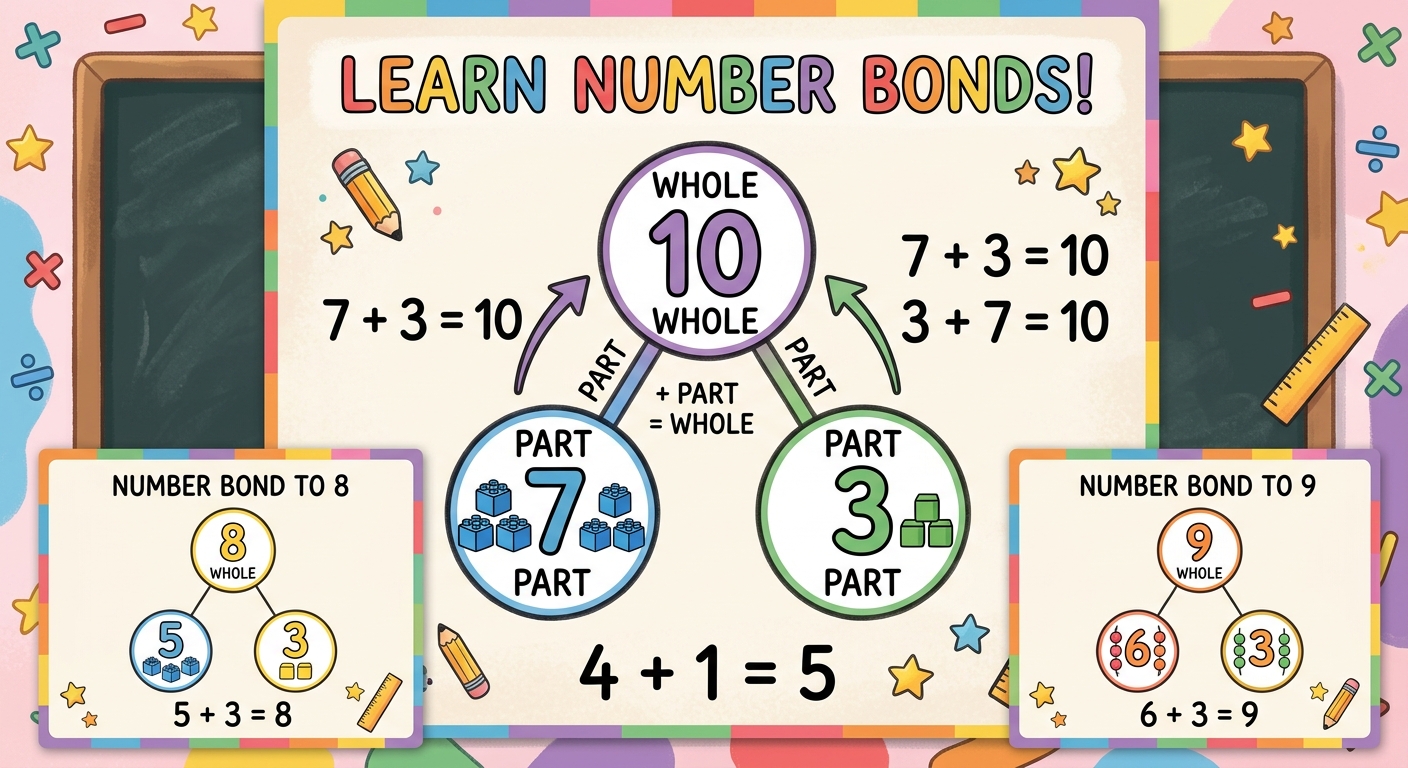
- A number bond shows how a number (the whole) splits into two parts. For 10, one bond is 6 and 4, because 6 + 4 = 10.
- It’s usually drawn as three connected circles: the whole in one circle, and a line to each part.
- One number bond gives four facts. The bond 12, 7, 5 gives 7 + 5 = 12, 5 + 7 = 12, 12 – 7 = 5, and 12 – 5 = 7.
- The bonds that make 10 matter most. Kids who know them cold can add 8 + 5 by thinking 8 + 2 = 10, then 10 + 3 = 13.
- If a child is still counting on fingers for every bond by the end of 1st grade, the gap is usually earlier number sense, and short daily practice is the fix.
Number bonds are a simple way to show that a number is made of parts. A number bond has a whole (say, 9) and two parts that add up to it (say, 5 and 4). Kids learn them in kindergarten through 2nd grade so they can see how addition and subtraction connect, and so they can add and subtract with thinking instead of counting.
If your child’s homework has circles joined by lines, and you weren’t taught math this way, that’s a number bond. Below we’ll show what they look like, the bonds worth memorizing, how they turn into faster mental math, what to do at home, and practice problems with answers.
What a number bond looks like
The usual picture is three circles. The whole goes in one circle, often at the top. Two lines connect it to two smaller circles holding the parts. Some worksheets flip it sideways or put the whole at the bottom. The idea is the same: part + part = whole.
You might also see it called part-part-whole. Number bonds were popularized by Singapore math programs and now show up in many U.S. curricula too.
Here’s how the three numbers relate, using a whole of 9:
| Whole | Part | Part | Addition | Subtraction |
|---|---|---|---|---|
| 9 | 5 | 4 | 5 + 4 = 9 | 9 – 5 = 4 |
| 9 | 6 | 3 | 6 + 3 = 9 | 9 – 6 = 3 |
| 9 | 9 | 0 | 9 + 0 = 9 | 9 – 9 = 0 |
The point kids should notice: when you know the whole and one part, you can always find the other part. That’s subtraction, and number bonds make it feel like the same fact as addition instead of a brand new skill.
Number bonds to 10
These are the bonds kindergarten and 1st grade teachers push hardest, because 10 is the base of our number system. There are only six to learn, since 3 and 7 is the same bond as 7 and 3.
| Whole | Part | Part |
|---|---|---|
| 10 | 10 | 0 |
| 10 | 9 | 1 |
| 10 | 8 | 2 |
| 10 | 7 | 3 |
| 10 | 6 | 4 |
| 10 | 5 | 5 |
Before bonds to 10, kids usually learn bonds to 5 (like 4 and 1, 3 and 2). After them, bonds to 20 come easier because each one leans on a bond to 10. For example, 20 splits into 13 and 7 because 10 + 10 = 20 and 3 + 7 = 10.
How number bonds speed up addition and subtraction
This is the real payoff. Once the bonds to 10 are automatic, kids can break awkward problems into friendly ones.
Example 1: making ten to add
8 + 5
8 needs 2 more to make 10, so split 5 into 2 and 3.
8 + 2 = 10
10 + 3 = 13
Instead of counting up five times from 8, the child does two easy steps.
Example 2: making ten to subtract
13 – 5
Split 5 into 3 and 2, so the first step lands on 10.
13 – 3 = 10
10 – 2 = 8
Another way that works: split 13 into 10 and 3. Then 10 – 5 = 5, and 5 + 3 = 8. Either path is fine. Being able to pick one is the skill.
Example 3: one bond, four facts
The bond with whole 12 and parts 7 and 5 gives a whole fact family:
7 + 5 = 12
5 + 7 = 12
12 – 7 = 5
12 – 5 = 7
That’s four facts for the effort of learning one, which is why teachers lean on bonds so much.
Example 4: bigger numbers in 2nd grade
47 + 8
47 needs 3 to reach 50, so split 8 into 3 and 5.
47 + 3 = 50
50 + 5 = 55
Bonds also show place value. A 2nd grader might split 36 into 30 and 6, which makes 36 + 20 easy: 30 + 20 = 50, then 50 + 6 = 56.
How to practice number bonds at home
A few minutes a day works better than one long session. Some ways to do it without a worksheet:
- The hiding game. Put 7 small objects on the table. Cover some with a cup. Your child counts the ones showing and says how many are hiding. Then check.
- Fingers for 10. Hold up 6 fingers and ask how many are down. Ten fingers make bonds to 10 very visible.
- Egg carton or ten frame. Put 8 items in a 10 slot tray. How many empty spots? That’s the missing part.
- Quick call and answer. You say “4,” they say “6” (for bonds to 10). Then switch roles.
- Bonds in the wild. “There are 9 of us at dinner and 5 have plates. How many still need one?”
Keep it light. If your child gets tense with timed drills, drop the timer. Speed comes from understanding plus repetition, and pressure tends to slow kids down. We cover this more in Math Anxiety In Children: What It Looks Like And What Helps.
Common mistakes with number bonds
- Putting the whole in a part circle. If the bond shows 3 and 8 as parts, the whole is 11, not 5. Ask, “Which number is the biggest? That’s the whole.”
- Counting every time. Early on, counting is fine. By 1st grade, kids should be recalling bonds to 10, not counting them out.
- Treating the missing part as the smaller number minus the bigger. For whole 9 and part 4, some kids try 4 – 9. The rule is always whole minus part.
- Memorizing without meaning. A kid can chant “7 and 3” and still not use it for 17 + 3. Ask them to show a bond with objects now and then.
- Thinking a number has only one bond. 10 has six different bonds. Asking “What’s another way to make 10?” builds flexibility.
Practice problems
- The whole is 10. One part is 7. What’s the other part?
- The whole is 8. One part is 5. What’s the other part?
- List every number bond for 6.
- Write the four facts that come from the bond with whole 9 and parts 4 and 5.
- Use making ten to solve 9 + 6.
- Use a number bond to solve 14 – 6.
- The whole is 15. One part is 9. What’s the other part?
- Use a number bond to solve 38 + 7.
Answers
- 3
- 3
- 6 and 0, 5 and 1, 4 and 2, 3 and 3.
- 4 + 5 = 9, 5 + 4 = 9, 9 – 4 = 5, 9 – 5 = 4.
- Split 6 into 1 and 5. 9 + 1 = 10, then 10 + 5 = 15.
- Split 6 into 4 and 2. 14 – 4 = 10, then 10 – 2 = 8.
- 15 – 9 = 6
- Split 7 into 2 and 5. 38 + 2 = 40, then 40 + 5 = 45.
If your child is stuck on number bonds
Number bonds are one of the first places a gap shows up, and the gap usually sits even earlier. Look for these:
- Counting skills. Can your child count a pile of objects once each, without skipping or double counting?
- Seeing small amounts at a glance. Kids who have to count 3 dots one by one will struggle to hold two parts in their head.
- Counting on. Starting at 6 and counting up “7, 8, 9” instead of starting over from 1.
These gaps matter because bonds feed straight into 2nd grade fluency and 3rd grade multiplication. A 3rd grader still counting on fingers for 8 + 5 is a common warning sign, and Is My Child Behind In Math? 12 Signs By Grade Level covers what to watch for at each age. For why a few minutes of practice a day beats cramming, see Why 20 Minutes A Day Beats A 90-Minute Tutoring Session. And Math Skills By Grade Level: What Your Child Should Know shows what these early skills need to support in 3rd grade and beyond.
Frequently asked questions
What is a number bond in math?
A number bond shows a whole number and two parts that add up to it. For example, 7 is the whole, and 3 and 4 are the parts.
What are number bonds to 10?
The pairs of numbers that add to 10: 0 and 10, 1 and 9, 2 and 8, 3 and 7, 4 and 6, and 5 and 5.
What grade learns number bonds?
Kindergarten introduces breaking numbers up to 10 into pairs. First grade uses bonds to 10 to add and subtract within 20. Second grade builds speed with those facts and stretches bonds to bigger numbers.
Is a number bond the same as a fact family?
They’re closely linked. A number bond is the picture of the three numbers. A fact family is the set of addition and subtraction sentences that come from it.
Can a number bond have more than two parts?
Yes. 10 can split into 5, 3, and 2. Most early worksheets use two parts, but three part bonds show up as kids get comfortable.
Why does my child’s school teach number bonds?
Because they make addition and subtraction the same idea, and they set up mental math like making ten. Kids who understand bonds rely less on counting and more on reasoning.
Find the actual gap
If number bonds aren’t sticking, drilling the same worksheet rarely helps. Math Anon starts with a short adaptive assessment that checks the skills underneath, like counting on and quick recognition of small amounts, and gives you a written report on what’s missing.
From there your child does about 20 minutes a day of practice built around those exact gaps, and you get a weekly report on progress. The assessment is $49, credited back in full on your first month. Start the assessment or see pricing.





