
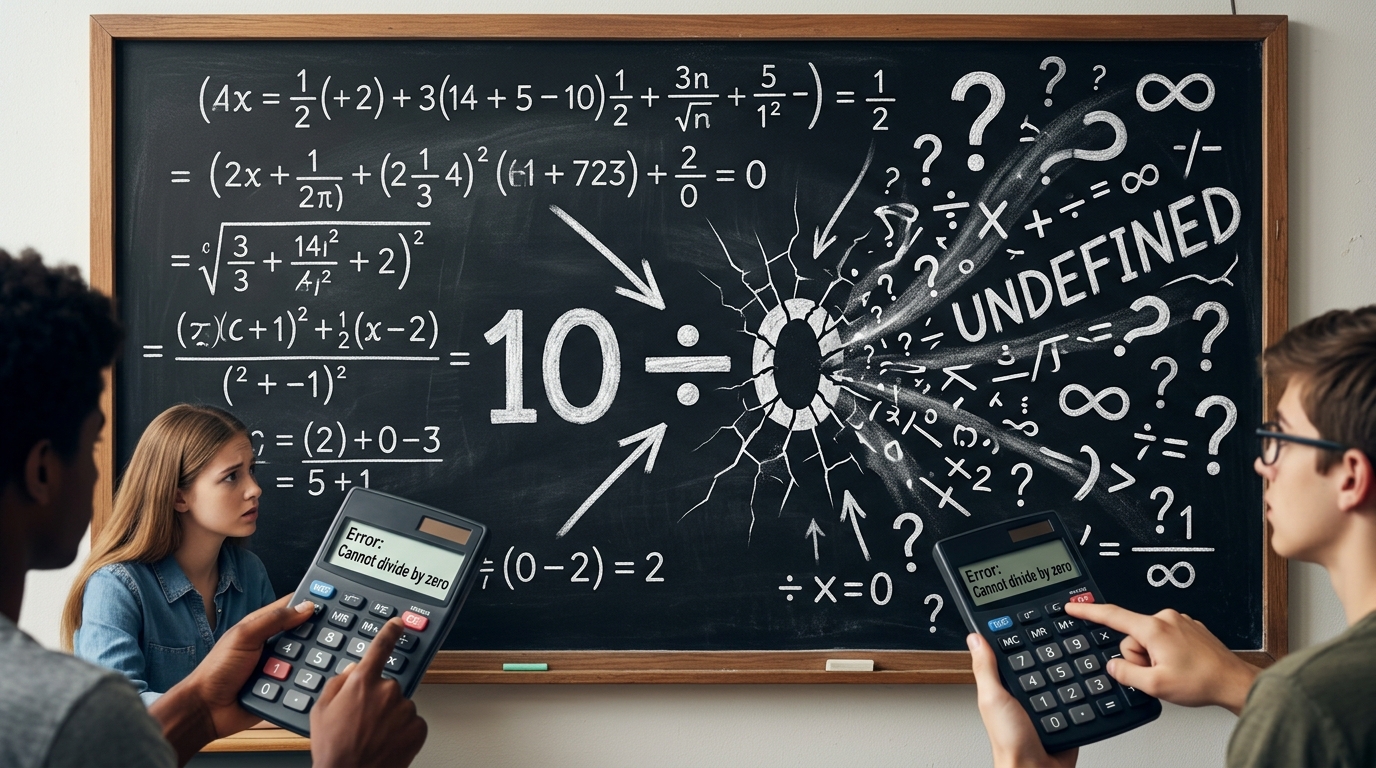
Dividing By Zero: Why The Answer Is Undefined
The short version
- You can’t divide by zero. Any number divided by zero is undefined, because no number times 0 gives you back the number you started with.
- Zero divided by a number is fine. 0 ÷ 5 = 0, since 0 × 5 = 0. Kids mix these two up all the time.
- 0 ÷ 0 is also undefined. Every number times 0 equals 0, so there’s no single answer to pick.
- The answer isn’t infinity. Dividing by numbers closer and closer to 0 makes the result grow huge in the positive direction from one side and the negative direction from the other, so it never settles on one value.
- In algebra, this is why a fraction like 5/(x – 4) has a restriction: x can’t be 4.
Dividing by zero is undefined. Division undoes multiplication, so 12 ÷ 0 would have to be a number that gives 12 when you multiply it by 0. No such number exists, because anything times 0 is 0. That’s why your calculator says “Error.”
That one idea answers the question, but kids usually want to know why “undefined” isn’t just a teacher dodge. Below are three different ways to see it, what happens with 0 ÷ 0, where dividing by zero sneaks into algebra and graphing, and practice problems with answers.
Why can’t you divide by zero? Three ways to see it
1. Check it with multiplication
Every division fact has a matching multiplication fact:
12 ÷ 3 = 4 because 4 × 3 = 12
12 ÷ 0 = ? would need ? × 0 = 12
Try any number. 5 × 0 = 0. 1,000 × 0 = 0. The product is always 0, never 12. There’s no answer, so we call it undefined. This is the explanation most math teachers use, and it’s the one to lead with at home.
2. Think of division as making groups
12 ÷ 3 asks, “How many groups of 3 can you make from 12?” You can take away 3 four times: 12, 9, 6, 3, 0. So the answer is 4.
Now try 12 ÷ 0: “How many groups of 0 can you make from 12?” You take away 0 and still have 12. Take away 0 again, still 12. You can do it forever and never use up the 12. There’s no count to report.
3. Watch the pattern as the divisor shrinks
Divide 12 by smaller and smaller numbers and see what happens:
| Problem | Answer |
|---|---|
| 12 ÷ 4 | 3 |
| 12 ÷ 1 | 12 |
| 12 ÷ 0.1 | 120 |
| 12 ÷ 0.01 | 1,200 |
| 12 ÷ 0.001 | 12,000 |
| 12 ÷ (-0.001) | -12,000 |
| 12 ÷ (-0.01) | -1,200 |
As the divisor gets closer to 0 from the positive side, the answer grows without end. From the negative side, it heads the other way, toward huge negative numbers. The two sides don’t meet. So there’s no single value you could call 12 ÷ 0, not even infinity. This is also a good preview of limits, which older students see in precalculus and calculus.
What about 0 ÷ 0?
This one breaks for the opposite reason. Use the multiplication check:
0 ÷ 0 = ? would need ? × 0 = 0
Now every number works. 3 × 0 = 0, 50 × 0 = 0, -8 × 0 = 0. When a question has every number as an answer, it doesn’t have a useful answer, so 0 ÷ 0 is also undefined. In higher math it gets a special label, indeterminate, because in calculus problems that start out as 0/0 can end up at many different values depending on where they came from.
A common student guess is 0 ÷ 0 = 1, because “a number divided by itself is 1.” That rule only holds for numbers other than zero. The 0 ÷ 0 case is exactly where it breaks.
Dividing by zero vs. dividing zero
The order matters, and this is where most homework mistakes come from.
| Problem | Answer | Why |
|---|---|---|
| 0 ÷ 5 | 0 | 0 × 5 = 0. Zero shared among 5 people is 0 each. |
| 5 ÷ 0 | Undefined | No number times 0 equals 5. |
| 0 ÷ 0 | Undefined (indeterminate) | Every number times 0 equals 0, so there’s no single answer. |
| 0 × 5 | 0 | Five groups of nothing is nothing. |
A memory trick kids like: zero on top is fine, zero on the bottom is a problem. As a fraction, 0/5 = 0, but 5/0 doesn’t exist.
Where dividing by zero shows up in algebra
Once variables arrive, dividing by zero stops being a trivia question and starts costing points.
Restrictions on fractions with variables
A fraction is undefined whenever its denominator equals 0. To find the problem value, set the denominator equal to 0 and solve.
For 7/(x – 3):
x – 3 = 0
x = 3
So x can be any number except 3. For 8/(2x + 6):
2x + 6 = 0
2x = -6
x = -3
Undefined slope
Slope is (change in y) ÷ (change in x). For the points (3, 1) and (3, 5):
slope = (5 – 1) ÷ (3 – 3) = 4 ÷ 0
That’s undefined, and the line is vertical. Don’t confuse it with a slope of 0, which is a flat, horizontal line: there the top of the fraction is 0, not the bottom.
The fake proof that 2 = 1
This classic trick shows why dividing by zero is banned. Start with two equal numbers, a = b.
a = b
a² = ab (multiply both sides by a)
a² – b² = ab – b² (subtract b² from both sides)
(a + b)(a – b) = b(a – b) (factor both sides)
a + b = b (divide both sides by a – b)
b + b = b (since a = b)
2b = b
2 = 1
Every step looks legal except one. Since a = b, the quantity a – b is 0, so the “divide both sides by a – b” step divides by zero. Allow that one move and you can “prove” anything, which is exactly why math doesn’t allow it.
Common mistakes with dividing by zero
- Answering 0. 5 ÷ 0 is undefined, not 0. The kid is mixing it up with 0 ÷ 5.
- Answering infinity. Infinity isn’t a regular number you can multiply back, and the answer runs toward both positive and negative values anyway.
- Saying 0 ÷ 0 = 1. The “divided by itself” rule excludes zero.
- Calling 0 ÷ 5 undefined. Zero on top is fine. The answer is 0.
- Skipping restrictions in algebra. When simplifying 5/(x – 4), note that x can’t be 4, even if the problem doesn’t ask directly.
- Mixing up zero slope and undefined slope. Horizontal lines have slope 0. Vertical lines have undefined slope.
Practice problems
- 0 ÷ 9 = ?
- 9 ÷ 0 = ?
- 0 ÷ 0 = ?
- 12 ÷ 0.01 = ?
- What value of x makes 5/(x – 4) undefined?
- What value of x makes 8/(2x + 6) undefined?
- Find the slope of the line through (2, 1) and (2, 7).
- A student says 0 ÷ 0 = 1 because any number divided by itself is 1. What’s wrong with that?
Answers
- 0, because 0 × 9 = 0.
- Undefined. No number times 0 gives 9.
- Undefined (indeterminate). Every number times 0 gives 0, so there’s no single answer.
- 1,200. Check: 1,200 × 0.01 = 12.
- x = 4, because 4 – 4 = 0.
- x = -3, because 2(-3) + 6 = 0.
- Undefined. (7 – 1) ÷ (2 – 2) = 6 ÷ 0. The line is vertical.
- The rule “a number divided by itself is 1” only works for numbers other than 0. If 0 ÷ 0 were 1, it could just as well be 2 or 7, since 2 × 0 and 7 × 0 both equal 0.
If your child is stuck on dividing by zero
Confusion about dividing by zero is usually a sign that division itself isn’t fully clear. In 3rd grade, kids are supposed to learn that division is an unknown factor problem: 12 ÷ 3 means “3 times what is 12?” A child who has that idea can reason out 12 ÷ 0 on their own. A child who learned division as a list of memorized facts has nothing to reason with.
Check whether your child can explain 20 ÷ 4 using multiplication. If not, that’s the skill to shore up. Math Skills By Grade Level: What Your Child Should Know shows where multiplication and division fit in 3rd through 5th grade. In middle school, the algebra versions (restrictions and undefined slope) depend on fractions being solid, which we cover in Struggling With Algebra? The Real Problem Is Usually Fourth Grade Fractions. If you’re seeing gaps in several places, Mind The Gap: A Parent’s Guide To Math Assessment For Kids explains how to find the root.
Frequently asked questions
Can you divide by zero?
No. In ordinary arithmetic, dividing by zero is undefined. There’s no number that works as an answer.
What is 1 divided by 0?
Undefined. You’d need a number that gives 1 when multiplied by 0, and none exists.
Is dividing by zero infinity?
No. Dividing by tiny positive numbers gives huge positive results, and dividing by tiny negative numbers gives huge negative results. Since those don’t agree, the answer isn’t infinity or anything else.
Is zero divided by a number zero?
Yes. 0 divided by any nonzero number is 0. For example, 0 ÷ 8 = 0 because 0 × 8 = 0.
What happens when you divide by zero on a calculator?
Most calculators show “Error” or “Undefined.” Spreadsheets like Excel and Google Sheets show #DIV/0!, which is the same message in spreadsheet form.
Find the actual gap
When a kid can’t explain why dividing by zero fails, it often points back to how they understand division in the first place. Math Anon starts with a short adaptive assessment that finds the specific skills your child is missing, from 3rd grade division through middle school algebra, and gives you a written report.
Next comes about 20 minutes a day of targeted practice on those skills, plus a progress report in your inbox each week. The assessment is $49 and gets credited back in full on your first month. Start the assessment or check out pricing.





