
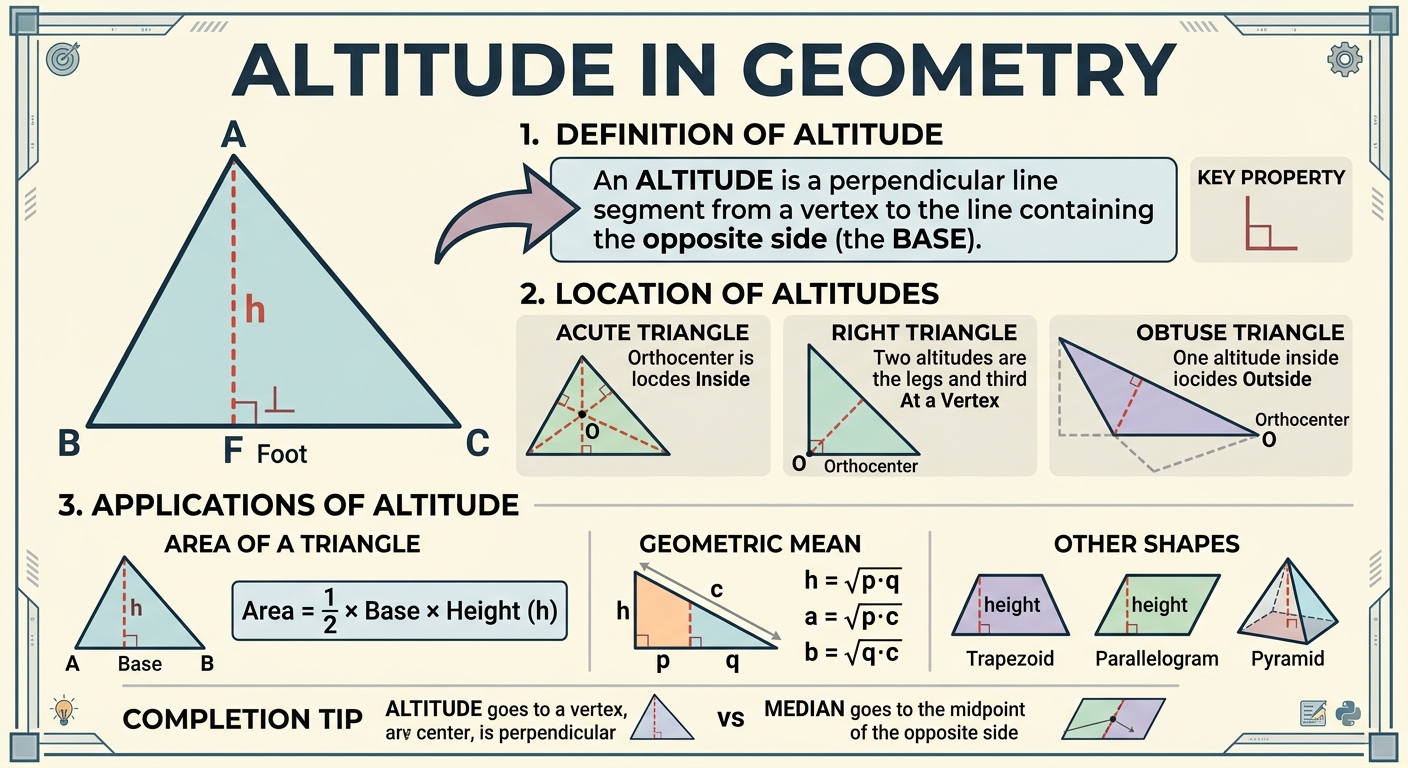
Altitude In Geometry: Definition, Examples And Practice
The short version
- An altitude is a line segment from a vertex of a shape that meets the opposite side (or the line that side sits on) at a right angle. Its length is the shape’s height.
- Every triangle has three altitudes, one from each corner. They can sit inside the triangle, lie along a side, or fall outside it, depending on the triangle’s angles.
- The altitude is the “h” in the area formula A = ½ × b × h, and it has to match the base you picked.
- If you know the area and the base, the altitude is h = 2A ÷ b.
In geometry, an altitude is a segment drawn from a vertex straight to the opposite side, meeting that side at a 90° angle. The length of that segment is the height of the shape, which is why teachers use “altitude” and “height” almost interchangeably. The key word is perpendicular: a line from a corner to the other side only counts as an altitude if it hits at a right angle.
Kids usually meet altitudes around grades 5 and 6 with the area of a triangle, then again in middle and high school geometry, where the tricky cases show up.
Altitude definition in geometry
In plain words, an altitude is the shortest path from a vertex to the line containing the opposite side. The shortest path from a point to a line is always the perpendicular one, which is why there’s a right angle (often marked with a small square) where it lands.
A few terms travel with it:
- Base: the side the altitude drops onto. Any side can be the base.
- Foot of the altitude: the point where the altitude meets the base (or the base’s extension).
- Orthocenter: the single point where all three altitudes of a triangle (or the lines they sit on) cross.
What are altitudes in different triangles?
A triangle has three vertices, so it has three altitudes. Where they sit depends on the biggest angle in the triangle.
| Triangle type | Where the altitudes are | Where the orthocenter is |
|---|---|---|
| Acute (all angles under 90°) | All three are inside the triangle | Inside |
| Right (one 90° angle) | Two altitudes are the legs themselves; the third goes from the right angle to the hypotenuse | At the right angle vertex |
| Obtuse (one angle over 90°) | One is inside; two fall outside, so you have to extend the base to draw them | Outside |
The obtuse case trips up a lot of students. Drop a perpendicular from the top of a long, leaning triangle and it may land past the end of the base. That’s fine. Extend the base with a dashed line, and the altitude meets the extension at a right angle.
In a right triangle, the legs already meet at 90°, so each leg is the altitude to the other leg. That’s why the area of a right triangle is just half of leg × leg.
How to find the altitude of a triangle
1. Work backward from the area
Start with A = ½ × b × h. Multiply both sides by 2 and divide by b, and you get h = 2A ÷ b.
Example: A triangle has an area of 42 square inches and a base of 12 inches. How long is the altitude to that base?
h = 2 × 42 ÷ 12
h = 84 ÷ 12
h = 7 inches
2. Use the Pythagorean theorem
When the altitude splits the triangle into two right triangles, you can use a² + b² = c².
Example: An isosceles triangle has sides 13, 13, and 10. Find the altitude to the side of length 10.
In an isosceles triangle, the altitude to the base cuts the base exactly in half, so each half is 5.
Each half is a right triangle with hypotenuse 13 and one leg 5.
h² + 5² = 13²
h² + 25 = 169
h² = 144
h = 12
Now the area is easy: ½ × 10 × 12 = 60.
Example: An equilateral triangle has sides of 8. The altitude splits the base into two pieces of 4.
h² + 4² = 8²
h² = 64 – 16 = 48
h = √48 = 4√3, which is about 6.93
That gives a shortcut worth knowing: the altitude of any equilateral triangle with side s is (s√3) ÷ 2.
3. The altitude to the hypotenuse
For a right triangle, the altitude from the right angle to the hypotenuse equals leg × leg ÷ hypotenuse. It comes from writing the area two ways.
Example: A right triangle has legs 6 and 8 and hypotenuse 10.
Area using the legs: ½ × 6 × 8 = 24
Area using the hypotenuse: ½ × 10 × h = 24
5h = 24
h = 4.8
Notice this triangle has three altitudes: 8 (to the side of 6), 6 (to the side of 8), and 4.8 (to the side of 10). Every base and altitude pair gives the same area of 24. That’s a good way to check your work.
Using altitude to find area
The altitude is what makes the area formulas work. Here’s where it shows up:
| Shape | Area formula | What the altitude is |
|---|---|---|
| Triangle | A = ½ × b × h | Perpendicular distance from the base to the opposite vertex |
| Parallelogram | A = b × h | Perpendicular distance between the two parallel bases |
| Trapezoid | A = ½ × (b₁ + b₂) × h | Perpendicular distance between the parallel sides |
Obtuse example: Put a triangle on a grid with corners at (0, 0), (5, 0), and (8, 4). The base runs from 0 to 5 along the x axis. The top vertex is at x = 8, past the end of the base, so the altitude drops straight down to (8, 0), outside the triangle. Its length is 4.
Area = ½ × 5 × 4 = 10 square units
The slanted side from (5, 0) to (8, 4) is 5 units long. A student who uses 5 as the height gets 12.5, which is wrong.
Common mistakes with altitude
- Using a slanted side as the height. This is the big one. The height has to be perpendicular to the base.
- Mismatching base and altitude. If you use the side of 10 as the base, you need the altitude to that side, not the altitude to a different side.
- Thinking the altitude must be inside. In obtuse triangles, two altitudes fall outside. Kids who don’t know this often draw a wrong line just to keep it inside.
- Forgetting the ½ for triangles.
- Assuming the altitude hits the midpoint. That’s a median. They only match in isosceles and equilateral triangles.
- Stopping at h² in Pythagorean problems. If h² = 144, the altitude is 12, not 144.
Practice problems
- A triangle has a base of 9 cm and an altitude of 4 cm. What’s its area?
- A triangle has an area of 35 square feet and a base of 10 feet. How long is the altitude to that base?
- A triangle has an area of 24 square meters and an altitude of 6 meters. How long is the base?
- A parallelogram has a base of 15, a slanted side of 5, and an altitude of 4. What’s its area?
- An isosceles triangle has sides 10, 10, and 12. Find the altitude to the side of length 12, then find the area.
- Find the altitude of an equilateral triangle with side 6. Give the exact answer and a decimal to the nearest hundredth.
- A right triangle has legs 5 and 12 and hypotenuse 13. Find the altitude to the hypotenuse, to the nearest hundredth.
- A triangle with sides 13, 14, and 15 has an area of 84. Find the altitude to the side of length 14 and the altitude to the side of length 15.
Answers
- ½ × 9 × 4 = 18 square cm.
- h = 2 × 35 ÷ 10 = 70 ÷ 10 = 7 feet.
- b = 2 × 24 ÷ 6 = 48 ÷ 6 = 8 meters.
- 15 × 4 = 60. The 5 is a distractor, since the slanted side isn’t the altitude.
- Half the base is 6. h² = 10² – 6² = 100 – 36 = 64, so h = 8. Area = ½ × 12 × 8 = 48.
- h = (6√3) ÷ 2 = 3√3, which is about 5.20.
- Area = ½ × 5 × 12 = 30. Then ½ × 13 × h = 30, so h = 60 ÷ 13, about 4.62.
- To the side of 14: h = 2 × 84 ÷ 14 = 168 ÷ 14 = 12. To the side of 15: h = 168 ÷ 15 = 11.2.
If your child is stuck on altitude
When a kid can’t find an altitude, the problem is rarely the word itself. It’s usually one of the skills underneath it. Can they spot a right angle and tell it apart from an angle that just looks close? Do they know why the area of a triangle is half of base × height, or did they memorize the formula without the picture? In the harder problems, can they square numbers, take square roots, and rearrange a simple equation like 5h = 24?
Angle sense is a common weak spot. If your child is shaky on right angles and how angles add up, our post on supplementary angles is a good place to check. And if geometry is one of several topics that feel hard at once, it’s worth looking at the bigger picture with these signs a child is behind in math. Altitude problems pull in area, division, and the Pythagorean theorem all at once, so older gaps surface here.
Frequently asked questions
What are altitudes in a triangle?
Altitudes are the three segments you can draw from each vertex of a triangle to the opposite side, meeting it at a right angle. Each one is the height of the triangle when you treat that opposite side as the base.
Is altitude the same as height?
Close. The altitude is the segment, and the height is its length. On most worksheets the words mean the same thing. Outside math class, altitude also means height above sea level.
Can an altitude be outside the triangle?
Yes. In an obtuse triangle, the altitudes from the two acute angles land outside the triangle. You extend the base with a dashed line so the altitude has somewhere to meet it at 90°.
Is the altitude of a triangle the same as the median?
Only in special cases. An altitude meets the opposite side at a right angle, and a median meets it at the midpoint. They’re the same segment in an equilateral triangle, and for the altitude from the top vertex of an isosceles triangle.
What’s the altitude of a right triangle?
A right triangle has three. The two legs are altitudes to each other. The third runs from the right angle to the hypotenuse, and its length is leg × leg ÷ hypotenuse.
Find the actual gap
If altitude problems keep ending in wrong answers, it helps to know which skill is actually missing. Math Anon starts with a short adaptive assessment that zeroes in on the specific gaps, from area and right angles back to multiplication facts, and you get a written report of what it found.
From there, your child gets about 20 minutes a day of practice aimed only at those gaps, and you get a progress report every week. The assessment is $49, and that amount is credited back in full on your first month. Start the assessment or see pricing.





