
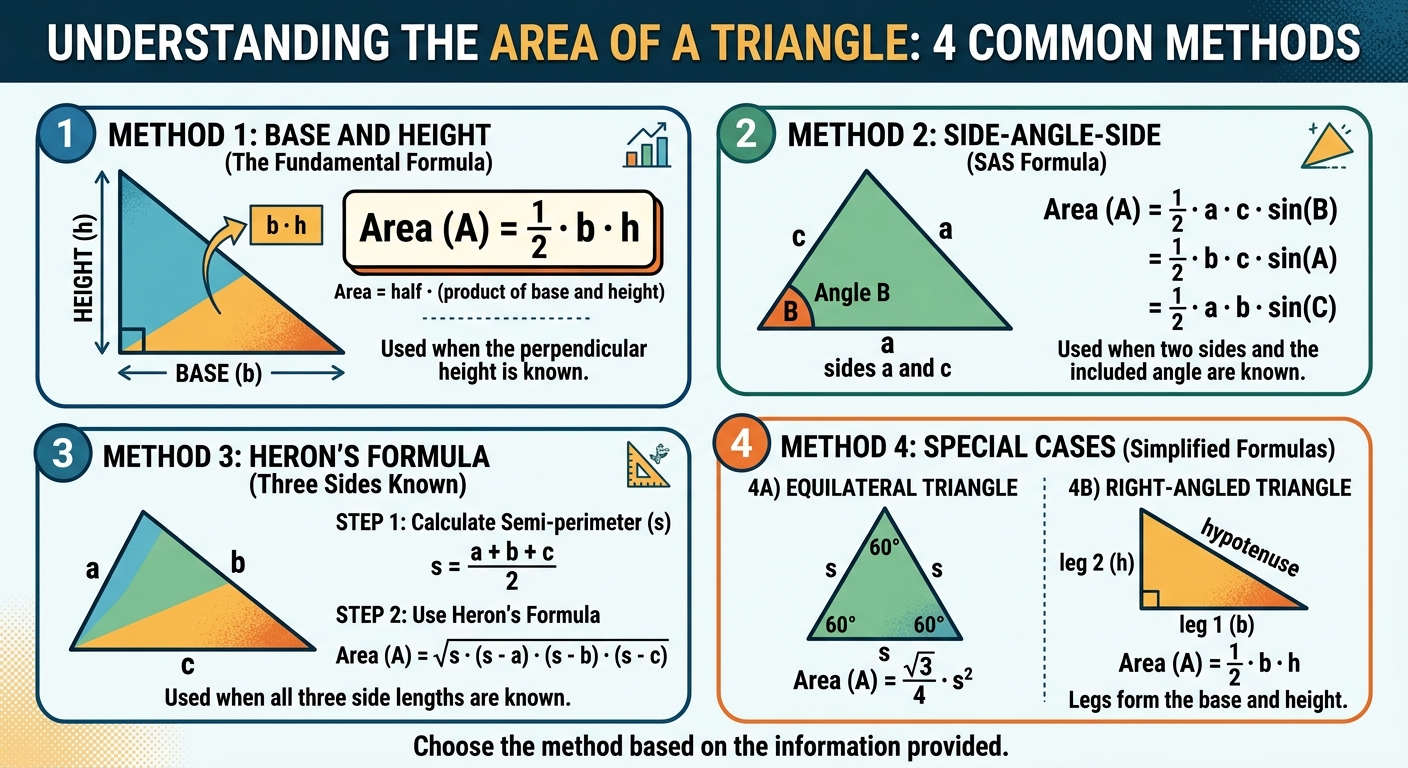
Area Of A Triangle: Formula, Examples And Practice
The short version
- The area of a triangle is half the base times the height: A = ½ × b × h, or A = (b × h) ÷ 2.
- The height has to be perpendicular to the base (it meets the base at a right angle). It’s usually not one of the slanted sides.
- Every triangle is half of a rectangle or parallelogram with the same base and height, which is why you divide by 2.
- If you only know the three side lengths, use Heron’s formula instead.
- Area is always in square units: cm², in², ft², or m².
To find the area of a triangle, multiply the base by the height and divide by 2. A triangle with a base of 10 cm and a height of 6 cm has an area of 10 × 6 ÷ 2 = 30 cm². That one formula works for every triangle: right, acute, obtuse, isosceles, or scalene.
The arithmetic is easy. Picking the right height is where kids slip, especially when the triangle is tilted or the height falls outside the shape. We’ll walk through why the formula works, how to spot the height, worked examples with each triangle type, what to do when you only have the side lengths, and the mistakes that cost the most points.
The area of a triangle formula
A = ½ × b × h
- b is the base: any one side of the triangle you choose.
- h is the height: the straight-line distance from the base to the opposite corner, measured at a right angle to the base.
You’ll also see it written as A = bh/2 or A = (b × h) ÷ 2. They’re the same thing. Some kids find “multiply, then halve” easier. Others halve one of the numbers first. For a base of 8 and a height of 7, half of 8 is 4, and 4 × 7 = 28. Same answer as 8 × 7 = 56, then 56 ÷ 2 = 28.
Why you divide by 2
Draw a rectangle 8 units wide and 5 units tall. Its area is 8 × 5 = 40 square units. Now draw a diagonal from one corner to the opposite corner. You’ve cut the rectangle into two identical right triangles, so each one is 40 ÷ 2 = 20 square units.
That works for triangles without a right angle too. Take two copies of any triangle, flip one, and fit them together along a side. They make a parallelogram with the same base and height, and a parallelogram’s area is base × height. One triangle is half of that. When a kid sees this once, the ½ stops being a random rule they forget.
How to find the base and height
Any side can be the base. Once you pick it, the height is the perpendicular distance from that base to the corner across from it. On worksheets, the height is usually a dashed line with a small square showing the right angle.
| Triangle type | Where the height is |
|---|---|
| Right triangle | The two sides that form the right angle (the legs) are the base and height. The longest side, the hypotenuse, is never the height. |
| Acute triangle | Inside the triangle, dropping straight down from the top corner to the base. |
| Obtuse triangle | Often outside the triangle. You extend the base line and drop the height to that extension. |
| Equilateral or isosceles | Inside, landing exactly in the middle of the base. |
The obtuse case confuses a lot of kids because the height looks like it’s hanging in empty space. It still counts. The formula still uses the original base length, not the extended line.
Worked examples
Example 1: right triangle
A right triangle has legs of 8 in and 5 in, and a hypotenuse of about 9.43 in.
Base = 8, height = 5 (the legs)
A = ½ × 8 × 5 = ½ × 40 = 20 in²
The hypotenuse doesn’t get used at all. It’s there to tempt you.
Example 2: acute triangle
Base = 14 cm, height = 9 cm.
A = ½ × 14 × 9
= 7 × 9
= 63 cm²
Example 3: obtuse triangle
An obtuse triangle has a base of 10 m. The height, drawn outside the triangle to the extended base, is 7 m.
A = ½ × 10 × 7 = 35 m²
Example 4: decimals
Base = 7.5 ft, height = 4 ft.
A = ½ × 7.5 × 4
= 7.5 × 2
= 15 ft²
Example 5: working backward to find the height
A triangle has an area of 54 cm² and a base of 12 cm. What’s the height?
54 = ½ × 12 × h
54 = 6h
h = 54 ÷ 6 = 9 cm
Example 6: on a coordinate plane
Find the area of the triangle with corners at (1, 1), (7, 1), and (4, 6).
The first two points share y = 1, so that side is flat. Base = 7 – 1 = 6
The third point is at y = 6, so the height is 6 – 1 = 5
A = ½ × 6 × 5 = 15 square units
Finding the area of a triangle with three sides (Heron’s formula)
Sometimes a problem gives you three side lengths and no height. Heron’s formula handles that in two steps.
- Find the semi-perimeter, s, which is half the perimeter: s = (a + b + c) ÷ 2.
- Area = √[s(s – a)(s – b)(s – c)]
Example: sides 13, 14, and 15.
s = (13 + 14 + 15) ÷ 2 = 42 ÷ 2 = 21
s – a = 8, s – b = 7, s – c = 6
Area = √(21 × 8 × 7 × 6) = √7056 = 84 square units
You can check Heron’s formula against the regular formula. An isosceles triangle with sides 5, 5, and 6 has s = 8, so the area is √(8 × 3 × 3 × 2) = √144 = 12. Drop the height to the middle of the 6 side and you get a right triangle with sides 3, 4, and 5, so the height is 4 and ½ × 6 × 4 = 12. Both methods agree.
Other area formulas you might see
| What you know | Formula |
|---|---|
| Base and height | A = ½bh |
| Legs of a right triangle | A = ½ × leg × leg |
| Side of an equilateral triangle, s | A = (√3 ÷ 4) × s², so a side of 6 gives about 15.59 |
| All three sides | Heron’s formula |
| Two sides and the angle between them (high school) | A = ½ab × sin C |
Common mistakes
- Forgetting to divide by 2. This is the top error. A kid who writes 60 for a base of 10 and height of 6 found the area of the whole rectangle.
- Using a slanted side as the height. The height must meet the base at a right angle. When a diagram labels all three sides plus a dashed height, the two slanted sides are usually distractors.
- Using the hypotenuse on a right triangle. Use the two legs.
- Mixing units. A base in feet and a height in inches has to be converted to one unit first.
- Writing plain units. Area is in square units: 30 cm², not 30 cm.
- Mixing up area and perimeter. Perimeter adds the three sides. Area measures the space inside.
Practice problems
- Find the area: base 10, height 6.
- A right triangle has legs of 9 and 4. Find the area.
- Find the area: base 15 cm, height 8 cm.
- Find the area: base 11 ft, height 5 ft.
- A triangle’s area is 48 in² and its base is 12 in. Find the height.
- A triangle has sides 6, 8, and 10. Find its area.
- Find the area of the triangle with corners at (0, 0), (8, 0), and (3, 5).
- A triangle has a base of 3 ft and a height of 18 in. Find the area in square feet.
Answers
- ½ × 10 × 6 = 30 square units
- ½ × 9 × 4 = 18 square units
- ½ × 15 × 8 = 60 cm²
- ½ × 11 × 5 = 27.5 ft²
- 48 = ½ × 12 × h, so 48 = 6h and h = 8 in
- 6² + 8² = 36 + 64 = 100 = 10², so it’s a right triangle with legs 6 and 8. ½ × 6 × 8 = 24 square units. (Heron’s formula agrees: s = 12, √(12 × 6 × 4 × 2) = √576 = 24.)
- Base = 8 (along the x-axis), height = 5. ½ × 8 × 5 = 20 square units
- 18 in = 1.5 ft. ½ × 3 × 1.5 = 2.25 ft²
What it means if your kid is stuck on triangle area
Triangle area usually shows up in sixth grade, but it stands on skills from third and fourth grade. When a child can’t get these right, check the pieces underneath:
- Area of a rectangle. If they don’t see area as rows of unit squares, the ½ has nothing to attach to.
- Multiplication facts. Slow facts turn a two-step problem into a grind, and errors creep in.
- Halving and fractions. Halving odd numbers (½ × 11 × 5) and decimals trips kids who never got comfortable with fractions.
- Perpendicular lines and right angles. Without this, the dashed height line is just another line.
Our guide to math skills by grade level shows where each of those is supposed to land. If your kid is also shaky on angle vocabulary, Supplementary Angles, Explained covers another geometry basic that feeds into triangle work. And if you’re wondering whether this is a one-topic stumble or a sign of something bigger, these signs by grade level help sort that out.
Frequently asked questions
What is the formula for the area of a triangle?
A = ½ × base × height. Multiply the base by the perpendicular height, then divide by 2.
How do you find the area of a triangle without the height?
If you know all three sides, use Heron’s formula. If it’s a right triangle, the two legs are the base and height. If you know two sides and the angle between them, use A = ½ab × sin C.
Why is the area of a triangle half of base times height?
Two identical copies of any triangle fit together into a parallelogram (or a rectangle, for a right triangle) with the same base and height. That shape’s area is base × height, so one triangle is half of it.
Is the area of all triangles found the same way?
Yes. ½ × b × h works for every triangle. Only the location of the height changes: it’s a leg in right triangles, inside acute triangles, and often outside obtuse ones.
What units is the area of a triangle measured in?
Square units. If the sides are in centimeters, the area is in square centimeters (cm²). If they’re in feet, it’s square feet (ft²).
Find the actual gap
If triangle area keeps coming out wrong, the problem is often a few grades back: rectangle area, multiplication facts, or fractions. Math Anon begins with a short adaptive assessment that pinpoints which of those skills are missing and sends you a written report.
Then your kid does about 20 minutes a day of practice aimed only at those gaps, and you get a progress report each week. The assessment costs $49, credited back in full on your first month. Start the assessment or check pricing first.





