
How To Find Area: Formulas For Every Shape, With Examples
The short version
- Area is the number of unit squares that fit inside a flat shape, so the answer is always in square units (cm², ft², square units).
- Rectangles: length × width. Triangles: ½ × base × height. Circles: π × radius × radius.
- The height of a triangle or parallelogram is the straight-up distance that meets the base at a right angle, never the slanted side.
- For odd shapes, split them into rectangles and triangles and add the pieces, or find a big rectangle and subtract what’s missing.
- Converting units? 1 square foot is 144 square inches and 1 square yard is 9 square feet, because both dimensions convert.
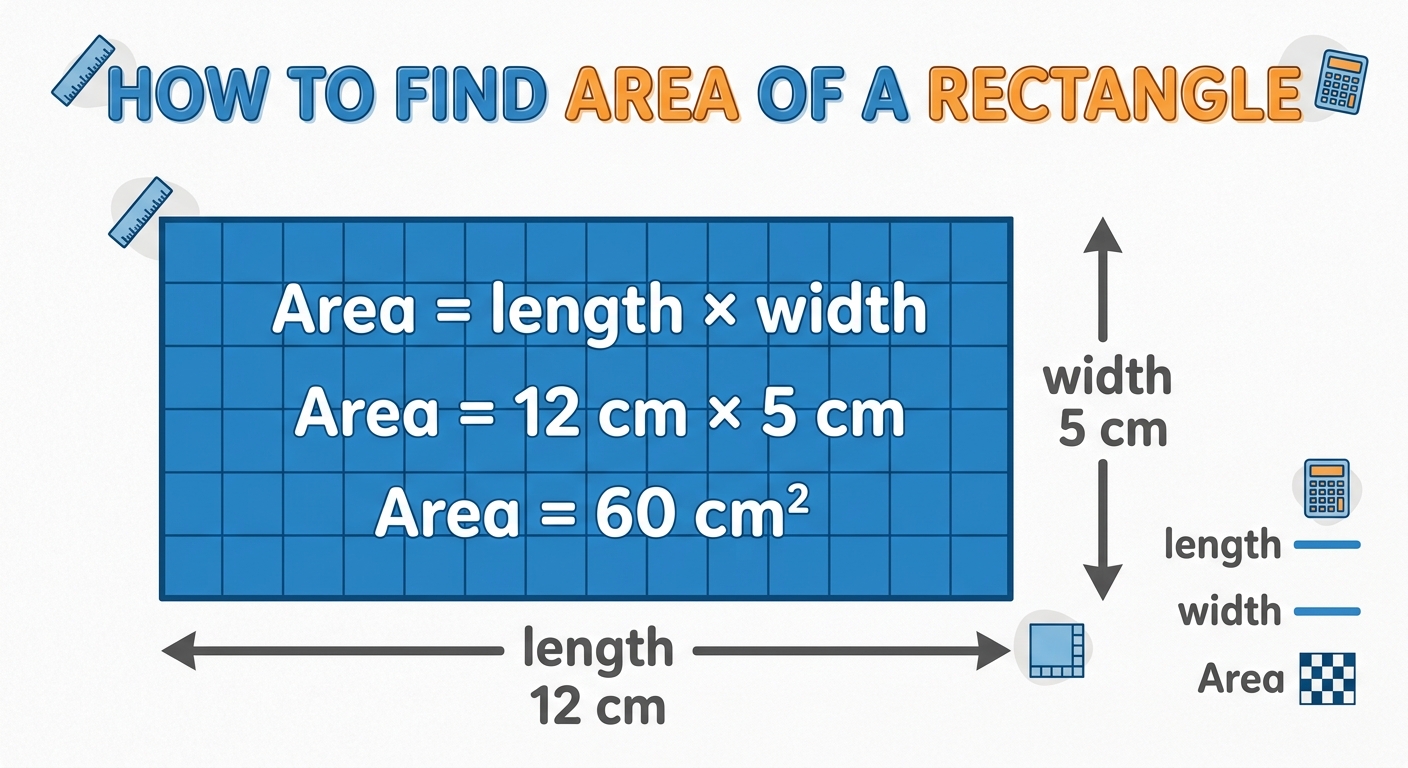
Here’s how to find area: work out how many unit squares cover a flat shape. For a rectangle, that’s length × width: a rectangle 5 units long and 3 units wide holds 5 × 3 = 15 square units. Every other area formula (triangles, parallelograms, trapezoids, circles) is built from that same idea.
This guide covers how to find area for each common shape with a worked example, why the formulas work, how to handle L-shapes and other irregular figures, and how to convert between square feet, square yards and square inches without the classic mistake. There’s a practice set with answers at the end.
What area means
Area measures the space inside a flat, two-dimensional shape. Picture covering a floor with square tiles that are 1 foot on each side. The number of tiles you need is the floor’s area in square feet.
A rectangle 4 tiles wide and 6 tiles long has 4 rows of 6, or 24 tiles. That’s why multiplying works: length × width is just a fast way to count the squares in rows.
Area vs perimeter
Area is the inside. Perimeter is the distance around the edge. Same 6 by 4 rectangle:
Area: 6 × 4 = 24 square units
Perimeter: 6 + 4 + 6 + 4 = 20 units
Area uses square units. Perimeter uses plain units, because it’s a length.
Area formulas for common shapes
| Shape | Formula | What the letters mean |
|---|---|---|
| Square | A = s × s | s = side length |
| Rectangle | A = l × w | l = length, w = width |
| Parallelogram | A = b × h | b = base, h = perpendicular height |
| Triangle | A = ½ × b × h | b = base, h = perpendicular height |
| Trapezoid | A = ½ × (b₁ + b₂) × h | b₁ and b₂ = the two parallel sides, h = height |
| Circle | A = π × r × r | r = radius, π ≈ 3.14 |
How to find area of each shape, with examples
Rectangles and squares
A bedroom is 12 feet by 9 feet.
A = 12 × 9 = 108 square feet
A square tile is 7 cm on each side.
A = 7 × 7 = 49 cm²
Parallelograms
Slice the triangle off one end of a parallelogram, slide it to the other end, and you get a rectangle. So the area is base × height, where height is measured straight up from the base.
Base 10 m, height 6 m, slanted side 7.5 m.
A = 10 × 6 = 60 m²
The 7.5 isn’t used. It’s there to catch kids who multiply the sides.
Triangles
Two copies of any triangle fit together to make a parallelogram. That’s where the ½ comes from.
Base 8 in, height 5 in.
A = ½ × 8 × 5 = ½ × 40 = 20 in²
For a right triangle, the two legs are the base and height. Legs 6 and 9:
A = ½ × 6 × 9 = 27 square units
Trapezoids
Average the two parallel sides, then multiply by the height.
Parallel sides 6 ft and 10 ft, height 4 ft.
A = ½ × (6 + 10) × 4
= ½ × 16 × 4
= 32 ft²
Circles
Square the radius and multiply by π. If you’re given the diameter, cut it in half first.
A pizza has a diameter of 10 inches, so r = 5.
A = 3.14 × 5 × 5 = 3.14 × 25 = 78.5 in²
In exact form, that’s 25π in².
How to find area of irregular shapes
Most real rooms and yards aren’t a single tidy shape. You have two tools.
Split and add
An L-shaped room: a 10 ft by 3 ft strip along the bottom, and a 4 ft by 5 ft section rising from the left end.
Bottom strip: 10 × 3 = 30 ft²
Upper section: 4 × 5 = 20 ft²
Total: 30 + 20 = 50 ft²
Box it and subtract
Same room. Draw a rectangle around the whole thing: 10 ft wide and 3 + 5 = 8 ft tall, so 80 ft². The empty corner is 10 – 4 = 6 ft wide and 5 ft tall, so 30 ft².
80 – 30 = 50 ft²
Both methods give 50. Getting the same answer two ways is a great self-check for kids.
Shapes with curves
A rectangle 8 m by 4 m with a half circle attached to one 4 m end. The half circle’s diameter is 4, so its radius is 2.
Rectangle: 8 × 4 = 32 m²
Half circle: ½ × 3.14 × 2 × 2 = 6.28 m²
Total: 32 + 6.28 = 38.28 m²
No formula at all
For a blob drawn on grid paper, count the full squares, then count squares that are about half covered and add half that number. It’s an estimate, and that’s fine.
Square units and conversions
This is where adults slip too. There are 3 feet in a yard, but there are 9 square feet in a square yard, because a 1 yard by 1 yard square is 3 feet by 3 feet.
| Conversion | Why |
|---|---|
| 1 ft² = 144 in² | 12 × 12 |
| 1 yd² = 9 ft² | 3 × 3 |
| 1 m² = 10,000 cm² | 100 × 100 |
A 12 ft by 15 ft room is 180 ft². If carpet is sold by the square yard, that’s 180 ÷ 9 = 20 square yards, not 180 ÷ 3 = 60.
Common mistakes when finding area
- Using the slanted side as the height. Height meets the base at a right angle. The slanted side is always longer.
- Forgetting the ½ for triangles. A kid who gets 40 for a triangle with base 8 and height 5 found the rectangle around it.
- Using the diameter in the circle formula. A 10 inch pizza with r = 10 comes out to 314 in², four times too big.
- Mixing units. A 3 ft by 18 in rug has to be all feet (3 × 1.5 = 4.5 ft²) or all inches (36 × 18 = 648 in²) before multiplying.
- Leaving off the “square.” Area answers are in square units. “24 ft” is a length.
- Adding when you should multiply. This is usually area and perimeter getting mixed up.
Practice problems
- Find the area of a rectangle 9 units long and 4 units wide.
- Find the area of a square with sides of 11 cm.
- Find the area of a triangle with a base of 14 in and a height of 6 in.
- A parallelogram has a base of 12 m, a height of 7 m and slanted sides of 9 m. Find its area.
- A trapezoid has parallel sides of 5 ft and 9 ft and a height of 6 ft. Find its area.
- Find the area of a circle with a diameter of 12 cm. Use 3.14 for π.
- A room is 12 ft by 15 ft. How many square yards of carpet cover it?
- A garden is 20 m by 10 m. A 4 m by 4 m square patio sits in the middle. How much of the garden is grass?
Answers
- 9 × 4 = 36 square units
- 11 × 11 = 121 cm²
- ½ × 14 × 6 = 42 in²
- 12 × 7 = 84 m². The 9 m sides aren’t used.
- ½ × (5 + 9) × 6 = ½ × 14 × 6 = 42 ft²
- r = 6, so 3.14 × 6 × 6 = 3.14 × 36 = 113.04 cm²
- 12 × 15 = 180 ft², and 180 ÷ 9 = 20 square yards
- 20 × 10 = 200 m², minus 4 × 4 = 16 m², leaves 184 m² of grass
If your kid is stuck on area
Kids usually meet area in third grade by counting squares, then move to formulas in fourth through sixth. When a kid can’t figure out how to find area, the missing piece is usually earlier: multiplication facts that aren’t automatic, not seeing multiplication as rows and columns (which is the whole reason length × width works), or shaky decimals once π shows up. Mixing up area and perimeter is also a sign the idea of “inside vs around” never quite landed.
Our grade 3 to 5 skills guide shows when each of those should be solid. If area is one of several topics going wrong, these 12 signs by grade level can tell you whether it’s a pattern, and short daily practice is usually the fastest way to close it.
Frequently asked questions
How do you find the area of a shape?
Use the formula for that shape: length × width for a rectangle, ½ × base × height for a triangle, π × r × r for a circle. For shapes without a formula, split them into shapes that have one and add the pieces.
What is the formula for area?
There’s no single formula. The most common is A = l × w for rectangles, and most of the others (parallelograms, triangles, trapezoids) come from rearranging or halving a rectangle.
How do you find the area of a triangle?
Multiply the base by the height and divide by 2. A triangle with base 10 and height 7 has an area of 35 square units.
How do you find the area of an irregular shape?
Break it into rectangles, triangles or half circles, find each area and add them. Or draw a rectangle around the whole thing and subtract the empty parts.
What’s the difference between area and perimeter?
Area is the space inside a shape, measured in square units. Perimeter is the distance around the outside, measured in regular units.
Why is area measured in square units?
Because you’re counting squares. Multiplying feet by feet gives square feet, the same way the rows and columns of tiles make a grid.
Find the actual gap
A kid who keeps missing area problems often has a gap in multiplication or decimals that no amount of formula drills will fix. Math Anon starts with a short adaptive assessment that tracks down which skills are missing and gives you a clear written report.
Then it sets up about 20 minutes of daily practice aimed only at those skills, with a progress report landing every week. The assessment is $49, credited back in full on the first month. Start the assessment or read through pricing.





