
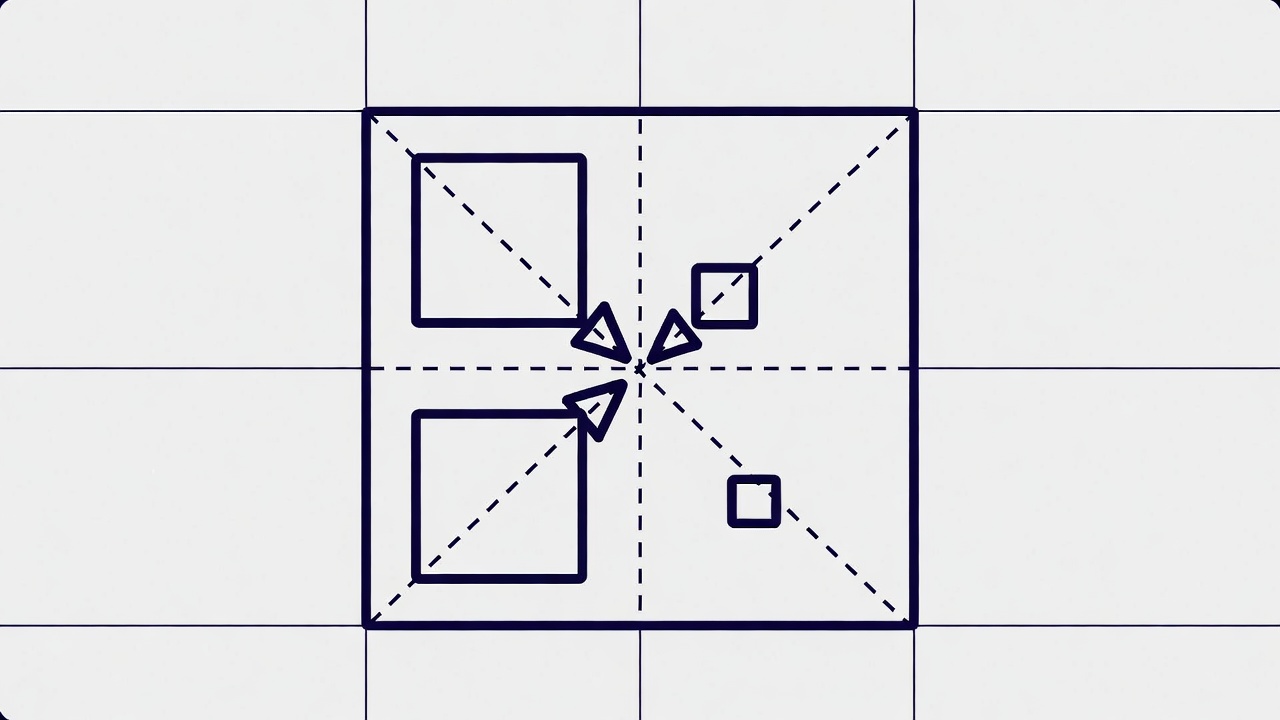
What Is A Scale Factor? Definition, Formula And Examples
The short version
- A scale factor is the number you multiply every length by to make a bigger or smaller copy of a shape. Scale factor = new length ÷ original length.
- A scale factor greater than 1 enlarges, a scale factor between 0 and 1 shrinks, and a scale factor of exactly 1 gives an identical copy.
- Only lengths scale by the scale factor k. Area scales by k² and volume by k³, so doubling the sides of a cube makes its volume 8 times bigger.
- Map scales and model ratios are scale factors too. A 1:24 model car is 1/24 the size of the real car in every direction.
A scale factor is the number that tells you how much a shape has been enlarged or reduced. To find it, divide a length on the new shape by the matching length on the original: scale factor = new ÷ original. If a 4 cm side becomes 12 cm, the scale factor is 12 ÷ 4 = 3, and every other side got 3 times longer too.
Below you’ll find the scale factor definition in plain terms, how to find a scale factor and use it to get missing lengths, how it works on maps and blueprints, what happens to area and volume, and practice problems with answers.
Scale factor definition
When two shapes are similar, they’re the same shape but maybe a different size. Their angles match, and every length on one is the same multiple of the matching length on the other. That multiple is the scale factor, often written as k.
The key word is “every.” If one side doubles and another side triples, the shapes aren’t similar, and no single multiplier works. That’s a good way to check whether a picture has been scaled or just stretched.
| Value of k | What happens | Example |
|---|---|---|
| Greater than 1 | Enlargement | k = 3: a 5 cm side becomes 15 cm |
| Exactly 1 | Same size (congruent copy) | k = 1: a 5 cm side stays 5 cm |
| Between 0 and 1 | Reduction | k = 1/5: a 5 cm side becomes 1 cm |
Values less than 1 can be written as fractions or decimals. A k of 1/4 and a k of 0.25 mean the same thing: every length is a quarter of the original.
How to find a scale factor
- Pick a pair of matching sides, one on the original and one on the copy.
- Divide: new length ÷ original length.
- Check with a second pair of sides. If you get the same number, you’re done.
Example 1: Enlargement
A rectangle is 4 in by 6 in. A copy is 10 in by 15 in. What’s the scale factor?
10 ÷ 4 = 2.5
Check: 15 ÷ 6 = 2.5
Scale factor = 2.5
Example 2: Going the other way
Same two rectangles, but now the 10 by 15 rectangle is the original and the 4 by 6 is the copy.
4 ÷ 10 = 0.4 = 2/5
Big to small is the reciprocal of small to big: 1 ÷ 2.5 = 0.4. That’s why it matters which shape the problem calls the original. Getting it backwards is one of the most common mistakes.
Using a scale factor to find missing lengths
Once you know k, multiply original lengths by it to get new ones, or divide new lengths by it to get original ones.
Example 3: Shrinking a triangle
A triangle with sides 9, 12 and 15 is reduced by a scale factor of 1/3.
9 × 1/3 = 3
12 × 1/3 = 4
15 × 1/3 = 5
New sides: 3, 4 and 5
Example 4: Similar triangles with a missing side
A small triangle has sides 5 and 8. A similar large triangle has 20 where the small one has 8. Find the side that matches 5.
Scale factor = 20 ÷ 8 = 2.5
Missing side = 5 × 2.5 = 12.5
Scale factor on maps, drawings and models
Maps, floor plans and model kits all use this idea, just written as a scale.
Example 5: Map distance
A map’s scale is 1 inch = 5 miles. Two towns are 3.5 inches apart on the map.
3.5 × 5 = 17.5 miles
Going backward, a real distance of 40 miles would be 40 ÷ 5 = 8 inches on the map.
Example 6: Floor plan
On a floor plan, 1 cm represents 2 m. A room measures 4.5 cm by 3 cm on the plan.
Length: 4.5 × 2 = 9 m
Width: 3 × 2 = 6 m
Real room: 9 m by 6 m
Example 7: Model car
A model car is built at 1:24. The model is 7.5 inches long. How long is the real car?
7.5 × 24 = 180 inches
180 ÷ 12 = 15 feet
A scale written as 1:24 means real car to model is × 1/24, and model to real car is × 24. When units differ (cm on the plan, m in real life), keep the units written next to each number so nothing gets mixed up.
What a scale factor does to area and volume
This is the part most explanations skip, and it’s where students lose points in grades 7 and 8.
| Measurement | Multiplied by | If k = 2 | If k = 3 |
|---|---|---|---|
| Length, perimeter | k | 2 times | 3 times |
| Area, surface area | k² | 4 times | 9 times |
| Volume | k³ | 8 times | 27 times |
Example 8: Area
A 3 by 3 square (area 9) is enlarged by a scale factor of 4.
New side: 3 × 4 = 12
New area: 12 × 12 = 144
Check with the rule: 9 × 4² = 9 × 16 = 144
The area grew 16 times, even though each side only grew 4 times. That’s because both the length and the width got 4 times bigger.
Example 9: Volume
A cube with 2 cm edges (volume 8 cm³) is scaled up by 3.
New edge: 6 cm
New volume: 6³ = 216 cm³
Check: 8 × 3³ = 8 × 27 = 216 cm³
Common scale factor mistakes
- Dividing in the wrong order. Always new ÷ original. Original ÷ new gives the reciprocal.
- Adding instead of multiplying. A kid sees 4 become 8 and decides every side gets “+4.” A 6 cm side then becomes 10 cm instead of 12 cm, and the shape is no longer similar.
- Scaling area by k. Doubling the sides of a garden gives four times the area, not twice.
- Mixing units. On a plan where 1 cm = 2 m, the answer is in meters. Writing “9 cm” for the real room is a units slip, not a math one.
- Thinking a k under 1 is “wrong.” Reductions are just as valid as enlargements.
Practice problems
- A 3 by 5 rectangle is enlarged by a scale factor of 4. What are the new dimensions?
- A line segment is 16 cm long. A reduced copy is 4 cm long. What’s the scale factor?
- A map scale is 1 inch = 20 miles. How far apart are two cities that are 2.5 inches apart on the map?
- A triangle has sides 6, 8 and 10. A similar triangle’s shortest side is 15. Find its other two sides.
- On a blueprint, 1/4 inch represents 1 foot. A wall is 5 inches long on the blueprint. How long is the real wall?
- A square has an area of 25 cm². It’s enlarged by a scale factor of 3. What’s the new area?
- A building 30 m tall is modeled at 1:50. How tall is the model in centimeters?
- Two similar boxes have a scale factor of 2. The smaller box holds 10 cm³. How much does the larger one hold?
Answers
- 12 by 20
- 4 ÷ 16 = 1/4 (or 0.25)
- 2.5 × 20 = 50 miles
- Scale factor = 15 ÷ 6 = 2.5. Other sides: 8 × 2.5 = 20 and 10 × 2.5 = 25.
- 5 ÷ 1/4 = 20 feet (each inch on the plan is 4 feet)
- 25 × 3² = 25 × 9 = 225 cm²
- 30 ÷ 50 = 0.6 m = 60 cm
- 10 × 2³ = 10 × 8 = 80 cm³
If your child is stuck on scale factor
Scale factor usually shows up in grade 7 with scale drawings and in grade 8 with dilations and similar figures. When a student can’t get it, the concept is rarely the problem. The math underneath is.
Look for these gaps. Multiplying and dividing by fractions and decimals (grades 5 and 6), since multipliers like 2.5 and 1/4 are everywhere. Ratios and proportions (grade 6). And the idea of equivalent fractions from grade 4, which is really the same idea as similar shapes. A kid who can’t do 12 × 1/3 in their head will find every one of these problems hard. That same fractions gap tends to resurface later, as we explain in struggling with algebra? The real problem is usually fourth grade fractions. For a wider check on where your child should be, see these 12 signs by grade level.
Frequently asked questions
What is the formula for scale factor?
Scale factor = new length ÷ original length. To find a new length, multiply the original length by the scale factor.
Can a scale factor be a fraction or a decimal?
Yes. Anything between 0 and 1 shrinks the shape, and it’s often written as a fraction like 1/2 or a decimal like 0.5. Enlargements can be decimals too, like 1.5.
What does a scale factor of 1 mean?
The copy is exactly the same size as the original. The shapes are congruent.
Can a scale factor be negative?
In some high school geometry courses, yes. A dilation with a negative scale factor puts the image on the opposite side of the center point, which looks like a flip through that point. The size still changes by the number without its sign. In middle school, they’re always positive.
How does scale factor affect area?
Area is multiplied by k². With k = 3, the area becomes 9 times as big. Volume is multiplied by k³.
Find the actual gap
If your child freezes on scale factor, the fix is usually a fractions or ratios skill from a year or two back, and it’s hard to spot from homework alone. Math Anon starts with a short adaptive assessment that finds the exact skills that are missing and gives you a written report.
Then your child practices those skills for about 20 minutes a day, and you get a weekly progress report so you can see the gaps close. Start the assessment. It costs $49 and is credited back in full on your first month. Plans are listed on our pricing page.





