
How To Find Volume: Formulas For Every Shape
The short version
- Volume is the amount of space a 3D object fills, measured in cubic units like cm³ or ft³.
- For boxes, prisms and cylinders, volume = area of the base × height. For pyramids and cones, take one third of that.
- A sphere’s volume is (4/3)πr³. Use the radius, not the diameter.
- Converting cubic units isn’t the same as converting lengths: 1 cubic foot is 12 × 12 × 12 = 1,728 cubic inches, not 12.
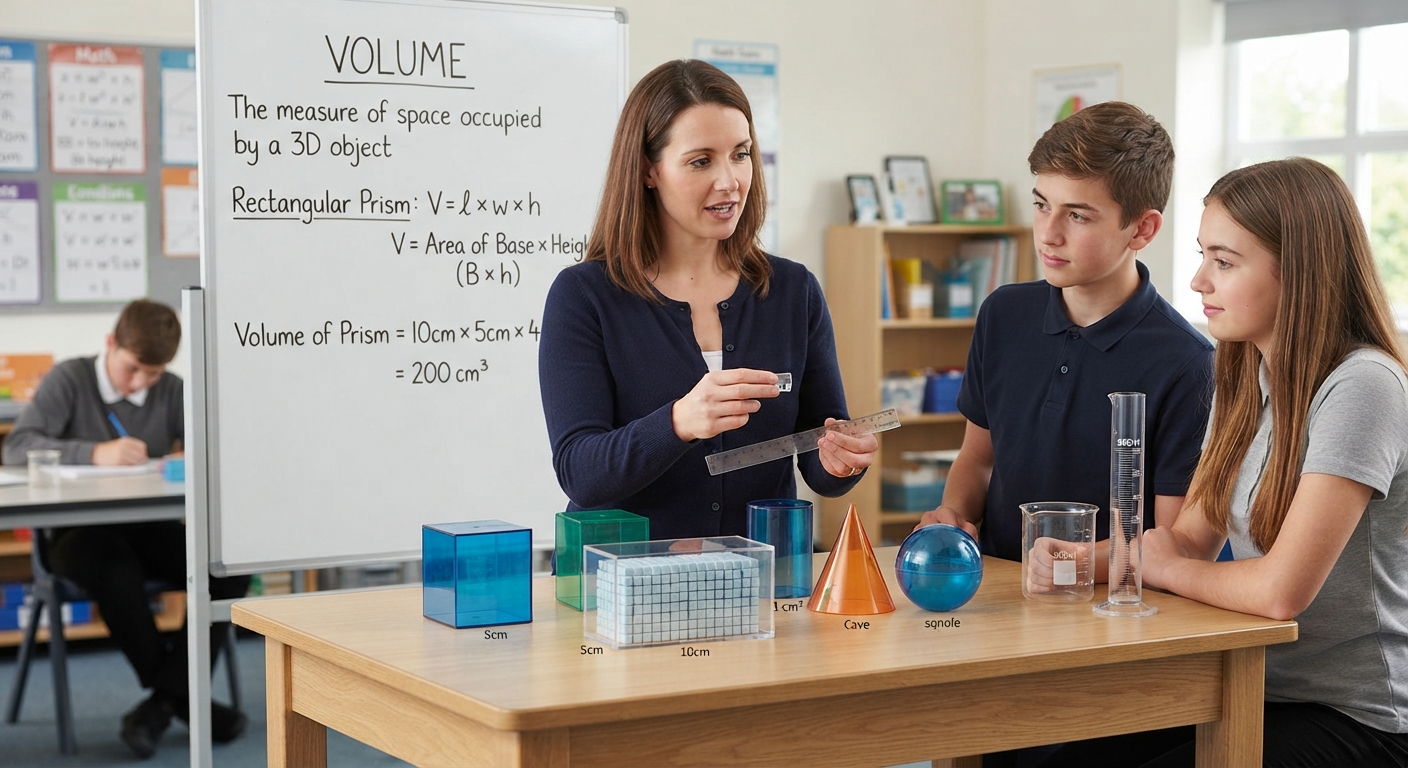
Volume is how much space a three-dimensional object takes up, counted in cubic units. To work out volume for a box, multiply length × width × height. For any prism or cylinder, multiply the area of the base by the height; for a pyramid or cone, do the same and divide by 3.
A box 6 cm long, 4 cm wide and 3 cm tall holds 6 × 4 × 3 = 72 cubic centimeters. Below is every formula a K-12 student is likely to need, in one table, plus worked examples, unit conversions and a practice set with answers.
What volume actually measures
Think of a unit cube: a little block 1 cm on every side. Its volume is 1 cubic centimeter (1 cm³). The volume of any solid is how many of those blocks would fill it.
That’s why volume uses cubed units. Length has one dimension (cm), area has two (cm²), and volume has three (cm³). A kid who writes an answer in cm² for a volume problem is telling you they multiplied the right numbers but don’t yet see what the numbers mean.
Capacity is the same idea for liquids. One cubic centimeter holds exactly 1 milliliter, and 1,000 cm³ is 1 liter.
Volume formulas for common solids
| Shape | Volume formula | What the letters mean |
|---|---|---|
| Cube | V = s³ | s = side length |
| Rectangular prism (box) | V = l × w × h | length, width, height |
| Any prism | V = B × h | B = area of the base |
| Cylinder | V = πr²h | r = radius, h = height |
| Pyramid | V = (1/3) × B × h | B = area of the base |
| Cone | V = (1/3)πr²h | r = radius, h = height |
| Sphere | V = (4/3)πr³ | r = radius |
| Hemisphere | V = (2/3)πr³ | half a sphere |
Notice the pattern. Most of these are really one formula: base area × height. A box, a triangular prism and a cylinder all work that way. Pyramids and cones are the “pointy” versions, and a point cuts the volume to exactly one third of the matching prism or cylinder.
How to work out volume, step by step
- Name the shape and pick its formula from the table.
- Check the units. If one measurement is in inches and another in feet, convert first.
- If there’s a circle, find the radius. Half the diameter.
- Find the base area if the formula uses B.
- Multiply, and apply 1/3 or 4/3 if the shape calls for it.
- Write the answer in cubic units.
Example 1: a cube
A cube has sides of 5 inches.
V = 5³ = 5 × 5 × 5 = 125 in³
Example 2: a triangular prism
A tent-shaped prism has a triangle end with base 6 ft and height 4 ft, and it’s 10 ft long.
Base area: (1/2) × 6 × 4 = 12 ft²
Volume: 12 × 10 = 120 ft³
Example 3: a cylinder
A can has radius 3 cm and height 10 cm.
V = π × 3² × 10 = π × 9 × 10 = 90π
90π ≈ 282.7 cm³
Example 4: a cone with the same base and height
V = (1/3) × π × 3² × 10 = (1/3) × 90π = 30π ≈ 94.2 cm³
Exactly one third of the cylinder in Example 3.
Example 5: a square pyramid
Base 6 m by 6 m, height 5 m.
B = 6 × 6 = 36 m²
V = (1/3) × 36 × 5 = 12 × 5 = 60 m³
Example 6: a sphere
A ball has radius 6 in.
r³ = 6 × 6 × 6 = 216
V = (4/3) × π × 216 = 288π ≈ 904.8 in³
Volume of composite shapes
A composite solid is two or more simple solids stuck together. Split it into pieces you know, find each volume, and add. (If a piece is cut out, subtract it.)
Say a toy house is a box 10 cm long, 8 cm wide and 6 cm tall, with a triangular prism roof. The roof’s triangle end has base 8 cm and height 3 cm, and it runs the full 10 cm length.
Box: 10 × 8 × 6 = 480 cm³
Roof base area: (1/2) × 8 × 3 = 12 cm²
Roof: 12 × 10 = 120 cm³
Total: 480 + 120 = 600 cm³
Units and conversions
This is where most real-world volume problems go wrong. Because volume has three dimensions, a conversion factor gets cubed too.
| Conversion | Why |
|---|---|
| 1 ft³ = 1,728 in³ | 12 × 12 × 12 |
| 1 yd³ = 27 ft³ | 3 × 3 × 3 |
| 1 m³ = 1,000,000 cm³ | 100 × 100 × 100 |
| 1 cm³ = 1 mL | by definition of the milliliter |
| 1 US gallon = 231 in³ | by definition of the gallon |
Example: a raised garden bed is 8 ft by 4 ft and 1.5 ft deep. That’s 8 × 4 × 1.5 = 48 ft³ of soil. Soil is often sold by the cubic yard, so divide by 27: 48 ÷ 27 ≈ 1.8 yd³.
Example: a fish tank is 24 in by 12 in by 16 in. That’s 24 × 12 × 16 = 4,608 in³. Divide by 231 and you get about 19.9 gallons, which is why it’s sold as a 20 gallon tank.
What about irregular objects?
For a rock or a toy with no formula, use water. Fill a measuring cylinder to 50 mL, drop the object in, and read the new level. If it rises to 72 mL, the object’s volume is 72 – 50 = 22 mL, which is 22 cm³.
Common mistakes
- Using the diameter as the radius. A cylinder 10 cm across has r = 5. Plugging in 10 makes the answer four times too big.
- Forgetting the 1/3 for cones and pyramids.
- Using slant height. The h in cone and pyramid formulas is the straight-up height, from the tip down to the base at a right angle.
- Converting like it’s a length. 2 ft³ is 3,456 in³, not 24 in³.
- Square units on the answer. Volume is always cubic units.
- Mixing units. A box 2 ft by 6 in by 3 in has to be all inches (24 × 6 × 3) or all feet before you multiply.
Practice problems
Use π ≈ 3.14159 where needed and round decimal answers to the nearest tenth.
- Find the volume of a box 7 cm by 2 cm by 5 cm.
- Find the volume of a cube with sides of 4 ft.
- Find the volume of a cylinder with radius 2 in and height 7 in.
- A cylinder has diameter 10 m and height 4 m. Find its volume.
- Find the volume of a square pyramid with base 9 cm by 9 cm and height 10 cm.
- Find the volume of a cone with radius 6 cm and height 9 cm.
- Find the volume of a sphere with radius 3 in.
- How many cubic feet are in 2 cubic yards?
Answers
- 7 × 2 × 5 = 70 cm³
- 4³ = 64 ft³
- π × 4 × 7 = 28π ≈ 88.0 in³
- r = 5, so π × 25 × 4 = 100π ≈ 314.2 m³
- (1/3) × 81 × 10 = 270 cm³
- (1/3) × π × 36 × 9 = 108π ≈ 339.3 cm³
- (4/3) × π × 27 = 36π ≈ 113.1 in³
- 2 × 27 = 54 ft³
If your child is stuck on volume
Volume formulas are short, so when a kid struggles with them, the formula usually isn’t what’s missing. Look underneath. Is multiplication fluent enough that 24 × 12 × 16 doesn’t become a wall? Do they know the area of a triangle and a circle, since you need those to get the base? Can they multiply by 1/3 or 4/3 without freezing? Those are elementary and middle school skills, and volume just stacks them on top of each other.
Our guide to math skills by grade level shows when multiplication and area should be solid (fifth grade is when volume of a box first appears). If your child is avoiding the homework altogether, math anxiety in children covers what that can look like. And short daily practice on the weak skill works better than marathon sessions, as we explain in why 20 minutes a day beats a 90-minute tutoring session.
Frequently asked questions
What is the formula for volume?
It depends on the shape. For a box it’s length × width × height. For any prism or cylinder it’s base area × height. Pyramids and cones use one third of that, and a sphere uses (4/3)πr³.
What’s the difference between volume and area?
Area measures a flat surface in square units. Volume measures the space inside a solid in cubic units. The floor of a room has area; the air in the room has volume.
How do you work out the volume of a cylinder?
Square the radius, multiply by π, then multiply by the height. A cylinder with radius 4 and height 5 has volume π × 16 × 5 = 80π, about 251.3 cubic units.
Why is a cone one third of a cylinder?
If a cone and a cylinder share the same base and height, it takes exactly three cones’ worth of sand or water to fill the cylinder. Calculus proves it, but the pouring test is a great way for a kid to see it.
What units is volume measured in?
Cubic units: cm³, m³, in³, ft³ or yd³. For liquids, you’ll also see milliliters, liters and gallons. 1 cm³ equals 1 mL.
Find the actual gap
When a volume problem goes wrong, it’s usually the multiplication, the area of the base, or the fraction step, and each of those is a different fix. Math Anon’s short adaptive assessment figures out which skills are actually missing and sends you a written report so you know.
Your child then gets targeted practice, about 20 minutes a day, on the skills the report flagged, and you’ll see a progress report every week. Start the assessment. It’s $49, credited back in full toward the first month. Details are on our pricing page.





