
Radius Vs Diameter Vs Circumference
The short version
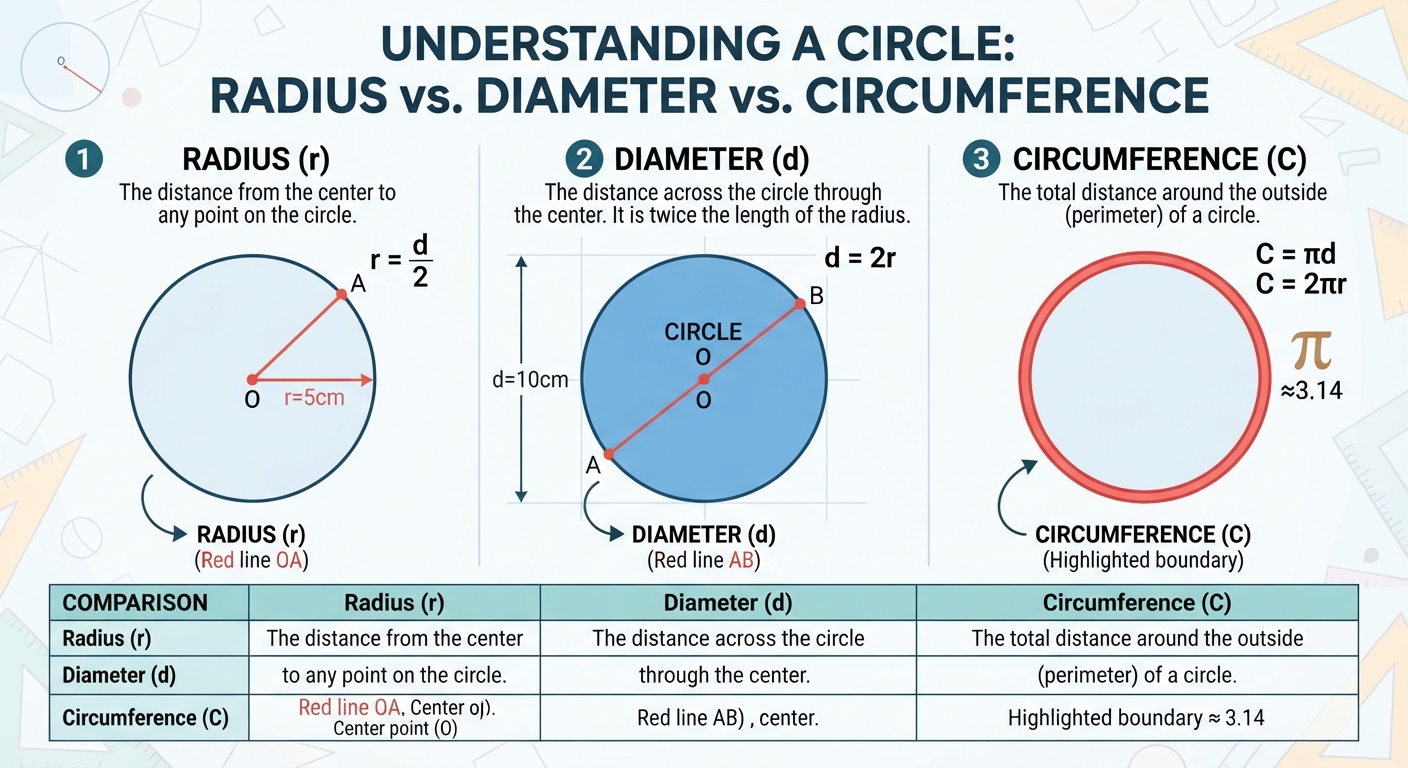
- The radius goes from the center of a circle to the edge. The diameter goes all the way across, through the center. The diameter is always twice the radius.
- Circumference is the distance all the way around the outside. It equals π × diameter, or 2 × π × radius.
- If you know any one of the three, you can find the other two: d = 2r, r = d ÷ 2, C = πd, and d = C ÷ π.
- Use 3.14 for π unless the problem says otherwise. A circle with a radius of 5 cm has a diameter of 10 cm and a circumference of 31.4 cm.
- Most lost points here aren’t about circles at all. They come from plugging the wrong number into the right formula, usually the diameter into a radius formula.
The radius vs diameter question has one answer that settles almost everything: the diameter is exactly two radii long. Cut a circle straight across through the middle and you get the diameter. Stop halfway, at the center, and you have the radius. Circumference is the third measurement, the distance around the rim, and it connects to both through π.
That’s the whole relationship. Everything else on this page is practice using it, because knowing the rule and remembering to apply it under time pressure are two different skills.
What each measurement actually is
Radius (r). The distance from the center point of a circle to any point on the edge. Every radius in a single circle is the same length. That’s what makes a circle a circle.
Diameter (d). The distance across a circle along a straight line that passes through the center. It’s the longest straight line you can draw inside a circle. The symbol ⌀ is sometimes used on drawings and product listings to mean diameter.
Circumference (C). The distance around the outside of the circle. It’s the circle version of perimeter. If you wrapped a string around a can and then measured the string, you’d have the circumference.
A chord is worth knowing too, because it causes trouble. A chord is any straight line joining two points on the circle. The diameter is just the longest chord, the one that happens to hit the center. A kid who measures “across” a circle without going through the center has measured a chord, and their answer will come out short.
Radius vs diameter: the formulas and how to switch between them
These four relationships cover almost every circle problem in elementary and middle school math.
d = 2r
r = d ÷ 2
C = πd
C = 2πr
Run them backward and you can start from the circumference instead.
d = C ÷ π
r = C ÷ (2π)
Here’s the same thing as a lookup table. Find the row for what you were given, then read across.
| You are given | Radius | Diameter | Circumference |
|---|---|---|---|
| Radius r | r | 2r | 2πr |
| Diameter d | d ÷ 2 | d | πd |
| Circumference C | C ÷ (2π) | C ÷ π | C |
π is about 3.14159, and school problems almost always round it to 3.14. If a problem asks for the answer “in terms of π,” leave the symbol in place and write 12π cm instead of 37.68 cm. That’s an exact answer rather than a rounded one.
Worked example 1: start from the radius
A circular garden bed has a radius of 5 feet. Find the diameter and the circumference.
d = 2r = 2 × 5 = 10 feet
C = πd = 3.14 × 10 = 31.4 feet
You could also go straight to C = 2πr = 2 × 3.14 × 5 = 31.4 feet. Same answer, which is a decent way to check yourself.
Worked example 2: start from the diameter
A pizza is 14 inches across. Find the radius and the circumference.
r = d ÷ 2 = 14 ÷ 2 = 7 inches
C = πd = 3.14 × 14 = 43.96 inches
When a package says a pizza, a plate or a tire is “14 inches,” it means the diameter. Nobody sells a pizza by its radius.
Worked example 3: start from the circumference
A tree trunk measures 25.12 inches around. Find the diameter and the radius.
d = C ÷ π = 25.12 ÷ 3.14 = 8 inches
r = d ÷ 2 = 8 ÷ 2 = 4 inches
Check it forward: 3.14 × 8 = 25.12. That matches, so the answer holds. Working backward and then checking forward takes about ten seconds and catches most arithmetic slips.
Worked example 4: comparing two circles
Circle A has a radius of 7 cm. Circle B has a diameter of 12 cm. Which one is bigger around?
Put them in the same terms first. Circle A has a diameter of 2 × 7 = 14 cm, so its circumference is 3.14 × 14 = 43.96 cm. Circle B’s circumference is 3.14 × 12 = 37.68 cm. Circle A wins.
Notice you didn’t strictly need π. The circle with the bigger diameter always has the bigger circumference, so comparing 14 to 12 was enough.
Where area fits in
Area is a fourth measurement and it’s the one that punishes the radius vs diameter mix up hardest. The formula uses the radius, squared.
A = πr²
For a circle with a radius of 5 cm: A = 3.14 × 5² = 3.14 × 25 = 78.5 square cm.
If a kid grabs the diameter by mistake and computes 3.14 × 10² = 314, they’re off by a factor of four, not two, because the error gets squared. If you’d rather work from the diameter, the honest version of the formula is A = πd² ÷ 4. Check: 3.14 × 100 ÷ 4 = 78.5 square cm. Same answer.
Common mistakes
Putting the diameter into C = 2πr. This is the single most common circle error. The problem says “diameter 10,” the student writes 2 × 3.14 × 10 = 62.8, and the answer is double what it should be. Fix: circle the given number and label it d or r before touching a formula.
Putting the diameter into A = πr². Same root cause, four times the damage. Any area answer that looks suspiciously huge is worth rechecking for this.
Halving the circumference to get the radius. The radius isn’t half the circumference, it’s the circumference divided by 2π, which is about 6.28. Halving a circumference of 31.4 gives 15.7, and the real radius is 5.
Measuring across a circle without hitting the center. That’s a chord, and it’s shorter than the diameter. On a drawn circle, the diameter is the longest line you can fit inside it, so if a slightly different line is longer, you missed the center.
Dropping units or using the wrong kind. Circumference answers end in cm, inches or feet. Area answers end in square cm, square inches or square feet. Teachers take points for this constantly.
Practice problems
Use 3.14 for π. Round to two decimal places where you need to.
1. A circle has a radius of 9 cm. What is its diameter?
2. A circle has a diameter of 24 inches. What is its radius?
3. A circle has a radius of 6 m. What is its circumference?
4. A circular tabletop has a diameter of 15 feet. How much trim do you need to go all the way around it?
5. A circle has a circumference of 43.96 cm. What is its diameter?
6. A bike wheel has a diameter of 26 inches. How far does the bike travel in 10 full turns of the wheel? Give the answer in feet.
7. A circle has a circumference of 62.8 m. What is its radius, and what is its area?
Answers
1. d = 2 × 9 = 18 cm
2. r = 24 ÷ 2 = 12 inches
3. C = 2 × 3.14 × 6 = 37.68 m
4. C = 3.14 × 15 = 47.1 feet
5. d = 43.96 ÷ 3.14 = 14 cm. Check: 3.14 × 14 = 43.96.
6. One turn covers C = 3.14 × 26 = 81.64 inches. Ten turns cover 816.4 inches. Then 816.4 ÷ 12 = about 68.03 feet.
7. d = 62.8 ÷ 3.14 = 20 m, so r = 10 m. Area = 3.14 × 10² = 3.14 × 100 = 314 square m.
What it means if your child keeps getting these wrong
Circle problems look like geometry, but they fail for arithmetic reasons far more often. A kid who can recite “the diameter is twice the radius” and still misses half the questions usually has one of three things going on underneath.
The first is halving and doubling. Finding the radius from a diameter of 15 means computing 7.5, and a student who isn’t comfortable with decimals or with halving odd numbers will stall or guess. The second is multiplying decimals. Every circumference answer runs through 3.14 × something, so shaky decimal multiplication turns into wrong circle answers that look like a geometry problem. The third is reading the question. Word problems bury the given measurement in a sentence about a pizza or a trampoline, and a kid who’s rushing grabs whatever number appears first.
If any of that sounds familiar, the circle unit isn’t the place to drill. Go back and check the multiplication and decimal skills that sit under it. Our guide to math skills by grade level lays out what should be solid before circle formulas show up, and 12 signs your child is behind in math covers what a real gap looks like versus a rough week. If the frustration has gotten loud, math anxiety in children is worth a read before you add more practice.
Frequently asked questions
Is the radius half the diameter?
Yes, always. In any circle, r = d ÷ 2 and d = 2r. That single relationship is the core of the radius vs diameter comparison, and it never changes no matter how big or small the circle is.
How do you find the diameter from the circumference?
Divide the circumference by π. So d = C ÷ 3.14. A circle with a circumference of 31.4 cm has a diameter of 31.4 ÷ 3.14 = 10 cm. To get the radius from there, halve it.
Is the diameter the same as the width of a circle?
For a circle, yes. The widest possible measurement across a circle is its diameter, and it’s the same in every direction. That’s not true for ovals or other shapes, which is why the word diameter is reserved for circles and spheres.
What is the symbol for diameter?
The symbol ⌀ means diameter. You’ll see it on blueprints, drill bits, pipes and hardware listings, written like ⌀12 mm. In school math the letter d is used instead, and the letter r stands for radius.
Why does every circle use the same number for π?
Because circumference and diameter grow together at a fixed rate. Divide any circle’s circumference by its diameter and you get about 3.14159, whether it’s a coin or a stadium. That ratio is what π is.
What grade do kids learn radius, diameter and circumference?
Radius and diameter usually show up around third or fourth grade as vocabulary. Circumference and area formulas typically land in sixth or seventh grade, once students are comfortable multiplying decimals and working with formulas that have more than one step.
Find the actual gap
When circle problems go wrong, the real cause is rarely the circle. It’s a decimal multiplication step, a halving step, or a habit of grabbing the first number in the problem. Guessing which one it is wastes weeks. Math Anon starts with a short adaptive assessment that works out exactly which skills are missing, then sends you a written report in plain language saying what to do about it.
After that, your child gets about 20 minutes of targeted practice a day aimed at those specific gaps, plus a weekly progress report so you can see what moved. Start the assessment for $49, credited back in full on your first month. Full details are on our pricing page, and if you’re weighing options, we broke down what math tutoring actually costs.





