
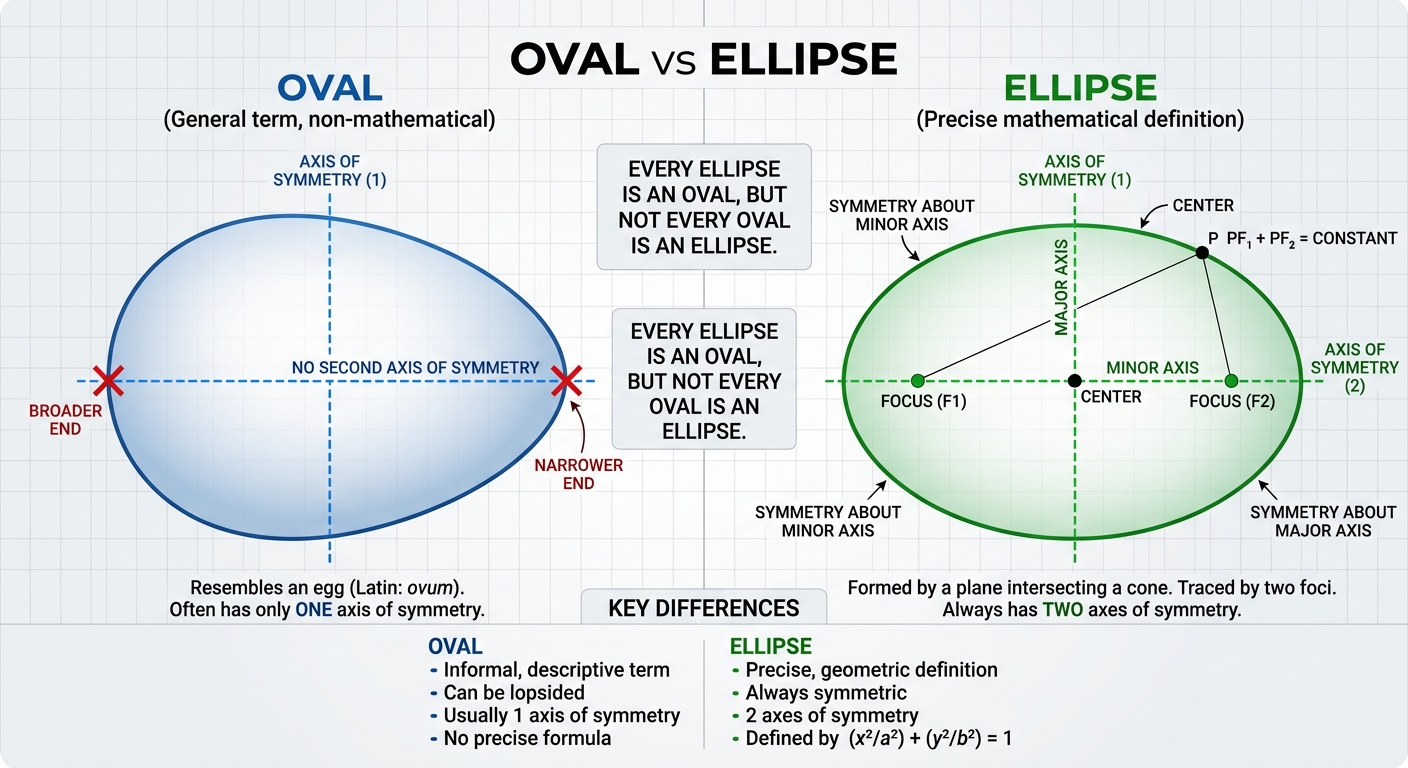
Oval Vs Ellipse: What Makes An Ellipse Special
The short version
- An ellipse is a closed curve where the distances from any point on it to two fixed points (the foci) always add up to the same number.
- “Oval” is an everyday word for any rounded, egg-like shape. Every ellipse is an oval, but not every oval is an ellipse.
- Quick test: an ellipse has two lines of symmetry and looks the same after a half turn. An egg shape has only one line of symmetry, so it’s an oval but not an ellipse.
- Area of an ellipse = π × a × b, where a and b are half the long and short widths. A circle is the special ellipse where a = b.
An ellipse is a stretched circle with an exact mathematical rule behind it: pick two points called foci, and the ellipse is every point whose distances to those two foci add up to the same total. An oval has no such rule. It’s a loose name for any smooth, rounded, closed shape, so an egg, a stretched circle and a running track can all get called ovals.
So when a worksheet asks “oval vs ellipse,” the answer is that ellipse is the precise math term and oval is the casual one. Below: how to tell them apart, the parts and formulas of an ellipse, and where kids go wrong.
What makes an ellipse an ellipse
You can draw one with two thumbtacks, a string and a pencil. Tie each end of the string to a tack, leaving slack, pull it tight with the pencil and trace around. The string’s length never changes, so the two distances always add up to the same total.
Move the tacks closer together and the ellipse gets rounder. Put both tacks in the same hole and you get a circle. Spread them apart and the ellipse gets long and skinny.
The parts of an ellipse
| Part | What it is | Usual letter |
|---|---|---|
| Center | The midpoint, halfway between the foci | (h, k) or the origin |
| Major axis | The longest line across, through both foci | length 2a |
| Minor axis | The shortest line across, through the center | length 2b |
| Semi-major axis | Half the major axis | a |
| Semi-minor axis | Half the minor axis | b |
| Foci | The two fixed points inside, each c units from the center | c |
These three lengths are linked by one equation: c2 = a2 – b2. It looks like the Pythagorean theorem because it is one. Draw a line from the end of the minor axis to a focus and you get a right triangle with legs b and c and a hypotenuse of a.
Oval vs ellipse: how to tell them apart
| Feature | Ellipse | Oval (general) |
|---|---|---|
| Exact definition | Yes, the two-foci rule | No, it’s a descriptive word |
| Lines of symmetry | Exactly 2 (a circle has infinitely many) | Often 1, sometimes 2 |
| Same after a half turn | Always | Not for an egg shape |
| Area formula | π × a × b | Depends on the shape |
| Examples | A circle viewed at a slant, a slice through a cone at an angle, a planet’s orbit | An egg, a stadium-shaped track, a rounded rectangle |
The fold test works well at the kitchen table. Cut the shape out of paper. Fold it in half the long way, then the short way. If both folds line up edge to edge, you might have an ellipse. If only the long fold works, like an egg with a fat end and a pointy end, it’s an oval but not an ellipse.
One catch: passing the fold test doesn’t prove a shape is an ellipse. A standard running track is made of two semicircles joined by straight sides. It has two lines of symmetry, but it has flat stretches, and an ellipse never does. So a running track is an oval and a stadium shape, not an ellipse.
Ellipse formulas with worked examples
The equation
An ellipse centered at the origin, stretched along the x-axis, has this equation:
x2/a2 + y2/b2 = 1
The bigger denominator tells you which way it’s stretched. If the bigger number sits under x2, the ellipse is wide. If it sits under y2, it’s tall.
Example: Take x2/25 + y2/9 = 1.
a2 = 25, so a = 5. The major axis is 2 × 5 = 10 units long, along the x-axis.
b2 = 9, so b = 3. The minor axis is 2 × 3 = 6 units long.
c2 = 25 – 9 = 16, so c = 4. The foci sit at (4, 0) and (-4, 0).
Checking the two-foci rule with real numbers
Is the point (3, 2.4) on that ellipse? Plug it in:
32/25 + 2.42/9 = 9/25 + 5.76/9 = 0.36 + 0.64 = 1
Yes, it’s on the ellipse.
Now measure to each focus.
To (4, 0): √((4 – 3)2 + 2.42) = √(1 + 5.76) = √6.76 = 2.6
To (-4, 0): √((3 + 4)2 + 2.42) = √(49 + 5.76) = √54.76 = 7.4
2.6 + 7.4 = 10, which is exactly 2a. The rule holds.
Area
Area = π × a × b. For our ellipse, that’s π × 5 × 3 = 15π ≈ 47.12 square units. For a circle, a and b both equal r, which gives the familiar πr2.
Perimeter
Here’s a surprise for older students: there’s no simple exact formula for the perimeter of an ellipse. Mathematicians use approximations. A good one comes from Ramanujan:
P ≈ π × [3(a + b) – √((3a + b)(a + 3b))]
For a = 5 and b = 3:
3(5 + 3) = 24
(3 × 5 + 3)(5 + 3 × 3) = 18 × 14 = 252, and √252 ≈ 15.875
P ≈ π × (24 – 15.875) = π × 8.125 ≈ 25.53 units
Eccentricity: how stretched is it?
Eccentricity e = c ÷ a. It’s always at least 0 and less than 1. A circle has e = 0. Our example has e = 4 ÷ 5 = 0.8, which is fairly stretched. Earth’s orbit around the sun is an ellipse with an eccentricity of about 0.017, so close to a circle that you couldn’t see the difference in a drawing.
Common mistakes with the ellipse shape
- Using the full axis in the area formula. If the ellipse is 10 wide and 6 tall, the area is π × 5 × 3, not π × 10 × 6. The formula needs the halves.
- Adding instead of subtracting for c. For an ellipse, c2 = a2 – b2. Kids who’ve just learned the Pythagorean theorem often write a2 + b2 out of habit.
- Calling every oval an ellipse. An egg and a running track aren’t ellipses.
- Forgetting the square roots in the equation. In x2/36 + y2/16 = 1, a is 6, not 36.
- Thinking a circle doesn’t count. It does. A circle is an ellipse whose two foci happen to be in the same spot.
Practice problems
- A shape has a fat end, a pointy end and one line of symmetry. Is it an ellipse, an oval, or both?
- Is a circle with radius 4 an ellipse? If so, what is its area?
- An ellipse has a major axis of 12 cm and a minor axis of 8 cm. Find its area.
- For x2/36 + y2/16 = 1, find a, b, and the length of each axis. Is the ellipse wide or tall?
- Is the point (0, 4) on x2/36 + y2/16 = 1? What about (3, 3)?
- An ellipse has a = 13 and b = 5. How far is each focus from the center?
- Find the eccentricity of the ellipse in problem 6.
- You tie a 10-foot rope to two stakes 6 feet apart and trace a flower bed. How long and wide is the bed, and what’s its area?
Answers
- It’s an oval but not an ellipse. An ellipse needs two lines of symmetry.
- Yes. a = b = 4, so the area is π × 4 × 4 = 16π ≈ 50.27 square units.
- a = 6 and b = 4, so the area is π × 6 × 4 = 24π ≈ 75.40 cm2.
- a = √36 = 6 and b = √16 = 4. The major axis is 12 and the minor axis is 8. The bigger denominator is under x2, so it’s wide.
- (0, 4): 0/36 + 16/16 = 1, so yes. (3, 3): 9/36 + 9/16 = 0.25 + 0.5625 = 0.8125. That’s less than 1, so the point is inside the ellipse, not on it.
- c2 = 169 – 25 = 144, so c = 12. Each focus is 12 units from the center.
- e = 12 ÷ 13 ≈ 0.92, a long, skinny ellipse.
- The rope length is 2a, so a = 5 and the bed is 10 feet long. The stakes are the foci, so c = 3. b2 = 25 – 9 = 16, so b = 4 and the bed is 8 feet wide. Area = π × 5 × 4 = 20π ≈ 62.83 square feet.
What it means if your kid is stuck on ellipses
Younger kids only need to recognize the ellipse shape and name it. When older kids get stuck on ellipse problems, the ellipse is rarely the real issue. The work leans on squaring, square roots, the Pythagorean theorem and dividing fractions, and a gap in any one of those makes every ellipse problem feel impossible.
If your kid can’t find a when the equation says a2 = 36, the gap is square roots. If they freeze at 9/36 + 9/16, it’s fractions, which is the same gap that shows up in most algebra struggles. We explain that pattern in why algebra trouble usually starts with fourth grade fractions. For the earlier building blocks like symmetry and area, see math skills by grade level, and if you’re wondering whether this is a one-off or a pattern, these 12 signs can help.
Frequently asked questions
Is an oval the same as an ellipse?
Not quite. An ellipse is a specific oval that follows the two-foci rule. Oval is a broader, informal word that also covers egg shapes and stadium shapes.
Is a circle an ellipse?
Yes. A circle is an ellipse whose two foci sit on the same point, so its long and short axes are equal.
What is the formula for the area of an ellipse?
Area = π × a × b, where a is half the longest width and b is half the shortest width.
What are some real-life ellipse shapes?
The orbits of planets, the shadow of a ball under a slanted light, and the surface of juice in a tilted round glass are all ellipses. A round plate seen from an angle looks like one too.
Find the actual gap
When ellipse homework goes sideways, it usually points back to square roots, fractions or area. Math Anon’s short adaptive assessment tracks down which of those earlier skills are missing and sends you a written report that names them.
Then your kid practices those exact skills for about 20 minutes a day, and you get a progress update each week. The assessment costs $49, and we credit it back in full on your first month. Start the assessment or look over pricing first.





