
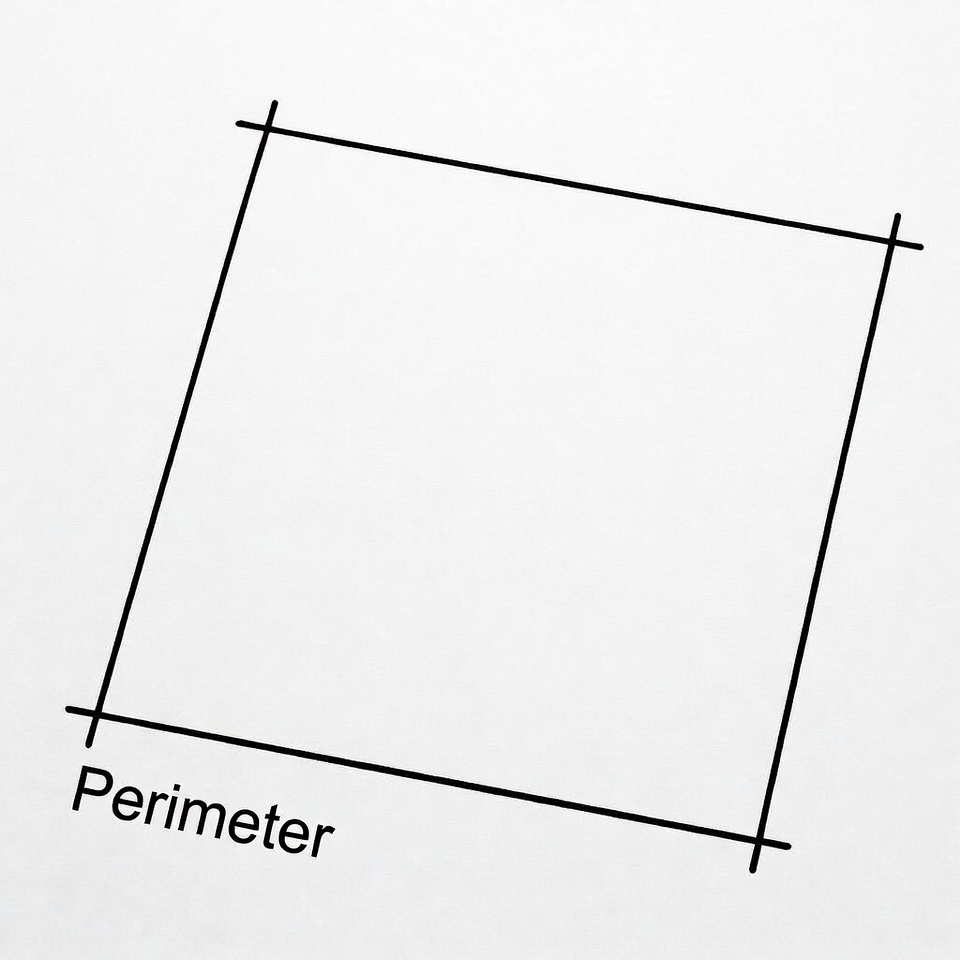
What Is Perimeter? Formulas, Examples And Perimeter Vs Area
The short version
- Perimeter is the total distance around the outside of a flat shape. To find it, add up the lengths of all the sides.
- Rectangle: P = 2 × (length + width). Square: P = 4 × side. For a circle, the perimeter is called the circumference: C = 2πr.
- Perimeter measures the border, and area measures the space inside. Perimeter is in plain units (feet), area is in square units (square feet).
- Two shapes can have the same area and very different perimeters, so you can’t find one from the other.
- For L-shapes and other odd shapes, find any missing side lengths first, then add every side once.
Perimeter is the total length of the boundary of a flat shape: the distance you’d walk if you went all the way around its edge once. You find the perimeter by adding up the lengths of every side. A rectangle that’s 8 feet long and 5 feet wide has a perimeter of 8 + 5 + 8 + 5 = 26 feet.
Below you’ll find the formulas for common shapes, how to handle shapes with missing sides, the difference between perimeter and area (the part that confuses kids most), worked examples and practice problems with answers.
How to find the perimeter of any shape
Every perimeter problem comes down to the same three moves:
- Make sure you know the length of every side. If one is missing, figure it out from the others.
- Add them all together, counting each side exactly once.
- Write the unit (cm, inches, feet). Perimeter is a length, so no “square” in the unit.
A tip for younger kids: put a small mark on each side as you add it, so none get skipped or counted twice.
Perimeter formulas for common shapes
The formulas are shortcuts for adding sides. They’re handy, but adding every side always works too.
| Shape | Formula | Example | Perimeter |
|---|---|---|---|
| Square | P = 4 × s | Side 7 cm | 28 cm |
| Rectangle | P = 2 × (l + w) | 8 ft by 5 ft | 26 ft |
| Triangle | P = a + b + c | Sides 6, 8, 10 in | 24 in |
| Regular polygon | P = n × s (n sides) | Hexagon, side 4 m | 24 m |
| Circle | C = 2πr or πd | Radius 5 cm | 10π ≈ 31.4 cm |
Perimeter vs area
This is where most homework mistakes happen. Perimeter is the fence around a yard. Area is the grass inside it. You’d buy fencing by the foot (perimeter) and sod by the square foot (area).
| Perimeter | Area | |
|---|---|---|
| What it measures | Distance around the edge | Space inside the shape |
| How you get it (rectangle) | Add the sides: 2 × (l + w) | Multiply: l × w |
| Units | cm, ft, m | cm², ft², m² |
| Real life | Fence, picture frame, trim, running track | Carpet, paint, tiles, garden soil |
| 6 ft by 4 ft rectangle | 20 ft | 24 ft² |
Same area, different perimeter
Here’s a demo worth doing with 12 square tiles or on grid paper. Arrange all 12 into rectangles and check each perimeter:
1 by 12: area 12, perimeter 2 × (1 + 12) = 26
2 by 6: area 12, perimeter 2 × (2 + 6) = 16
3 by 4: area 12, perimeter 2 × (3 + 4) = 14
Same number of tiles, but the perimeter swings from 14 to 26. Long skinny shapes have a big perimeter. Shapes close to a square have the smallest. Once a kid sees this with their own hands, the two ideas stop blurring together.
Worked examples
Example 1: Rectangle
A garden is 15 feet long and 10 feet wide. How much fencing goes around it?
P = 2 × (15 + 10) = 2 × 25 = 50 feet.
Example 2: Missing side on a rectangle
A rectangle has a perimeter of 30 cm and a length of 9 cm. Find the width.
The two lengths use 9 + 9 = 18 cm.
That leaves 30 – 18 = 12 cm for the two widths.
Each width is 12 ÷ 2 = 6 cm. Check: 9 + 6 + 9 + 6 = 30.
Example 3: Square from its perimeter
A square has a perimeter of 44 inches. How long is each side?
All 4 sides are equal, so 44 ÷ 4 = 11 inches.
Example 4: An L-shaped room
Start with a 10 m by 8 m rectangle and cut a 4 m by 3 m notch out of the top right corner. Going around the edge:
Bottom: 10 m
Right side (below the notch): 8 – 3 = 5 m
Notch, going left: 4 m
Notch, going up: 3 m
Top (left of the notch): 10 – 4 = 6 m
Left side: 8 m
Perimeter = 10 + 5 + 4 + 3 + 6 + 8 = 36 m
Interesting fact: that’s the same as the full 10 by 8 rectangle, 2 × (10 + 8) = 36 m. Cutting a rectangle out of a corner moves two edges inward without changing their total length. The area does shrink, though, from 80 m² to 68 m².
Example 5: Regular polygon
A stop sign is a regular octagon. If each side is 12.5 inches, what’s the perimeter?
P = 8 × 12.5 = 100 inches.
Common mistakes
- Multiplying length × width. That’s area. For a 6 by 4 rectangle, 24 is the area and 20 is the perimeter.
- Adding only the two labeled sides. A rectangle labeled 8 and 5 has four sides. 8 + 5 = 13 is only half the perimeter.
- Skipping unlabeled sides on odd shapes. In an L-shape, some sides aren’t labeled on purpose. Work them out before adding.
- Square units. Writing 26 ft² for a perimeter is wrong. Perimeter is a length.
- Counting the inside lines. If a shape is drawn with a line through the middle, that line isn’t part of the perimeter. Only the outside edge counts.
- Mixing units. A side in feet and a side in inches have to be converted before adding.
Practice problems
- Find the perimeter of a rectangle 12 cm long and 3 cm wide.
- Find the perimeter of a square with sides of 9 inches.
- A triangle has sides of 5 m, 7 m and 9 m. What’s its perimeter?
- A square has a perimeter of 44 ft. How long is each side?
- A rectangle has a perimeter of 40 cm and a width of 8 cm. What’s its length?
- A regular octagon has sides of 2.5 cm. What’s its perimeter?
- Three rectangles each have an area of 16 square units and whole-number sides: 1 by 16, 2 by 8 and 4 by 4. Which has the smallest perimeter?
- Fencing costs $4 per foot. How much does it cost to fence a 15 ft by 10 ft yard?
Answers
- 30 cm. 2 × (12 + 3) = 30.
- 36 inches. 4 × 9 = 36.
- 21 m. 5 + 7 + 9 = 21.
- 11 ft. 44 ÷ 4 = 11.
- 12 cm. 40 – 16 = 24 for the two lengths, and 24 ÷ 2 = 12.
- 20 cm. 8 × 2.5 = 20.
- The 4 by 4 square. Its perimeter is 16, while 2 by 8 gives 20 and 1 by 16 gives 34.
- $200. The perimeter is 2 × (15 + 10) = 50 ft, and 50 × $4 = $200.
If your child is stuck on perimeter
Perimeter shows up in third grade and comes back every year in harder forms. If your child mixes up perimeter and area, don’t just drill the formulas. Go back to tiles or grid paper and let them count squares for area and edges for perimeter. Formulas memorized without that picture tend to get swapped under pressure.
If the idea makes sense but answers are still wrong, look at the arithmetic. Missing-side problems use subtraction and division, and slow addition makes a six-sided shape feel like a marathon. Our math skills by grade level guide shows what should be solid by each grade, and is my child behind in math? lists the warning signs worth watching. Short, regular practice fixes this faster than long weekend sessions, for reasons we explain in why 20 minutes a day beats a 90-minute tutoring session.
Frequently asked questions
What is perimeter in simple words?
Perimeter is the distance all the way around a shape. Picture walking along its edge once and measuring how far you went.
What’s the formula for perimeter of a rectangle?
P = 2 × (length + width). For a 7 by 3 rectangle, that’s 2 × 10 = 20.
What’s the difference between perimeter and area?
Perimeter is the length around the outside, measured in units like feet. Area is the space inside, measured in square units like square feet.
Is circumference the same as perimeter?
Yes. Circumference is the name for the perimeter of a circle. You find it with C = 2πr or C = πd.
Can two shapes have the same perimeter but different areas?
Yes. A 1 by 9 rectangle and a 5 by 5 square both have a perimeter of 20, but their areas are 9 and 25.
Find the actual gap
When perimeter keeps going wrong, the cause is usually an earlier skill, like shaky addition or a fuzzy picture of what area means. Math Anon starts with a short adaptive assessment that finds the exact skills your child is missing and gives you a written report on them.
Your child then gets about 20 minutes a day of practice aimed at those gaps, and you get a weekly progress report. It’s $49 for the assessment, and all of it is credited back on your first month. Start the assessment or read about our pricing.
Related reading
- Math Skills By Grade Level: What Your Child Should Know
- Is My Child Behind In Math? 12 Signs By Grade Level
- Why 20 Minutes A Day Beats A 90-Minute Tutoring Session
- Mind The Gap: A Parent’s Guide To Math Assessment For Kids
- What Is Pi? Why 3.14 Is Only The Start
- How Long Is A Meter? Size, Conversions And Real Examples





