
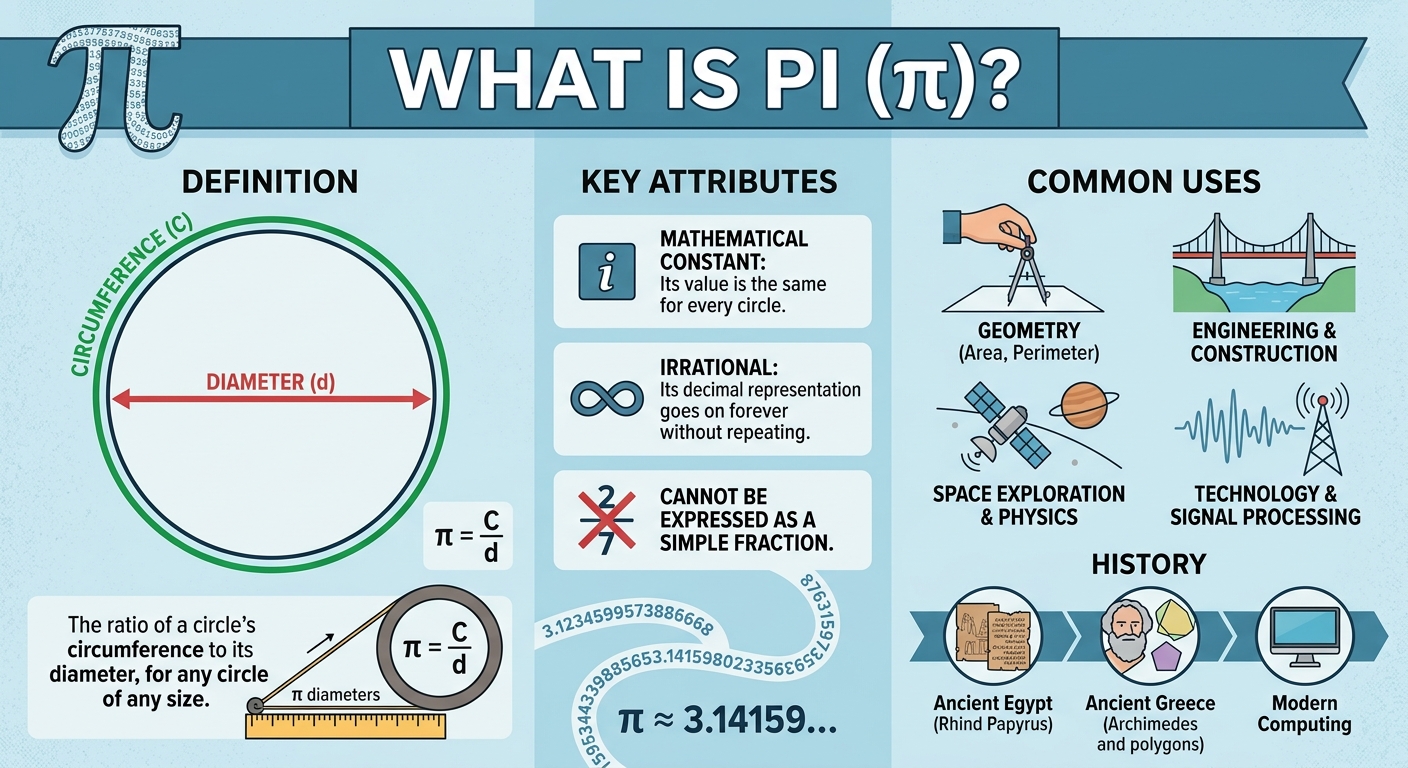
What Is Pi? Why 3.14 Is Only The Start
The short version
- Pi (π) is the number you get when you divide any circle’s circumference (the distance around) by its diameter (the distance across). It’s the same for every circle, big or small.
- Pi is about 3.14, but its decimals go on forever without repeating: 3.14159265358979… That makes it an irrational number.
- The two formulas kids use most are circumference C = π × d (or 2 × π × r) and area A = π × r².
- The most common mistake is mixing up radius and diameter. The radius is half the diameter, and the area formula needs the radius.
Pi is the ratio of a circle’s circumference to its diameter, and it’s roughly 3.14. Wrap a string around any round object, then lay that string across the middle: it’ll fit about 3 and a bit times. That “3 and a bit” is pi, written with the Greek letter π.
School math uses 3.14 or the fraction 22/7 as a stand-in, but neither one is exact. Below we’ll show where pi comes from, how to use it in the circle formulas with real numbers, the mistakes that cost kids points, and practice problems with an answer key.
What pi actually measures
Every circle has two lengths you can measure: the distance across through the center (the diameter) and the distance around the edge (the circumference). Divide the second by the first and you always land on the same number, about 3.14159. A coin, a bike wheel and a round table all give the same answer, because every circle is a scaled copy of every other circle.
That’s why pi is a constant. It doesn’t depend on units or size. A circle with a 1-inch diameter has a circumference of about 3.14 inches. A circle with a 100-meter diameter has a circumference of about 314 meters.
You can check this at the kitchen table. Take a can, wrap a strip of paper around it, mark where it overlaps, and measure that length. Then measure straight across the top. Divide. With careful measuring, kids usually get something between 3.1 and 3.2, which is a great way to see pi instead of just memorizing it.
Radius vs. diameter
The radius goes from the center to the edge. It’s half the diameter. So a circle with a diameter of 10 cm has a radius of 5 cm. Almost every pi mistake starts right here, so it’s worth saying twice.
Why pi is more than 3.14
Here are the first 20 decimal places: 3.14159265358979323846. The digits keep going forever and never settle into a repeating pattern. Numbers like that are called irrational, meaning you can’t write them exactly as a fraction of two whole numbers.
So 3.14 is a rounded version of pi, good to two decimal places. The fraction 22/7 is another approximation. As a decimal it’s 3.142857…, which is a little bigger than pi. Both are close enough for homework, and teachers will tell you which one to use.
| Value | As a decimal | How close to pi? |
|---|---|---|
| 3 | 3 | Rough estimate, off by about 0.14 |
| 3.14 | 3.14 | Off by about 0.0016 |
| 22/7 | 3.142857… | Off by about 0.0013 (a bit too big) |
| 3.14159 | 3.14159 | Off by less than 0.000003 |
How many digits do you really need? NASA’s Jet Propulsion Laboratory has explained that its most precise spacecraft calculations uses pi to 15 decimal places. For a sixth grader finding the area of a pizza, two decimal places is plenty.
A little history: the Greek mathematician Archimedes trapped pi between 223/71 and 22/7 by drawing polygons inside and outside a circle. The symbol π was first used for this number in 1706 by William Jones and became standard after Leonhard Euler adopted it. Pi Day is March 14 (3/14) for obvious reasons.
How to use pi: the circle formulas
| You want | Formula | Answer is in |
|---|---|---|
| Circumference (distance around) | C = π × d or C = 2 × π × r | Units (cm, in, ft) |
| Area (space inside) | A = π × r² | Square units (cm², in², ft²) |
| Diameter from circumference | d = C ÷ π | Units |
Example 1: circumference from the diameter
A circle has a diameter of 10 cm. Use 3.14 for pi.
C = π × d
C = 3.14 × 10 = 31.4 cm
Example 2: circumference and area from the radius
A circle has a radius of 4 inches.
Circumference: C = 2 × 3.14 × 4 = 25.12 inches
Area: A = 3.14 × 4² = 3.14 × 16 = 50.24 square inches
Notice the order in the area formula. Square the radius first (4² = 16), then multiply by pi.
Example 3: working backward
A round garden bed has a circumference of 62.8 feet. How wide is it?
d = C ÷ π
d = 62.8 ÷ 3.14 = 20 feet
Example 4: using 22/7
When the diameter or radius is a multiple of 7, 22/7 makes the math easy. A wheel has a diameter of 14 inches.
C = 22/7 × 14 = 22 × 2 = 44 inches
Example 5: leaving the answer “in terms of pi”
In middle school and algebra, teachers often want the exact answer, so you keep the π symbol instead of rounding. A circle with radius 5 has area:
A = π × 5² = 25π
If you need a decimal, 25 × 3.14 = 78.5 square units.
Example 6: the pizza question
Is one 12-inch pizza more food than two 8-inch pizzas? The size is the diameter, so the radii are 6 and 4.
One 12-inch: 3.14 × 6² = 3.14 × 36 = 113.04 square inches
Two 8-inch: 2 × 3.14 × 4² = 2 × 3.14 × 16 = 100.48 square inches
The single 12-inch pizza wins. Area grows with the square of the radius, which surprises a lot of adults too.
Common mistakes with pi
- Using the diameter in the area formula. A = π × r² needs the radius. If the problem gives a diameter of 10, the radius is 5. Plugging in 10 gives an area four times too big.
- Multiplying before squaring. In π × r², only the r gets squared. For r = 3, the area is 3.14 × 9 = 28.26, not (3.14 × 3)² = 88.7364.
- Forgetting square units. Circumference is a length (cm). Area is square units (cm²).
- Thinking pi equals 3.14 or 22/7 exactly. They’re approximations. That’s why answers are often labeled “about” or use the ≈ sign.
- Rounding too early. In a multi-step problem, keep more digits (or keep the π symbol) until the last step.
- Decimal slips. 3.14 × 16 trips kids up more than the geometry does. If the multiplication is shaky, the circle problems will be too.
Practice problems
Use 3.14 for pi unless the problem says otherwise.
- Find the circumference of a circle with a diameter of 6 m.
- Find the circumference of a circle with a radius of 10 in.
- Find the area of a circle with a radius of 3 cm.
- Find the area of a circle with a diameter of 10 ft.
- Use 22/7 to find the circumference of a circle with a diameter of 21 cm.
- A circle’s circumference is 31.4 inches. What’s its radius?
- Find the area of a circle with radius 7, in terms of π.
- A semicircle (half circle) has a diameter of 8 cm. Find its perimeter, including the straight edge.
Answers
- C = 3.14 × 6 = 18.84 m
- C = 2 × 3.14 × 10 = 62.8 in
- A = 3.14 × 3² = 3.14 × 9 = 28.26 cm²
- Radius is 5, so A = 3.14 × 25 = 78.5 ft²
- C = 22/7 × 21 = 22 × 3 = 66 cm
- d = 31.4 ÷ 3.14 = 10, so r = 5 inches
- A = π × 7² = 49π square units (about 153.86)
- Curved part: 3.14 × 8 ÷ 2 = 12.56. Add the straight edge: 12.56 + 8 = 20.56 cm
If your kid is stuck on pi
Pi itself is one number. When a child can’t get circle problems right, the trouble almost always sits in a skill from a year or two earlier. Look for these:
- Multiplying decimals, like 3.14 × 16. This is a fifth grade skill, and it’s the most common hidden gap.
- Halving and doubling to move between radius and diameter.
- Exponents and order of operations, so r² gets done before multiplying by π.
- Substituting numbers into a formula, which is really early algebra.
If the decimal work is the problem, more circle worksheets won’t fix it. Go back to the skill that’s missing. Our guide to math skills by grade level shows where decimal multiplication and fraction work should land, and these signs your child is behind in math can help you tell a one-topic wobble from a bigger gap. For formula trouble, the pattern in struggling with algebra applies here too.
Frequently asked questions
What is pi exactly?
Pi is the circumference of any circle divided by its diameter. It has no exact decimal or fraction form, so we write it as π. To 10 decimal places it’s 3.1415926536.
Why is pi 3.14?
3.14 is pi rounded to two decimal places. The real value is 3.14159…, and the digits never end, so 3.14 is a handy shortcut for everyday problems.
Is 22/7 the same as pi?
No. 22/7 is 3.142857…, slightly bigger than pi. It’s a good approximation and makes the math easier when a radius or diameter is a multiple of 7.
Is pi a rational number?
No, pi is irrational. It can’t be written as a fraction of two whole numbers, and its decimal never repeats or ends. This was proved in the 1760s by Johann Lambert.
What grade do kids learn about pi?
Most students meet pi in seventh grade, when they learn the circumference and area formulas. It shows up again in geometry and in finding the volume of cylinders, cones and spheres.
Why is Pi Day on March 14?
Written as a month and day, March 14 is 3/14, the first three digits of pi. Schools often celebrate with circle activities and, yes, pie.
Find the actual gap
When circle problems go wrong, the fix usually lives in decimals, exponents or formula work, and it’s hard to spot which one from a single worksheet. Math Anon starts with a short adaptive assessment that pinpoints the missing skills and gives you a written report of what it found.
From there, your child gets about 20 minutes a day of practice aimed at those exact skills, and you get a progress report every week. The assessment costs $49, and that’s credited back in full on your first month. Start the assessment or see pricing.





