
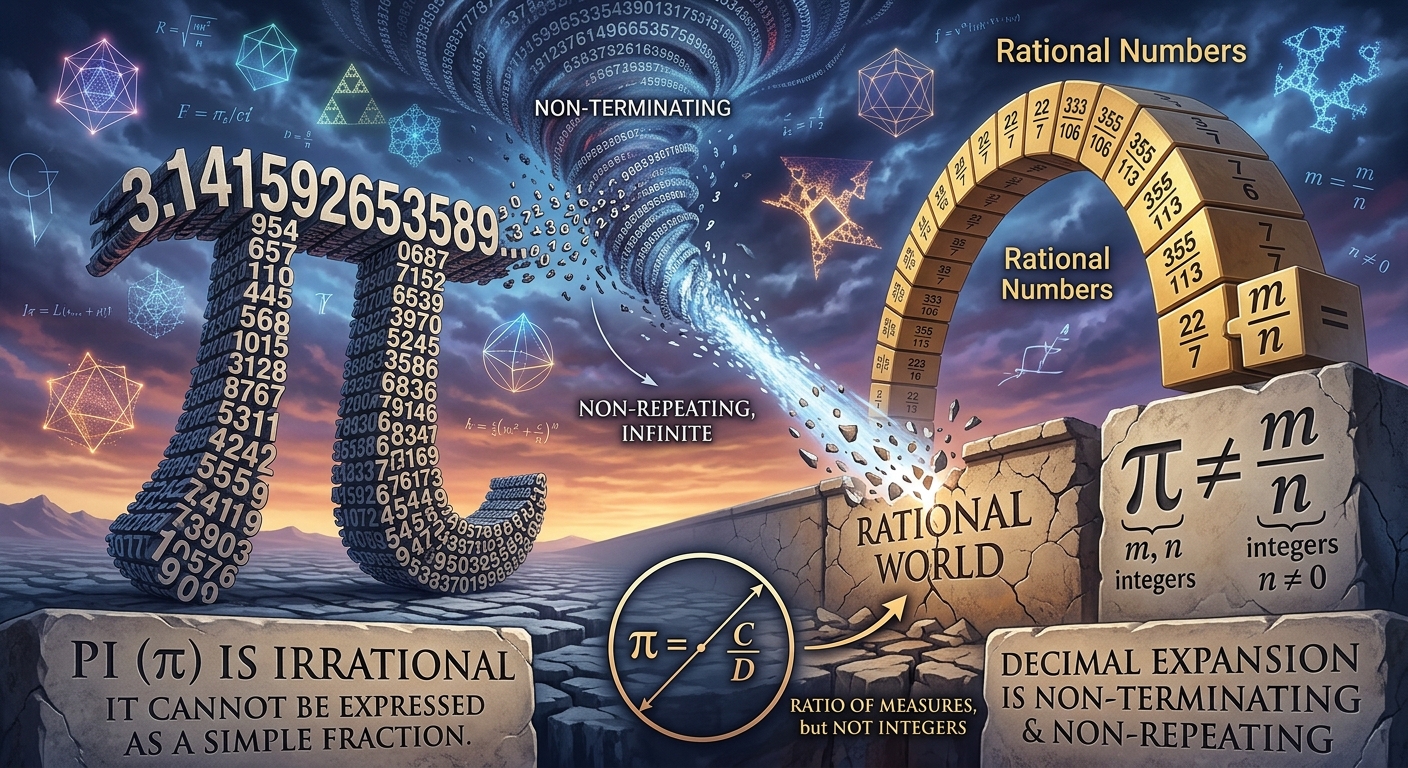
Is Pi Rational? Why Pi Is Irrational (And 22/7 Isn’t Pi)
The short version
- Pi is irrational. It can’t be written as a fraction of two whole numbers, and its decimal never ends and never repeats.
- 22/7 and 3.14 are rational numbers that sit close to pi. They’re handy approximations, but neither one equals pi.
- Pi = circumference ÷ diameter looks like a fraction, but for any real circle those two lengths can’t both be whole numbers, so it doesn’t count.
- Mathematicians proved pi is irrational in the 1760s. Nobody is still checking digits to find out.
Is pi rational? No. Pi is an irrational number, which means no fraction of two integers equals it exactly, and its decimal form (3.14159265358979…) goes on forever without settling into a repeating pattern.
That’s settled math, and it doesn’t depend on how many digits anyone has computed. Below we’ll cover what rational and irrational actually mean, why 22/7 trips so many kids up, how to test any number yourself, and a set of practice problems with answers.
What rational and irrational mean
A rational number is any number you can write as a fraction a/b, where a and b are integers and b isn’t zero. The word comes from “ratio.” Every whole number is rational (7 = 7/1), every fraction is rational, and every decimal that either stops or repeats is rational.
An irrational number is a real number that can’t be written that way. Its decimal never terminates and never repeats. Famous examples are √2, √3, pi, and the number e.
| Number | Decimal form | Rational? | Why |
|---|---|---|---|
| 5 | 5 | Yes | 5 = 5/1 |
| 3/8 | 0.375 | Yes | Decimal stops |
| 1/3 | 0.333… | Yes | Decimal repeats |
| √25 | 5 | Yes | 25 is a perfect square |
| √2 | 1.41421356… | No | Never stops or repeats |
| π | 3.14159265… | No | Never stops or repeats |
Here’s a quick way to think about it: a decimal that ends or loops is a fraction in disguise. A decimal that wanders forever with no loop isn’t.
Is pi rational? Why the answer is no
Pi is the ratio of any circle’s circumference to its diameter. Measure a circle with a diameter of 10 cm and its circumference comes out to about 31.4159 cm. Divide one by the other and you get pi, every time, for every circle.
Johann Heinrich Lambert proved pi is irrational in the 1760s. In 1882 Ferdinand von Lindemann went further and proved pi is transcendental, meaning it isn’t the solution to any polynomial equation with integer coefficients. Every transcendental number is irrational, so that sealed it twice over. Later mathematicians found shorter proofs, but they all rely on calculus, which is why middle school textbooks state the fact without proving it.
So is pi rational in some tiny way we haven’t found yet? No. When your kid asks “how do we know pi doesn’t repeat after a trillion digits?”, the real answer is that computers aren’t how we know. A proof shows it can’t repeat, ever. The trillions of digits people have calculated are a separate hobby.
“But pi is C ÷ d. Isn’t that a fraction?”
This is the sharpest objection kids raise, and the textbook often skips it. A rational number has to be a ratio of two integers. For any circle, the circumference and the diameter can’t both be whole numbers (or both be fractions of whole numbers). If the diameter is exactly 1 inch, the circumference is π inches, which is irrational. If you make the circumference exactly 10 inches, the diameter becomes 10/π inches, also irrational. One of the two lengths is always irrational, so C/d never turns into an integer over an integer.
Why 22/7 and 3.14 aren’t pi
Most kids meet pi as “3.14” or “22/7,” so it’s natural to wonder: is pi rational after all, since it’s written as a fraction? Both are rational numbers that happen to land near pi.
Checking 3.14:
3.14 = 314/100 = 157/50
That’s a fraction of two integers, so 3.14 is rational. Pi is about 3.14159, so 3.14 is off by roughly 0.0016.
Checking 22/7:
22 ÷ 7 = 3.142857142857…
The block 142857 repeats forever, which tells you it’s rational.
Pi = 3.141592653…
22/7 – π ≈ 0.00126, so 22/7 is a little too big.
Checking 355/113:
355 ÷ 113 = 3.14159292…
Pi = 3.14159265…
The difference is about 0.00000027. Very close, still a fraction, still not pi.
| Approximation | Decimal | Rational? | How close to π |
|---|---|---|---|
| 3 | 3 | Yes | Off by about 0.14 |
| 3.14 | 3.14 | Yes | Off by about 0.0016 |
| 22/7 | 3.142857… | Yes | Off by about 0.0013 |
| 355/113 | 3.14159292… | Yes | Off by about 0.0000003 |
This is why a teacher might say “use 3.14 for pi” on one worksheet and “leave your answer in terms of π” on another. The first gives an estimate. The second keeps the exact value.
How to tell if any number is rational
You can run the same test your kid’s teacher expects on a quiz. Ask these questions in order:
- Is it an integer or a fraction of integers? Then it’s rational.
- Is it a decimal that stops? Rational. Write it over a power of 10.
- Is it a decimal that repeats? Rational. It can be turned into a fraction.
- Is it a square root? If the number under the root is a perfect square (4, 9, 16, 25…), the root is rational. If not, it’s irrational.
- Does it involve π, like 2π or π/4? Multiplying or dividing π by a nonzero rational number keeps it irrational.
Worked example: turn a repeating decimal into a fraction
Show that 0.454545… is rational.
Let x = 0.454545…
The repeat is 2 digits long, so multiply by 100: 100x = 45.454545…
Subtract the first line from the second: 100x – x = 45.4545… – 0.4545…
99x = 45
x = 45/99 = 5/11
Check: 5 ÷ 11 = 0.4545… Yes.
There’s no way to do this with pi, because there’s no repeating block to line up and cancel.
Worked example: using pi in a real answer
A circle has a radius of 6 cm. Find its circumference.
C = 2πr = 2 × π × 6 = 12π cm (exact)
Using π ≈ 3.14: 12 × 3.14 = 37.68 cm (estimate)
Both answers are “right.” 12π is exact and irrational. 37.68 is a rational estimate.
Common mistakes with rational and irrational numbers
- Treating 22/7 as pi. It’s a close fraction, and fractions are rational by definition. Pi isn’t.
- Saying a long decimal must be irrational. 1/7 = 0.142857142857… looks messy but repeats, so it’s rational. Length doesn’t matter. Repeating does.
- Calling every square root irrational. √36 = 6, which is rational. Only roots of non-perfect squares are irrational.
- Thinking “irrational” means “not a real number.” Pi is a real number. It sits on the number line between 3.14 and 3.15. It just can’t be written as a fraction.
- Rounding too early. If a problem says “in terms of π,” an answer of 37.68 instead of 12π usually loses points.
Practice problems
- Is 9 rational or irrational?
- Is 0.625 rational? If so, write it as a fraction in lowest terms.
- Is √49 rational or irrational?
- Is √50 rational or irrational?
- Is 22/7 rational? Does it equal π?
- Write 0.363636… as a fraction in lowest terms.
- Is 3π rational or irrational?
- A circle has a diameter of 10 inches. Give its exact circumference, then an estimate using π ≈ 3.14.
Answers
- Rational. 9 = 9/1.
- Rational. 0.625 = 625/1000 = 5/8.
- Rational. √49 = 7.
- Irrational. 50 isn’t a perfect square (7² = 49 and 8² = 64), so √50 ≈ 7.071… never ends or repeats.
- Rational, because it’s a fraction of integers. It doesn’t equal π. 22/7 = 3.142857…, while π = 3.141592…
- Let x = 0.3636…, so 100x = 36.3636… Subtract: 99x = 36, so x = 36/99 = 4/11.
- Irrational. A nonzero whole number times π stays irrational.
- C = πd = 10π inches exactly. Estimate: 10 × 3.14 = 31.4 inches.
If your kid is stuck on rational vs irrational
Rational and irrational numbers usually show up in 8th grade, but the topic leans hard on skills from much earlier. A kid who can’t tell whether 0.375 is rational often isn’t confused about pi at all. They’re shaky on turning fractions into decimals and back, which is a 4th and 5th grade skill. A kid who says √36 is irrational may not have their perfect squares memorized.
Look at what your kid gets wrong on the practice problems above. Missing #2 or #6 points to fractions and decimals. Missing #3 or #4 points to multiplication facts and squares. Our guide to math skills by grade level shows where those pieces are supposed to land, and why algebra trouble usually traces back to fourth grade fractions explains how those gaps compound. If you’re not sure whether this is a one-off or a pattern, our list of signs a child is behind in math is a good gut check.
Frequently asked questions
Is pi a rational number?
No. Pi is irrational. It can’t be written as a fraction of two integers, and its decimal expansion never ends or repeats.
Why can’t pi be written as a fraction?
Because it has been proven that no pair of integers divides to give exactly π. Fractions always produce decimals that stop or repeat, and pi’s decimal does neither. Lambert proved this in the 1760s.
Is 22/7 equal to pi?
No. 22/7 is about 3.142857, and pi is about 3.141593. They agree to two decimal places, which is why 22/7 is a popular shortcut for estimates.
Is pi a real number?
Yes. Pi is a real number, and more specifically an irrational real number. It has an exact spot on the number line a little past 3.14.
Will pi ever end or repeat?
No. This is proven, so no future computer calculation will find a point where the digits stop or start looping.
Is 3.14 rational or irrational?
3.14 is rational because it equals 157/50. It’s an approximation of pi, and pi itself is irrational.
Find the actual gap
When a kid can’t sort rational from irrational, the missing skill is almost always a few grades back: converting fractions and decimals, or knowing perfect squares cold. Math Anon starts with a short adaptive assessment that pinpoints which of those earlier skills are missing and gives you a written report on what it found.
From there your kid gets about 20 minutes a day of practice aimed at those exact gaps, and you get a progress report every week. The assessment is $49, and that amount is credited back in full on your first month. Start the assessment or see pricing.





