
Radius Of A Circle: Definition, Formulas And Examples
The short version
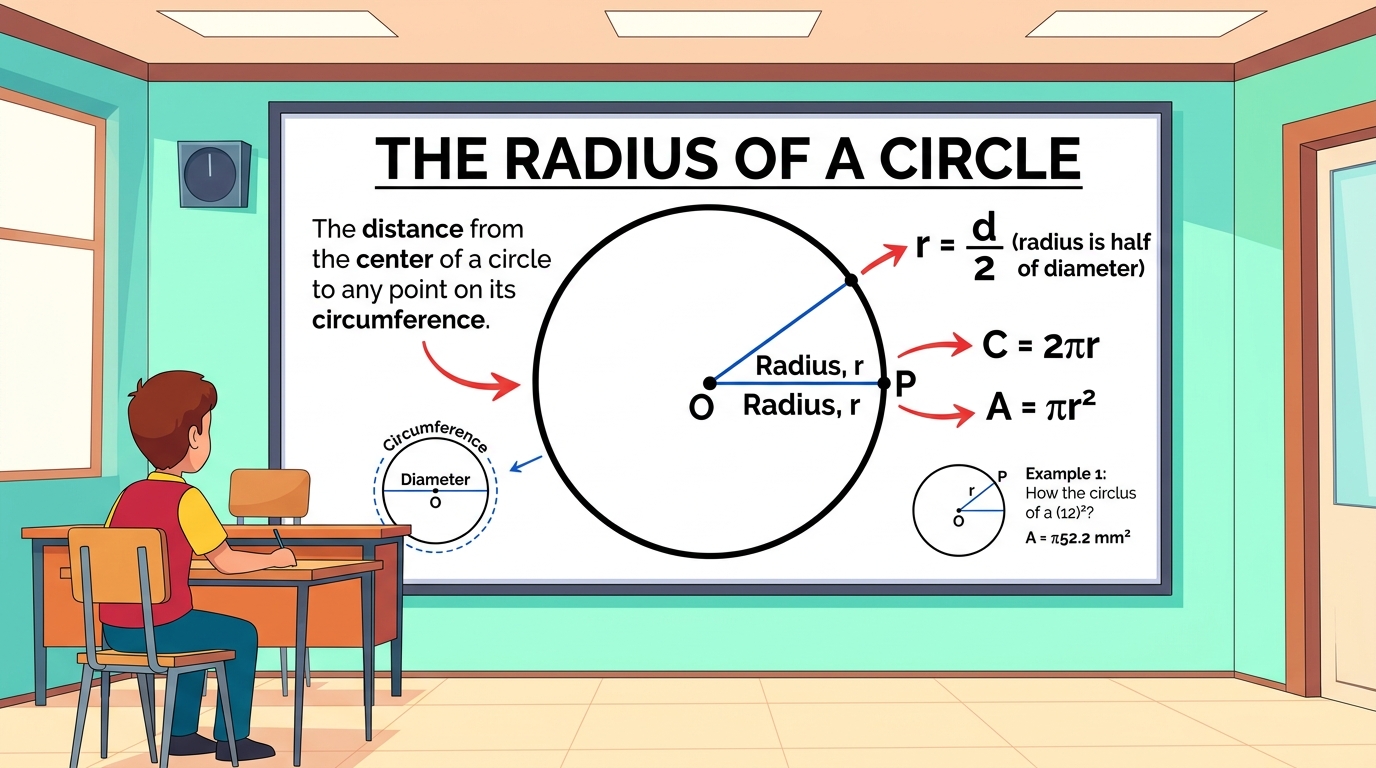
- The radius of a circle is the distance from the center to any point on the edge. Every radius of the same circle is the same length.
- The radius is half the diameter: r = d ÷ 2. The diameter is twice the radius: d = 2r.
- If you know the circumference, r = C ÷ (2π). If you know the area, r = √(A ÷ π).
- The most common mistake is plugging the diameter into A = πr². Always cut the diameter in half first.
- A sphere has a radius too: the distance from its center to any point on its surface.
The radius of a circle is the distance from the center of the circle to any point on its edge. If a circle is 10 inches across, its radius is 5 inches, because the radius is always half the diameter. The plural is radii (say “RAY-dee-eye”), and every radius in a circle is the same length. That’s what makes a circle a circle.
Below are the formulas that connect radius to diameter, circumference and area, how to work backwards to find the radius from any of them, worked examples and practice problems with answers.
Radius, diameter and circumference
These three words get mixed up constantly, so here they are side by side for a circle with a radius of 5 cm.
| Term | What it is | Formula | When r = 5 cm |
|---|---|---|---|
| Radius (r) | Center to edge | r = d ÷ 2 | 5 cm |
| Diameter (d) | Edge to edge, straight through the center | d = 2r | 10 cm |
| Circumference (C) | Distance all the way around | C = 2πr or C = πd | 10π ≈ 31.4 cm |
| Area (A) | Space inside the circle | A = πr² | 25π ≈ 78.5 cm² |
A simple way to keep them straight: the radius is a ray from the center, going one way. The diameter goes all the way across, like a line cutting a pizza in half. The circumference is the crust.
How to find the radius from anything you know
School problems rarely hand you the radius. Usually you get one of the other measurements and have to work back to it. Here are all three ways.
From the diameter
Divide by 2. A 16-inch diameter gives an 8-inch radius.
From the circumference
Since C = 2πr, divide the circumference by 2π: r = C ÷ (2π).
From the area
Since A = πr², divide the area by π, then take the square root: r = √(A ÷ π). Don’t skip the square root. Dividing by π only gets you r², not r.
Worked examples
For these we use π ≈ 3.14 unless the answer is left in terms of π.
Example 1: Radius from diameter
A round table is 14 feet across. What’s its radius?
r = d ÷ 2 = 14 ÷ 2 = 7 feet.
Example 2: Radius from circumference
A bike wheel has a circumference of 62.8 inches. Find the radius.
r = C ÷ (2π) = 62.8 ÷ (2 × 3.14) = 62.8 ÷ 6.28 = 10 inches.
Example 3: Radius from area
A circular rug covers 28.26 square feet. Find the radius.
r² = A ÷ π = 28.26 ÷ 3.14 = 9
r = √9 = 3 feet.
Example 4: Use the radius to find everything else
A circle has a radius of 6 m.
Diameter: d = 2 × 6 = 12 m.
Circumference: C = 2 × π × 6 = 12π ≈ 37.68 m.
Area: A = π × 6² = π × 36 = 36π ≈ 113.04 m².
Notice the order in the area: square the radius first (6² = 36), then multiply by π.
Example 5: Why the radius matters more than you’d think
Is one 12-inch pizza more food than two 8-inch pizzas? Pizza sizes are diameters, so halve them first.
12-inch pizza: r = 6, area = 36π ≈ 113 square inches.
One 8-inch pizza: r = 4, area = 16π ≈ 50 square inches. Two of them: 32π ≈ 100 square inches.
The single 12-inch pizza wins. Because the radius gets squared, a small change in radius makes a big change in area. Double the radius and the area gets four times bigger.
Example 6: Radius from a circle’s equation
For older students, a circle on a graph has the equation (x – h)² + (y – k)² = r², where (h, k) is the center.
For x² + y² = 49, the center is (0, 0) and r² = 49, so the radius is 7.
The radius of a sphere
A ball, a globe or a marble each has a radius too. It’s the distance from the exact center to any point on the surface. The same half-the-diameter rule applies: a basketball about 9.5 inches across has a radius of about 4.75 inches. Sphere formulas use the radius as well, like volume V = (4/3)πr³ and surface area SA = 4πr², so finding the radius is almost always step one.
Common mistakes
- Using the diameter in the area formula. With d = 10, A = π × 10² = 100π is wrong. The radius is 5, so A = 25π. That mistake makes the answer four times too big.
- Multiplying by π before squaring. For r = 3, some kids do (3 × 3.14)² ≈ 88.7. The correct order is 3² = 9, then 9 × 3.14 = 28.26.
- Squaring when they mean doubling. r² is r × r, not r × 2. For r = 5, r² is 25, not 10.
- Skipping the square root. Going from area back to radius, dividing by π gives r², not r.
- Wrong units. Radius, diameter and circumference are lengths (cm). Area is square units (cm²).
- Measuring from edge to edge off center. A line across a circle that misses the center is a chord, and it’s shorter than the diameter.
Practice problems
Use π ≈ 3.14 unless the problem says otherwise.
- A circle has a diameter of 20 cm. What’s its radius?
- A circle has a radius of 4.5 inches. What’s its diameter?
- A circle’s circumference is 18.84 m. Find the radius.
- Find the area of a circle with a radius of 10 ft.
- A circle’s area is 50.24 square inches. Find the radius.
- A soccer ball is 22 cm across. What’s its radius?
- A circle’s circumference is exactly 10π cm. Find the radius, then the exact area in terms of π.
- What’s the center and radius of the circle (x – 2)² + (y + 1)² = 81?
Answers
- 10 cm (20 ÷ 2).
- 9 inches (4.5 × 2).
- 3 m. 18.84 ÷ 6.28 = 3.
- 314 square feet. 10² = 100, and 100 × 3.14 = 314.
- 4 inches. 50.24 ÷ 3.14 = 16, and √16 = 4.
- 11 cm (22 ÷ 2).
- Radius 5 cm, since 10π ÷ 2π = 5. Area = π × 5² = 25π cm².
- Center (2, -1), radius 9, because r² = 81.
If your child is stuck on radius problems
Circle formulas usually arrive in seventh grade. When kids get stuck here, the cause is almost always one of three older skills: dividing by 2 and by decimals like 6.28, understanding exponents (r² as r × r), and plugging a number into a formula in the right order. A kid who does 3 × 3.14 and then squares it needs order of operations practice more than circle practice.
Look at what goes wrong on the homework. If it’s the decimal division, go back to the decimal and multiplication work covered in our math skills by grade level guide. If mistakes are showing up across several topics at once, our list of signs your child is behind in math will help you figure out how far back the gap goes. Geometry vocabulary tends to build on itself, too. Kids who are fuzzy on angle terms, covered in supplementary angles, explained, often mix up circle terms as well.
Frequently asked questions
What is the math definition of radius?
The radius is a line segment from the center of a circle (or sphere) to any point on it, or the length of that segment. In a given circle, every radius has the same length.
Is the radius half the diameter?
Yes, always. r = d ÷ 2, and d = 2r.
How do you find the radius of a circle from the circumference?
Divide the circumference by 2π. A circumference of 31.4 cm gives 31.4 ÷ 6.28 = 5 cm.
How do you find the radius from the area?
Divide the area by π, then take the square root. An area of 78.5 cm² gives 78.5 ÷ 3.14 = 25, and √25 = 5 cm.
What’s the plural of radius?
Radii. “Radiuses” is also accepted in everyday English, but math books use radii.
Find the actual gap
When circle problems go wrong, the mistake usually comes from an older skill like decimals or exponents, and homework alone won’t tell you which one. Math Anon begins with a short adaptive assessment that finds the specific skills your child is missing and sends you a written report.
After that, your child practices exactly those skills for about 20 minutes a day, and you get a weekly progress report. The assessment is $49, and the whole amount is credited to your first month. Start the assessment or see our pricing.





