
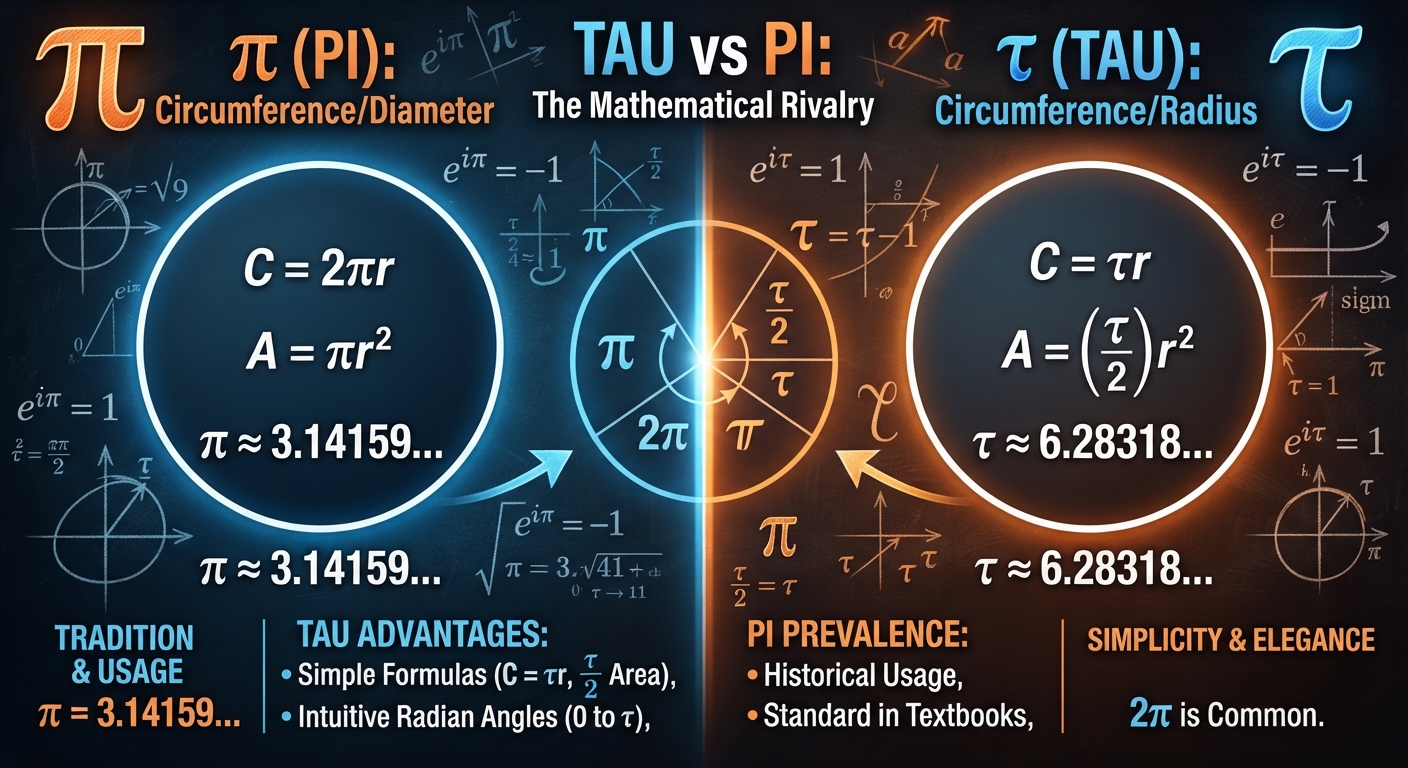
Tau Vs Pi: What Tau Is And Why It Exists
The short version
- Tau (τ) is a circle constant equal to a circle’s circumference divided by its radius. It works out to about 6.283185, which is exactly twice pi.
- So τ = 2π, and every formula you know still works. C = τr is the same statement as C = 2πr.
- Tau’s selling point is angles. One full turn is τ radians, a half turn is τ/2, a quarter turn is τ/4, so the fraction of the circle is right there in the number.
- Pi keeps one clear edge in the area formula: A = πr² is tidier than A = ½τr², though that second form matches other physics formulas nicely.
- Schools teach pi, tests use pi, and no student is penalized for that. Tau is worth knowing because it makes radians click, not because anyone has to switch.
Tau is the circle constant you get when you divide a circle’s circumference by its radius. Its value is about 6.283185307, and it’s written with the Greek letter τ. Because a diameter is two radii, tau is exactly double pi: τ = 2π = 6.283185…
That’s the whole definition. The interesting part is the argument that goes with it. A group of mathematicians and teachers think tau should have been the constant we teach first, because circles are built from radii, not diameters. Here’s what that argument actually says, where it holds up, and where pi still wins.
What tau is, in numbers
Take any circle. Measure around the outside (the circumference) and measure from the center to the edge (the radius). Divide the first by the second. You get the same number every time, for every circle, forever.
τ = C ÷ r = 6.283185307179586…
Pi is the same idea with the diameter instead:
π = C ÷ d = 3.141592653589793…
Since d = 2r, the two constants have to be related by a factor of 2. Both are irrational, so the decimals run forever without repeating. For homework, 6.28 is usually close enough, and most calculators will give you more digits than any problem needs.
Tau vs pi, formula by formula
| What you want | With pi | With tau |
|---|---|---|
| Circumference from radius | C = 2πr | C = τr |
| Circumference from diameter | C = πd | C = τd ÷ 2 |
| Area of a circle | A = πr² | A = ½τr² |
| Full turn in radians | 2π | τ |
| Quarter turn in radians | π/2 | τ/4 |
| Arc length, angle θ in radians | s = rθ | s = rθ |
Two of those rows favor tau, one favors pi, and the rest are a wash. That’s an honest scorecard. Nobody is claiming pi gives wrong answers.
Where tau actually helps: radians
Radians are where most students first hit real trouble with circles, and it’s the one place tau earns its keep. With tau, the radian measure of an angle is just the fraction of the circle you turned, multiplied by τ.
| Fraction of a circle | Degrees | In tau | In pi |
|---|---|---|---|
| Whole circle | 360° | τ | 2π |
| Half | 180° | τ/2 | π |
| Quarter | 90° | τ/4 | π/2 |
| Third | 120° | τ/3 | 2π/3 |
| Sixth | 60° | τ/6 | π/3 |
| Eighth | 45° | τ/8 | π/4 |
Look at the third row. A quarter of a circle is τ/4 but π/2, and a sixth of a circle is τ/6 but π/3. With pi, every denominator is half of what your gut expects, and kids spend a month fighting that. With tau, τ/6 means one sixth of the way around. Nothing to translate.
This is also why the tau argument matters more in trigonometry than in fifth grade circumference problems. A kid learning C = 2πr is fine. A kid trying to remember whether 5π/6 is past the top of the circle has a real reason to wish for tau.
Where pi still wins
Area. A = πr² is short and every student can hold it in their head. In tau form it becomes A = ½τr², which looks worse at first glance.
Tau fans point out that the ½ isn’t clutter, it’s a family resemblance. Distance under constant acceleration is ½at². Kinetic energy is ½mv². Area of a triangle is ½bh. Those halves all come from the same kind of accumulation, and area of a circle belongs in that group. That’s a fair point and it still doesn’t make ½τr² easier for a sixth grader.
The bigger advantage for pi is everything outside the math itself. Textbooks, standardized tests, calculators, engineering references, and roughly four centuries of published work all use pi. Switching would cost more than it saves.
Worked examples with tau
Example 1: circumference of a circle with radius 5 cm
C = τr
C = 6.283185 × 5
C = 31.4159 cm, or about 31.42 cm
Check it the pi way: C = 2πr = 2 × 3.141593 × 5 = 31.4159 cm. Identical, as it must be.
Example 2: area of a circle with radius 5 cm
A = ½τr²
A = 0.5 × 6.283185 × 25
A = 78.5398, or about 78.54 cm²
The pi version: A = πr² = 3.141593 × 25 = 78.54 cm². Same number again.
Example 3: turning 135° into tau radians
135 ÷ 360 = 3/8 of a circle
So the angle is 3τ/8
In pi: 3τ/8 = 3(2π)/8 = 3π/4
Tau Day, June 28
Pi Day is March 14, because 3/14 matches 3.14. Tau Day is June 28, because 6/28 matches 6.28. It started in 2010 with Michael Hartl’s “Tau Manifesto,” which built on a 2001 article by Bob Palais called “π Is Wrong!” Classrooms that celebrate it usually do circle puzzles and eat two pies, since tau is two pi. It’s a joke with a real lesson attached, which is the best kind of school holiday.
Common mistakes with tau and pi
Thinking they give different answers. They don’t. τ = 2π is an exact statement, not an approximation, so any correct formula written in tau matches the pi version to every decimal place.
Mixing radius and diameter. This is the error underneath most wrong circle answers, tau or no tau. If a problem hands you a diameter of 10 and you plug 10 into C = τr, your answer is double what it should be. Halve it first.
Using tau on a test that asks for pi. If the directions say “leave your answer in terms of π,” write 10π, not 5τ. Same value, wrong format, lost point.
Rounding too early. Using 6.3 instead of 6.283185 in a multi-step problem pushes your final answer off by enough to miss. Keep the calculator value until the last step.
Reading ½τr² as (½τr)². The exponent only touches the r. Square the radius first, then multiply.
Practice problems
1. Write tau to two decimal places.
2. A circle has a radius of 4 cm. Find its circumference using C = τr. Round to two decimal places.
3. A circle has a diameter of 10 inches. Find its circumference using tau.
4. Convert τ/8 to degrees.
5. Write 270° in terms of tau, then in terms of pi.
6. Find the area of a circle with radius 6 using A = ½τr². Round to two decimal places.
7. A wheel makes 3 full rotations. How many tau radians is that, and how many degrees?
8. Which is larger, 5π or 2τ?
Answers
1. 6.28.
2. C = 6.283185 × 4 = 25.132741, so about 25.13 cm.
3. The radius is 10 ÷ 2 = 5 inches, so C = 6.283185 × 5 = 31.415927, about 31.42 inches.
4. One eighth of 360° = 45°.
5. 270 ÷ 360 = 3/4 of a circle, so 3τ/4. In pi terms that’s 3(2π)/4 = 3π/2.
6. A = 0.5 × 6.283185 × 36 = 113.097335, about 113.10 square units.
7. 3τ radians, which is 3 × 360° = 1080°.
8. 2τ = 4π, and 5π is bigger than 4π, so 5π. In decimals, 5π is about 15.71 and 2τ is about 12.57.
If your kid is lost on circle constants
When circle problems go wrong, the constant is almost never the reason. Three earlier skills cause most of it.
The first is telling radius from diameter and halving or doubling on command. A student who can’t do that conversion without thinking will get every second circle problem wrong no matter which constant is printed on the page.
The second is multiplying decimals. 6.283185 × 4 by hand, or even entering it correctly on a calculator, needs place value that’s solid. The third is fractions, because radians are fractions of a circle and nothing else. A kid who doesn’t feel that 3/8 is a bit less than half has no shot at placing 3τ/8 on a diagram. Our post on why algebra trouble usually traces back to fourth grade fractions covers that chain, and math skills by grade level shows what should already be automatic before circles show up. If circle geometry is one of several sore spots, the grade by grade signs a child is behind is a useful check, and for angle vocabulary the post on supplementary angles covers the degree side of the same topic.
Frequently asked questions
What is the value of tau?
Tau is approximately 6.283185307179586, and it goes on forever without repeating because it’s irrational. For most schoolwork, 6.28 is plenty. The exact statement is τ = 2π.
Is tau better than pi?
For radians and angles, tau is clearly easier to read, since τ/6 means one sixth of a circle while π/3 means the same thing with an extra translation step. For area, pi’s version is shorter. Neither one is more correct, and every answer comes out the same either way.
Why don’t schools teach tau?
Pi has a few hundred years of textbooks, tests, calculators, and reference tables behind it. A change that only reshuffles which constant you write, without fixing any wrong answers, isn’t worth rewriting all of that. Plenty of teachers mention tau anyway when radians come up.
When is Tau Day?
June 28, written 6/28 in the United States, to match 6.28. It’s the tau version of Pi Day on March 14.
How do I type the tau symbol?
On a Mac, press Option and t for τ. On Windows, hold Alt and type 0964 on the number pad, or use the Insert Symbol menu in Word. In HTML, τ produces τ. On most phone keyboards you’ll find it under the Greek symbol set or by searching “tau” in the emoji and symbol search.
Does tau change the answer to circle problems?
No. Because τ = 2π exactly, C = τr and C = 2πr are the same equation written two ways. The only thing that changes is which symbol you write down.
Find the actual gap
If circles are where your child stalls, the useful question is which earlier skill is missing: decimal multiplication, fraction sense, or the radius and diameter relationship. Math Anon starts with a short adaptive assessment that adjusts to each answer and then gives you a written report naming those skills by name.
From there your child practices what’s actually missing for about 20 minutes a day, and a progress report lands every week so you can see movement instead of guessing. The assessment costs $49 and we credit every dollar of it back on your first month. Start the assessment, or check pricing first.





