
What Is A Polygon? Names, Angles And Types
The short version
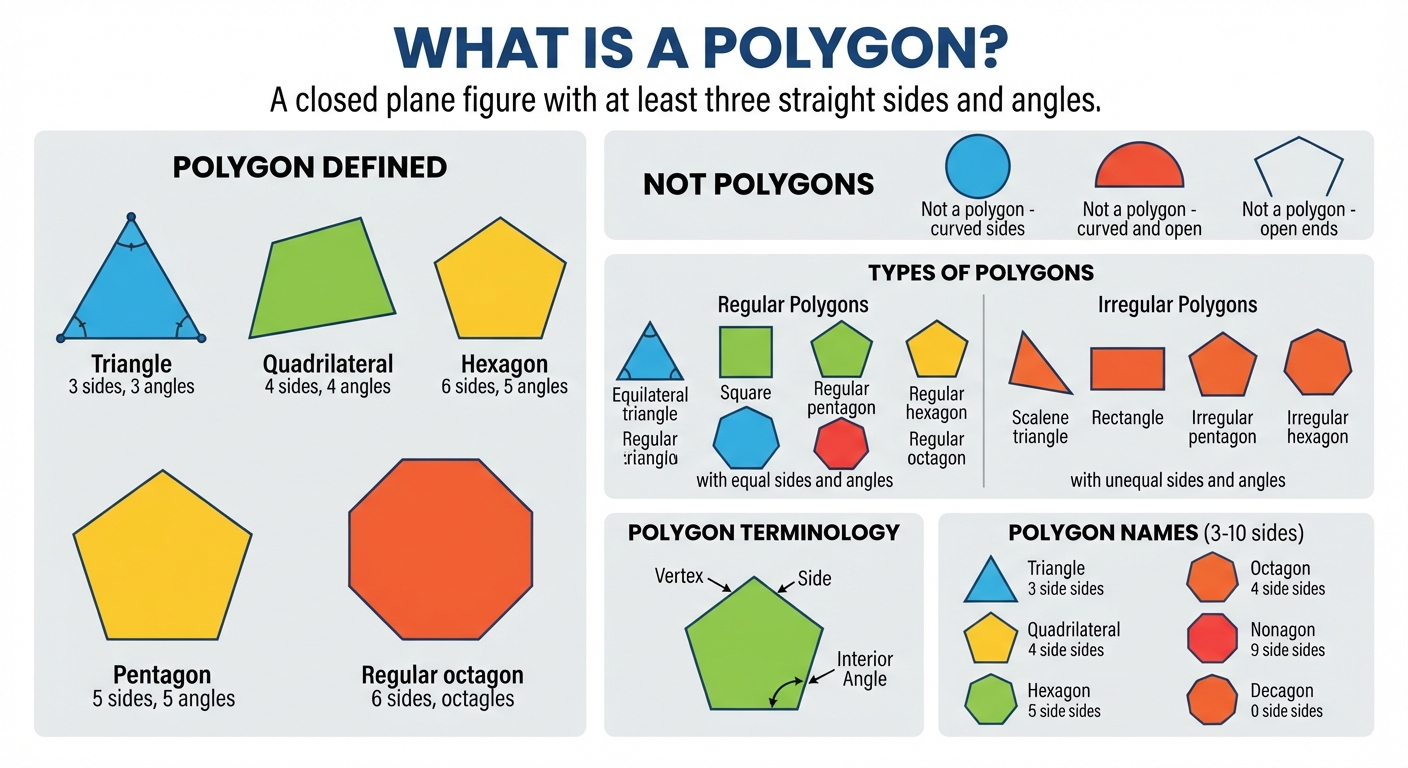
- A polygon is a flat, closed shape made of straight line segments that meet only at their endpoints. Three sides is the minimum.
- Circles, arcs, open shapes, and anything with a curve are not polygons, and neither are 3D solids like cubes.
- Polygons are named by side count: 3 triangle, 4 quadrilateral, 5 pentagon, 6 hexagon, 8 octagon, 10 decagon.
- The interior angles of any polygon add up to (n – 2) × 180°, where n is the number of sides. A hexagon gives (6 – 2) × 180 = 720°.
- Regular means all sides and all angles are equal. A square is regular, a 4 by 7 rectangle is not.
A polygon is a closed, two dimensional shape whose sides are all straight line segments. The segments connect end to end, they don’t cross, and the shape closes up with no gaps. Triangles, squares, pentagons, and stop signs are polygons. Circles are not.
The word comes from Greek: “poly” means many and “gon” means angle, so a polygon is a many angled figure. Every polygon has the same number of angles as sides, which is why the naming system works the way it does.
Below is what makes a shape count as a polygon, the full list of names, the angle formulas kids actually get tested on, and practice problems with worked answers.
What makes a shape a polygon
A shape has to pass four tests:
- It’s flat, meaning it lies in a plane. A cube is not a polygon; each of its faces is.
- Every side is a straight segment. One curve anywhere disqualifies it.
- It’s closed, so you can trace the whole outline and end where you started.
- The sides meet only at their endpoints and never cross through each other.
Three sides is the floor. You can’t close a shape with two straight segments, so there’s no such thing as a two sided polygon.
| Shape | Polygon? | Why |
|---|---|---|
| Triangle | Yes | Three straight sides, closed |
| Circle | No | No straight sides |
| Semicircle | No | One side is curved |
| Star outline | Yes | Straight sides, closed, sides meet at endpoints |
| Cube | No | It’s 3D, not flat |
| Arrow shape | Yes | Straight sides and closed, even though it caves in |
Polygon names by number of sides
Learn the first few and the rest follow a pattern. Past 12, most people write “20 sided polygon” rather than fight with the Greek.
| Sides | Name | Interior angle sum | Each angle if regular |
|---|---|---|---|
| 3 | Triangle | 180° | 60° |
| 4 | Quadrilateral | 360° | 90° |
| 5 | Pentagon | 540° | 108° |
| 6 | Hexagon | 720° | 120° |
| 7 | Heptagon | 900° | about 128.57° |
| 8 | Octagon | 1080° | 135° |
| 9 | Nonagon | 1260° | 140° |
| 10 | Decagon | 1440° | 144° |
| 12 | Dodecagon | 1800° | 150° |
A polygon with n sides, when n is large or unknown, is called an n-gon or an n sided polygon. A 15 sided one is a 15-gon, and nobody will blame you for writing it that way.
Regular vs irregular polygons
A regular polygon has all sides the same length and all angles the same size. Both conditions, not one. A stop sign is a regular octagon. An equilateral triangle is a regular triangle.
Irregular means at least one of those fails. A 4 by 7 rectangle has four right angles but two different side lengths, so it’s irregular. A rhombus that isn’t a square has four equal sides but unequal angles, so it’s irregular too. The square is the only quadrilateral that’s regular.
Convex vs concave polygons
A convex polygon has every interior angle under 180°. No corner points inward, and any line segment you draw between two points inside stays inside.
A concave polygon has at least one interior angle bigger than 180°, called a reflex angle. That corner caves in, which is an easy way to remember the word. Arrow shapes and star outlines are concave. Drawing a segment across the dent takes you outside the shape and back in.
A quick test: if you could stretch a rubber band around the shape and it would touch every corner, it’s convex. If the band skips a corner, that corner caves in and the shape is concave.
The interior angle sum formula
Every polygon splits into triangles by drawing diagonals from one corner. A quadrilateral splits into 2 triangles, a pentagon into 3, a hexagon into 4. You always get n – 2 triangles, and each triangle holds 180°.
Sum of interior angles = (n – 2) × 180°
Example 1: interior angle sum of a hexagon
n = 6
(6 – 2) × 180
4 × 180 = 720°
Example 2: each angle of a regular octagon
n = 8
Sum = (8 – 2) × 180 = 6 × 180 = 1080°
Regular, so divide evenly: 1080 ÷ 8 = 135°
Example 3: working backwards from the sum
A polygon’s interior angles add to 1440°. How many sides?
1440 ÷ 180 = 8
8 = n – 2, so n = 10 sides, a decagon
Exterior angles
The exterior angles of any convex polygon always add to 360°, no matter how many sides. So in a regular polygon each exterior angle is 360 ÷ n. A regular octagon has exterior angles of 360 ÷ 8 = 45°, and 45 + 135 = 180, which checks out since each interior and exterior pair sits on a straight line. That’s the same relationship covered in our post on supplementary angles.
Common mistakes with polygons
Counting a curve as a side. A semicircle and a “D” shape both look closed and tidy, but the curved edge means no polygon.
Assuming equal angles means regular. A rectangle has four identical 90° angles and is still irregular, because the sides differ. Both conditions have to hold.
Forgetting the minus 2. Writing 6 × 180 = 1080 for a hexagon is the single most common error on this topic. The formula is (n – 2) × 180, and the subtraction happens first.
Dividing when the polygon isn’t regular. You can only split the sum evenly across the corners if every angle matches. For an irregular pentagon you know the total is 540°, and that’s all.
Calling a cube a polygon. A cube is a polyhedron. Its six square faces are polygons, but the solid itself is not.
Practice problems
1. Which of these is not a polygon: square, circle, pentagon, triangle?
2. How many sides does a heptagon have?
3. Find the interior angle sum of a nonagon.
4. Find each interior angle of a regular decagon.
5. A polygon’s interior angles add to 1800°. How many sides does it have?
6. Find each exterior angle of a regular octagon.
7. Is a rectangle measuring 4 cm by 7 cm regular or irregular? Explain in one sentence.
8. Each interior angle of a regular polygon measures 156°. How many sides does it have?
Answers
1. The circle, because it has no straight sides.
2. 7 sides, and 7 angles.
3. (9 – 2) × 180 = 7 × 180 = 1260°.
4. Sum is (10 – 2) × 180 = 1440°. Regular, so 1440 ÷ 10 = 144° each.
5. 1800 ÷ 180 = 10, and 10 = n – 2, so n = 12 sides, a dodecagon.
6. 360 ÷ 8 = 45°. Each interior angle is 135°, and 135 + 45 = 180.
7. Irregular. The four angles are equal at 90°, but the sides are not all the same length.
8. Each exterior angle is 180 – 156 = 24°, and 360 ÷ 24 = 15 sides. Check: (15 – 2) × 180 = 2340, and 2340 ÷ 15 = 156°.
If your kid is stuck on polygons
Polygon questions are rarely a geometry problem. Watch which part goes wrong and the real gap shows up fast.
If the shape names are the trouble, it’s vocabulary and it fixes quickly with a chart on the fridge. If the angle formula is the trouble, the gap is usually order of operations, because (n – 2) × 180 punishes anyone who multiplies before subtracting. If problem 8 style questions are the trouble, the gap is algebra: solving 180n – 360 = 2340 takes comfortable inverse operations, and that skill starts in middle school.
The quietest gap is division. A student who can’t do 1080 ÷ 8 without stalling will avoid every regular polygon question, and it will look like a geometry problem when it isn’t. Our guide to math skills by grade level lists what should already be automatic, and the 12 signs a child is behind in math helps you tell a rough week from a real gap. If your child freezes rather than guesses, math anxiety in children is worth reading too.
Frequently asked questions
What is a polygon in simple terms?
A closed flat shape with straight sides that meet at corners. Think of a fence made of straight boards that comes all the way back around with no gaps and no curved pieces.
Is a circle a polygon?
No. A polygon needs straight sides, and a circle is one continuous curve. Ovals, semicircles, and any shape with a rounded edge are out for the same reason.
What is the smallest polygon?
A triangle, with three sides. Two straight segments can’t close a shape, so three is the minimum.
What is a regular polygon?
One where every side is the same length and every angle is the same size. An equilateral triangle, a square, and a stop sign shape all qualify. If only one of those two things is true, the polygon is irregular.
How do you find the sum of interior angles of a polygon?
Use (n – 2) × 180°, with n as the number of sides. A pentagon gives (5 – 2) × 180 = 540°. The formula works because any polygon splits into n – 2 triangles, and every triangle holds 180°.
What’s the difference between a polygon and a polyhedron?
A polygon is flat and a polyhedron is a solid whose faces are polygons. A square is a polygon; a cube is a polyhedron made of six square faces.
Find the actual gap
When geometry gets rocky, the missing piece is usually older than the lesson: division facts, order of operations, or solving a simple equation. Math Anon begins with a short adaptive assessment that changes as your child answers, then gives you a written report that names the shaky skills instead of a vague grade level.
Practice then targets those skills for roughly 20 minutes a day, and a progress report arrives weekly so you can see exactly what’s moving. The assessment is $49, credited back in full on your first month. Start the assessment or read the pricing page first.





