
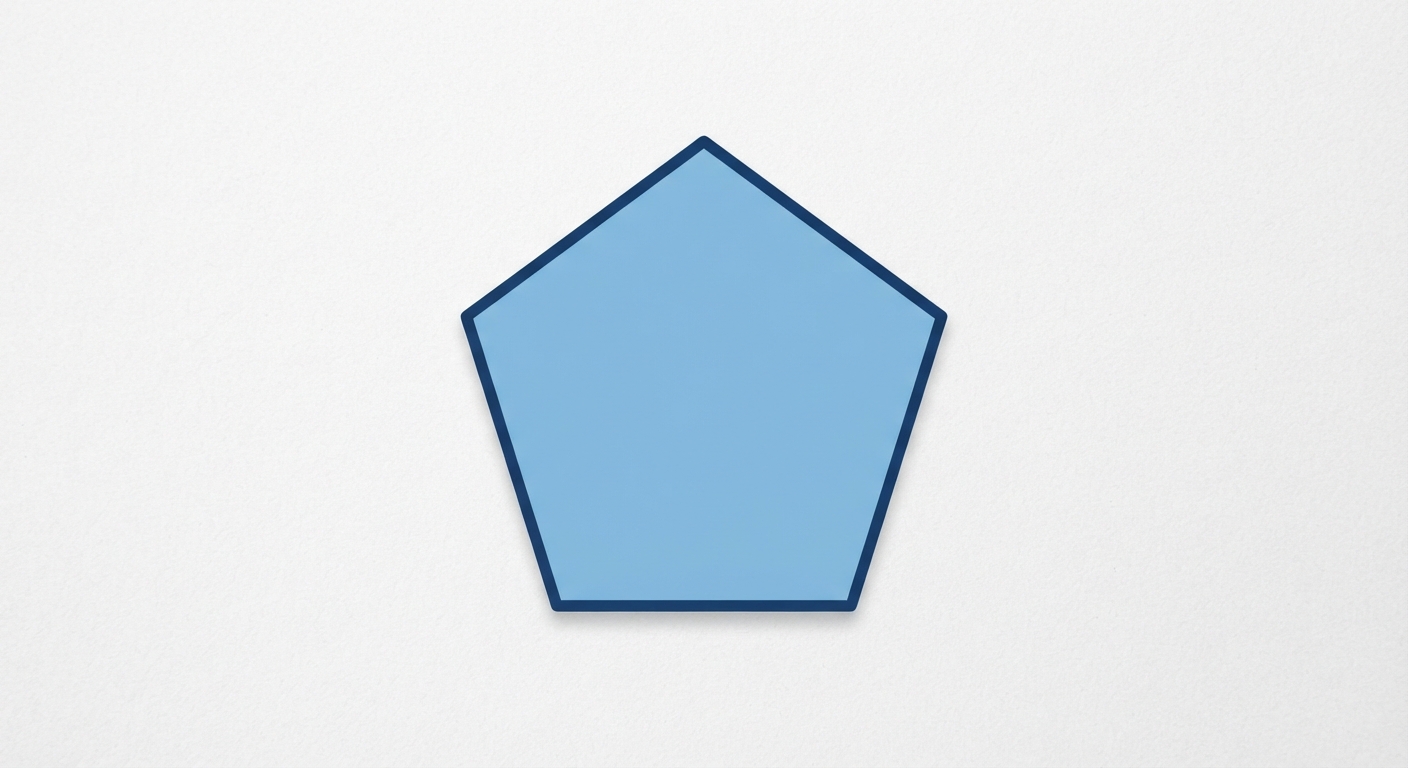
Pentagon Shape: Sides, Angles And Area
The short version
- A pentagon is a closed shape with five straight sides, five vertices and five angles.
- The interior angles of any pentagon add up to 540 degrees, regular or not.
- In a regular one every side matches and every interior angle is 540 ÷ 5 = 108 degrees.
- Perimeter is just the five sides added up. For a regular pentagon with side s, area = ½ × perimeter × apothem, or about 1.72 × s².
- Home plate on a baseball field, the school crossing sign, and the black panels on a classic soccer ball are all pentagons.
A pentagon is a five-sided polygon. Penta means five in Greek, and gon means angle, so the name says exactly what it is: five sides, five corners, five angles, all joined in a closed loop with no curves and no gaps. Its interior angles always total 540 degrees.
That total is the fact most homework problems hang on. Below we cover how to get 540 without memorizing it, the difference between regular and irregular pentagons, how to find a missing angle, perimeter and area with real numbers, and practice problems with a full answer key.
Pentagon basics
To count as a pentagon, a shape has to be a polygon first. All five sides are straight segments, they meet only at their endpoints, and the figure closes up. A five-sided figure with one curved side isn’t a pentagon.
| Property | Pentagon |
|---|---|
| Sides | 5 |
| Vertices (corners) | 5 |
| Interior angles | 5, adding to 540 degrees |
| Diagonals | 5 |
| Triangles from one vertex | 3 |
| Lines of symmetry (regular) | 5 |
The diagonal count comes from a formula that works for any polygon: n(n – 3) ÷ 2, so 5 × 2 ÷ 2 = 5. Draw all five inside a regular one and you get a five-pointed star, which is where the pentagram comes from.
Regular and irregular pentagons
A regular pentagon has five equal sides and five equal angles. That’s the shape most people picture, and the one with clean numbers: every angle is 108 degrees, five lines of symmetry, and it looks the same after a 72 degree turn.
An irregular pentagon has five sides too, but they don’t all match. Home plate is a good example, with two long parallel sides, a short one, and two that meet at a point. Still five sides, still 540 degrees of interior angle, no equal-sides rule.
There’s a second split worth knowing. A convex pentagon has every interior angle under 180 degrees and no corners pushed inward. A concave one has an angle bigger than 180, so part of the shape caves in, like an arrowhead. Both count.
Pentagon angles
This one is worth understanding instead of memorizing. Pick a vertex of any pentagon and draw diagonals to the two non-neighboring vertices. You’ve cut it into 3 triangles. Every triangle holds 180 degrees, and those angles together make up all of the pentagon’s angles.
3 × 180 = 540 degrees
The general rule for a polygon with n sides is (n – 2) × 180, so (5 – 2) × 180 = 540. This holds for every one ever drawn, skinny, lopsided or perfect.
Each angle in a regular pentagon
If all five angles are equal, split the total evenly.
540 ÷ 5 = 108 degrees
The exterior angle, measured by extending one side, is what’s left over: 180 – 108 = 72 degrees. The exterior angles of any polygon add to 360, and 360 ÷ 5 = 72 checks out. That 72 is also the angle at the center between two neighboring vertices.
Finding a missing angle
Four of the angles measure 100, 115, 90 and 130 degrees. Find the fifth.
Step 1: add what you have.
100 + 115 = 215
215 + 90 = 305
305 + 130 = 435
Step 2: subtract from 540.
540 – 435 = 105 degrees
Check: 100 + 115 + 90 + 130 + 105 = 540. It works. Missing angle problems in any polygon follow this pattern, and they’re first cousins to the ones in our post on supplementary angles, where two angles have to hit 180 instead of five hitting 540.
Perimeter and area of a pentagon
Perimeter
Add the five side lengths. Nothing fancy.
Irregular pentagon with sides 5, 7, 4, 9 and 6 inches:
5 + 7 + 4 + 9 + 6 = 31 inches
Regular pentagon with a side of 8 cm:
5 × 8 = 40 cm
Area of a regular pentagon
The workhorse formula uses the apothem, which is the distance from the center straight out to the middle of a side.
Area = ½ × perimeter × apothem
Take a regular one with 6 cm sides and an apothem of about 4.13 cm.
Perimeter = 5 × 6 = 30 cm
Area = ½ × 30 × 4.13
Area = 15 × 4.13 = about 61.9 square cm
If you only know the side length, there’s a shortcut: area is about 1.72 × s². For s = 6, that’s 1.72 × 36 = 61.9 square cm, matching what we got above. For a 10 cm side, area is roughly 172 square cm.
The formula works because lines from the center to each vertex slice the pentagon into 5 identical triangles, each with base s and height equal to the apothem. Five of those is 5 × (½ × s × apothem), and 5s is the perimeter.
Area of an irregular pentagon
There’s no single formula. Split the shape into triangles and rectangles, find each piece, then add. Home plate breaks into a square plus a triangle.
Pentagons in the real world
- Home plate in baseball and softball.
- The school crossing sign in the United States, which is pentagonal so drivers recognize it by outline alone.
- The black panels on a classic stitched soccer ball. There are 12 pentagons and 20 hexagons on one.
- The Pentagon building outside Washington, D.C., five sides and five floors.
- The cross section of an okra pod, and the outline of many five-petal blossoms.
One thing regular pentagons can’t do is tile a floor. Corners of 108 degrees don’t divide evenly into 360, so gaps appear. Squares (90) and regular hexagons (120) do divide evenly, which is why you see those in tile and honeycomb.
Common mistakes with pentagons
Thinking every pentagon has 108 degree angles. Only regular ones do. An irregular one still totals 540, but the individual angles can be anything, including one over 180.
Mixing up 540 and 360. The interior angles add to 540. The exterior angles add to 360. Those are different measurements, and problems ask for both.
Confusing the apothem with the radius. The apothem goes from the center to the midpoint of a side. The radius goes from the center to a vertex, and it’s longer.
Assuming a five-pointed star is a pentagon. A star has ten sides and ten vertices. The five-sided shape is the small one in the middle of it.
Practice problems
1. How many sides, vertices and angles does a pentagon have?
2. What do the interior angles of any pentagon add up to?
3. What is each interior angle of a regular pentagon?
4. Four angles of a pentagon are 100, 115, 90 and 130 degrees. Find the fifth.
5. A regular pentagon has sides of 8 cm. What is its perimeter?
6. An irregular one has sides of 5, 7, 4, 9 and 6 inches. What is its perimeter?
7. A regular one has 6 cm sides and an apothem of 4.13 cm. Find the area, rounded to one decimal place.
8. What is each exterior angle of a regular pentagon, and how many diagonals does it have?
Answers
1. Five of each.
2. 540 degrees, from (5 – 2) × 180.
3. 540 ÷ 5 = 108 degrees.
4. 100 + 115 + 90 + 130 = 435, and 540 – 435 = 105 degrees.
5. 5 × 8 = 40 cm.
6. 5 + 7 + 4 + 9 + 6 = 31 inches.
7. Perimeter is 30 cm, so area = ½ × 30 × 4.13 = 61.95, which rounds to 61.9 square cm.
8. Each exterior angle is 360 ÷ 5 = 72 degrees, and there are 5 diagonals.
What it means if your kid is stuck on pentagons
Naming a pentagon is a first grade skill, and if that’s the sticking point a few minutes with shape cards usually fixes it.
The angle and area work is middle school, and that’s where real gaps show up. A kid who can’t find the fifth angle is often fine on the geometry and stuck on the arithmetic: adding four multi-digit numbers, then subtracting from 540 without a calculator. When every step takes effort, the thread snaps before the answer arrives.
Area problems lean on multiplying decimals, since apothems are rarely whole numbers. 15 × 4.13 trips up more eighth graders than the formula does. That kind of hidden arithmetic gap is exactly what the signs a child is behind in math describes, and math skills by grade level shows which elementary skills geometry quietly assumes are automatic.
If the shapes are fine but every problem still ends in tears, math anxiety in children covers what that looks like at the kitchen table.
Frequently asked questions
What is a pentagon shape?
A closed flat figure with five straight sides, five vertices and five interior angles that add to 540 degrees. If all the sides and angles match, it’s a regular pentagon and each angle is 108 degrees.
Does a pentagon have 5 or 6 sides?
Five. A six-sided shape is a hexagon. The prefixes track the count: quad is four, penta is five, hexa is six, hepta is seven, octa is eight.
What is the sum of the angles in a pentagon?
540 degrees for the interior angles. You can get it from (n – 2) × 180 with n = 5, or by cutting the shape into 3 triangles at 180 degrees each. The exterior angles add to 360, as they do for every polygon.
How do you find the area of a pentagon?
For a regular one, area = ½ × perimeter × apothem, or about 1.72 × s² if you only have the side length. For an irregular one, cut it into triangles and rectangles, find each area, and add them together.
Is a pentagon a 2D or 3D shape?
2D. It’s flat, with only length and width. The 3D versions are the pentagonal prism, with two five-sided ends, and the pentagonal pyramid, with one five-sided base.
What grade do kids learn about pentagons?
Naming and drawing them happens in first and second grade. Classifying them as regular or irregular and counting sides and vertices comes in third through fifth. Interior angle sums, apothems and area land in middle school geometry.
Find the actual gap
When geometry homework stalls, the cause is often sitting two or three grades back in arithmetic, not in the shapes themselves. Math Anon starts every student with a short adaptive assessment that tests across grade levels and tells you exactly which skills are missing, in a written report you can actually read.
Then your child gets about 20 minutes a day of practice aimed at those exact gaps, and you get a progress report every week showing what’s closed. The assessment is $49, credited back in full on your first month. Start the assessment or read the pricing page first.





