
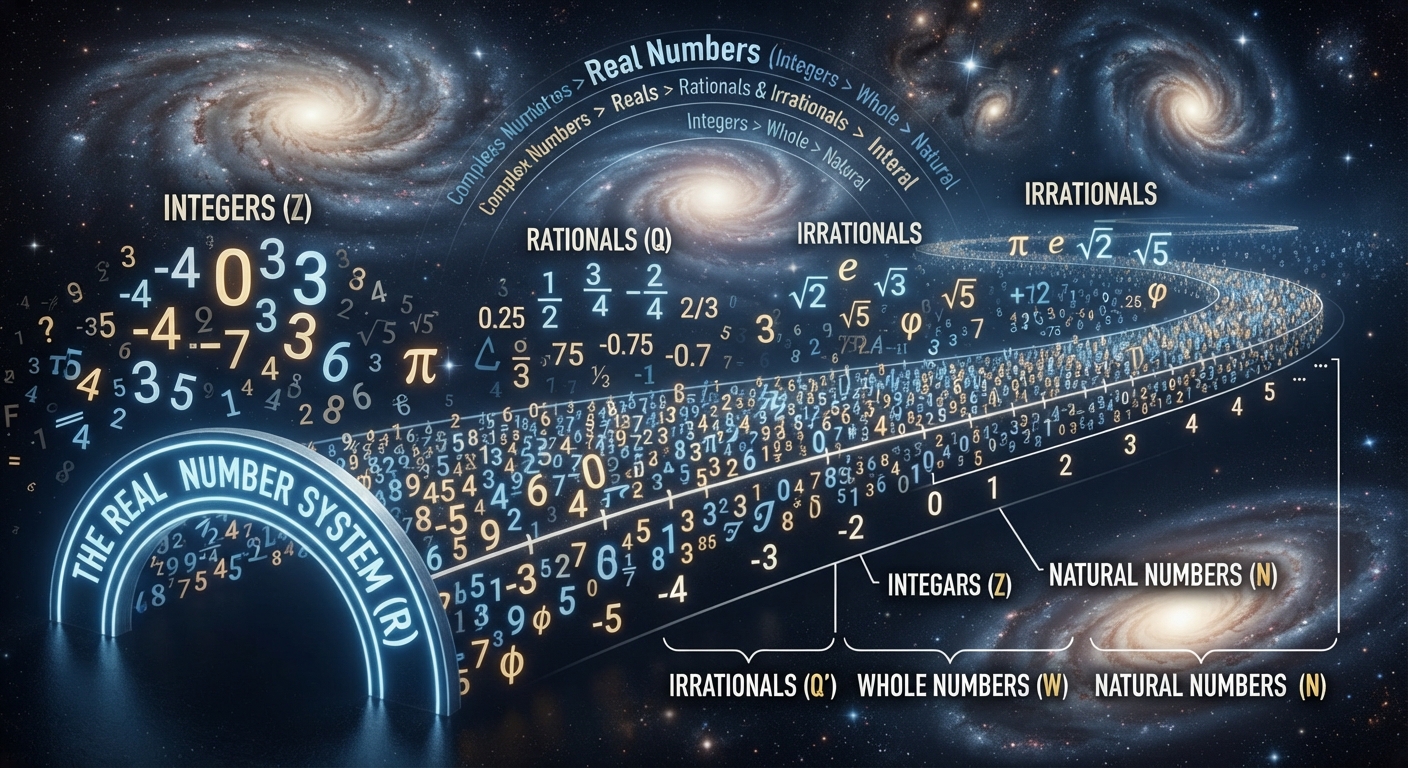
What Are Real Numbers? The Number System Explained
The short version
- Real numbers are every number that sits somewhere on the number line: all the rationals plus all the irrationals.
- That covers counting numbers, zero, negatives, fractions, decimals that stop, decimals that repeat, and decimals that never repeat, like π.
- The sets nest inside each other. Natural fits in whole, whole fits in integers, integers fit in rational, and rational plus irrational makes up the reals.
- The square root of a negative number isn’t real. √(-4) is imaginary, and dividing by zero gives nothing at all.
- The symbol for the set of real numbers is a double-struck R.
Real numbers are all the numbers you can plot on a number line. Pick any point on that line, anywhere, and the value there is a real number. That takes in -17, 0, 2/3, 4.85, √7 and π, along with every value packed between them.
The quickest way to understand real numbers is to see what’s left out. Only two things get excluded: square roots of negatives, which are imaginary, and anything divided by zero, which isn’t a number at all. Below we lay out the whole number system in one table, sort tricky cases, cover the properties that show up in algebra class, and finish with practice problems and answers.
The definition of real numbers
A real number is any number that belongs to either the rational numbers or the irrational numbers. Those two groups together fill the number line completely, with no gaps.
Rational means the number can be written as a fraction of two integers. As a decimal, it either stops (0.25) or repeats forever in a block (0.4545…). That group holds every integer, since 9 can be written as 9/1.
Irrational means no such fraction exists. As a decimal it runs on forever with no repeating block. π, e, √2 and √13 all live here.
Put them together and you have the reals. Between any two real numbers, however close, there are infinitely many more. That’s why a number line is drawn as a solid line instead of a row of dots.
The number system in one table
Each row below sits inside the row under it. This nesting is the thing most kids miss, and once it clicks, questions like “name every set this number belongs to” stop being guesswork.
| Set | Symbol | What’s in it | New in this row |
|---|---|---|---|
| Natural (counting) | N | 1, 2, 3, 4, … | The counting numbers |
| Whole | W | 0, 1, 2, 3, … | Zero |
| Integers | Z | …, -2, -1, 0, 1, 2, … | Negatives like -7 |
| Rational | Q | Any a/b with integers a and b, b not zero | Fractions and repeating decimals: 3/4, -2.5, 0.666… |
| Irrational | none standard | Decimals that never end and never repeat | π, e, √2 |
| Real | R | Every rational and every irrational number | The whole number line |
Read it as a set of nested boxes. Every natural number is whole, every whole number is an integer, every integer is rational, and every rational number is real. The irrationals sit inside the reals but share nothing with the rationals. No number is both.
Worked example: naming every set
Which sets does -6 belong to?
It’s negative, so it’s not natural and not whole.
It has no fractional part, so it is an integer.
It can be written as -6/1, so it is rational.
Rational means real.
Answer: integer, rational, real.
Which sets does √36 belong to?
√36 = 6, so don’t let the root fool you.
6 is a counting number, so it’s natural, whole and an integer.
6 = 6/1, so it’s rational and therefore real.
Answer: natural, whole, integer, rational, real.
What isn’t a real number
Two things, and that’s it.
Square roots of negative numbers. No real number squared gives a negative result, since a negative times a negative is positive. So √(-4) has no home on the number line. Mathematicians made one up: i, defined so that i² = -1. That makes √(-4) = 2i, an imaginary number. Real numbers and imaginary numbers together form the complex numbers, which most students meet in Algebra 2.
Anything over zero. 7 ÷ 0 is undefined. It isn’t infinity, it isn’t a real number, and it isn’t zero. There’s no value that works, so the expression has no answer. Note that 0 ÷ 7 is fine and equals 0.
| Expression | Real number? | Why |
|---|---|---|
| -8.25 | Yes | A terminating decimal, so it’s rational. |
| √15 | Yes | Irrational, about 3.873, but still on the line. |
| 0 | Yes | Zero is whole, an integer, rational and real. |
| √(-25) | No | Imaginary. It equals 5i. |
| 4 ÷ 0 | No | Undefined. |
| 22/7 | Yes | A fraction of integers, so rational and real. |
| -π | Yes | Irrational and negative, which is allowed. |
Properties of real numbers
Algebra runs on a handful of rules that hold for every real number. Textbooks name them, and tests ask you to name them back.
| Property | What it says | Example |
|---|---|---|
| Commutative | Order doesn’t matter for adding or multiplying. | 4 + 9 = 9 + 4 |
| Associative | Grouping doesn’t matter for adding or multiplying. | (2 + 3) + 7 = 2 + (3 + 7) |
| Distributive | Multiplying over a sum spreads to both terms. | 6(4 + 5) = 24 + 30 = 54 |
| Identity | Adding 0 or multiplying by 1 changes nothing. | 13 + 0 = 13 and 13 × 1 = 13 |
| Inverse | Every real has an opposite, and every one but 0 has a reciprocal. | 8 + (-8) = 0 and 8 × ⅛ = 1 |
| Closure | Add, subtract or multiply two reals and the answer is real. | √2 × √2 = 2 |
Watch the wording on commutative and associative. They cover addition and multiplication only. Subtraction and division break both: 10 – 4 = 6 while 4 – 10 = -6, and (12 ÷ 6) ÷ 2 = 1 while 12 ÷ (6 ÷ 2) = 4.
Closure has one exception worth naming. Division is closed for real numbers except when the divisor is 0, which is the same rule from earlier wearing a different hat.
Common mistakes with real numbers
Thinking “real” means whole or positive. The word makes it sound like the normal, simple numbers. -4.7 and √11 are just as real as 3.
Calling √36 irrational because it has a root sign. Simplify first. √36 = 6, which is a natural number.
Forgetting that zero isn’t a natural number. Zero is whole, an integer, rational and real, but counting starts at 1.
Saying dividing by zero gives zero or infinity. It gives nothing. The expression is undefined and is not a real number.
Naming only one set. When a problem asks which sets a number belongs to, most numbers belong to several. -6 is an integer and rational and real, all at once.
Assuming irrational numbers can’t be plotted. They have exact positions. √2 is the diagonal of a one-by-one square, and you can mark it with a compass.
Practice problems
1. Which of these are real numbers? -8, 3/5, √16, π, √(-4), 0
2. Name every set that 0 belongs to.
3. Name every set that -12 belongs to.
4. Name every set that √2 belongs to.
5. True or false: every integer is a rational number.
6. True or false: every real number is rational.
7. Use the distributive property to compute 7(10 + 3), then check your answer another way.
8. Is 9 ÷ 0 a real number? Explain in one sentence.
Answers
1. Real: -8, 3/5, √16 (which is 4), π and 0. Not real: √(-4), which equals 2i.
2. Whole, integer, rational, real. Not natural, since counting starts at 1.
3. Integer, rational, real.
4. Irrational and real. Nothing else, since it can’t be written as a fraction.
5. True. Any integer n can be written as n/1.
6. False. π and √2 are real but not rational.
7. 7 × 10 = 70 and 7 × 3 = 21, so 70 + 21 = 91. Checking: 10 + 3 = 13 and 7 × 13 = 91.
8. No. Dividing by zero is undefined, so there’s no real value it equals.
What it means if your kid is stuck on real numbers
This unit is classification, not calculation. There’s almost nothing to compute. When a student can’t do it, the problem is usually that one of the earlier sets never got solid.
The most common hole is fractions and decimals. Sorting a number into rational or irrational means knowing that 0.375 is 3/8 and that 5/11 gives a repeating decimal. If converting between the two forms is slow or shaky, every sorting question turns into a coin flip. That same fraction gap is what makes the next two years of algebra so hard, which we cover in why algebra trouble usually starts with fourth grade fractions.
The second hole is perfect squares. A kid who doesn’t recognize 16, 36, 49 and 81 instantly will misclassify √36 as irrational every time, and that’s a third grade multiplication fact problem showing up in eighth grade clothes.
If you’re trying to figure out where things went sideways, the signs a child is behind in math breaks the warning signs down by grade, and math skills by grade level lists what should already be automatic before this unit starts.
Frequently asked questions
What is a real number in simple terms?
Any number you can find a spot for on a number line. Positive, negative, zero, fractions, decimals and roots all count. The only numbers left out are imaginary ones, like the square root of a negative.
Is 0 a real number?
Yes. Zero is a real number, and it’s also a whole number, an integer and a rational number. The one set it misses is the natural numbers, which start at 1.
Are all real numbers rational?
No. Rational numbers are one half of the reals, and irrational numbers are the other half. π and √5 are real but not rational, because neither can be written as a fraction of integers.
Is infinity a real number?
No. Infinity is an idea about growing without end, not a value with a location on the number line. You can’t add 1 to it or plot it, so it fails the basic test.
What’s the difference between real numbers and integers?
Integers are only the whole amounts and their negatives, with nothing between them. Real numbers include all of those plus every fraction, decimal and irrational value in between. Every integer is real, but most real numbers are not integers.
What grade do students learn about real numbers?
Sixth and seventh graders work with rational numbers and the number line. Eighth grade is usually where the full real number system gets named and classified, including irrationals. Algebra 2 then adds imaginary and complex numbers on top.
Find the actual gap
A classification unit like this one exposes old gaps rather than creating new ones. If your child is lost here, something earlier is loose. Math Anon begins with a short adaptive assessment that checks skills across grade levels and produces a written report naming exactly which ones are missing, whether that’s fifth grade decimals or third grade multiplication facts.
After that comes about 20 minutes of daily practice built around those specific gaps, plus a progress report each week so you can watch them close. The assessment is $49 and we credit every dollar back on your first month. Start the assessment, or look at pricing first.





