
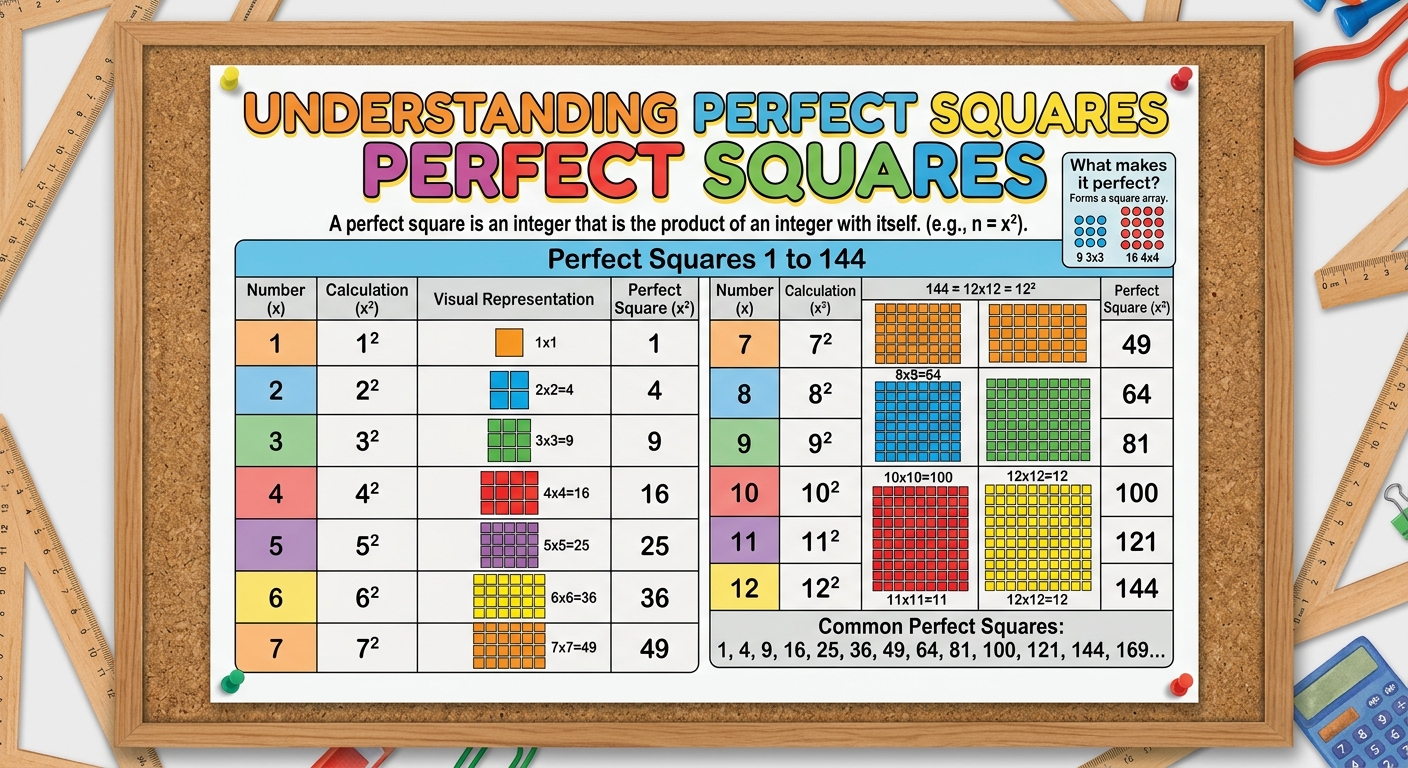
Perfect Squares: Full List From 1 To 2,500 And How To Spot One
The short version
- A perfect square is a whole number you get by multiplying a whole number by itself: 1, 4, 9, 16, 25, 36, 49, 64, 81, 100 and so on.
- The full list of perfect squares from 1² to 50² is in the table below, ending at 50² = 2,500.
- Quick test: a perfect square never ends in 2, 3, 7 or 8. If it passes that, find the two squares it sits between or check its prime factors.
- In the prime factorization of a perfect square, every prime shows up an even number of times. 36 = 2² × 3², so it’s a perfect square. 72 = 2³ × 3², so it isn’t.
- Kids who know the squares up to 12² or 15² by heart move much faster through square roots, the Pythagorean theorem and factoring later on.
Perfect squares are the numbers you get when you multiply a whole number by itself. 5 × 5 = 25, so 25 is a perfect square. The first ten perfect squares are 1, 4, 9, 16, 25, 36, 49, 64, 81 and 100. They’re called “squares” because that many dots can be arranged into an actual square: 25 dots make a 5 by 5 grid, with nothing left over.
Below is a complete list of perfect squares up to 2,500, three ways to tell whether a big number is one, worked examples, and practice problems with answers.
Perfect squares list: 1 to 50
Read each pair as “the number squared” and “what it equals.” The squares of 1 to 12 are the ones kids are expected to know cold by middle school. Knowing up to 15² or 20² makes square roots much faster.
| Square | Value | Square | Value | Square | Value |
|---|---|---|---|---|---|
| 1² | 1 | 18² | 324 | 35² | 1,225 |
| 2² | 4 | 19² | 361 | 36² | 1,296 |
| 3² | 9 | 20² | 400 | 37² | 1,369 |
| 4² | 16 | 21² | 441 | 38² | 1,444 |
| 5² | 25 | 22² | 484 | 39² | 1,521 |
| 6² | 36 | 23² | 529 | 40² | 1,600 |
| 7² | 49 | 24² | 576 | 41² | 1,681 |
| 8² | 64 | 25² | 625 | 42² | 1,764 |
| 9² | 81 | 26² | 676 | 43² | 1,849 |
| 10² | 100 | 27² | 729 | 44² | 1,936 |
| 11² | 121 | 28² | 784 | 45² | 2,025 |
| 12² | 144 | 29² | 841 | 46² | 2,116 |
| 13² | 169 | 30² | 900 | 47² | 2,209 |
| 14² | 196 | 31² | 961 | 48² | 2,304 |
| 15² | 225 | 32² | 1,024 | 49² | 2,401 |
| 16² | 256 | 33² | 1,089 | 50² | 2,500 |
| 17² | 289 | 34² | 1,156 |
Two shortcuts help if you’re checking the table. Any number ending in 0, squared, just gets two zeros: 30² = 900, 40² = 1,600. And a number ending in 5 squared always ends in 25: 35² = 1,225, 45² = 2,025.
What makes a number a perfect square
The word “perfect” means the square root comes out to a whole number with nothing left over. The square root of 49 is 7, a whole number, so 49 is a perfect square. The square root of 50 is about 7.07, so 50 isn’t.
Zero counts too, since 0 × 0 = 0. Negative numbers don’t: (-6) × (-6) = 36, and 6 × 6 = 36, so squaring always gives zero or a positive result. That means -36 can’t be a perfect square in ordinary arithmetic. Notice that 36 has two square roots, 6 and -6, which matters once kids start solving equations like x² = 36.
The odd number pattern
Here’s a pattern worth showing any kid. Look at the gaps between perfect squares:
1, 4, 9, 16, 25, 36
Gaps: 3, 5, 7, 9, 11
The gaps are the odd numbers, in order. That means adding up the first n odd numbers always gives n². The first four odd numbers are 1 + 3 + 5 + 7 = 16, which is 4². You can see why in a grid: to grow a 4 by 4 square into a 5 by 5 square, you add a new row and a new column that share a corner, which is 4 + 4 + 1 = 9 dots.
How to tell if a number is a perfect square
Test 1: Look at the last digit
Perfect squares only ever end in 0, 1, 4, 5, 6 or 9. If a number ends in 2, 3, 7 or 8, stop. It’s not a perfect square. This test can only rule numbers out, though. Plenty of numbers end in 1 or 6 and still aren’t perfect squares (like 21 or 56).
Test 2: Trap it between two squares
Find the perfect squares just below and just above your number. If your number lands on one of them, it’s a perfect square. If it falls between, it isn’t.
Test 3: Prime factorization
Break the number into primes. If every prime appears an even number of times, it’s a perfect square, and you can build the square root by taking half of each group.
Worked examples
Example 1: Is 196 a perfect square?
Last digit is 6, so it passes the first test.
13² = 169 and 14² = 196.
Yes. 196 is a perfect square, and √196 = 14.
Example 2: Is 220 a perfect square?
Last digit is 0, so it passes the first test.
14² = 196 and 15² = 225.
220 sits between 196 and 225, so it’s not a perfect square.
Example 3: Is 3,248 a perfect square?
It ends in 8. Perfect squares never end in 8, so no. No other work needed.
Example 4: Use prime factors on 324
324 = 4 × 81 = 2 × 2 × 3 × 3 × 3 × 3 = 2² × 3⁴.
Both exponents (2 and 4) are even, so 324 is a perfect square.
Take half of each exponent: 2¹ × 3² = 2 × 9 = 18. Check: 18 × 18 = 324.
Example 5: Use prime factors on 72
72 = 8 × 9 = 2³ × 3².
The 2 shows up three times, an odd number, so 72 isn’t a perfect square.
Multiply by one more 2 and you get 144 = 2⁴ × 3², which is 12².
Example 6: Estimate the square root of 60
7² = 49 and 8² = 64.
60 is much closer to 64, so √60 is a bit less than 8.
A calculator gives about 7.75.
Where perfect squares show up
Kids meet perfect squares again in almost every later unit:
- Area. A square garden with 9-foot sides covers 81 square feet. If you know the area is 81, the side is √81 = 9.
- Simplifying square roots. √50 = √25 × √2 = 5√2. You can only do this if you spot 25 as a perfect square factor of 50.
- The Pythagorean theorem. In a 3, 4, 5 right triangle, 9 + 16 = 25. Every step is a perfect square.
- Factoring in algebra. x² – 49 factors to (x + 7)(x – 7) because 49 is 7². And x² + 6x + 9 is (x + 3)², called a perfect square trinomial.
Common mistakes
- Doubling instead of squaring. 6² is 36, not 12. The small 2 means “times itself,” not “times 2.”
- Thinking any even number is a perfect square. 8, 18 and 32 are even but none are perfect squares.
- Trusting the last digit alone. 76 ends in 6 but falls between 64 and 81, so it isn’t one.
- Forgetting the negative square root. x² = 49 has two answers, 7 and -7. Kids often stop at 7.
- Mixing up squares and square roots. The square of 16 is 256. The square root of 16 is 4. Say both out loud so the words stick.
Practice problems
- Is 81 a perfect square? If so, what’s its square root?
- List every perfect square between 50 and 100.
- Is 150 a perfect square?
- Without doing any multiplying, explain why 4,327 can’t be a perfect square.
- √90 falls between which two whole numbers?
- 576 is a perfect square. What number was squared to get it?
- Use prime factors to decide whether 180 is a perfect square. If it isn’t, what’s the smallest whole number you could multiply it by to make one?
- What’s the sum of the first 9 odd numbers?
Answers
- Yes. 9 × 9 = 81, so √81 = 9.
- 64 and 81.
- No. 12² = 144 and 13² = 169, and 150 falls between them.
- It ends in 7, and no perfect square ends in 7.
- 9 and 10, because 9² = 81 and 10² = 100.
- 24, because 24 × 24 = 576.
- 180 = 2² × 3² × 5. The 5 appears only once, so it’s not a perfect square. Multiply by 5 to get 900, which is 30².
- 81. The first 9 odd numbers add to 9² = 81 (1 + 3 + 5 + 7 + 9 + 11 + 13 + 15 + 17 = 81).
If your child is stuck on perfect squares
Perfect squares are really a multiplication skill. A kid who can’t recall 7 × 7 or 8 × 8 fast will find this topic slow and frustrating, and the fix is usually multiplication fact fluency, which is meant to be solid by the end of third or fourth grade. Our guide to math skills by grade level lays out when those facts are expected.
Short daily practice is the fastest way to build that recall. We explain why in why 20 minutes a day beats a 90-minute tutoring session. And if your child freezes on timed fact drills, math anxiety in children may be part of the picture, which calls for a different approach than more drills.
Frequently asked questions
What are the perfect squares from 1 to 100?
There are ten: 1, 4, 9, 16, 25, 36, 49, 64, 81 and 100.
Is 0 a perfect square?
Yes. 0 × 0 = 0, and 0 is a whole number, so 0 counts.
Can a perfect square be negative?
No. A number times itself is never negative, because a positive times a positive and a negative times a negative both give a positive.
Is 1 a perfect square?
Yes. 1 × 1 = 1, so 1 is the first perfect square after 0.
How many perfect squares are there between 1 and 1,000?
Counting 1, there are 31 of them, from 1² = 1 up to 31² = 961. The next one, 32² = 1,024, is past 1,000.
What’s the difference between a perfect square and a square root?
A perfect square is the result of squaring, like 49. Its square root is the number you squared to get it, 7.
Find the actual gap
If perfect squares feel hard, the missing piece is usually further back, like shaky multiplication facts, and it’s hard to spot from homework alone. Math Anon begins with a short adaptive assessment that tracks down the exact skills your child hasn’t mastered, then gives you a written report.
After that it’s about 20 minutes of targeted practice a day, plus a progress report each week so you can see what’s changing. The assessment is $49, and we credit all of it toward the first month. Start the assessment, or check our pricing first.





