
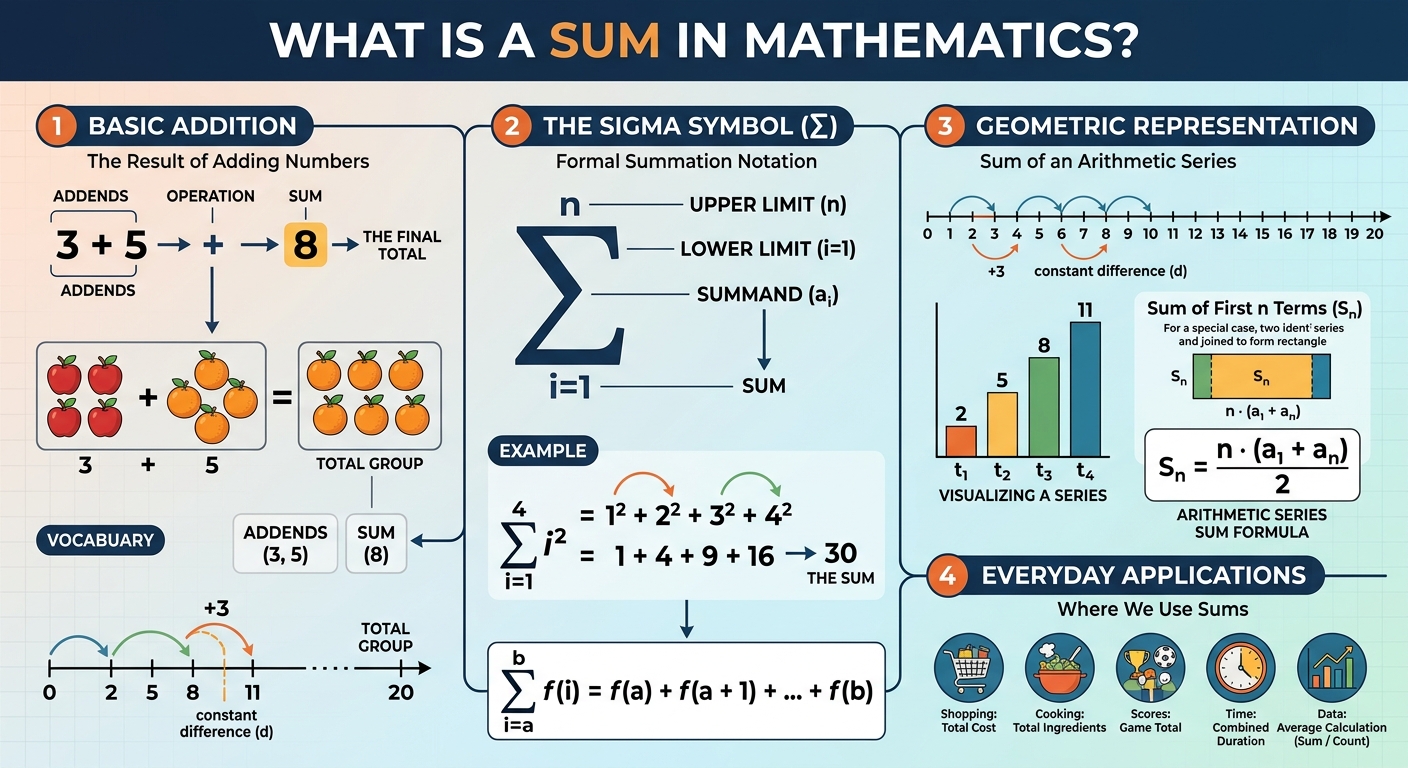
What Is A Sum In Math? Meaning And Examples
The short version
- A sum in math is the answer you get when you add numbers together. In 6 + 9 = 15, the sum is 15.
- The numbers being added are called addends. You can add two addends or twenty, and the result is still called the sum.
- “Find the sum” always means add. Word problems also signal a sum with words like total, altogether, in all and combined.
- The other answers have their own names: difference (subtract), product (multiply) and quotient (divide). Mixing these up causes a lot of wrong answers on homework.
A sum in math is the result of adding two or more numbers. In 4 + 7 = 11, the numbers 4 and 7 are the addends and 11 is the sum. If a worksheet says “find the sum,” your child needs to add every number listed.
That’s the whole definition, but the word shows up in trickier places than first grade addition: word problems, decimals, negative numbers, fractions, and later in algebra. Below we cover each one with worked examples, plus the mistakes that trip kids up and a set of practice problems with answers.
What does sum mean?
Sum means total. When you put amounts together, the sum is how much you end up with. If you have 3 apples and someone gives you 5 more, the sum is 8 apples.
Here are the parts of an addition sentence:
| Part | In 12 + 30 = 42 | What it means |
|---|---|---|
| Addends | 12 and 30 | The numbers being added |
| Plus sign | + | The instruction to add |
| Sum | 42 | The result |
Order doesn’t matter when you add. 12 + 30 and 30 + 12 give the same sum. That’s called the commutative property, and it’s handy: kids can start with the bigger number and count on from there.
Sum vs difference, product and quotient
Each of the four operations has its own name for the answer. Kids who confuse them will do the wrong operation even when they know how to compute, so it’s worth drilling these four words.
| Operation | Answer is called | Example |
|---|---|---|
| Addition | Sum | 8 + 2 = 10 |
| Subtraction | Difference | 8 – 2 = 6 |
| Multiplication | Product | 8 × 2 = 16 |
| Division | Quotient | 8 ÷ 2 = 4 |
A quick memory trick: “sum” and “some” sound the same, and when you add you’re putting some more with what you already have.
How to find the sum: worked examples
Whole numbers with regrouping
Find the sum of 368 and 257.
Ones: 8 + 7 = 15. Write 5, carry 1 ten.
Tens: 6 + 5 + 1 = 12. Write 2, carry 1 hundred.
Hundreds: 3 + 2 + 1 = 6.
Sum: 625
More than two addends
Find the sum of 15, 22 and 35.
Look for friendly pairs first: 15 + 35 = 50.
Then 50 + 22 = 72.
Sum: 72
Decimals
Find the sum of 12.5 and 3.75. Line up the decimal points, and fill the empty spot with a zero.
12.50
+ 3.75
= 16.25
Fractions
When the denominators match, add the tops and keep the bottom: 2/5 + 1/5 = 3/5.
When they don’t match, rewrite them first. For 1/2 + 1/3:
1/2 = 3/6 and 1/3 = 2/6
3/6 + 2/6 = 5/6
Negative numbers
The sum of -6 and 10 is 4. Start at -6 on a number line and move 10 steps right. You pass zero after 6 steps and land on 4.
The sum of -6 and -10 is -16. Adding a negative moves you left, so you go further below zero.
Sum in math word problems
Word problems rarely use the plus sign, so kids need to spot the words that mean “add.” These usually point to a sum:
- sum, total, altogether
- in all, combined, together
- plus, more than, increased by
Treat these as clues, not rules. “How many more” usually means subtract, even though it contains the word “more.” The safest habit is to picture what’s happening: are amounts being joined? Then you’re finding a sum.
Example: Maya read 45 pages on Monday, 38 on Tuesday and 52 on Wednesday. How many pages did she read in all?
45 + 38 + 52 = 135 pages
Working backward: Two numbers have a sum of 90. One of them is 34. What’s the other? Here you know the sum and one addend, so you subtract: 90 – 34 = 56. Check it: 34 + 56 = 90.
Sums in higher math
The word keeps coming back as kids get older.
Adding a long list. To find the sum of the whole numbers from 1 to 100, pair the ends: 1 + 100 = 101, 2 + 99 = 101, and so on. There are 50 of these pairs, so the sum is 50 × 101 = 5,050.
Angle sums. The angles inside any triangle have a sum of 180°. If two angles are 50° and 60°, the third is 180 – 110 = 70°.
Sigma notation. In high school, the Greek letter Σ means “add up all of these.” It’s the same idea of a sum in math, written in shorthand.
Algebra. “The sum of a number and 7 is 19” becomes x + 7 = 19, so x = 12. Kids who aren’t solid on what “sum” means can’t translate sentences like this into equations.
Common mistakes
- Multiplying instead of adding. “Find the sum of 6 and 4” gets answered with 24. That’s the product. The sum is 10.
- Misaligned decimals. Adding 2.5 + 1.25 with the numbers pushed to the right edge lines the 5 up under the hundredths and gives 1.50. Line up the points: the answer is 3.75.
- Adding the denominators. 1/4 + 1/4 is 2/4 (or 1/2), not 2/8.
- Forgetting to carry. 47 + 38 written as 75 means the extra ten from 7 + 8 = 15 got dropped. The correct sum is 85.
- Trusting keywords over meaning. “How many more” questions get added when they should be subtracted.
Practice problems
1. Find the sum of 14 and 29.
2. Find the sum of 7, 12 and 25.
3. What is the sum of 3.6 and 1.25?
4. What is the sum of -8 and 5?
5. Find the sum: 1/4 + 2/3.
6. Two numbers have a sum of 50. One of them is 18. What’s the other number?
7. What is the sum of all the whole numbers from 1 to 20?
8. The sum of two numbers in a row (like 5 and 6) is 37. What are the numbers?
Answers
1. 43
2. 44 (7 + 12 = 19, then 19 + 25 = 44)
3. 4.85 (3.60 + 1.25)
4. -3
5. 11/12 (3/12 + 8/12)
6. 32 (50 – 18 = 32)
7. 210. Pair the ends: 1 + 20 = 21, and there are 10 pairs, so 10 × 21 = 210.
8. 18 and 19. Take away 1 to make the numbers equal: 37 – 1 = 36, and 36 ÷ 2 = 18. The numbers are 18 and 18 + 1 = 19.
What it means if your child is stuck on sums
If a kid in third grade or later still struggles to find a sum, the word itself is rarely the issue. Look at which examples go wrong. Errors with carrying usually trace back to place value: they don’t fully see that the 1 they carry is worth ten. Errors with decimals often come from the same place. Trouble with fraction sums points to a shaky idea of what a denominator is, which is the gap we cover in why algebra struggles often start with fourth grade fractions.
Slow, finger counting addition in third or fourth grade is another flag. It’s worth checking against what kids should know at each grade. The fix for fact fluency is short, regular practice rather than long sessions, and we explain why in why 20 minutes a day beats a 90-minute tutoring session.
Frequently asked questions
What is a sum?
A sum in math is the total you get from adding numbers. In 5 + 5 = 10, the sum is 10.
Does sum mean add or multiply?
Add. The answer to a multiplication problem is the product. “The sum of 3 and 4” is 7, while “the product of 3 and 4” is 12.
Can a sum be negative?
Yes. If the negative addends outweigh the positive ones, the sum is negative. For example, -9 + 4 = -5.
What is the sum of a number and itself?
It’s double the number. The sum of 8 and 8 is 16. In algebra, x + x = 2x.
What’s the difference between a sum and a total?
In everyday use they mean the same thing. “Sum” is the math term; “total” is the word you’ll see more often in word problems and on receipts.
Find the actual gap
When sums keep coming back wrong, the mistake usually lives a grade or two earlier, in place value, fact fluency or fractions. Math Anon’s short adaptive assessment tracks down exactly which skills are missing and gives you a written report that spells it out.
Your child then works on those skills for about 20 minutes a day, and you get a progress report each week so you can see what’s closing. The assessment is $49, credited back in full on the first month. Start the assessment, or look over pricing first.





