
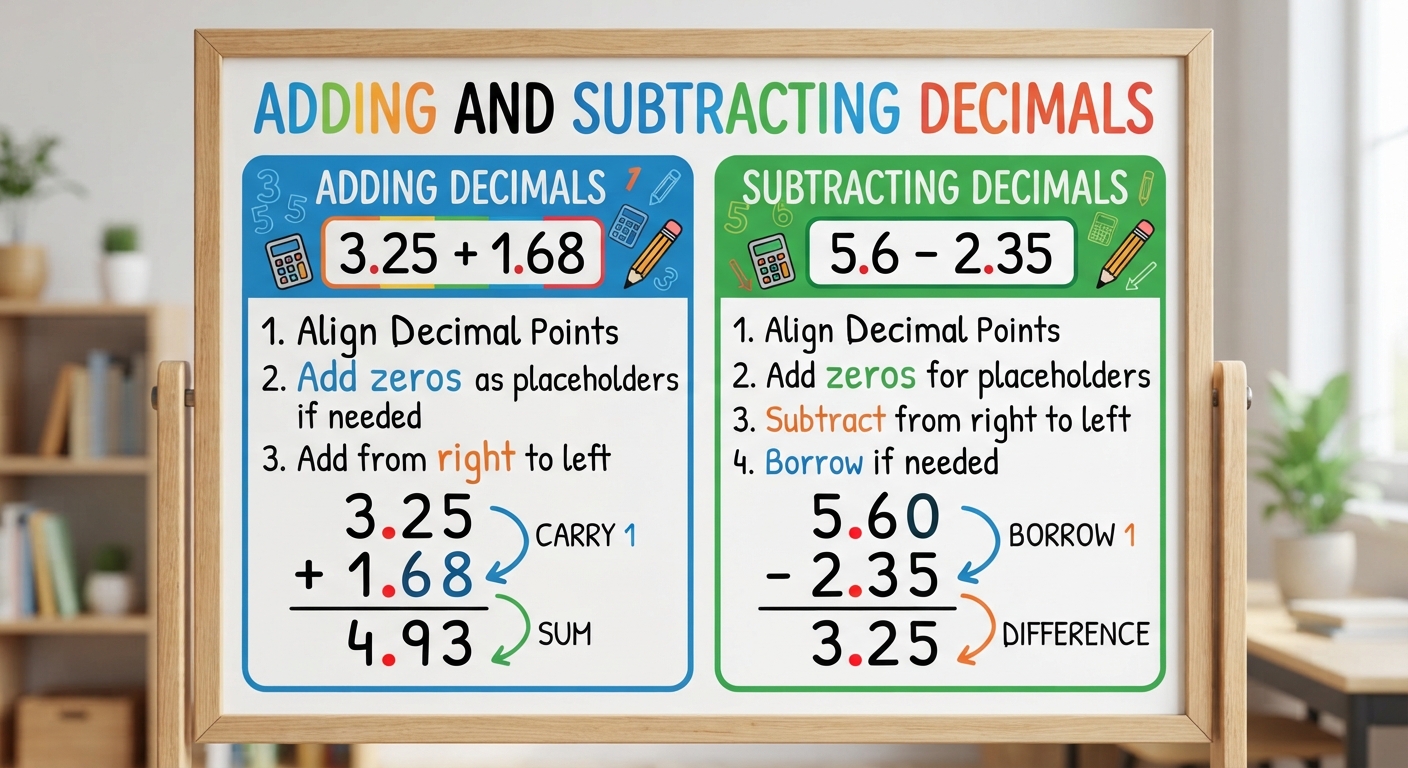
Adding And Subtracting Decimals, Step By Step
The short version
- To add or subtract decimals, line up the decimal points, not the right edges of the numbers.
- Fill any empty places with zeros so every number has the same count of digits after the point. 4.6 becomes 4.60 next to 3.25.
- Then add or subtract column by column, right to left, exactly as with whole numbers, and bring the decimal point straight down into the answer.
- A whole number has a decimal point at its end: 10 is 10.00. That’s the trick to problems like 10 – 3.47 = 6.53.
- Estimate first. If 12.78 + 5.465 should be about 18, an answer of 181.43 means something got misaligned.
Adding and subtracting decimals comes down to one rule: line up the decimal points. Write the numbers in a column with the points directly under each other, add zeros so they all have the same number of decimal places, then add or subtract the way you would with whole numbers. The decimal point in the answer goes straight below the others.
So 3.25 + 4.6 becomes 3.25 + 4.60 = 7.85, and 8.3 – 2.76 becomes 8.30 – 2.76 = 5.54. Below are the steps, worked examples with regrouping and whole numbers, money problems, a way to check your work, and practice with answers.
Why you line up the decimal points
You can only add things that are the same kind. Tenths go with tenths, hundredths go with hundredths, ones go with ones. Lining up the decimal points is just a way of making sure each column holds one place value.
Whole numbers hide this because they’re lined up on the right, and the right edge happens to be the ones place. With decimals, the right edge could be tenths in one number and thousandths in another. That’s why the decimal point, and not the edge, is the anchor.
Say a kid lines up the right edges of 4.5 and 2.36. The 5 tenths ends up in the same column as the 6 hundredths, and the answer is wrong no matter how carefully they add. Lined up by the point, 4.50 + 2.36 = 6.86.
How to add decimals
- Write the numbers in a column with the decimal points lined up.
- Add zeros at the end so every number has the same number of decimal places.
- Add from the right, carrying when a column reaches 10 or more.
- Bring the decimal point straight down.
Example 1: no carrying
3.25 + 4.6
Write 4.6 as 4.60.
Hundredths: 5 + 0 = 5
Tenths: 2 + 6 = 8
Ones: 3 + 4 = 7
Answer: 7.85
Example 2: different lengths and carrying
12.78 + 5.465
Write 12.78 as 12.780.
Thousandths: 0 + 5 = 5
Hundredths: 8 + 6 = 14. Write 4, carry 1.
Tenths: 7 + 4 + 1 = 12. Write 2, carry 1.
Ones: 2 + 5 + 1 = 8
Tens: 1
Answer: 18.245
Example 3: a whole number plus a decimal
7 + 2.35
Write 7 as 7.00.
7.00 + 2.35 = 9.35
How to subtract decimals
The setup is identical: line up the points, pad with zeros, then subtract right to left, borrowing when the top digit is smaller.
Example 4: no borrowing
9.75 – 3.42
Hundredths: 5 – 2 = 3
Tenths: 7 – 4 = 3
Ones: 9 – 3 = 6
Answer: 6.33
Example 5: with borrowing
8.3 – 2.76
Write 8.3 as 8.30.
Hundredths: 0 – 6 won’t work. Borrow from the tenths: the 3 becomes 2, and the 0 becomes 10. Then 10 – 6 = 4.
Tenths: 2 – 7 won’t work. Borrow from the ones: the 8 becomes 7, and the 2 becomes 12. Then 12 – 7 = 5.
Ones: 7 – 2 = 5
Answer: 5.54
Example 6: subtracting from a whole number
This is the one kids most often get wrong. 10 – 3.47
Write 10 as 10.00.
You need to borrow for the hundredths, but the tenths is 0 and the ones is 0. Go all the way to the tens.
10.00 regroups as 9 ones, 9 tenths and 10 hundredths (which is still 10).
Hundredths: 10 – 7 = 3
Tenths: 9 – 4 = 5
Ones: 9 – 3 = 6
Answer: 6.53
Example 7: extra decimal places on the bottom
5.004 – 1.8
Write 1.8 as 1.800.
5.004 – 1.800 = 3.204
Estimate to check your answer
Round each number to something easy, do the math in your head, and compare. This catches almost every alignment mistake.
| Problem | Estimate | Exact answer |
|---|---|---|
| 12.78 + 5.465 | 13 + 5 = 18 | 18.245 |
| 8.3 – 2.76 | 8 – 3 = 5 | 5.54 |
| 10 – 3.47 | 10 – 3.5 = 6.5 | 6.53 |
| 5.004 – 1.8 | 5 – 2 = 3 | 3.204 |
You can also check subtraction by adding back: 6.53 + 3.47 = 10.00. If the answer and the number you subtracted add up to what you started with, it’s right.
Adding and subtracting decimals with money
Money is decimals to the hundredths place, which makes it the best everyday practice there is.
A snack is $3.50, a book is $12.99, and a pencil is $0.89.
3.50 + 12.99 = 16.49
16.49 + 0.89 = 17.38
Total: $17.38
Pay with a $20 bill:
20.00 – 17.38 = 2.62
Change: $2.62
When a problem mixes adding and subtracting, go left to right. 15.2 – 4.75 + 0.6 is 15.20 – 4.75 = 10.45, then 10.45 + 0.60 = 11.05.
Common mistakes
- Lining up the right edges. Decimals line up by the point. This one mistake causes most wrong answers.
- Losing the decimal point. Doing the column math perfectly and writing 785 instead of 7.85.
- Not knowing where the point is in a whole number. It’s at the end: 10 is 10.0 or 10.00.
- Flipping digits to avoid borrowing. In 8.30 – 2.76, doing 6 – 0 = 6 in the hundredths column instead of borrowing. The same habit shows up in whole-number subtraction.
- Getting lost borrowing across zeros. In 10.00 – 3.47, it helps to think of 10.00 as 1,000 hundredths and just take away 347 of them.
Practice problems
- 2.4 + 3.5
- 6.25 + 1.8
- 9.7 – 4.3
- 15 + 0.68
- 7.4 – 2.85
- 20 – 6.37
- 3.009 + 12.99
- 50.1 – 0.456
- You pay for items costing $3.75 and $2.49 with a $10 bill. How much change do you get?
Answers
- 5.9
- 8.05 (6.25 + 1.80)
- 5.4
- 15.68 (15.00 + 0.68)
- 4.55 (7.40 – 2.85)
- 13.63 (20.00 – 6.37)
- 15.999 (3.009 + 12.990)
- 49.644 (50.100 – 0.456)
- $3.76. The items total 3.75 + 2.49 = 6.24, and 10.00 – 6.24 = 3.76.
If your child is stuck adding and subtracting decimals
If the decimal point is the only new thing here, why do so many kids struggle? Because the work underneath is whole-number addition and subtraction with regrouping, plus place value. A kid who still guesses when borrowing across zeros in 400 – 167 will have the same trouble with 4.00 – 1.67. And a kid who doesn’t really know that the 7 in 0.07 means seven hundredths will line numbers up by the edge every time.
Both of those come from second through fourth grade, and decimal addition and subtraction usually shows up around fifth. Our guide to math skills by grade level shows the order these skills are meant to build in, and these signs your child is behind in math can help you spot the pattern. Fixing an old gap goes faster with a little work every day, as we explain in why 20 minutes a day beats a 90-minute tutoring session.
Frequently asked questions
What is the rule for adding and subtracting decimals?
Line up the decimal points, add zeros so every number has the same number of decimal places, then add or subtract as with whole numbers. The decimal point in the answer goes directly under the others.
How do you subtract a decimal from a whole number?
Put a decimal point and zeros after the whole number so it matches the decimal. For 6 – 2.45, write 6.00 – 2.45, then subtract to get 3.55.
Why do you add zeros when adding decimals?
Adding zeros at the end doesn’t change the value (4.6 and 4.60 are equal), but it fills the empty columns so you don’t skip a place or subtract from a blank.
What grade learns adding and subtracting decimals?
In most US schools following the Common Core standards, it’s fifth grade, working to the hundredths place. Fourth grade lays the groundwork with tenths and hundredths, and sixth grade expects it to be fluent.
How can you check a decimal subtraction answer?
Add your answer to the number you subtracted. If you get the number you started with, you’re right. For 8.3 – 2.76 = 5.54, check that 5.54 + 2.76 = 8.30.
Find the actual gap
When decimal problems keep coming back wrong, it’s worth finding out whether the gap is place value, regrouping, or something else before drilling more worksheets. Math Anon starts with a short adaptive assessment that pinpoints the missing skills and puts them in a written report you can read in a few minutes.
Your child then practices about 20 minutes a day on exactly those skills, and weekly progress reports show you what’s changing. Start the assessment. It’s $49, and you get it back in full as credit on the first month. Plans are on our pricing page.





