
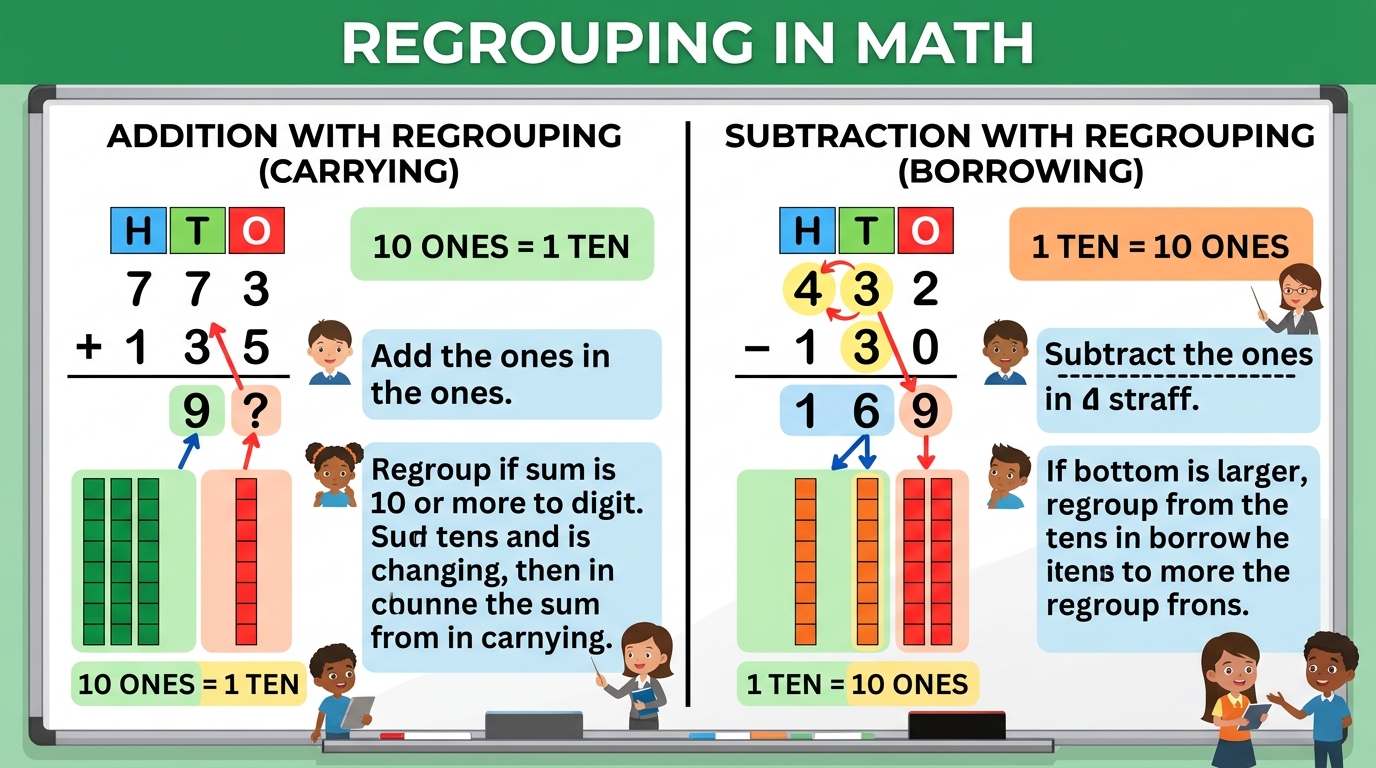
What Is Regrouping In Math? Carrying And Borrowing
The short version
- Regrouping means trading between place values: 10 ones become 1 ten, 10 tens become 1 hundred, and the reverse. It keeps every column to a single digit.
- In addition, you regroup (carry) when a column adds up to 10 or more. In 58 + 27, the ones make 15, so you write 5 and move 1 ten over.
- In subtraction, you regroup (borrow) when the top digit is smaller than the bottom one. In 62 – 38, you trade 1 ten for 10 ones so you can do 12 – 8.
- Carrying and borrowing are older names for the same thing. Schools now say regrouping or trading because it describes what’s really happening to the number.
Regrouping in math is trading 10 of one place value for 1 of the next place value up, or 1 of a bigger place for 10 of the next smaller one. You do it in addition when a column adds to 10 or more (that’s carrying) and in subtraction when a column’s top digit is too small (that’s borrowing). The number’s value never changes; it’s just written differently.
Below we walk through regrouping in addition and subtraction step by step, including the dreaded subtraction across zeros, then show how it works in multiplication and decimals. You’ll also find the mistakes to watch for and practice problems with an answer key.
What is regrouping in mathematics?
Our number system is built on groups of ten. Ten ones make a ten, ten tens make a hundred, ten hundreds make a thousand. Regrouping uses that fact to rename a number without changing it.
Take 52. You usually think of it as 5 tens and 2 ones. But you could also call it 4 tens and 12 ones. Both are worth 52:
5 tens + 2 ones = 50 + 2 = 52
4 tens + 12 ones = 40 + 12 = 52
That second version looks odd, but it’s exactly what you need when you have to subtract 8 from the ones place. Seeing that the same number can be split more than one way is the whole idea behind regrouping.
Why kids learn “regroup” instead of “carry” and “borrow”
If you learned “carry the one” and “borrow from the neighbor,” you learned the same method. The words changed because they hide what’s going on. Nothing is borrowed, and nothing needs to be paid back. When your child “borrows,” they’re breaking a ten into ten ones. When they “carry,” they’re bundling ten ones into a ten. Using “regroup” or “trade” keeps that picture front and center.
Regrouping in addition (carrying)
Start in the ones column and work left. Whenever a column adds up to 10 or more, keep the ones digit there and move the ten to the next column.
Example 1: 58 + 27
Ones: 8 + 7 = 15. That’s 1 ten and 5 ones. Write 5, and put a small 1 above the tens column.
Tens: 5 + 2 + 1 (the regrouped ten) = 8.
Answer: 85
Example 2: 476 + 358 (regrouping twice)
Ones: 6 + 8 = 14. Write 4, regroup 1 ten.
Tens: 7 + 5 + 1 = 13. That’s 13 tens, or 1 hundred and 3 tens. Write 3, regroup 1 hundred.
Hundreds: 4 + 3 + 1 = 8.
Answer: 834
A quick estimate catches big errors: 476 is about 480 and 358 is about 360, and 480 + 360 = 840. The answer 834 is close, so it’s reasonable.
Regrouping in subtraction (borrowing)
Again start with the ones. If the top digit is smaller than the bottom digit, take 1 from the next column to the left and turn it into 10 in the column you’re working on.
Example 3: 62 – 38
Ones: 2 – 8 won’t work. Regroup 1 of the 6 tens into 10 ones. Now you have 5 tens and 12 ones.
Ones: 12 – 8 = 4
Tens: 5 – 3 = 2
Answer: 24. Check by adding: 24 + 38 = 62.
Example 4: 523 – 267 (regrouping twice)
Ones: 3 – 7 won’t work. Regroup a ten: the tens go from 2 to 1, the ones go from 3 to 13. 13 – 7 = 6.
Tens: 1 – 6 won’t work. Regroup a hundred: the hundreds go from 5 to 4, the tens go from 1 to 11. 11 – 6 = 5.
Hundreds: 4 – 2 = 2.
Answer: 256. Check: 256 + 267 = 523.
Example 5: regrouping across zeros, 400 – 173
This is the version that trips up the most kids. The ones need to regroup, but there are no tens to take from. So go further left.
Regroup 1 hundred into 10 tens: 3 hundreds, 10 tens, 0 ones.
Now regroup 1 of those tens into 10 ones: 3 hundreds, 9 tens, 10 ones.
Ones: 10 – 3 = 7
Tens: 9 – 7 = 2
Hundreds: 3 – 1 = 2
Answer: 227
A shortcut many teachers show: read 400 as 40 tens. Take 1 away and you have 39 tens and 10 ones. That’s the same 3, 9 and 10 in one step.
Regrouping beyond addition and subtraction
Multiplication
Multiplying bigger numbers uses the same trade. For 47 × 6:
Ones: 7 × 6 = 42. Write 2, regroup 4 tens.
Tens: 4 × 6 = 24 tens, plus the 4 regrouped tens = 28 tens.
Answer: 282
The common slip here is adding the regrouped 4 before multiplying (4 + 4 = 8, then 8 × 6 = 48). Multiply first, then add.
Decimals
Decimals follow the same rules, since 10 tenths make 1 whole. For 3.7 + 2.5, the tenths add to 7 + 5 = 12 tenths, which is 1 whole and 2 tenths. Write 2, regroup 1 into the ones: 3 + 2 + 1 = 6. Answer: 6.2.
How to teach regrouping at home
If the written steps aren’t sticking, make the trade physical. You don’t need to buy anything.
- Use dimes and pennies. Ten pennies trade for a dime. To “subtract 8 cents” from 2 dimes and 2 pennies, you have to break a dime first.
- Bundle straws or craft sticks in tens with rubber bands. Regrouping in subtraction means snapping a rubber band off a bundle.
- Draw a place value chart with columns labeled hundreds, tens and ones, and physically cross out and rewrite the digits as you trade.
Once your child can explain what the little 1 means (“it’s a ten”), switch back to paper.
Common mistakes with regrouping
- Subtracting the smaller digit from the bigger one. For 62 – 38, a kid does 8 – 2 = 6 in the ones and 6 – 3 = 3 in the tens, and writes 36. The true answer is 24. This is the most common regrouping error.
- Forgetting to add the carried 1. 58 + 27 comes out as 75 instead of 85.
- Regrouping but not reducing the next column. The ones become 12, but the tens stay at 6 instead of dropping to 5.
- Getting lost across zeros. 400 – 173 turns into 373 when a kid treats 0 – 3 as 3 and 0 – 7 as 7.
- Writing two digits in one column. Writing 15 under the ones instead of 5 and a regrouped ten.
- Misaligned columns. Stacking 358 under 4,760 with the 3 under the 4 mixes up place values. Always line up the ones.
Practice problems
1. 36 + 47
2. 81 – 29
3. 258 + 367
4. 704 – 358
5. 1,000 – 462
6. 63 × 4
7. 5.8 + 3.6
8. Does 243 + 516 need any regrouping? Find the sum.
Answers
1. 83 (6 + 7 = 13, write 3 and regroup 1 ten; 3 + 4 + 1 = 8)
2. 52 (regroup a ten: 11 – 9 = 2, then 7 – 2 = 5)
3. 625 (regrouping in both the ones and the tens)
4. 346. The ones need a ten, and there are 0 tens, so regroup a hundred first: 6 hundreds, 9 tens, 14 ones. Then 14 – 8 = 6, 9 – 5 = 4, 6 – 3 = 3.
5. 538. Read 1,000 as 100 tens: take 1 and you have 99 tens and 10 ones, so 9 hundreds, 9 tens and 10 ones. Then 10 – 2 = 8, 9 – 6 = 3, 9 – 4 = 5.
6. 252 (3 × 4 = 12, write 2 and regroup 1 ten; 6 × 4 = 24, plus 1 = 25)
7. 9.4 (8 + 6 = 14 tenths, write 4 and regroup 1 whole; 5 + 3 + 1 = 9)
8. No regrouping needed, since no column reaches 10. The sum is 759.
What it means if your child is stuck on regrouping
Regrouping starts with models in first and second grade, and by fourth grade kids are expected to add and subtract multi-digit numbers fluently with the standard method. A child still stuck on it in third or fourth grade almost always has a place value gap. They can follow the steps, but they don’t see that the 6 in 62 means 60, so the trade makes no sense to them and the steps fall apart under pressure.
That gap is worth fixing before it spreads, because regrouping sits inside long multiplication, long division and decimal work. Our guide to math skills by grade level shows what should be in place when, and these 12 signs can help you tell a rough week from a real problem. Place value sticks best with short, regular practice, which is why 20 minutes a day beats a long weekly session.
Frequently asked questions
What is regrouping in math for kids?
It’s trading 10 of something for 1 of the next bigger thing, like 10 ones for 1 ten. In addition you trade up when a column gets to 10 or more. In subtraction you trade down when you don’t have enough to take away.
Is regrouping the same as carrying and borrowing?
Yes. Carrying is regrouping in addition, and borrowing is regrouping in subtraction. The steps are identical; only the names changed.
What grade learns regrouping?
Kids usually start regrouping in first and second grade with objects and drawings, then use it with three digit numbers in second grade. Fluency with the standard method is expected by fourth grade.
How do you know when to regroup?
In addition, regroup when a column adds up to 10 or more. In subtraction, regroup when the top digit in a column is smaller than the bottom digit.
How do you regroup with zeros?
Move left until you find a digit that isn’t zero, regroup from there, and pass the tens down column by column. In 400 – 173, the 4 hundreds become 3 hundreds, 9 tens and 10 ones.
Find the actual gap
When regrouping won’t stick, drilling more subtraction worksheets rarely fixes it, because the missing piece is usually place value. Math Anon’s short adaptive assessment finds the exact skills that are missing and hands you a written report so you know what’s going on.
After that, your child works on those skills for about 20 minutes a day, and a progress report lands every week. The assessment is $49 and gets credited back in full on your first month. Start the assessment or read about pricing.





