
What Is A Term In Math? Examples And Like Terms
The short version
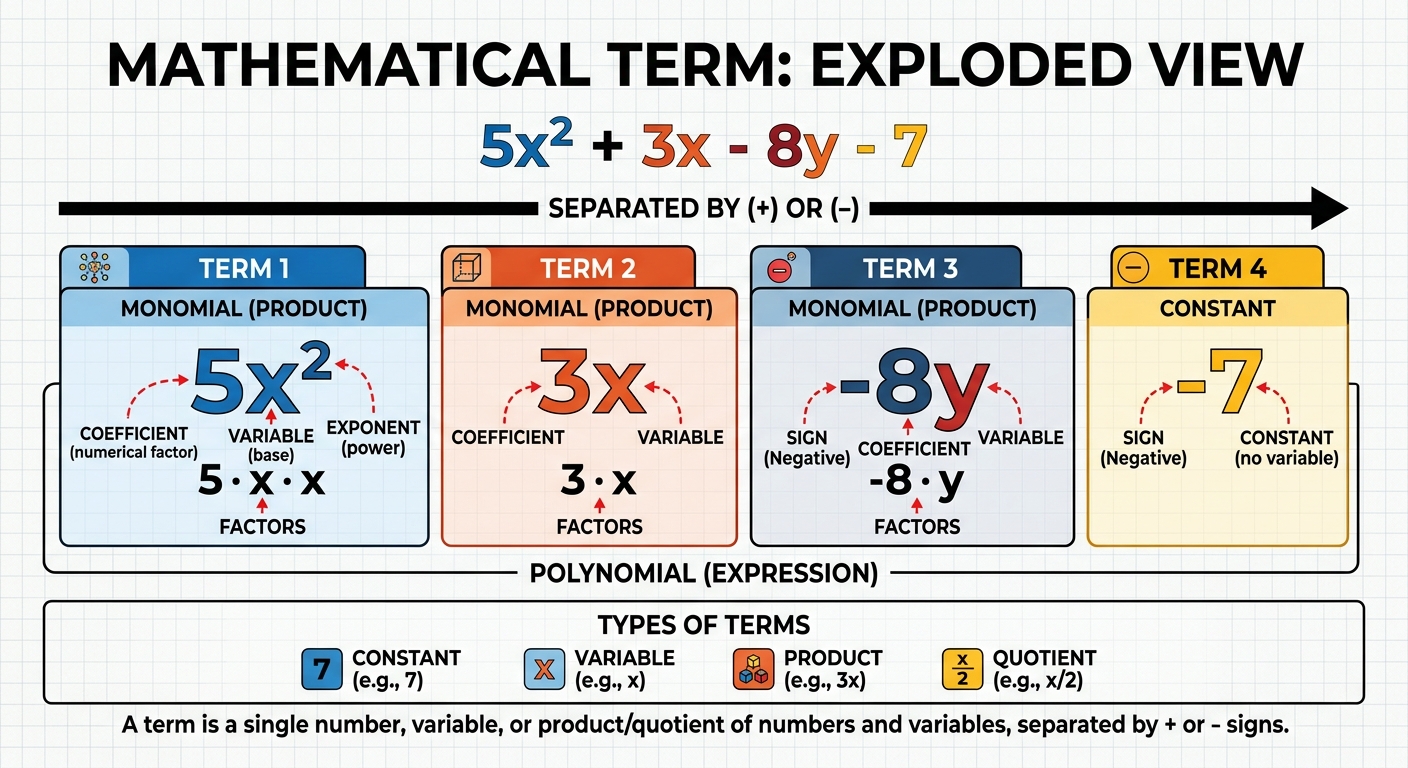
- A term in math is a single number, a single variable, or numbers and variables multiplied together. Terms are separated by + and – signs.
- In 4x² – 7x + 2 there are three terms: 4x², -7x and 2. The sign in front belongs to the term.
- A term has parts: the coefficient (the number in front), the variable, and sometimes an exponent. A term with no variable is a constant.
- Like terms have exactly the same variables with the same exponents, like 3x and -5x. Only like terms can be combined.
A term in math is one piece of an expression: a number, a variable, or a product of numbers and variables. Plus and minus signs split an expression into its terms. For example, 5x + 3 has two terms, 5x and 3, while 5x on its own is one term because multiplication keeps things together.
That definition matters most when kids start simplifying algebra, because you can only combine certain terms. Below we break down the parts of a term, show how to count terms and combine like terms, cover the other two ways “term” gets used in math, and finish with practice problems and answers.
What counts as a term in math?
Think of an expression as a sentence and terms as its words. The + and – signs are the spaces between them. Anything joined by multiplication or division stays inside one term.
| Expression | Terms | How many |
|---|---|---|
| 9 | 9 | 1 |
| 3xy | 3xy | 1 |
| 5x + 3 | 5x, 3 | 2 |
| 4x² – 7x + 2 | 4x², -7x, 2 | 3 |
| a/2 + b – 6 | a/2, b, -6 | 3 |
| 2(x + 5) | 2(x + 5) | 1 (until you distribute) |
Two rows deserve a second look. 3xy is one term because 3, x and y are all multiplied. And 2(x + 5) counts as a single term as written, since the parentheses keep the plus sign inside. Distribute and it becomes 2x + 10, which has two terms.
The sign travels with the term
In 4x² – 7x + 2, the middle term is -7x, not 7x. This sounds like a small detail, but it’s the source of more algebra mistakes than almost anything else. When you move terms around or combine them, the sign in front goes wherever the term goes.
The parts of a term
Coefficient: the number multiplying the variable. In -3y², the coefficient is -3.
Variable: the letter standing for an unknown value. In -3y², that’s y.
Exponent: the small raised number showing repeated multiplication. In -3y², it’s 2.
Constant: a term with no variable at all, like 12 or -6. Its value never changes.
| Term | Coefficient | Variable part |
|---|---|---|
| 7x | 7 | x |
| -3y² | -3 | y² |
| x | 1 | x |
| -m | -1 | m |
| x/4 | 1/4 | x |
| 12 | none (it’s a constant) | none |
A bare x has a coefficient of 1, even though nobody writes the 1. And -m has a coefficient of -1. Kids who miss this get stuck the moment they have to combine x + 4x, which is 5x.
Like terms and how to combine them
Like terms have the same variable part: the same letters raised to the same powers. The coefficients can be anything.
| Like terms | Not like terms | Why not |
|---|---|---|
| 3x and -5x | 3x and 3y | Different variables |
| 2a² and 9a² | 2a² and 2a | Different exponents |
| 4xy and -xy | 4xy and 4x | One is missing y |
| 7 and -2 | 7 and 7x | One has a variable |
To combine like terms, add or subtract their coefficients and keep the variable part the same.
Example 1. Simplify 3x + 5 + 2x – 1.
Group the x terms: 3x + 2x = 5x
Group the constants: 5 – 1 = 4
Answer: 5x + 4
Example 2. Simplify 4a² + 3a – a² + 6a.
The a² terms: 4a² – a² = 3a²
The a terms: 3a + 6a = 9a
Answer: 3a² + 9a (these two can’t be combined further)
Example 3. Simplify 5y – 8 – 7y + 10.
The y terms: 5y – 7y = -2y
The constants: -8 + 10 = 2
Answer: -2y + 2
A handy check: pick a number for the variable and plug it into both the original and your answer. In Example 1, try x = 2. Original: 3(2) + 5 + 2(2) – 1 = 6 + 5 + 4 – 1 = 14. Simplified: 5(2) + 4 = 14. Same value, so the simplifying worked.
Terms, factors and expressions: what’s the difference?
These words get mixed up constantly, so here they are side by side using 6x + 15.
- Expression: the whole thing, 6x + 15.
- Terms: the pieces being added, 6x and 15.
- Factors: the pieces being multiplied inside a term. In 6x, the factors are 6 and x.
Rule of thumb: terms are added, factors are multiplied. If you factor 6x + 15 into 3(2x + 5), the whole expression becomes a product with two factors, 3 and (2x + 5).
Other ways the word term in math gets used
Terms of a sequence
In a list of numbers that follows a pattern, each number is a term. In the sequence 3, 7, 11, 15, the first term is 3 and the fourth term is 15. Since the pattern adds 4 each time, the nth term is 4n – 1. The 10th term is 4 × 10 – 1 = 39.
Lowest terms of a fraction
“Write the fraction in lowest terms” means simplify it until the top and bottom share no common factor except 1. Here the numerator and denominator are the fraction’s terms. 6/8 in lowest terms is 3/4, because both 6 and 8 divide by 2.
Common mistakes with terms
- Dropping a negative sign. Writing the terms of 9 – 4x as 9 and 4x. The second term is -4x.
- Combining unlike terms. 3x + 2 is already simplified. It isn’t 5x, and 2x² + 3x isn’t 5x³.
- Forgetting the invisible 1. x + x is 2x, and 5x – x is 4x, not 5.
- Counting factors as terms. 3xy is one term, not three.
- Splitting through parentheses. 2(x + 5) is one term until you distribute it.
Practice problems
1. How many terms are in 6x + 2y – 9?
2. What is the coefficient of x in 5 – 8x?
3. What is the constant term in 3x² + x – 11?
4. Which of these are like terms: 4x, 4x², -x, 4y?
5. Simplify: 7a + 3 – 2a + 5
6. Simplify: 2x² + 5x – x² – 7x + 4
7. In the sequence 2, 6, 10, 14, what is the 5th term? What is the 20th term?
8. Simplify 3(x + 4) + 2x. How many terms does your answer have?
Answers
1. 3 terms: 6x, 2y and -9.
2. -8
3. -11
4. 4x and -x. They both have x to the first power.
5. 5a + 8
6. x² – 2x + 4. The x² terms give 2x² – x² = x², and the x terms give 5x – 7x = -2x.
7. The 5th term is 18. The pattern adds 4, so the 20th term is 2 + 19 × 4 = 2 + 76 = 78.
8. 5x + 12, which has 2 terms. Distribute first: 3x + 12 + 2x, then combine 3x + 2x = 5x.
What it means if your child is stuck on terms
If terms and like terms aren’t clicking, the problem often isn’t the vocabulary. Look at what goes wrong. When the negative signs keep disappearing, the gap is usually integer operations: a kid who isn’t sure that 5 – 7 = -2 will never get 5y – 7y right. When they can’t handle x/4 or a coefficient like 1/2, it’s fractions. We explain why fraction gaps show up in algebra in Struggling With Algebra? The Real Problem Is Usually Fourth Grade Fractions.
Kids who hit a wall at this point can also start to decide they’re “not a math person,” which makes everything harder. If you’re seeing that, our post on math anxiety in children covers what helps. And if you want to know for sure which skill is missing, a math assessment beats guessing.
Frequently asked questions
What is an example of a term?
Any of these is a single term in math: 8, y, 5x, -2ab, 3x². In the expression 5x – 2, the terms are 5x and -2.
Is a number by itself a term?
Yes. A number with no variable is a term called a constant. In x + 7, the 7 is a constant term.
What is the difference between a term and a coefficient?
The coefficient is only the number part of a term. In the term 9x, the coefficient is 9 and the whole term is 9x.
Are 3x and 3x² like terms?
No. The exponents are different, so they can’t be combined. 3x + 3x² stays as it is.
How do you count the terms in an expression?
Count the pieces separated by + and – signs, but don’t split anything inside parentheses. In 4x² – 7x + 2 there are three terms.
Find the actual gap
Trouble with terms is usually trouble with something underneath: negative numbers, fractions, or the idea of a variable. Math Anon starts with a short adaptive assessment that finds precisely which of those skills are missing and sends you a written report on what it found.
Your child then gets about 20 minutes of practice a day aimed at those exact gaps, and you get progress reports every week. The assessment is $49, and you get all of it back as credit on your first month. Start the assessment or see pricing.





