
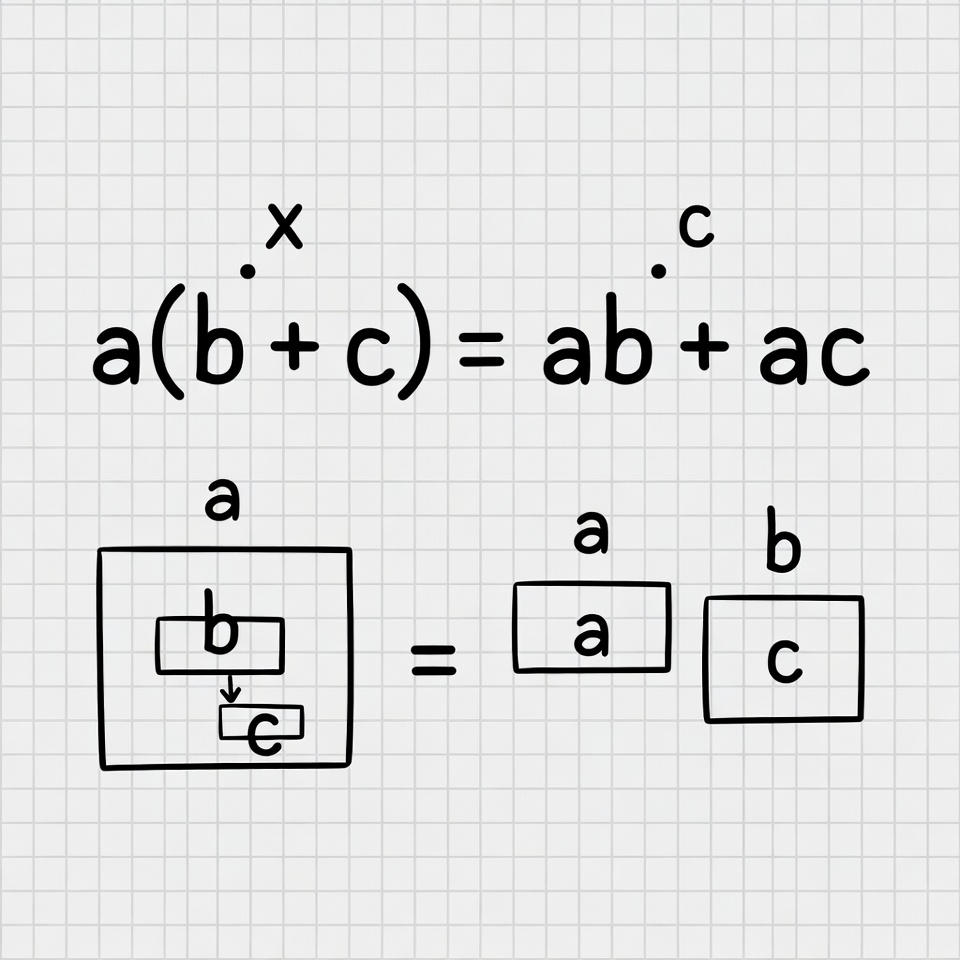
The Distributive Property: Definition, Examples And Practice
The short version
- The distributive property says a(b + c) = ab + ac. Multiply the number outside the parentheses by every term inside, then add.
- It works with subtraction too: a(b – c) = ab – ac. So 5(x – 2) = 5x – 10.
- With a negative outside, the sign goes to every term: -3(x – 4) = -3x + 12. Dropping that second sign change is the most common mistake.
- Run it backwards and it’s called factoring: 12x + 18 = 6(2x + 3).
- It’s also a mental math shortcut: 7 × 38 = 7 × 40 – 7 × 2 = 280 – 14 = 266.
The distributive property says that multiplying a number by a sum gives the same answer as multiplying it by each part of the sum and then adding. In symbols, a(b + c) = ab + ac. For example, 4(6 + 3) = 4 × 6 + 4 × 3 = 24 + 12 = 36, which matches 4 × 9 = 36.
Kids first use it in third grade to break up hard multiplication facts, and they’re still using it in algebra to clear parentheses and solve equations. Below you’ll see why it works, how to use it with variables and negative numbers, how to run it in reverse, and the mistakes that cost the most points.
What is the distributive property?
“Distribute” means to hand something out to everyone. In math, the number outside the parentheses gets handed out, by multiplication, to every term inside.
Addition: a(b + c) = ab + ac
Subtraction: a(b – c) = ab – ac
It works from the right side too: (b + c)a = ba + ca. And it works for more than two terms: 2(x + y + 5) = 2x + 2y + 10.
Why it works
Picture 4 bags, each holding 6 red marbles and 3 blue marbles. You can count the total two ways.
Count per bag, then multiply: each bag has 6 + 3 = 9 marbles, and 4 × 9 = 36.
Count each color, then add: 4 × 6 = 24 red and 4 × 3 = 12 blue, and 24 + 12 = 36.
Same marbles, same total. That’s 4(6 + 3) = 4 × 6 + 4 × 3.
The area model shows the same thing. A rectangle 4 units tall and 9 units wide has an area of 36. Draw a line splitting the width into 6 and 3, and you get two smaller rectangles with areas 24 and 12. Together, still 36. Many schools teach multi-digit multiplication this way, so your child may already be drawing these boxes.
Using the distributive property for mental math
This is where the property earns its keep for younger kids. Break an awkward number into friendly pieces, multiply each piece, then combine.
6 × 54
Split 54 into 50 + 4
6 × 50 = 300 and 6 × 4 = 24
300 + 24 = 324
7 × 38
Think of 38 as 40 – 2
7 × 40 = 280 and 7 × 2 = 14
280 – 14 = 266
99 × 8
99 is 100 – 1
100 × 8 = 800 and 1 × 8 = 8
800 – 8 = 792
Third graders use the same trick for facts they haven’t memorized. If 7 × 8 won’t come, 7 × 5 + 7 × 3 = 35 + 21 = 56 gets them there.
The distributive property with variables
In algebra, you usually can’t add what’s inside the parentheses first, because x + 3 won’t simplify. Distributing is how you clear the parentheses.
5(x + 3) = 5 × x + 5 × 3 = 5x + 15
2(3y – 4) = 2 × 3y – 2 × 4 = 6y – 8
x(x + 7) = x × x + x × 7 = x² + 7x
With a negative number outside
The negative gets multiplied into every term, and that changes signs.
-3(x – 4)
-3 × x = -3x
-3 × (-4) = +12
Result: -3x + 12
A minus sign alone in front of parentheses means -1: -(2x + 5) = -2x – 5.
Distributing, then combining like terms
2(x + 4) + 3(x – 1)
Distribute each: 2x + 8 + 3x – 3
Combine the x terms and the numbers: 5x + 5
Watch the subtraction version, which is where most sign errors happen:
3(2x + 1) – 2(x – 4)
Treat the second part as -2 times (x – 4): 6x + 3 – 2x + 8
Combine: 4x + 11
Solving an equation
3(x + 2) = 21
Distribute: 3x + 6 = 21
Subtract 6: 3x = 15
Divide by 3: x = 5
Check: 3(5 + 2) = 3 × 7 = 21.
Here you could also divide both sides by 3 first (x + 2 = 7), but distributing works every time, including when dividing first would create fractions.
Running it backwards: factoring
If you can multiply 6(2x + 3) out to 12x + 18, you can also go the other way. Find the biggest number that divides every term, pull it out front, and write what’s left inside the parentheses.
12x + 18
The greatest common factor of 12 and 18 is 6
12x ÷ 6 = 2x and 18 ÷ 6 = 3
Result: 6(2x + 3)
Check any factoring by distributing back out. If you land on the original expression, it’s right. This reverse skill becomes a big deal in Algebra 1.
Where the distributive property doesn’t apply
| Looks like it might work | Does it? | Why |
|---|---|---|
| 2(3 × 4) | No | Multiplication inside the parentheses, not addition. 2(3 × 4) = 24, but 6 × 8 = 48. |
| (12 + 8) ÷ 4 | Yes | Dividing a sum works: 12 ÷ 4 + 8 ÷ 4 = 3 + 2 = 5, and 20 ÷ 4 = 5. |
| 12 ÷ (4 + 2) | No | 12 ÷ 6 = 2, but 12 ÷ 4 + 12 ÷ 2 = 3 + 6 = 9. |
| (x + 3)² | No | It isn’t x² + 9. It’s (x + 3)(x + 3) = x² + 6x + 9. |
Common mistakes with the distributive property
- Multiplying only the first term. 3(x + 4) turned into 3x + 4. The 4 needs multiplying too: 3x + 12.
- Losing the second sign change. -2(x – 5) turned into -2x – 10. A negative times a negative is positive, so it’s -2x + 10.
- Forgetting the minus between groups. In 4x – (x + 6), the minus applies to both terms: 4x – x – 6 = 3x – 6.
- Distributing over multiplication. 2(3 × 4) isn’t 6 × 8. Only sums and differences get distributed.
- Squaring each term. (x + 3)² isn’t x² + 9. Write it as two sets of parentheses and multiply.
Practice problems
- Use the distributive property to find 6(10 + 3).
- Use the distributive property to find 8 × 47 in your head.
- Expand: 4(x + 9)
- Expand: 5(2y – 3)
- Expand: -2(3a – 7)
- Factor: 15x + 25
- Simplify: 3(2x + 1) – 2(x – 4)
- Solve: 4(x – 3) = 28
Answers
- 60 + 18 = 78
- 8 × 40 + 8 × 7 = 320 + 56 = 376
- 4x + 36
- 10y – 15
- -6a + 14 (-2 × -7 = +14)
- 5(3x + 5)
- 6x + 3 – 2x + 8 = 4x + 11
- 4x – 12 = 28, so 4x = 40 and x = 10. Check: 4(10 – 3) = 4 × 7 = 28.
If your child is stuck on the distributive property
The property itself is one short rule. When a kid can’t use it, a skill underneath is usually shaky:
- Multiplication facts. If 6 × 7 takes a long time, distributing adds a second and third multiplication to an already slow process.
- Place value. Mental math with the distributive property depends on seeing 47 as 40 + 7 without thinking about it.
- Integer rules. Almost all the sign errors above come from not being solid on negative times negative.
Algebra trouble tends to have roots a few grades back, and we explain the most common one in Struggling With Algebra? The Real Problem Is Usually Fourth Grade Fractions. To check which skills your child should have by now, see math skills by grade level. And if you’d like to understand what a proper skills check involves, read our parent’s guide to math assessment.
Frequently asked questions
What is the distributive property in simple terms?
When a number multiplies something in parentheses, it multiplies every term inside. 2(x + 5) = 2x + 10.
What is the formula for the distributive property?
a(b + c) = ab + ac, and for subtraction, a(b – c) = ab – ac.
Is “dist property” the same thing?
Yes. “Dist property” is just shorthand some students and teachers use for the distributive property.
Does the distributive property work with division?
Only when the sum is being divided: (12 + 8) ÷ 4 = 12 ÷ 4 + 8 ÷ 4. It doesn’t work when you divide by a sum. 12 ÷ (4 + 2) is 2, not 9.
How is the distributive property different from the commutative and associative properties?
The commutative property lets you swap order (3 + 5 = 5 + 3). The associative property lets you regroup (2 × (3 × 4) = (2 × 3) × 4). The distributive property is the one that connects multiplication and addition.
What grade learns the distributive property?
Under the Common Core standards, kids use it with whole numbers in third grade to multiply. In sixth grade they use it to write equivalent expressions with variables, and seventh grade adds negative numbers and fractions.
Find the actual gap
If the distributive property keeps producing wrong answers, look underneath it. Fact fluency, place value and negative number rules are the usual suspects, and a kid can be missing one without anyone noticing. Math Anon begins with a short adaptive assessment that identifies which skills are missing and gives you a written report.
From there it’s about 20 minutes of targeted practice a day, focused on those skills, plus a weekly progress report for you. The assessment is $49, and it’s fully credited to your first month. Start the assessment or view pricing.





