
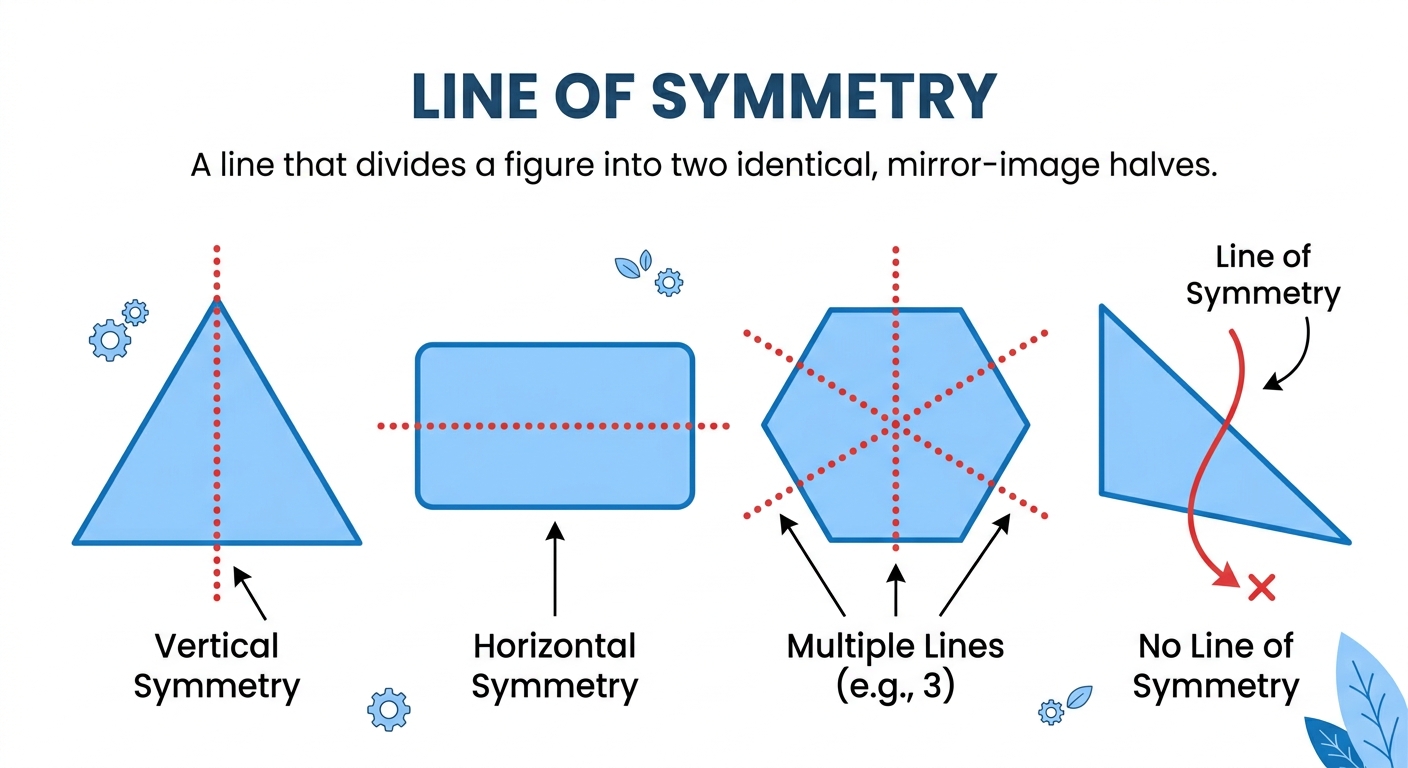
Lines Of Symmetry: How Many Does Each Shape Have?
The short version
- A line of symmetry is a line that splits a shape into two halves that are exact mirror images. Fold along it and the halves match perfectly.
- A square has 4 lines of symmetry: 2 through opposite corners and 2 through the middles of opposite sides.
- Any regular polygon has as many lines of symmetry as it has sides. An equilateral triangle has 3, a regular hexagon has 6, and a circle has infinitely many.
- Some shapes have none. A scalene triangle and a typical slanted parallelogram have 0 lines of symmetry.
Lines of symmetry are the fold lines that cut a shape into two matching mirror halves. If you could fold the shape along the line and every edge and corner lined up exactly, that line is a line of symmetry. A shape can have zero, one, several, or infinitely many of them, and counting them is a standard fourth grade geometry skill.
Below you’ll find a chart for common shapes, a quick way to count lines on any regular polygon, the mistakes kids make most, and practice problems with answers.
What is a line of symmetry?
A line of symmetry (also called a mirror line or axis of symmetry) divides a figure so that one side is the reflection of the other. Every point on one side has a partner on the other side at the same distance from the line, straight across.
The fold test is the easiest way to explain line symmetry to a kid. Cut the shape out of paper and fold it. If the two halves sit exactly on top of each other with nothing sticking out, the fold is a line of symmetry. If a corner pokes past the edge, it isn’t.
The mirror test works too. Stand a small mirror on the line. If the reflection plus the half you can see makes the whole original shape, you’ve found a line of symmetry.
Splitting in half isn’t enough
This is where most confusion starts. A line can cut a shape into two pieces with equal area and still fail the test. Take a rectangle and draw its diagonal. You get two identical triangles, but fold along that diagonal and the triangles don’t land on each other; the corners overshoot. Equal size isn’t the test. The halves have to be mirror images.
Lines of symmetry chart for common shapes
Here’s how many lines of symmetry the shapes kids meet in elementary and middle school have.
| Shape | Lines of symmetry | Where they are |
|---|---|---|
| Circle | Infinitely many | Any line through the center |
| Square | 4 | 2 diagonals, 2 through midpoints of opposite sides |
| Rectangle (not a square) | 2 | Through midpoints of opposite sides only |
| Rhombus (not a square) | 2 | The 2 diagonals |
| Parallelogram (no right angles, sides not all equal) | 0 | None |
| Kite | 1 | The diagonal between the two pairs of equal sides |
| Isosceles trapezoid | 1 | Through midpoints of the two parallel sides |
| Equilateral triangle | 3 | From each corner to the middle of the opposite side |
| Isosceles triangle (not equilateral) | 1 | From the top corner to the middle of the base |
| Scalene triangle | 0 | None |
| Regular pentagon | 5 | Each corner to the middle of the opposite side |
| Regular hexagon | 6 | 3 corner to corner, 3 side to side |
| Regular octagon | 8 | 4 corner to corner, 4 side to side |
How many lines of symmetry does a square have?
A square has 4 lines of symmetry. This is one of the most searched versions of the question, and kids often say 2 because they only think of the up and down line and the side to side line.
Here are all four:
- A vertical line through the middle of the top and bottom sides.
- A horizontal line through the middle of the left and right sides.
- Both diagonals, corner to opposite corner.
The diagonals work on a square because all four sides are the same length, so folding corner to corner puts each side exactly on its neighbor. On a rectangle that isn’t a square, the long side would land on the short side and stick out. That’s why a rectangle has only 2.
How to count lines of symmetry on any regular polygon
A regular polygon has all sides equal and all angles equal. For these shapes there’s a simple rule: the number of lines of symmetry equals the number of sides. A regular 10-sided shape has 10. A regular 20-sided shape has 20.
Where the lines go depends on whether the number of sides is odd or even.
Odd number of sides
Every line runs from a corner to the middle of the side directly across from it. A regular pentagon has 5 corners, so it has 5 of these lines.
Even number of sides
Half the lines connect opposite corners and half connect the midpoints of opposite sides. For a regular octagon:
8 sides ÷ 2 = 4 corner to corner lines
8 sides ÷ 2 = 4 side to side lines
4 + 4 = 8 lines of symmetry
A circle takes this idea to the limit. Any line through the center is a line of symmetry, so there’s no end to them.
Explaining line symmetry with letters and pictures
Capital letters make great practice because kids already know them. In a plain block font:
| Lines of symmetry | Letters |
|---|---|
| Vertical line only | A, M, T, U, V, W, Y |
| Horizontal line only | B, C, D, E, K |
| Both (2 lines) | H, I, O, X |
| None | F, G, J, L, N, P, Q, R, S, Z |
Fonts change the answer. A curly B or a slanted Y can lose its symmetry, so if a worksheet disagrees with this chart, check how the letter is drawn. N, S and Z are worth a second look: they look balanced because you can spin them halfway around and they match. That’s rotational symmetry, a different idea. Folding them never works.
Symmetry on a coordinate grid
In fifth and sixth grade, symmetry shows up on graph paper. If a shape is symmetric across the vertical line x = 4, every point has a partner the same distance on the other side. The point (1, 3) is 3 units left of the line, so its partner is 3 units right: (7, 3). The y value doesn’t change because you’re moving straight across.
Common mistakes with lines of symmetry
- Counting the diagonal of a rectangle. It makes two equal triangles, but they aren’t mirror images. A non-square rectangle has 2 lines, not 4.
- Stopping at 2 on a square. Kids find the vertical and horizontal lines and forget both diagonals.
- Assuming every polygon follows the “sides = lines” rule. It only works for regular polygons. An irregular pentagon might have 1 line or none.
- Mixing up line symmetry and rotational symmetry. S and Z look balanced when turned, but no fold works.
- Double counting on even polygons. On a hexagon, a line from corner to opposite corner is one line, not two, even though it touches two corners.
Practice problems
1. How many lines of symmetry does a rectangle that isn’t a square have?
2. How many lines of symmetry does a regular hexagon have?
3. How many lines of symmetry does the capital letter H have in a block font?
4. A triangle has sides of 4 cm, 6 cm and 7 cm. How many lines of symmetry does it have?
5. Which has more lines of symmetry, an equilateral triangle or a square? By how many?
6. A regular 12-sided polygon has how many lines of symmetry? How many of them pass through two corners?
7. A shape is symmetric across the line x = 4. The point (1, 3) is on the shape. What is its matching point on the other side?
Answers
1. 2 lines, both through the midpoints of opposite sides.
2. 6 lines: 3 corner to corner and 3 side to side.
3. 2 lines, one vertical and one horizontal.
4. 0. All three sides are different lengths, so it’s a scalene triangle.
5. The square, by 1. The square has 4 and the equilateral triangle has 3, and 4 – 3 = 1.
6. 12 lines. Since 12 is even, 12 ÷ 2 = 6 of them pass through two opposite corners and the other 6 pass through midpoints of opposite sides.
7. (7, 3). The point is 4 – 1 = 3 units left of the line, so its partner is 4 + 3 = 7.
If your child is stuck on lines of symmetry
When a kid can’t find lines of symmetry, the problem is rarely the idea of folding. More often they don’t have a firm grip on the shapes themselves. If they can’t tell a rhombus from a parallelogram, or don’t know that a square’s sides are all equal, they have no way to reason about which folds will work. Those shape properties are taught in second and third grade, and our guide to math skills by grade level shows where they sit.
The coordinate version adds another layer. A kid who stumbles on problem 7 may be fine with symmetry but shaky on distance along a number line. That’s a different gap, and it’s worth knowing which one you’re dealing with. If geometry is only one of several topics going sideways, our list of signs your child is behind in math can help you decide whether it’s a one-off or a pattern. A proper math assessment will separate the two.
Frequently asked questions
What are lines of symmetry in simple words?
They’re fold lines. If you fold a shape along the line and both halves match exactly, with nothing sticking out, that line is a line of symmetry.
How many lines of symmetry does a circle have?
Infinitely many. Any straight line through the center splits a circle into two matching halves, and you can draw as many of those as you like.
Can a shape have no lines of symmetry?
Yes. A scalene triangle, a slanted parallelogram and most irregular shapes have zero. The letters F, G and R also have none.
Does a parallelogram have lines of symmetry?
A general parallelogram has 0. Special parallelograms do: a rectangle has 2, a rhombus has 2, and a square has 4.
What grade learns lines of symmetry?
In the Common Core standards, identifying and drawing lines of symmetry is a fourth grade geometry skill. Many kids see simple symmetry earlier through art and folding activities.
Is a line of symmetry the same as an axis of symmetry?
They mean the same thing for flat shapes. In algebra, “axis of symmetry” usually refers to the vertical line that splits a parabola in half, like x = 2 for y = (x – 2)².
Find the actual gap
If lines of symmetry keep tripping your child up, guessing at the cause wastes time. Math Anon starts with a short adaptive assessment that pinpoints which earlier skills are missing, whether that’s shape properties, place value or something else, and you get a written report you can read in a few minutes.
From there, your child gets about 20 minutes a day of practice aimed only at those gaps, and you get a progress report every week. The assessment costs $49, and that’s credited back in full on your first month. Start the assessment or see pricing.





