
Types Of Lines In Math: Chart, Examples And Practice
The short version
- The main types of lines in math are horizontal, vertical, diagonal (oblique), parallel, perpendicular, intersecting and skew. Older grades add transversals, concurrent lines, tangents and secants.
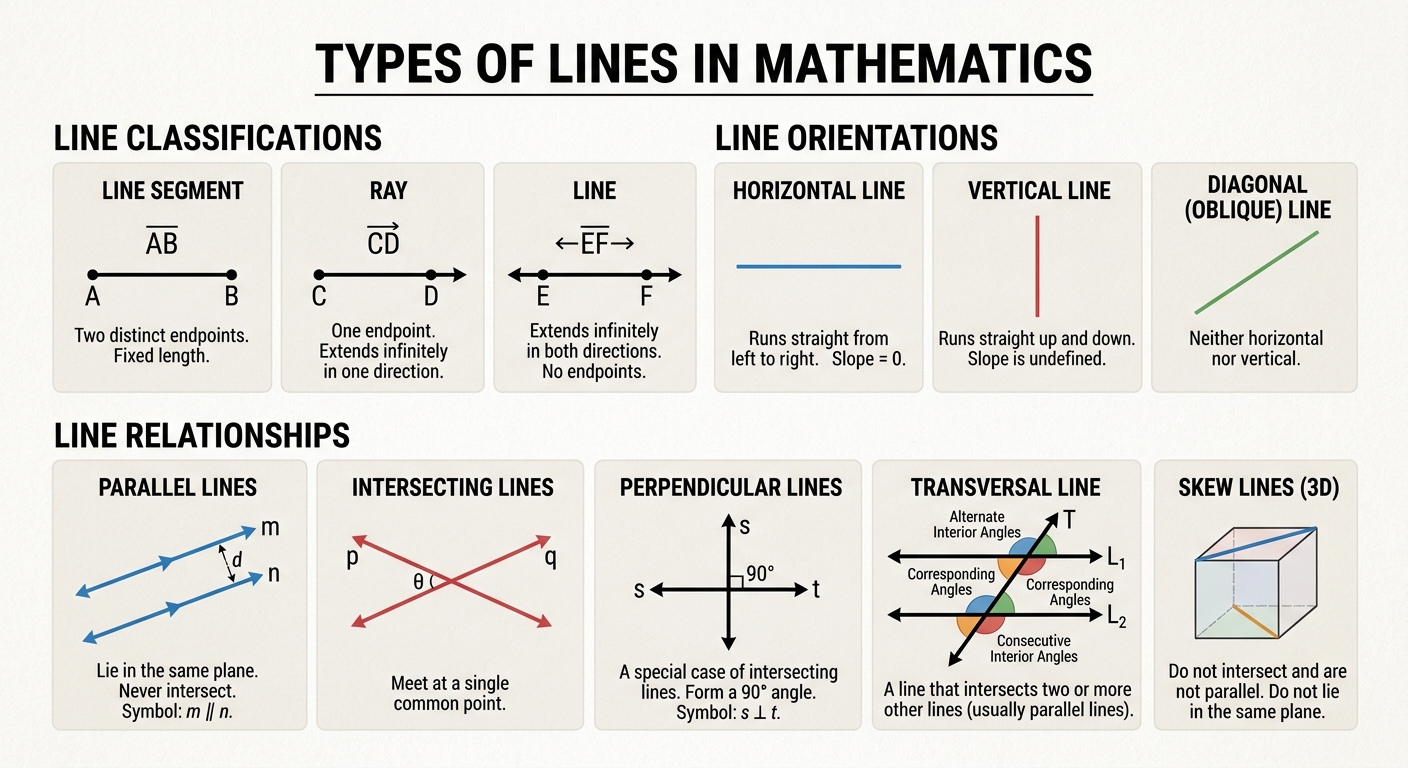
- A line goes on forever in both directions, a ray has one endpoint, and a line segment has two.
- Parallel lines never meet and have the same slope. Perpendicular lines meet at a 90° angle, and their slopes multiply to -1.
- Skew lines never meet but aren’t parallel. That can only happen in 3D, never on a flat sheet of paper.
The types of lines in math describe either a line’s direction (horizontal, vertical, diagonal) or how two or more lines relate to each other (parallel, perpendicular, intersecting, skew). Kids learn the names in third and fourth grade, then learn to prove them with slopes and angles in middle school and algebra.
Below is a chart of every type, the notation that goes with each, the slope rules for coordinate graphs, worked examples and practice problems with answers.
Line, ray and line segment
Before the types, get the three basic pieces straight. In geometry, “line” means something very specific: it’s perfectly straight, has no thickness and never ends.
| Name | Endpoints | Length | How to write it |
|---|---|---|---|
| Line | 0 | goes on forever both ways | AB with a two-headed arrow on top |
| Ray | 1 | goes on forever one way | AB with a one-headed arrow on top (A is the endpoint) |
| Line segment | 2 | can be measured | AB with a bar on top |
The edge of a ruler is a segment. A flashlight beam is a good picture of a ray. A true line can’t be drawn at all, so we draw a piece of one and put arrows on the ends to say “keeps going.”
Types of lines by direction
| Type | Direction | Slope | Equation looks like |
|---|---|---|---|
| Horizontal | Flat, left to right | 0 | y = 3 |
| Vertical | Straight up and down | Undefined | x = -2 |
| Diagonal (oblique) | Slanted | Any nonzero number | y = 2x + 1 |
A quick way to keep the first two straight: the horizon is horizontal. For the equations, a horizontal line has the same y value everywhere, so its equation only mentions y. A vertical line has the same x value everywhere, so its equation only mentions x. Kids mix these up constantly, and the fix is to plot three points and look.
Why is a vertical line’s slope undefined? Slope is rise ÷ run. On a vertical line, the run is 0, and you can’t divide by 0.
Younger kids also learn “curved lines” as a type. In later geometry, “line” means straight, and a curve is called a curve.
Types of lines by how they relate
Parallel lines
Parallel lines sit in the same flat plane and never meet, no matter how far they go. They’re always the same distance apart. The symbol is ∥, so AB ∥ CD means “line AB is parallel to line CD.” On a graph, parallel lines have the same slope and different y-intercepts.
Perpendicular lines
Perpendicular lines cross at a right angle, exactly 90°. The symbol is ⊥. On a graph, their slopes are negative reciprocals: flip the fraction and change the sign. Another way to check: multiply the two slopes. If you get -1, they’re perpendicular. The one exception is a horizontal line and a vertical line, which are perpendicular even though the vertical slope is undefined.
Intersecting lines
Intersecting lines cross at exactly one point. Perpendicular lines are a special case of intersecting lines. Any two lines on a flat surface with different slopes will intersect somewhere.
Skew lines
Skew lines never meet and aren’t parallel, because they’re in different planes. Picture a box: the top front edge and the bottom right edge don’t touch and don’t run the same direction. Since they need three dimensions, you’ll never find skew lines drawn on a single flat plane.
Transversals
A transversal is a line that crosses two or more other lines. When it crosses two parallel lines, it makes eight angles in matching pairs. Angles that sit side by side on the same straight line form a linear pair and add to 180°. That’s the same idea as supplementary angles.
Concurrent lines
Three or more lines that all pass through the same single point are concurrent. The lines y = x, y = -x and x = 0 are concurrent, since all three go through (0, 0).
Tangent and secant lines
These describe a line’s relationship to a circle. A tangent touches the circle at exactly one point and is perpendicular to the radius there. A secant cuts through the circle at two points.
Worked examples with types of lines
Example 1: Are y = 2x + 1 and y = 2x – 4 parallel, perpendicular or neither?
Both slopes are 2. Same slope, different y-intercepts (1 and -4).
They’re parallel.
Example 2: Are y = 2x + 1 and y = -½x + 3 parallel, perpendicular or neither?
Slopes are 2 and -½.
2 × (-½) = -1
They’re perpendicular.
Example 3: Where do y = x + 1 and y = -x + 5 intersect?
Set them equal: x + 1 = -x + 5
Add x to both sides: 2x + 1 = 5
Subtract 1: 2x = 4, so x = 2
Plug back in: y = 2 + 1 = 3
They cross at (2, 3). Check the other line: -2 + 5 = 3. It works.
Example 4: A transversal crosses two parallel lines and makes a 65° angle. What’s the angle right next to it on the same line?
180 – 65 = 115°
Common mistakes with types of lines
- Mixing up horizontal and vertical equations. x = 4 is vertical, not horizontal. It looks backward until you plot a few points.
- Calling perpendicular slopes “opposites.” The perpendicular slope to 3 is -1/3, not -3. You flip and change the sign.
- Calling any crossing lines perpendicular. Lines that cross at 80° are intersecting, not perpendicular. It has to be 90°.
- Saying skew lines are “just lines that don’t touch.” Parallel lines don’t touch either. Skew lines don’t touch and aren’t in the same plane.
- Measuring a line. You can measure a segment, but a line has no length because it never ends.
Practice problems
- How many endpoints does a line have? A ray? A line segment?
- What type of line is y = -4, and what’s its slope?
- Are y = 3x – 2 and y = 3x + 7 parallel, perpendicular or neither?
- Are y = 4x + 1 and y = -¼x – 3 parallel, perpendicular or neither?
- Are y = 2x and y = -2x parallel, perpendicular or neither?
- What’s the slope of any line perpendicular to y = ⅔x + 5?
- A transversal crosses two parallel lines. One angle is 72°. What’s the angle that forms a linear pair with it?
- Where do y = 2x – 1 and y = -x + 8 intersect?
Answers
- A line has 0, a ray has 1 and a line segment has 2.
- Horizontal, with a slope of 0.
- Parallel. Both slopes are 3, and the y-intercepts differ.
- Perpendicular. 4 × (-¼) = -1.
- Neither. They intersect at (0, 0), but 2 × (-2) = -4, not -1, so they aren’t perpendicular.
- Flip ⅔ to 3/2 and change the sign: -3/2.
- 180 – 72 = 108°.
- 2x – 1 = -x + 8, so 3x = 9 and x = 3. Then y = 2 × 3 – 1 = 5. They meet at (3, 5). Check: -3 + 8 = 5.
What it means if your kid is stuck on types of lines
Naming types of lines is mostly vocabulary, and a third or fourth grader who mixes up “parallel” and “perpendicular” usually just needs more looks at real examples. Once slopes enter the picture in seventh and eighth grade, the trouble usually shifts to skills that came earlier.
Negative reciprocals need solid fraction skills. Finding where two lines meet needs one-step and two-step equations. The transversal angle problems lean on knowing that a straight line is 180°, which we cover in Supplementary Angles, Explained. If fractions are the sticking point, this post on algebra and fourth grade fractions shows why that gap keeps resurfacing. To check what should be solid by grade, see math skills by grade level.
Frequently asked questions
What are the 5 types of lines?
Most elementary lists name horizontal, vertical, parallel, perpendicular and intersecting. Some swap in diagonal or add skew. There’s no single official list, so go with what your child’s teacher uses.
What’s the difference between parallel and perpendicular lines?
Parallel lines never meet and have equal slopes. Perpendicular lines cross at a 90° angle and have slopes that multiply to -1.
Can two lines be both parallel and perpendicular?
No. Parallel lines never meet, and perpendicular lines have to meet at a right angle.
What is an oblique line?
An oblique line is a slanted line, neither horizontal nor vertical. It’s the formal name for what younger kids call a diagonal line.
Are skew lines the same as parallel lines?
No. Both never meet, but parallel lines share a plane and point the same direction. Skew lines are in different planes and point different directions.
Find the actual gap
If types of lines keep getting mixed up once slopes and equations show up, the missing piece is often fractions or equation solving from a grade or two back. Math Anon starts with a short adaptive assessment that pinpoints which skills aren’t there yet and puts them in a written report you can read in a few minutes.
Then it’s about 20 minutes a day of practice built around those gaps, plus a weekly progress report so you can see what’s moving. The assessment costs $49, and the full amount is credited to the first month. Start the assessment or see pricing.





