
What Is A Transversal?
The short version
- A transversal is a line that crosses two or more other lines at different points. Crossing two lines creates eight angles, four at each intersection.
- When the two lines are parallel, corresponding angles, alternate interior angles and alternate exterior angles are all equal. Same side interior angles and same side exterior angles add to 180°.
- Only two measurements exist among those eight angles. Every angle equals either the first one or 180° minus it, so finding one angle gives you all eight.
- Those equality rules need the lines to be parallel. Without that, only vertical angles and linear pairs still hold.
- Run the rules backward and they prove parallelism: if a pair of corresponding angles is equal, the two lines have to be parallel.
A transversal is a straight line that cuts across two or more other lines. Think of a road crossing two parallel train tracks. The crossing line is the transversal, and where it meets each of the other lines it forms four angles, so two lines cut by a transversal give you eight angles in total.
Those eight angles aren’t independent. If you know one of them and the two lines are parallel, you can fill in the other seven without measuring anything.
How the eight angles get numbered
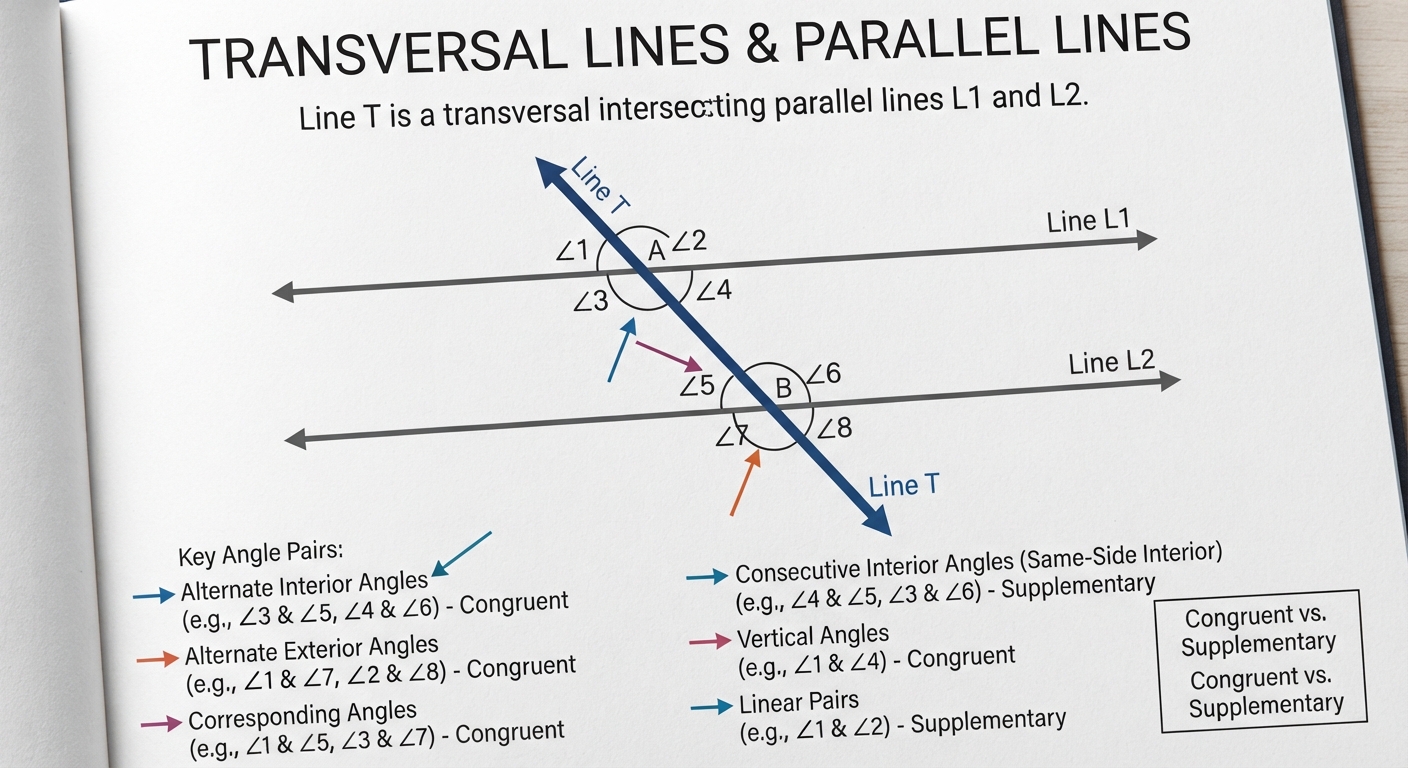
Picture two horizontal parallel lines with a transversal slanting through both. At the upper crossing, label the angles 1 (upper left), 2 (upper right), 3 (lower left) and 4 (lower right). At the lower crossing, use the same pattern for 5, 6, 7 and 8.
Two words do a lot of work here. Interior angles sit between the two parallel lines, which means angles 3, 4, 5 and 6. Exterior angles sit outside them: 1, 2, 7 and 8. Almost every angle pair name starts by telling you if the angle is inside or outside.
Every angle pair a transversal creates
| Pair name | Where they sit | Examples | Relationship |
|---|---|---|---|
| Corresponding | Same corner at each crossing | 1 and 5, 2 and 6, 3 and 7, 4 and 8 | Equal |
| Alternate interior | Inside, opposite sides | 3 and 6, 4 and 5 | Equal |
| Alternate exterior | Outside, opposite sides | 1 and 8, 2 and 7 | Equal |
| Same side interior | Inside, same side | 3 and 5, 4 and 6 | Add to 180° |
| Same side exterior | Outside, same side | 1 and 7, 2 and 8 | Add to 180° |
| Vertical | Across a single crossing | 1 and 4, 2 and 3, 5 and 8, 6 and 7 | Equal |
| Linear pair | Side by side on one line | 1 and 2, 3 and 4, 5 and 6 | Add to 180° |
Same side interior angles also go by co-interior or consecutive interior angles, depending on the textbook. Pairs that add to 180° are supplementary, and if that word is fuzzy, our guide to supplementary angles covers it properly.
Two shapes that make the names stick
Alternate interior angles trace a Z or a backward Z. Same side interior angles trace a C or a U. Corresponding angles trace an F, rotated whichever way the picture demands. Those letters are the fastest way to tell the two interior pairs apart, and that’s the confusion students hit most.
Worked example: find all eight angles
Two parallel lines are cut by a transversal, and angle 1 measures 115°. Find the rest.
Start at the top intersection.
Angle 2 forms a linear pair with angle 1, so angle 2 = 180° – 115° = 65°
Angle 3 also forms a linear pair with angle 1, so angle 3 = 65°
Angle 4 is vertical to angle 1, so angle 4 = 115°
Now drop to the bottom intersection using corresponding angles.
Angle 5 corresponds to angle 1, so angle 5 = 115°
Angle 6 corresponds to angle 2, so angle 6 = 65°
Angle 7 corresponds to angle 3, so angle 7 = 65°
Angle 8 corresponds to angle 4, so angle 8 = 115°
Check it against the other rules. Alternate interior angles 3 and 6 are both 65°. Alternate exterior angles 1 and 8 are both 115°. Same side interior angles 3 and 5 give 65° + 115° = 180°. Every rule agrees, which is the point: the whole picture holds only two numbers, 115 and 65.
Worked example: a transversal with algebra
Most test questions hide the angles behind expressions. Name the pair first, then write the equation it calls for.
Alternate interior angles measure (3x + 10)° and (5x – 30)°. Find x and the angle.
Alternate interior angles are equal, so set them equal.
3x + 10 = 5x – 30
10 + 30 = 5x – 3x
40 = 2x
x = 20
Check: 3(20) + 10 = 70 and 5(20) – 30 = 70. Both angles measure 70°.
Same side interior angles measure (2x + 20)° and (3x + 10)°. Find both angles.
These are supplementary, so they add to 180 rather than matching.
(2x + 20) + (3x + 10) = 180
5x + 30 = 180
5x = 150
x = 30
The angles are 2(30) + 20 = 80° and 3(30) + 10 = 100°, and 80 + 100 = 180.
Choosing between “set them equal” and “add to 180” is the whole question. Name the pair right and the algebra is ordinary.
What happens when the lines aren’t parallel
This is the part that gets skipped, and it costs students points. A transversal can cross any two lines. If they aren’t parallel, corresponding angles are not equal, alternate interior angles are not equal, and same side interior angles do not add to 180°.
Two things survive regardless. Vertical angles are always equal and linear pairs always add to 180°, because both come from a single intersection rather than from any relationship between the two lines.
The rule runs in reverse too, which is how proofs use it. If a pair of corresponding angles is equal, the lines must be parallel. The same goes for equal alternate interior angles, or same side interior angles totalling 180°.
Common mistakes
Using the equal rules on lines that aren’t parallel. Look for the arrow marks on the diagram or the words “parallel lines” in the problem. No parallel, no corresponding angle rule.
Confusing alternate interior with same side interior. One pair is equal, the other adds to 180°, so mixing them up flips the whole equation. Trace the Z or the C before writing anything.
Assuming every pair is equal. Most pairs do match, so students apply it everywhere. The same side pairs are supplementary instead.
Setting supplementary expressions equal. Writing 2x + 20 = 3x + 10 for a same side interior pair gives x = 10 and two angles of 40°, which don’t add to 180°. If the answer fails that check, the pair was misnamed.
Thinking a transversal has to be perpendicular. It can cross at any angle. Perpendicular is just the case where all eight angles are 90°.
Practice problems
For problems 1 through 5, two parallel lines are cut by a transversal and the angles are numbered as described above, with angle 1 measuring 72°.
1. Find angle 4.
2. Find angle 2.
3. Find angle 5, and name the pair that angles 1 and 5 form.
4. Find angle 6.
5. Angle 3 measures 108°. What does angle 5 measure, and what is that pair called?
6. Alternate interior angles measure (4x + 5)° and (6x – 25)°. Find x and the angle measure.
7. Same side interior angles measure (2x + 15)° and (3x + 15)°. Find both angles.
8. A transversal crosses two lines. One pair of corresponding angles measures 70° and 80°. Are the lines parallel?
Answers
1. 72°. Angles 1 and 4 are vertical angles, so they’re equal.
2. 108°. Angles 1 and 2 are a linear pair, so 180° – 72° = 108°.
3. 72°, and they’re corresponding angles, which are equal when the lines are parallel.
4. 108°. Angle 6 corresponds to angle 2, which is 108°.
5. 72°. Angles 3 and 5 are same side interior angles, so they add to 180°, and 180° – 108° = 72°.
6. Alternate interior angles are equal: 4x + 5 = 6x – 25, so 30 = 2x and x = 15. Each angle measures 4(15) + 5 = 65°, and 6(15) – 25 = 65° confirms it.
7. Same side interior angles are supplementary: (2x + 15) + (3x + 15) = 180, so 5x + 30 = 180, 5x = 150 and x = 30. The angles are 2(30) + 15 = 75° and 3(30) + 15 = 105°, which add to 180°.
8. No. Corresponding angles are equal only when the lines are parallel. Since 70° and 80° differ, these lines aren’t parallel.
What it means if your child is stuck on this
Transversal problems fail for one of two reasons, and they need opposite fixes.
The first is vocabulary. Five similar sounding pair names arrive in a single lesson, and a student who can’t reliably say which pair a diagram shows will guess between “equal” and “adds to 180” every time. The cure is naming practice on diagrams with no numbers at all, which takes about ten minutes a night for a week.
The second is the algebra. A kid who knows the pair is supplementary but can’t solve 5x + 30 = 180 doesn’t have a geometry problem. They have an equation solving problem in a geometry costume, and more angle worksheets won’t touch it. The real problem is usually fourth grade fractions explains the pattern underneath that. One more thing to rule out: if 180° – 108° is itself slow, the gap is subtraction fluency. 12 signs your child is behind in math helps you tell which you’re looking at.
Frequently asked questions
What is a transversal in geometry?
A transversal is a line that intersects two or more other lines at separate points. When the lines it crosses are parallel, the angle pairs it creates follow fixed rules that let you find all eight angles from one measurement.
Do the lines a transversal crosses have to be parallel?
No. A transversal can cross any two lines. But the familiar rules about corresponding and alternate angles being equal only apply when the lines are parallel, so check the diagram for parallel marks before using them.
Which angle pairs are equal and which add to 180 degrees?
With parallel lines, corresponding, alternate interior and alternate exterior pairs are equal. Same side interior and same side exterior pairs are supplementary, meaning they add to 180°. Vertical angles are always equal and linear pairs always total 180°, parallel or not.
How do you remember alternate interior angles?
Look for the Z. Alternate interior angles sit in the two corners of a Z shape traced through the figure, and they’re equal. Same side interior angles form a C or U shape instead, and those add to 180°.
How do you prove two lines are parallel using a transversal?
Show that one of the pairs behaves the way it should. If corresponding angles are equal, or alternate interior angles are equal, or same side interior angles add to 180°, then the lines are parallel. Any one of those is enough.
What grade do students learn about transversals?
Angle relationships with a transversal usually appear in eighth grade and again in high school geometry, where they become formal proofs. Students need supplementary angles and two step equations solid first.
Find the actual gap
When angle problems come back wrong, parents can’t usually tell if the trouble is vocabulary, equation solving or plain arithmetic. All three make the same red marks. Math Anon starts with a short adaptive assessment that separates them and gives you a written report naming the missing skills.
Then your child practices about 20 minutes a day on those skills only, with a weekly progress report so you can see what’s actually improving. Start the assessment for $49, credited back in full against your first month. See pricing for the rest, or read our guide to math assessment to see what the report covers.





