
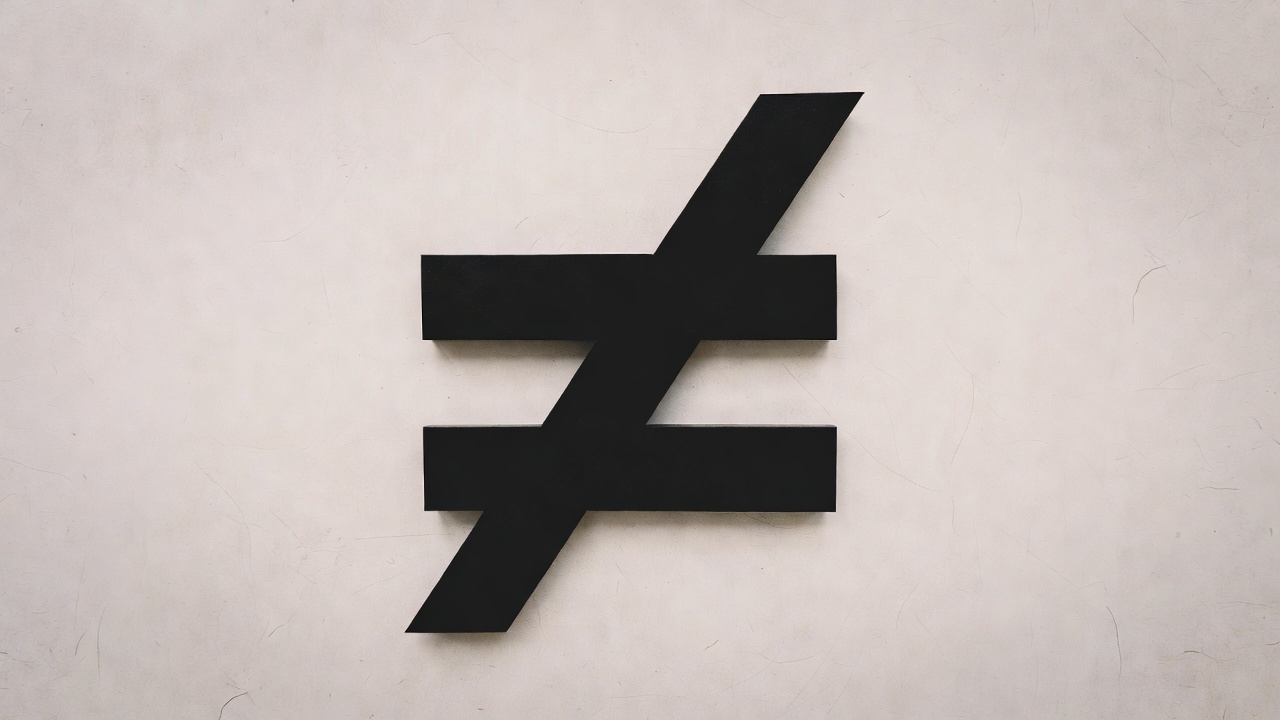
Not Equal Sign (≠): What It Means And How To Type It
The short version
- The not equal sign is ≠. It means the two sides have different values. 7 ≠ 4 reads “7 is not equal to 4.”
- To type it: Option + = on a Mac, Alt + 8800 on a Windows number pad, or type 2260 then Alt + X in Word. On a phone, press and hold the = key on the symbols screen.
- In Excel and Google Sheets formulas, “not equal” is written <>, as in =IF(A1<>B1, “Different”, “Same”). Most programming languages use !=.
- ≠ only says the values differ. It doesn’t say which one is bigger. For that you need < or >.
The not equal sign (≠) is an equal sign with a slash through it, and it means the values on each side are different. 5 + 2 ≠ 8 because 5 + 2 is 7. You read it out loud as “is not equal to” or “does not equal.”
If you just need the symbol, copy it here: ≠. Below are the keyboard shortcuts for every common device and app, then how the sign gets used in math class, from second grade comparisons up to algebra.
How to type the not equal sign
| Where you’re typing | How to get ≠ |
|---|---|
| Mac (any app) | Press Option + = |
| Windows (any app) | Hold Alt and type 8800 on the number pad, then let go of Alt. This needs a real number pad with Num Lock on. |
| Windows, no number pad | Press Windows key + . (period) to open the emoji panel, go to the Symbols tab, and look under math symbols. |
| Microsoft Word | Type 2260, then press Alt + X. Or use Insert, Symbol, More Symbols and pick the Mathematical Operators subset. |
| Google Docs | Insert, Special characters, then search “not equal.” You can also set up != to change into ≠ automatically under Tools, Preferences, Substitutions. |
| iPhone and Android | Switch to the numbers and symbols keyboard, then press and hold the = key. On most keyboards, including the default iPhone keyboard and Gboard, ≠ pops up as an option. |
| Chromebook | Press Ctrl + Shift + U, type 2260, then press Enter or Space. |
| HTML | Type ≠ or ≠ |
| LaTeX | Type \neq (or the shorter \ne) in math mode |
The character’s official Unicode name is NOT EQUAL TO, code point U+2260. That’s where the numbers in the shortcuts come from: 2260 is the code in hexadecimal, and 8800 is the same number in ordinary base ten.
By hand, it’s easy: draw an equal sign, then one slanted line through both bars.
The does not equal symbol in Excel and Google Sheets
Spreadsheets don’t use ≠ inside formulas. They use a less-than sign followed by a greater-than sign: <>. Think of it as “less than or greater than,” which covers every case except equal.
=A2<>B2 returns TRUE when the two cells hold different values.
=IF(A2<>0, B2/A2, “”) divides only when A2 isn’t zero.
=COUNTIF(C2:C50, “<>Done”) counts every row that isn’t marked Done.
If you want the ≠ character to show up inside a cell as text, use =UNICHAR(8800), or paste the symbol in directly.
Not equal in code
Most programming languages write “not equal” as !=, since the exclamation point means “not.” That’s true in Python, Java, C, and JavaScript. JavaScript also has !==, which checks that two values differ in value or type. SQL traditionally uses <>, though many databases accept != too.
What the not equal sign means in math
The equal sign says both sides are worth the same amount. The not equal sign says they aren’t. That’s all it claims.
9 ≠ 6
3 × 4 ≠ 14 (because 3 × 4 = 12)
0.3 ≠ 0.03
1/2 ≠ 1/3
A statement with ≠ can be true or false, just like one with =. “10 – 4 ≠ 6” is false, because 10 – 4 is exactly 6. Kids sometimes assume any statement with a ≠ in it is automatically “different,” so it’s worth asking them to work out both sides before deciding.
The sneaky cases are values that look different but aren’t. 2/4 and 1/2 look different, but they’re equal, so 2/4 ≠ 1/2 is false. Same with 0.50 and 0.5, or 3 + 5 and 2 × 4. Checking a ≠ statement means simplifying both sides first.
Not equal vs. other comparison symbols
| Symbol | Read as | True example |
|---|---|---|
| = | is equal to | 6 + 2 = 8 |
| ≠ | is not equal to | 6 + 2 ≠ 9 |
| < | is less than | 5 < 9 |
| > | is greater than | 9 > 5 |
| ≤ | is less than or equal to | 5 ≤ 5 |
| ≥ | is greater than or equal to | 7 ≥ 3 |
| ≈ | is approximately equal to | 3.14 ≈ 22/7 |
Here’s the difference that trips kids up. If 5 < 9 is true, then 5 ≠ 9 is also true. But ≠ gives you less information. It tells you the numbers differ without saying which way. So when a worksheet asks for <, >, or =, writing ≠ won’t get credit even though it isn’t technically wrong.
Where the not equal sign shows up in algebra
Values a variable can’t be
You can’t divide by zero, so any expression with a variable on the bottom comes with a warning. In 12 ÷ (x – 3), the bottom is zero when x = 3. So you’d write x ≠ 3. Textbooks often list these restrictions next to the problem, and students are expected to notice them.
Solving a not equal statement
You solve these the same way you’d solve an equation. For x + 4 ≠ 10, subtract 4 from both sides and get x ≠ 6. Any number works except 6.
Multiplying or dividing by a negative doesn’t flip ≠, which is different from < and >. -2x ≠ 8 becomes x ≠ -4.
Checking answers
When a kid plugs an answer back into an equation and the two sides come out different, that’s a ≠ result, and it means the answer is wrong. If x = 5 is a proposed answer to 2x + 1 = 13, the check gives 11 ≠ 13, so x = 5 isn’t the solution. (The real answer is x = 6.)
Common mistakes with the not equal sign
- Using ≠ when a direction is needed. ≠ doesn’t mean “bigger.” If the question is “which is greater,” the answer needs > or <.
- Judging by how the numbers look. 0.5 and 0.50 are equal. So are 3/6 and 1/2. Simplify both sides before choosing = or ≠.
- Confusing ≠ with ≈. ≈ means “close to.” 3.14 ≈ π is true, and so is 3.14 ≠ π. They answer different questions.
- Typing =/ or /= in a document. These work as shorthand in a text but aren’t the symbol. Use one of the shortcuts above.
- Using != in Excel. Excel returns an error. Spreadsheets want <>.
Practice problems
For 1 to 6, fill in = or ≠. Problems 7 and 8 are algebra.
- 6 + 3 ___ 9
- 4 × 5 ___ 24
- 1/2 ___ 3/6
- 0.5 ___ 0.05
- 15 – 7 ___ 2 × 4
- 2³ ___ 3²
- Solve: x + 7 ≠ 12
- What value can x not be in 20 ÷ (x + 5)?
Answers
- = (6 + 3 = 9)
- ≠ (4 × 5 = 20)
- = (3/6 simplifies to 1/2)
- ≠ (0.5 is five tenths, 0.05 is five hundredths)
- = (both sides equal 8)
- ≠ (2³ = 8 and 3² = 9)
- x ≠ 5 (subtract 7 from both sides)
- x ≠ -5, because -5 + 5 = 0 and you can’t divide by zero
If your child is stuck on equal and not equal
A kid who struggles with ≠ usually has a shaky idea of what = means. Lots of kids read the equal sign as “the answer goes next” instead of “both sides are worth the same.” You can spot it with a problem like 8 + 4 = ___ + 5. A kid who writes 12 is reading = as “write the answer.” The right answer is 7, because 8 + 4 and 7 + 5 are both 12.
That misunderstanding causes little trouble in second grade and a lot of trouble in algebra, where the whole game is keeping both sides balanced. We explain how early gaps like this one surface years later in Struggling With Algebra? The Real Problem Is Usually Fourth Grade Fractions. If ≠ problems with fractions or decimals are the sticking point, the gap is more likely equivalent fractions or place value. Our math skills by grade level guide shows when each of those is usually taught, and 12 signs your child may be behind in math can help you tell a one-off slip from a pattern.
Frequently asked questions
What does the ≠ sign mean?
It means “is not equal to.” The expressions on each side have different values. 8 ≠ 3 is true, and 4 + 4 ≠ 8 is false.
How do you type the does not equal sign on a keyboard?
On a Mac, press Option and the = key. On Windows, hold Alt and type 8800 on the number pad. In Word, type 2260 and press Alt + X. You can also copy it from here: ≠.
What is the not equal to symbol in Excel?
Excel uses <> for “not equal to” in formulas. =A1<>B1 returns TRUE if the cells differ. Excel doesn’t accept ≠ or != as an operator in formulas.
Is != the same as ≠?
They mean the same thing. != is how you write “not equal” in most programming languages because it’s easy to type. In math class, on paper, use ≠.
Does not equal mean greater than?
No. Not equal only means the values are different. The first value could be bigger or smaller. Use > or < when direction matters.
What grade learns the not equal sign?
It varies by curriculum. Many kids meet ≠ in the early grades when they sort true and false number sentences, then use it again in middle school and algebra for values a variable can’t take.
Find the actual gap
When a kid mixes up =, ≠, <, and >, the symbols usually aren’t the real problem. The trouble tends to sit in something underneath, like what the equal sign means, place value, or comparing fractions. Math Anon begins with a short adaptive assessment that finds exactly which skills are missing and sends you a written report.
After that, your child works on those specific skills for about 20 minutes a day, and you get a progress report each week. The assessment is $49 and fully credited back on your first month. Start the assessment, or check pricing first.





