
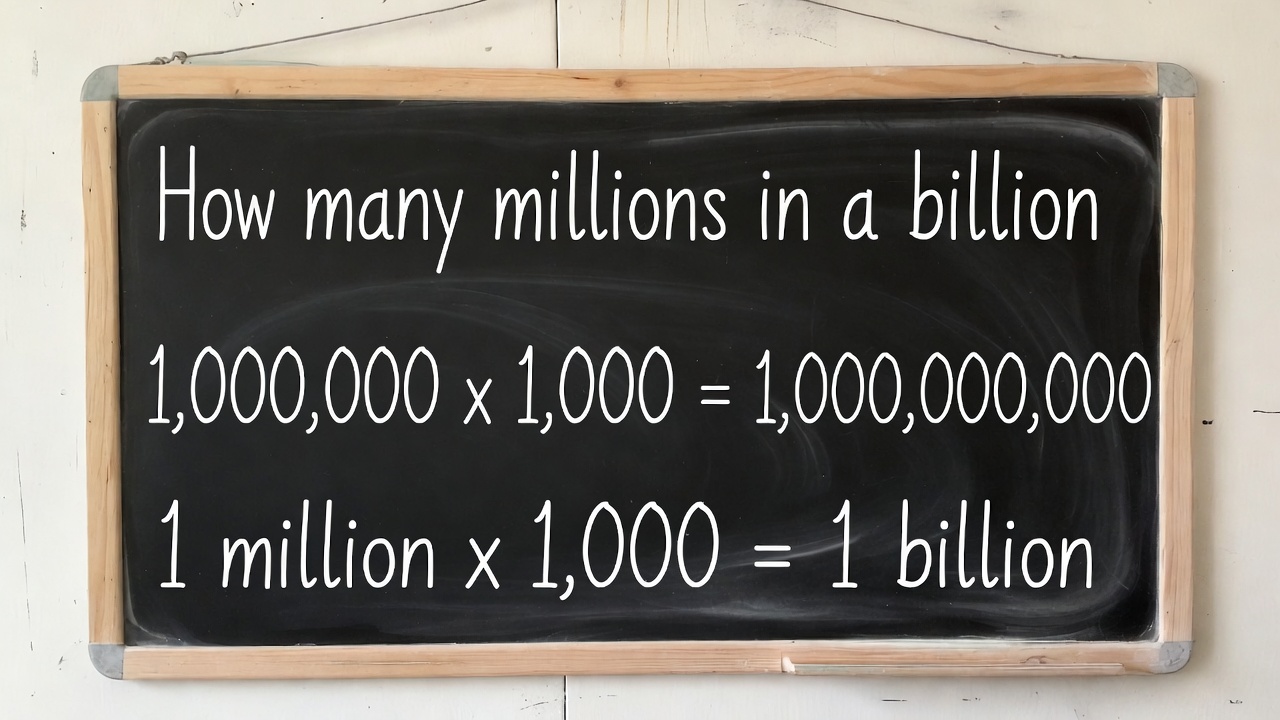
How Many Millions In A Billion? (Plus A Conversion Chart)
The short version
- There are 1,000 millions in a billion. 1,000,000,000 ÷ 1,000,000 = 1,000.
- A million has 6 zeros and a billion has 9. The 3 extra zeros are a factor of 1,000.
- To turn billions into millions, multiply by 1,000: 2.5 billion = 2,500 million. To go the other way, divide by 1,000.
- That’s the American (short scale) billion, which is now standard in English. Some languages use a word that looks like “billion” for a million million, so watch translations.
If you’re wondering how many millions in a billion, the answer is 1,000. Written out, one billion is 1,000,000,000, and one million is 1,000,000. Divide the first by the second and you get 1,000, so a billion is a thousand millions.
That’s the quick answer. The rest of this page shows three ways to prove it, a conversion chart for thousands through trillions, how to switch between millions and billions with decimals, and why a billion means something different in parts of Europe and Latin America.
The place value chart for big numbers
Big numbers are grouped in threes, and every group of three gets a new name. Each name is 1,000 times the one before it.
| Name | Written out | Zeros | Power of 10 |
|---|---|---|---|
| One thousand | 1,000 | 3 | 10³ |
| One million | 1,000,000 | 6 | 10⁶ |
| One billion | 1,000,000,000 | 9 | 10⁹ |
| One trillion | 1,000,000,000,000 | 12 | 10¹² |
| One quadrillion | 1,000,000,000,000,000 | 15 | 10¹⁵ |
Once a kid sees the pattern, the answer to “how many of one name fit in the next” is always the same: 1,000.
How many millions in a billion? Three ways to prove it
1. Count the zeros
A billion has 9 zeros. A million has 6. Take away 6 from 9 and you have 3 zeros left over. A 1 with 3 zeros is 1,000.
9 – 6 = 3 zeros, so the answer is 1,000.
2. Divide
1,000,000,000 ÷ 1,000,000 = 1,000
Check it by multiplying back: 1,000 × 1,000,000 = 1,000,000,000.
3. Use powers of ten
This is the version middle schoolers see. When you divide powers of ten, subtract the exponents.
10⁹ ÷ 10⁶ = 10⁹⁻⁶ = 10³ = 1,000
All three are the same idea. Every group of three zeros is another factor of 1,000.
Big number conversion chart
| Question | Answer |
|---|---|
| How many thousands in a million? | 1,000 |
| How many millions in a billion? | 1,000 |
| How many billions in a trillion? | 1,000 |
| How many thousands in a billion? | 1,000,000 |
| How many millions in a trillion? | 1,000,000 |
| How many hundred thousands in a million? | 10 |
| How many hundred millions in a billion? | 10 |
| How many ten millions in a billion? | 100 |
The last three rows catch a lot of kids. A billion holds 10 hundred millions, which is why “a billion is a hundred million” is a common wrong guess. It’s ten times too small.
Converting between millions and billions
News stories and company reports mix the two all the time, often with decimals. The rule is simple.
- Billions to millions: multiply by 1,000 (move the decimal 3 places right).
- Millions to billions: divide by 1,000 (move the decimal 3 places left).
Worked examples
2.5 billion to millions:
2.5 × 1,000 = 2,500 million
Written out: 2,500,000,000
1.08 billion to millions:
1.08 × 1,000 = 1,080 million
750 million to billions:
750 ÷ 1,000 = 0.75 billion
45 million to billions:
45 ÷ 1,000 = 0.045 billion
That last one is where kids slip. 45 million is much less than a tenth of a billion, so the answer needs a zero right after the decimal point. A quick sense check: a tenth of a billion is 100 million, and 45 million is less than half of that.
How big a billion really is
1,000 sounds like a small number, so “a billion is 1,000 millions” can make the two seem close. They aren’t. Two comparisons that help:
Counting seconds. A day has 86,400 seconds. A million seconds is about 11 1/2 days. A billion seconds is about 31 years and 8 months.
Spending money. Spend $1,000 every single day. You’d get through a million dollars in 1,000 days, a little under 3 years. Getting through a billion dollars at the same pace would take 1,000,000 days, which is more than 2,700 years.
Both show the same thing. A billion is a million, a thousand times over.
Short scale vs. long scale billions
In American English, and in modern British English too, a billion is 1,000,000,000. This is called the short scale. The UK used to use a different system and officially moved to the American one in the 1970s.
Many other languages still use the long scale, where the word that sounds like “billion” means a million millions, or 1,000,000,000,000. That’s what English speakers call a trillion. A few examples:
| Language | Word for 10⁹ (our billion) | Word for 10¹² (our trillion) |
|---|---|---|
| English (US and UK today) | billion | trillion |
| French | milliard | billion |
| German | Milliarde | Billion |
| Spanish | mil millones | billón |
So if you’re helping with homework in another language, or reading a translated article, check which billion it means. In India, big numbers are often written in lakhs and crores instead. One lakh is 100,000 and one crore is 10,000,000, so a billion is 100 crore.
Common mistakes
- Saying a billion is 100 million. It’s 1,000 million. 100 million is only a tenth of a billion.
- Losing count of zeros. Writing 1,000,000,000 without commas makes it easy to add or drop one. Group digits in threes from the right, every time.
- Adding zeros to a decimal. 2.5 billion isn’t 2.5000000000. Move the decimal point: 2,500,000,000.
- Multiplying when you should divide. Going from a smaller unit (millions) to a bigger one (billions), the number gets smaller. 750 million is 0.75 billion, not 750,000 billion.
Practice problems
- How many millions are in 3 billion?
- How many zeros are in one trillion?
- Write 4.5 billion in millions.
- Write 600 million in billions.
- How many thousands are in one billion?
- Write 8,200,000,000 in words using “billion.”
- How many billions are in 7.3 trillion?
- A company earns $250 million every 3 months. How much does it earn in a year, in billions?
Answers
- 3,000 (3 × 1,000)
- 12
- 4,500 million (4.5 × 1,000)
- 0.6 billion (600 ÷ 1,000)
- 1,000,000 (1,000,000,000 ÷ 1,000)
- 8.2 billion
- 7,300 (7.3 × 1,000)
- $1 billion (a year has four 3 month periods: 4 × 250 million = 1,000 million = 1 billion)
If your child is stuck on millions and billions
Trouble here almost always comes back to place value. A kid who isn’t sure why the 3 in 3,000 is worth more than the 3 in 300 will find millions and billions confusing, because the whole system is the same place value pattern stretched out. The other common gap is multiplying and dividing by 10, 100, and 1,000. If a kid can’t quickly say that 45 ÷ 1,000 = 0.045, converting 45 million to billions will feel like a trick. Once place value clicks, how many millions in a billion stops being a fact to memorize and becomes something a kid can work out.
Both skills are taught in upper elementary. Our math skills by grade level guide shows where place value and decimals usually land, and Is My Child Behind In Math? 12 Signs By Grade Level covers what it looks like when those skills are slipping. If you’re not sure where the gap is, our parent’s guide to math assessment explains how to find out.
Frequently asked questions
A billion is how many millions?
A billion is 1,000 millions. That’s why people sometimes call it “a thousand million.”
How many zeros are in a billion?
Nine. One billion is written 1,000,000,000.
How many billions are in a trillion?
1,000. A trillion has 12 zeros and a billion has 9, so the difference is 3 zeros, or 1,000.
What comes after a billion?
A trillion (12 zeros), then a quadrillion (15 zeros), then a quintillion (18 zeros). Each is 1,000 times the one before.
Is a billion the same in every country?
No. English uses the short scale, where a billion is 1,000,000,000. French, German, Spanish and many other languages use a long scale word that means 1,000,000,000,000, which is an English trillion.
How do you write 1.5 billion?
1,500,000,000. That’s 1,500 million.
Find the actual gap
If big numbers keep tripping up your child, the fix is usually back in place value or in multiplying and dividing by powers of ten. Math Anon’s short adaptive assessment tracks down which of those earlier skills is missing, then puts it in a written report so you can see it too.
Next comes about 20 minutes a day of practice built around those gaps, with a progress report sent every week. The assessment costs $49, and the full amount is credited to your first month. Start the assessment or look over pricing.





