
What Is A Binomial? Multiply, Square And Factor
The short version
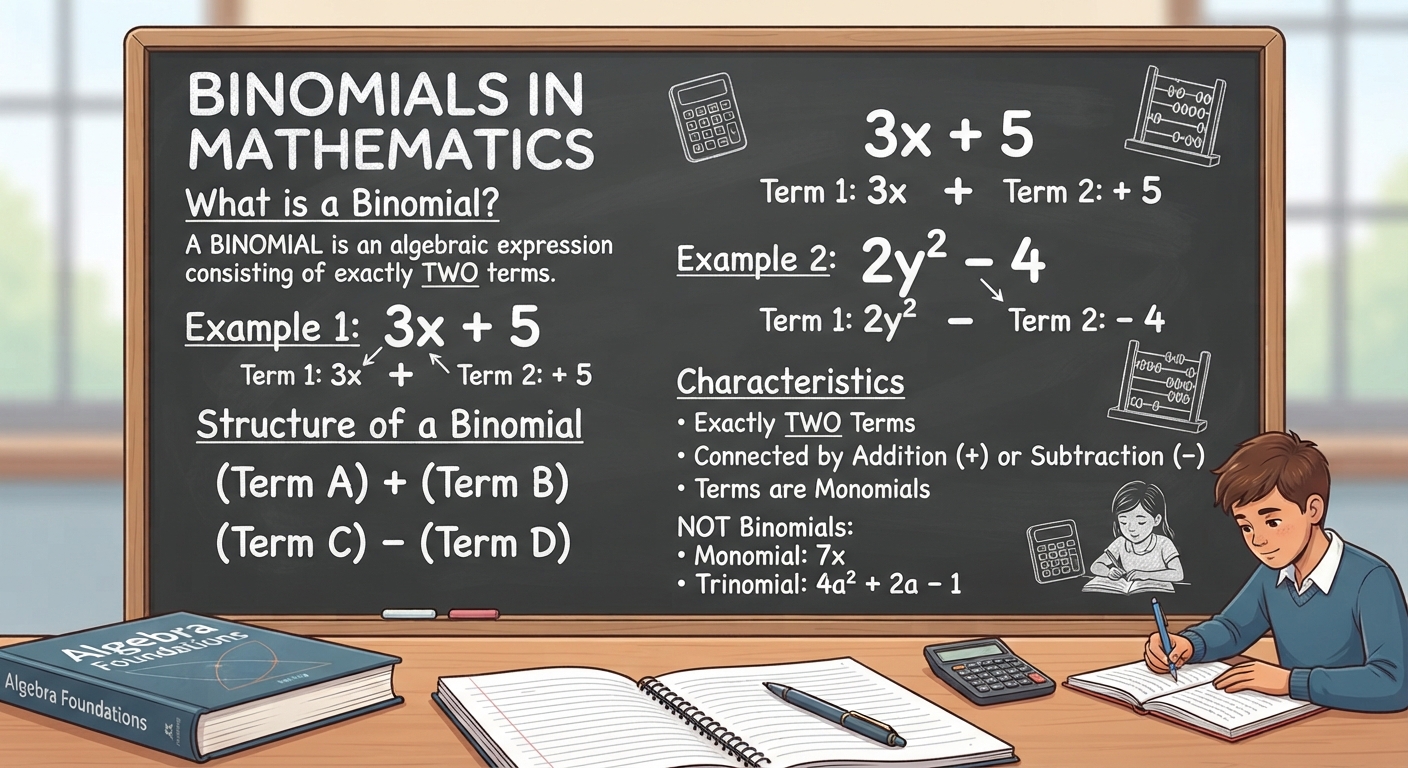
- A binomial is a polynomial with exactly two terms joined by a plus or minus sign, like x + 6, 3y – 5, or 4a² + 2b.
- To multiply two binomials, multiply every term in the first by every term in the second, then combine like terms: (x + 3)(x + 5) = x² + 8x + 15.
- Squaring a binomial is not squaring each piece. (a + b)² = a² + 2ab + b², and that middle term is where most points disappear.
- When two binomials match except for the sign, the middle terms cancel: (x + 6)(x – 6) = x² – 36. That shortcut is called the difference of squares.
- A kid who keeps missing these problems usually has a signed number or distributive property gap from an earlier grade, not a binomial problem.
A binomial is an algebraic expression with exactly two terms, connected by a plus sign or a minus sign. x + 6 is a binomial. 3y – 5 is a binomial. 4a² + 2b is a binomial. Each of those has two chunks of math separated by one operation sign, and that is the whole test.
The word comes from “bi,” meaning two, and “nomial,” meaning term. So a monomial has one term (5x), a binomial has two (5x + 2), and a trinomial has three (5x² + 2x + 1). Anything with two or more terms falls under the bigger umbrella of polynomials.
Most kids meet the word in pre-algebra or Algebra 1, and it shows up again every time they multiply, square, or factor. Below is what a binomial is, how to work with one, and the exact places students lose points.
What counts as a binomial and what doesn’t
Count the terms. Terms are separated by + and – signs, not by multiplication or division inside a single chunk. 7xy is one term even though it has three pieces multiplied together. 7x + y is two terms.
| Expression | Terms | Name |
|---|---|---|
| 9x | 1 | Monomial |
| x + 6 | 2 | Binomial |
| 2m – 11 | 2 | Binomial |
| 4a² + 2b | 2 | Binomial |
| 6xy | 1 | Monomial |
| x² + 5x + 4 | 3 | Trinomial |
One thing trips students up: a binomial can have two different variables. 4a² + 2b still has exactly two terms, so it qualifies. The variables don’t have to match. The count is all that matters.
Parts of a binomial
In 5x – 8, the 5 is the coefficient, the x is the variable, the minus sign belongs to the 8, and the 8 is a constant. Reading it as 5x and -8 (two terms, the second one negative) makes every later step cleaner, because the sign travels with the number.
How to multiply two binomials
Multiply each term in the first binomial by each term in the second. Two terms times two terms gives four products, and then you combine any that are alike. Some teachers call the bookkeeping trick FOIL, for first, outer, inner, last. FOIL is just a reminder of those four products, and it only works when both factors have exactly two terms, so we’d rather kids learn the distributive property underneath it.
Example 1: (x + 3)(x + 5)
x × x = x²
x × 5 = 5x
3 × x = 3x
3 × 5 = 15
Add them: x² + 5x + 3x + 15
Combine like terms: x² + 8x + 15
Example 2: (2x – 3)(x + 4)
2x × x = 2x²
2x × 4 = 8x
-3 × x = -3x
-3 × 4 = -12
Add them: 2x² + 8x – 3x – 12
Combine like terms: 2x² + 5x – 12
Notice how the minus sign stayed attached to the 3 the whole way through. That habit alone fixes a large share of wrong answers.
How to square a binomial
Squaring a binomial means multiplying it by itself, so (x + 7)² means (x + 7)(x + 7). It does not mean x² + 49. Writing it out the long way once or twice makes the reason obvious.
Example: (x + 7)²
(x + 7)(x + 7)
x × x = x²
x × 7 = 7x
7 × x = 7x
7 × 7 = 49
x² + 14x + 49
The two middle products are identical, which is why the pattern always looks the same:
(a + b)² = a² + 2ab + b²
(a – b)² = a² – 2ab + b²
Example: (3x – 2)²
a = 3x, b = 2
a² = 9x²
2ab = 2 × 3x × 2 = 12x, and the sign is negative
b² = 4
9x² – 12x + 4
Check it the long way if you want: (3x – 2)(3x – 2) = 9x² – 6x – 6x + 4 = 9x² – 12x + 4. Same answer.
The difference of squares pattern
When two binomials are identical except that one has a plus and the other has a minus, the outer and inner products cancel and you’re left with two terms.
Example: (x + 6)(x – 6)
x × x = x²
x × -6 = -6x
6 × x = 6x
6 × -6 = -36
The -6x and +6x cancel: x² – 36
The general pattern is (a + b)(a – b) = a² – b². It runs backwards too, which is how students factor:
| Expression | Factored form |
|---|---|
| x² – 36 | (x + 6)(x – 6) |
| 16x² – 25 | (4x + 5)(4x – 5) |
| x² – 81 | (x + 9)(x – 9) |
| 49 – y² | (7 + y)(7 – y) |
To use it backwards, both terms have to be perfect squares and the sign between them has to be a minus. x² + 36 does not factor this way over the real numbers, and a lot of kids try anyway.
Common mistakes with binomials
Distributing the exponent. Writing (x + 5)² = x² + 25 is the single most common error in Algebra 1. Exponents distribute over multiplication, not over addition. (3x)² really is 9x², but (3 + x)² is 9 + 6x + x².
Dropping a negative. In (2x – 3)(x + 4), the -3 has to stay negative in both of its products. A kid who writes +12 instead of -12 gets the shape of the answer right and the answer wrong.
Forgetting to combine like terms. Four products come out; usually two of them are alike. Leaving x² + 5x + 3x + 15 as the final answer costs credit even though every step before it was correct.
Using FOIL where it doesn’t apply. FOIL only covers two terms times two terms. For (x + 2)(x² + 3x – 1), you need the distributive property, which handles any size.
Calling 6xy a binomial. Two letters does not mean two terms. Look for the + or – sign between chunks.
Practice problems
1. Which of these is a binomial: 7y, 7y + 2, or 7y + 2z – 1?
2. Multiply: (x + 2)(x + 6)
3. Multiply: (x – 4)(x + 9)
4. Expand: (x + 5)²
5. Multiply: (2x + 7)(2x – 7)
6. Expand: (3x – 4)²
7. Factor: x² – 81
8. Multiply: (5x – 2)(3x + 4)
Answers
1. 7y + 2. The first is a monomial (one term) and the third is a trinomial (three terms).
2. x² + 8x + 12. Products: x², 6x, 2x, 12, and 6x + 2x = 8x.
3. x² + 5x – 36. Products: x², 9x, -4x, -36, and 9x – 4x = 5x.
4. x² + 10x + 25. Here 2ab = 2 × x × 5 = 10x.
5. 4x² – 49. Difference of squares, since 2x × 2x = 4x² and 7 × 7 = 49.
6. 9x² – 24x + 16. Here 2ab = 2 × 3x × 4 = 24x, negative because of the minus sign.
7. (x + 9)(x – 9), since 9 × 9 = 81.
8. 15x² + 14x – 8. Products: 15x², 20x, -6x, -8, and 20x – 6x = 14x.
If your kid is stuck on binomials, look one grade back
Binomial work is mostly bookkeeping. Almost every wrong answer we see traces to a skill from years earlier rather than to the new lesson. Three gaps account for most of it.
Signed numbers come first. If -3 × 4 takes a second thought, multiplying binomials turns into a sign lottery. That skill is a middle school one, and it doesn’t fix itself with more Algebra 1 homework.
The distributive property is second. A student who never fully understood that 4(x + 2) = 4x + 8 has no foundation for doing it twice in a row. Third is multiplication fluency: if 7 × 8 has to be counted out, the working memory that should be tracking four products is busy somewhere else. Our post on why algebra trouble usually starts in fourth grade fractions walks through how these older gaps hide under new topics, and math skills by grade level shows what should already be automatic. If the pattern looks familiar across several subjects, the signs a child is behind in math is worth ten minutes.
Frequently asked questions
What is a binomial in simple terms?
It’s a math expression with exactly two terms separated by a plus or minus sign. x + 4, 2y – 9, and 3m² + n are all binomials. If you can point at the one + or – in the middle and see a chunk on each side, you have a binomial.
What’s the difference between a binomial and a polynomial?
A binomial is a kind of polynomial. Polynomial is the family name for any expression built from terms with whole number exponents. A polynomial with one term is a monomial, with two terms it’s a binomial, and with three it’s a trinomial. Past three, most people just say polynomial.
Is 5x a binomial?
No. 5x is one term, so it’s a monomial. The 5 and the x are multiplied, not added, and multiplication inside a chunk doesn’t split it into separate terms.
Do you have to use FOIL to multiply binomials?
No. FOIL is a memory aid for the four products you get from two binomials, and it stops working the moment one factor has three terms. Distributing each term of the first expression across the second gives the same four products and keeps working for any size problem.
Why isn’t (x + 5)² equal to x² + 25?
Because squaring means multiplying the whole thing by itself, and that produces two middle products. (x + 5)(x + 5) gives x² + 5x + 5x + 25 = x² + 10x + 25. Try it with numbers: (2 + 3)² = 25, but 2² + 3² = 13.
What grade do kids learn binomials?
The vocabulary usually appears in grades 6 to 8, and multiplying, squaring, and factoring binomials is core Algebra 1 work, typically grade 8 or 9. Students see it again in Algebra 2 with quadratics and rational expressions.
Find the actual gap
Guessing which earlier skill is missing wastes weeks. Math Anon opens with a short adaptive assessment that adjusts as your child answers, then hands you a written report naming the specific skills that are shaky, whether that’s integer multiplication, the distributive property, or something further back.
After that, practice targets those skills for about 20 minutes a day, and you get a progress report every week so you can see what moved. The assessment is $49 and we credit the full amount back on your first month. Start the assessment or look over pricing first.





